

Speed Test: Why I Get Better 5G in a Crowded Tunnel Than in a NYC Cafe
Some things you have to physically experience to believe; otherwise, they sound like bad fiction or state-sponsored propaganda. This is a story about the invisible architecture of daily life.
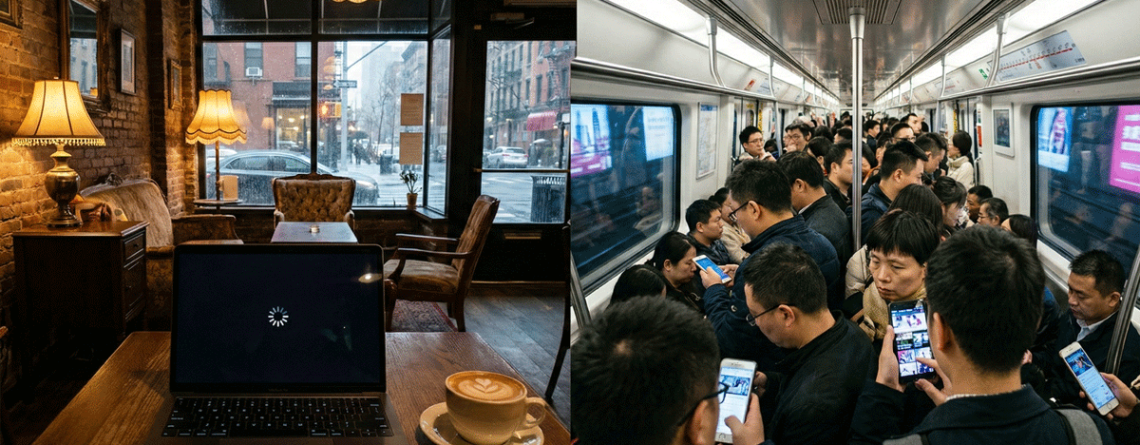
It starts last month in Chelsea, Manhattan. You know the vibe: exposed brick walls, the smell of ethically sourced beans, and a room full of people who look like “Creative Directors” frowning at MacBooks. I bought a $7 oat milk latte solely to acquire the WiFi password printed in fading ink at the bottom of the receipt.
I typed it in. Connected. And then, I watched the wheel of death spin.
I wasn’t trying to mine crypto; I just needed to email a PDF. Ten minutes later, I found myself standing on the sidewalk, holding my phone to the sky like a shaman praying for rain, trying to catch a whisper of a decent LTE signal. It felt archaic.
The Underground Reality
Now, cut to yesterday afternoon in Shanghai.
I was in what gamers might call “Hard Mode”—Line 2 of the subway during rush hour. I was contorted into a unnatural ‘S’ shape, wedged between a backpack and an elderly man’s thermos. There were no exposed brick walls here, just the humidity of a thousand breaths and the screech of metal on tracks.
It was loud. It was uncomfortable. It was the opposite of luxury.
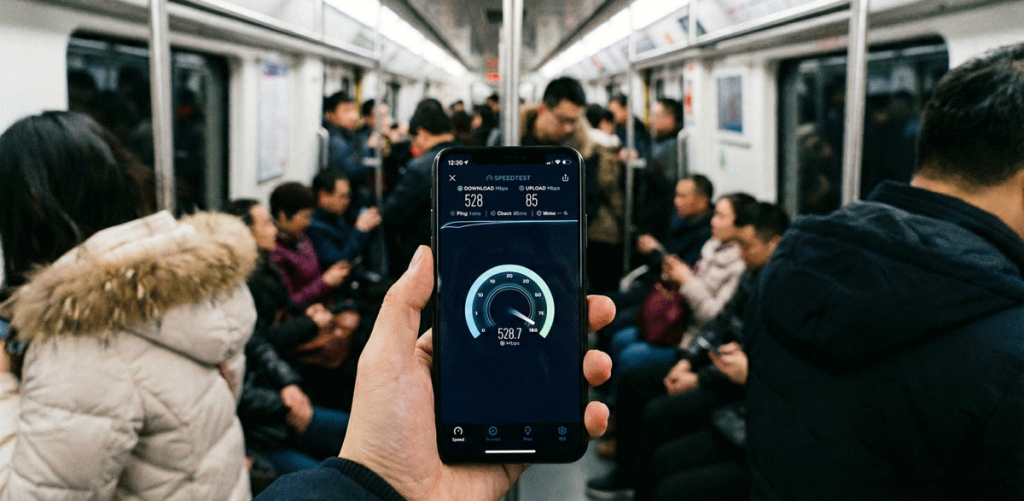
I pulled out my phone and ran a speed test.
Thirty meters underground, inside a metal tube hurtling at 80 kilometers per hour, my download speed hit 500 Mbps.
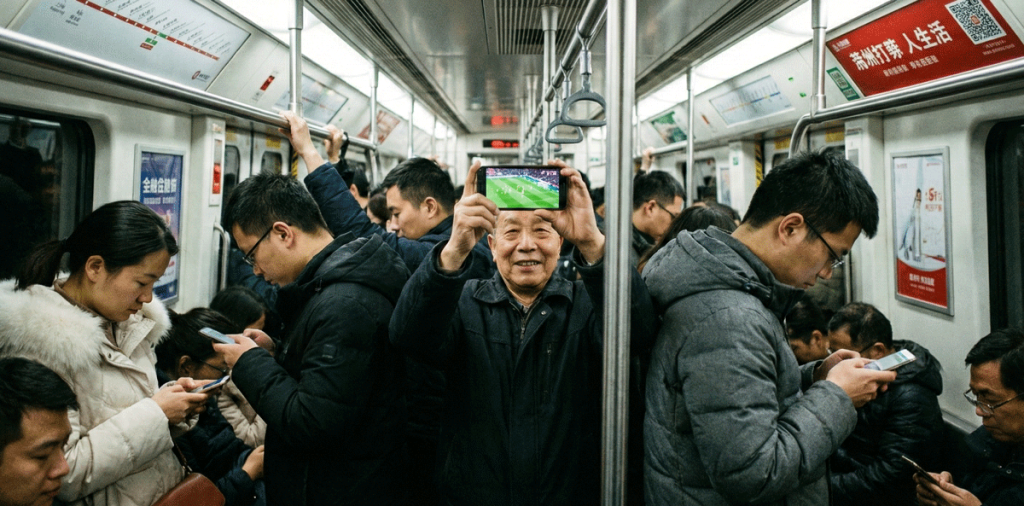
It felt almost rude. The man next to me was live-streaming a soccer match in high definition without a single stutter. Across from him, a teenager was playing a graphics-heavy MOBA game, his thumbs flying across the screen, zero lag.
The Utility vs. The Amenity
This creates a jarring cognitive dissonance for a Westerner.
In New York (and London, and Paris), high-speed connectivity is often treated as an amenity. It’s like a vintage wine or a good view—something you pay extra for, something that requires a specific, static environment. If the WiFi drops in a cafe, it’s an annoyance, but it’s “just one of those things.”
In China, data is utility, indistinguishable from tap water or electricity.
Nobody here gasps in amazement that they can stream Netflix in an elevator or a subway tunnel. It is the baseline expectation. If the signal dropped, the train car would likely erupt in confusion, the same way a restaurant would panic if the oxygen suddenly ran out.
The Future is Mundane
We tend to associate “futuristic tech” with sterile, elite environments—silicon office parks or high-end co-working spaces. But here, the bleeding edge of telecommunications infrastructure is being used by a construction worker to watch TikToks while squashed against a glass door.
I glanced at the elderly man’s screen again. A goal was scored. He muttered a curse of excitement. No one looked up; they were too busy consuming their own distinct streams of high-bandwidth content.
I looked down at my phone. That PDF from New York would have sent in 0.5 seconds here.
The train screeched to a halt. The doors opened, and the human tide spilled out onto the platform. I put my phone in my pocket. The signal bars were still full.




Leave a Reply