

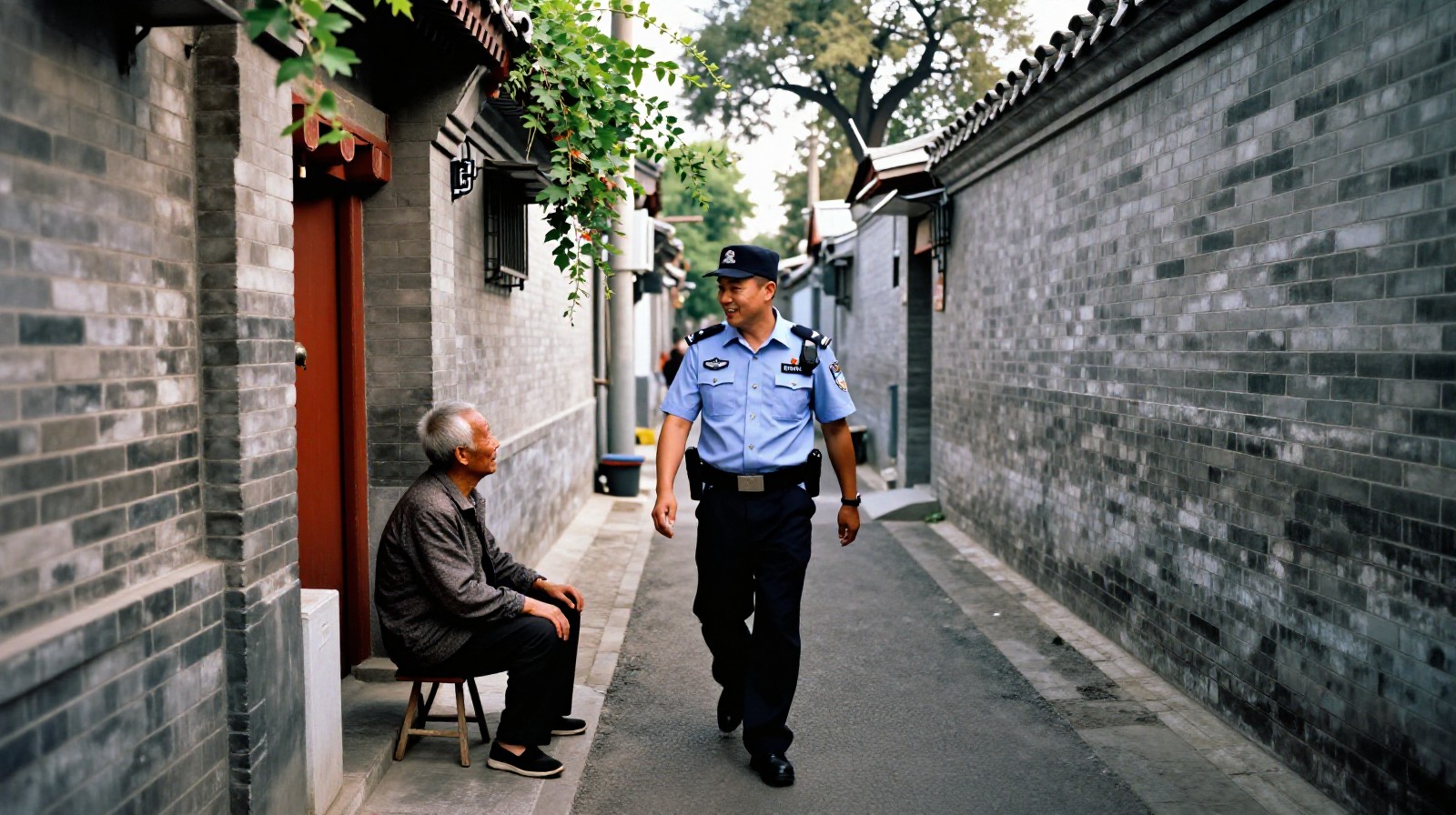
6:30 AM in the Hutong
The air in Beijing’s Dongsi neighborhood is cool and smells faintly of frying dough sticks from a nearby stall. At 6:30 AM, Officer Li Wei isn’t sipping coffee or checking emails on his phone. He is walking slowly down the narrow alleyway, his boots crunching on small stones. He stops to help a young mother lift her stroller over a cracked pavement slab.
“Good morning, Mrs. Zhang,” he calls out softly as he passes an elderly woman sweeping leaves from her doorway. “The weather is turning cold; don’t forget your wool scarf.”
He knows exactly who lives in which door. In a city of 21 million people, Li Wei is responsible for just three hundred households in this specific block. His job title translates roughly to ‘community police officer’ or ‘neighborhood cop,’ but the role feels more like a guardian angel with a badge.
The Art of Remembering Names
Most police work in the West involves responding to calls: 911 emergencies, traffic stops, or crime scenes. Li Wei’s work is different. It is proactive and deeply personal. He carries a small notebook, worn at the edges, filled with handwritten notes next to names.
He doesn’t just write down names. Next to Mr. Chen, he writes: ‘Retired teacher, lives alone, takes heart meds every Tuesday morning.’ Beside the Liu family, he notes: ‘Young couple, baby born last month, wife works night shift at hospital.’

This level of detail seems almost impossible in a modern megacity. Yet, it is the foundation of Li Wei’s strategy. When the local community center needs volunteers for an emergency drill, he knows exactly who to call first because they are retired and have time.
Trust Over Technology
You might wonder why high-tech surveillance cameras aren’t enough. Beijing has thousands of them. But technology cannot smell fear, hear a child crying through a wall, or notice that the usual noise from Apartment 402 has gone silent.
Last month, Li Wei noticed Mrs. Wang hadn’t come out to buy her morning bread for three days. He knocked on her door. Inside, she had fallen and broken her hip, unable to call for help for two full days. Because he knew her routine and her name, a tragedy was prevented.

This is the concept of ‘human-centric’ policing. In China’s governance model, this approach bridges the gap between the state and the individual. It transforms the police from distant enforcers into trusted neighbors. When residents trust Officer Li, they don’t hide problems; they invite him in.
The Balance of Rules and Renqing
Does this ‘soft’ approach work with China’s strict laws? Absolutely. But it requires a delicate balance between rules (fa) and human relationships (renqing).
When Li Wei encounters a dispute over noise or parking, he doesn’t immediately issue a fine. He sits on the steps of the community center, drinks tea with the neighbors, and mediates. “If we fight in court,” he tells them, “we win the case but lose the friendship.” This mediation often resolves 80% of conflicts before they ever reach a courtroom.

This doesn’t mean the law is ignored. If a crime occurs, Li Wei follows strict protocols to hand over cases to specialized units. But for daily life, the ‘soft’ touch prevents escalation. It creates a safety net made of social bonds rather than just concrete walls.
A Changing Role
Generations ago, this kind of deep community integration was standard. In today’s fast-paced, digital world, where people often don’t even know their neighbors’ names, Li Wei represents a counter-trend. He is an anchor in a shifting sea.
Younger officers sometimes find it hard to replicate his method. They are used to apps and data analytics. But during the pandemic lockdowns, when technology failed or panic spread, the residents of Dongsi relied on Officer Li’s voice on the phone. He coordinated food delivery, checked on the elderly, and kept order with a calm presence that no algorithm could mimic.

As China continues to modernize, the face of policing is changing. But in neighborhoods like Dongsi, the core remains: safety isn’t just about catching criminals; it’s about knowing people. It’s about recognizing the rhythm of a community and stepping in before the music stops.