

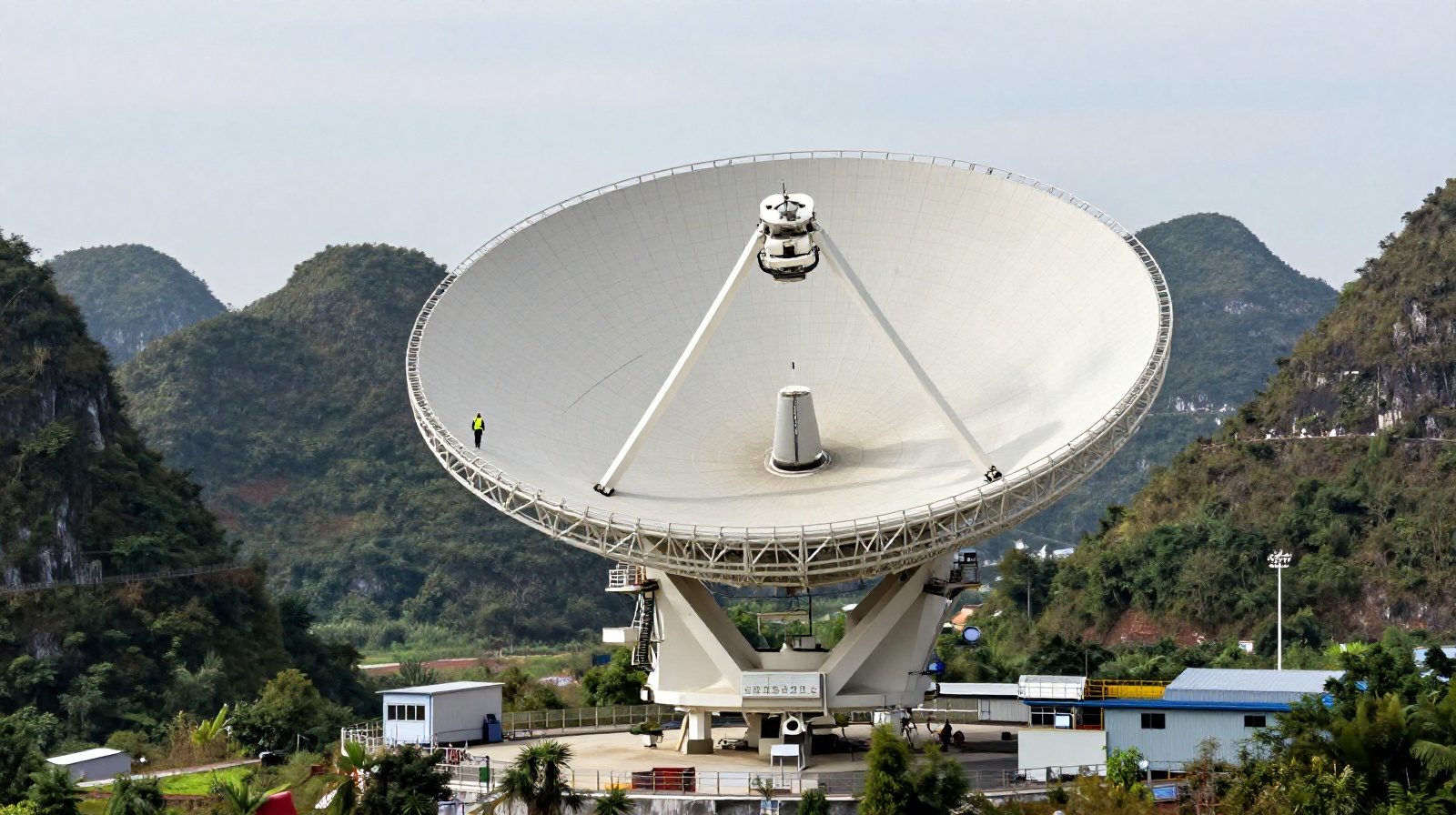
From Sci-Fi to Reality: What FAST Really Is
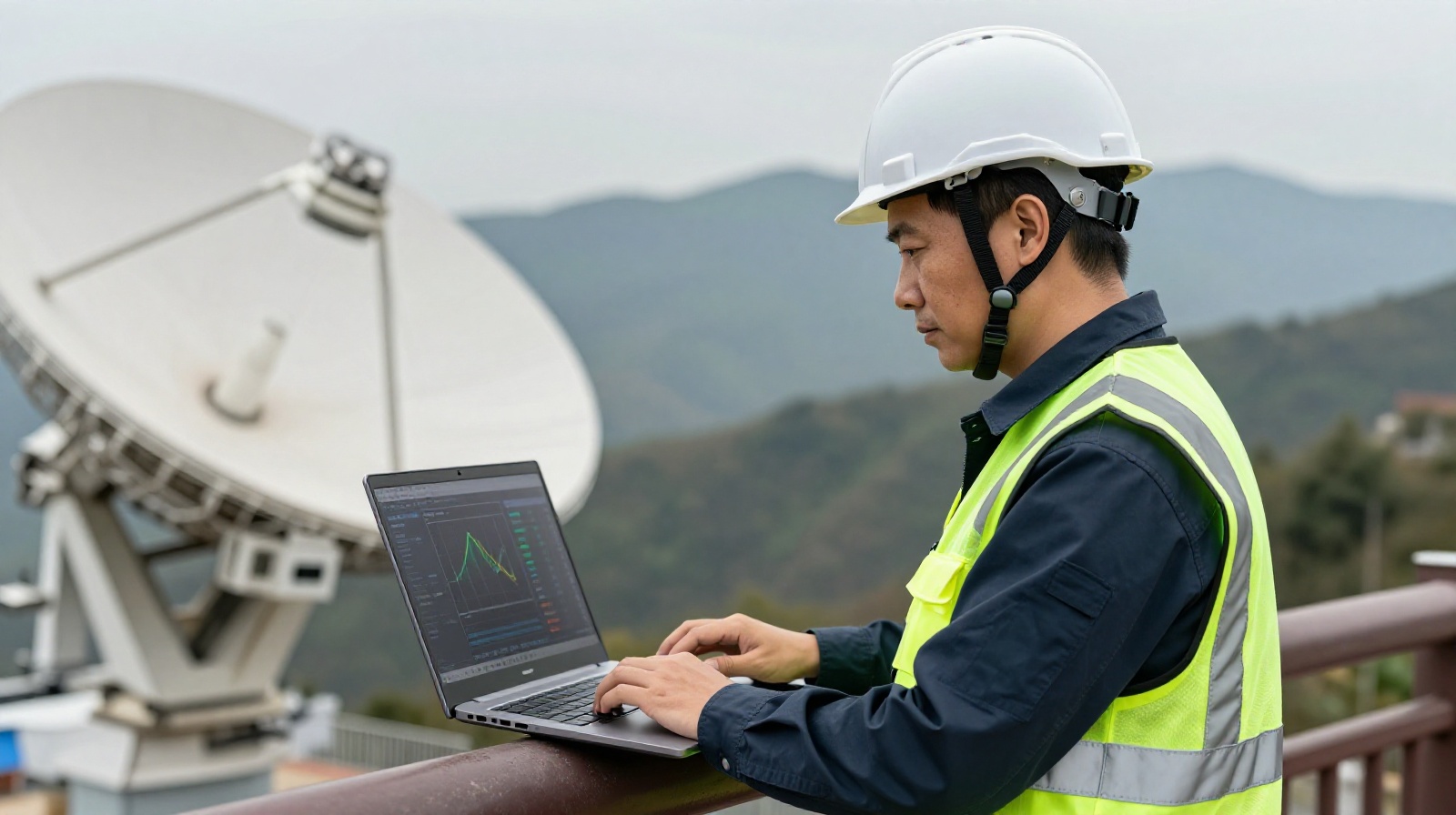
Five thousand meters from the nearest highway, deep inside the karst sinkholes of Guizhou province’s mountains, a woman in a yellow safety vest checks a laptop. She isn’t looking at social media or ordering dinner. Her screen displays radio waves coming from 13,000 light-years away.
This is the Five-hundred-meter Aperture Spherical Telescope (FAST), known locally as “Tianyan” or the “Sky Eye.” Completed in 2016, it is not just a movie set; it is the largest and most sensitive radio telescope on Earth. While Hollywood movies often depict aliens invading cities, scientists here use this dish to listen for faint signals from pulsars, neutron stars, and potentially intelligent civilizations.
For the engineers working here, the scale is hard to grasp until you see it. The dish spans 500 meters—roughly seven football fields. It sits in a natural limestone depression, which saves billions in construction costs compared to building a flat platform from scratch. This isn’t just about looking up; it’s about understanding our place in a vast universe without leaving the remote hills of western China.
The Human Behind the Steel: A Day in the Life
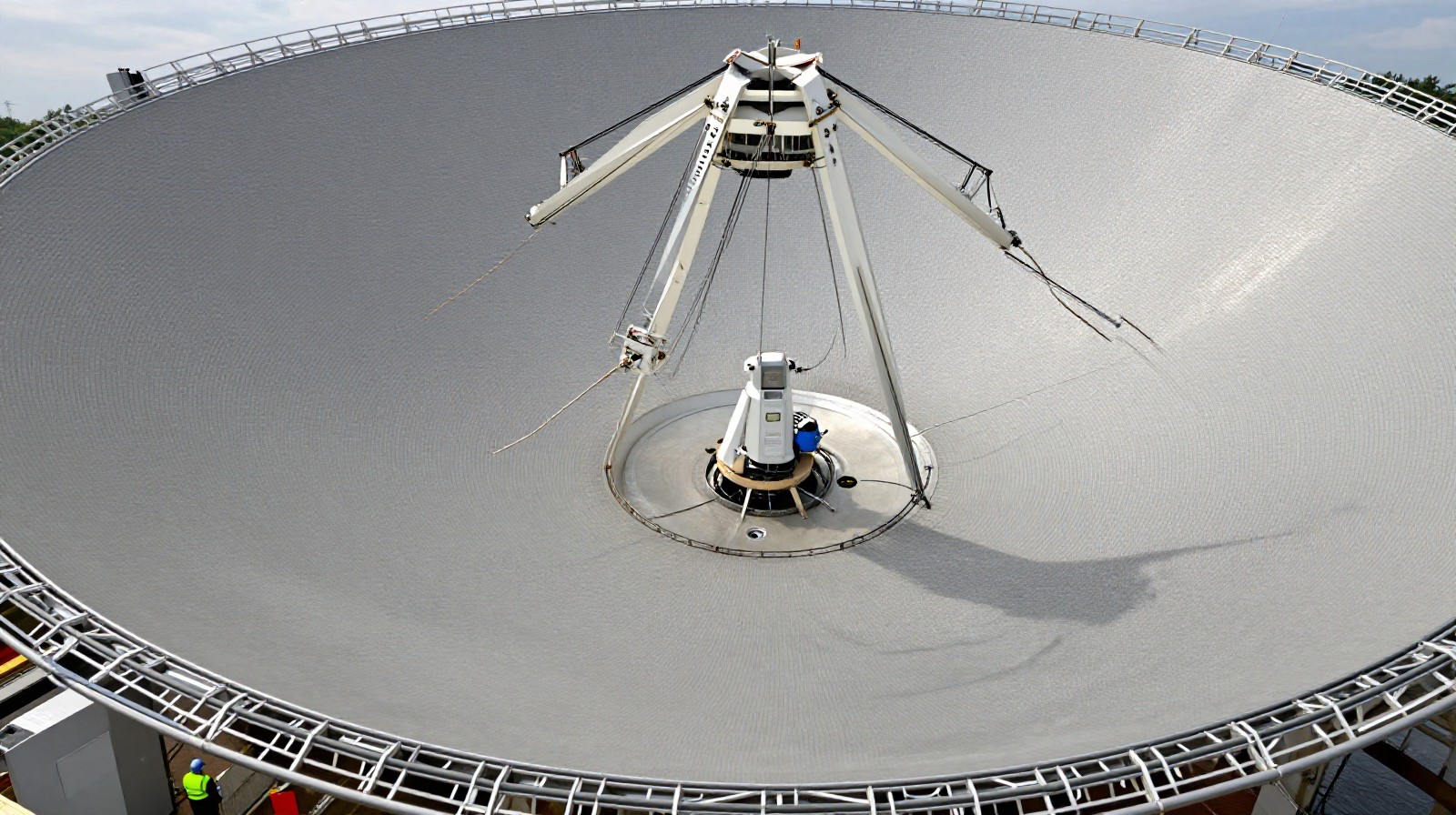
Driving to the site requires navigating winding mountain roads where wild monkeys often cross. Once at the base, the silence is heavy. The telescope itself moves subtly, adjusting its shape by pulling 6,000 cables to focus on different parts of the sky.
Liu Wei, a senior engineer who has worked here for six years, describes his routine. “We check the cable tension every morning,” he says. “If one cable is off by a millimeter, the whole image blurs.” His team works in shifts because they need to monitor the machine 24/7.
Life at FAST is isolated but purposeful. There are no shopping malls or nightclubs nearby. Instead, there is a small canteen serving hot noodles and dormitories that look like standard university hostels. The trade-off is clear: they give up city convenience for the chance to work on one of humanity’s most significant scientific instruments.
Beyond Aliens: Real Data for Real Villages
While the world buzzes with headlines about alien signals, FAST is quietly solving problems for millions of people back home. The telescope processes data at a speed that rivals supercomputers.
This computing power has found unexpected uses in geology and meteorology. Researchers use FAST’s high-precision timing to detect minute shifts in the Earth’s crust, improving earthquake prediction models. In nearby villages, farmers receive more accurate weather forecasts derived from this same data, helping them decide when to harvest crops or prepare for storms.
The benefits are tangible. A local community leader recently noted that during a severe storm season, the early warning system powered by FAST’s atmospheric analysis helped prevent crop damage worth thousands of dollars. It is a rare case where cutting-edge space technology directly protects rural livelihoods.

The Rural Revolution: Internet Speed in the Mountains
You might expect such a high-tech facility to leave the surrounding area behind, but the opposite has happened. The construction of FAST required massive infrastructure upgrades that are now benefiting ordinary residents.
To power the telescope and connect its data centers, engineers built fiber-optic networks deep into the mountains. Before this project, many villages in Guizhou had spotty mobile service or no internet at all. Today, thanks to the “FAST corridor,” high-speed internet is available in local homes and schools.
In a small village near the telescope, a young teacher uses the new connection to stream lectures from Beijing universities to her students. This digital bridge has allowed remote children to access the same educational resources as those in Shanghai or Shenzhen. The telescope didn’t just bring science to the mountains; it brought the world to them.

Why Young Engineers Choose the ‘Eye of Heaven’
In a country where many young graduates flock to bustling megacities like Beijing and Shanghai, the decision to work in Guizhou is notable. Why would talented engineers leave the city lights for a quiet mountain site?
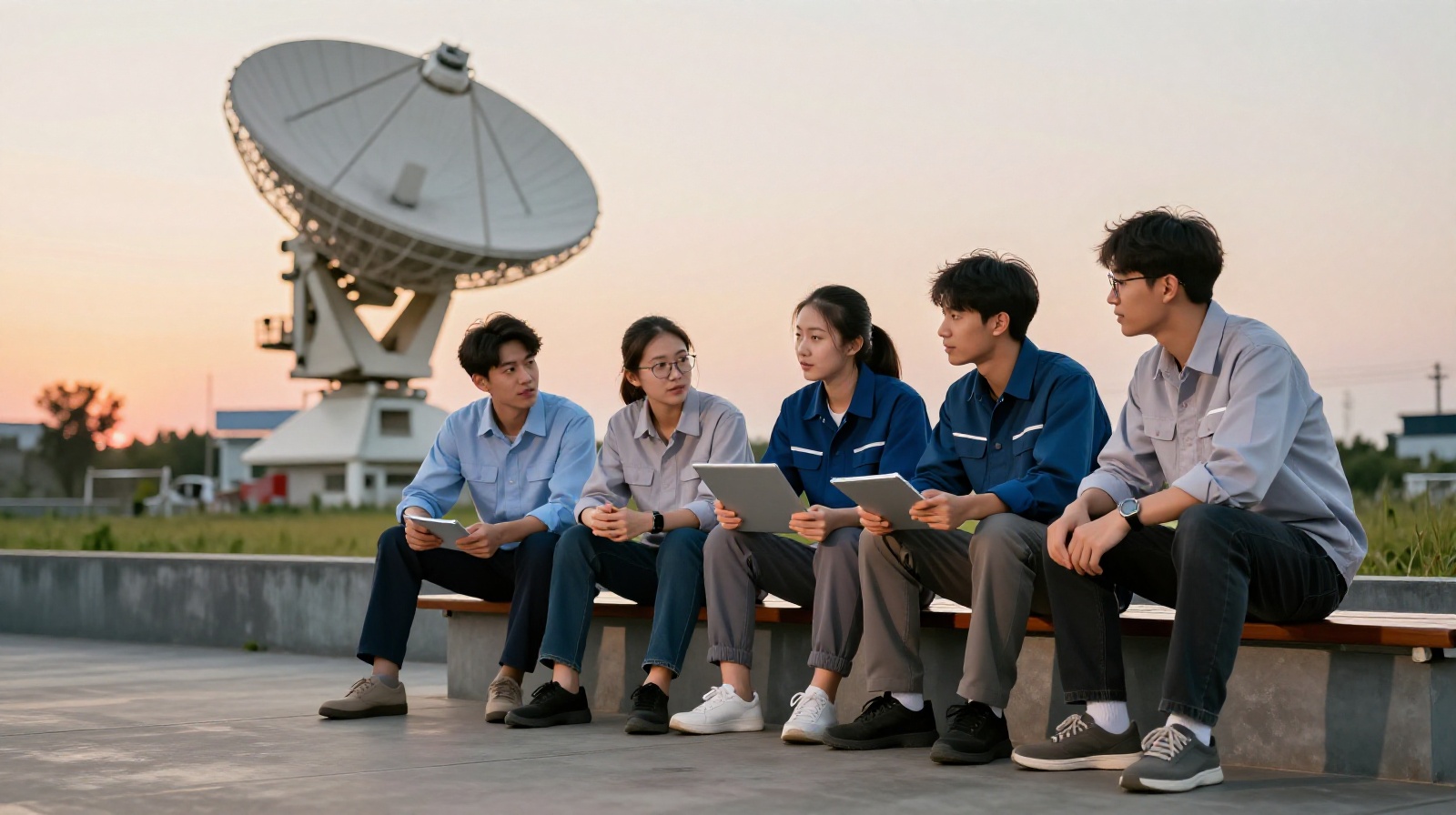
The answer lies in opportunity and mission. For these engineers, the City Eye offers access to cutting-edge projects that are impossible elsewhere. They aren’t just fixing code or building apps; they are calibrating instruments that see deeper into space than any other machine on the planet.
“In a city office, I might feel like a small gear,” says Chen Hao, a 28-year-old software specialist at FAST. “Here, my work directly contributes to global scientific discovery. That sense of purpose outweighs the lack of nightlife.” The government supports this by offering housing subsidies and competitive salaries that rival major tech hubs.
A Quiet Tech Confidence
China’s technological rise is often described in headlines about factories, electric cars, or 5G towers. But the story of FAST offers a different perspective. It shows a nation confident enough to invest billions in blue-sky research that may not yield immediate profits.
This telescope is not a showpiece for tourists; it is a working tool for scientists. Its success demonstrates that China’s ambition extends beyond manufacturing to leading fundamental science. For the people living in these mountains, the “Sky Eye” has become a symbol of hope, proving that high-tech innovation can thrive even in the most remote corners.