
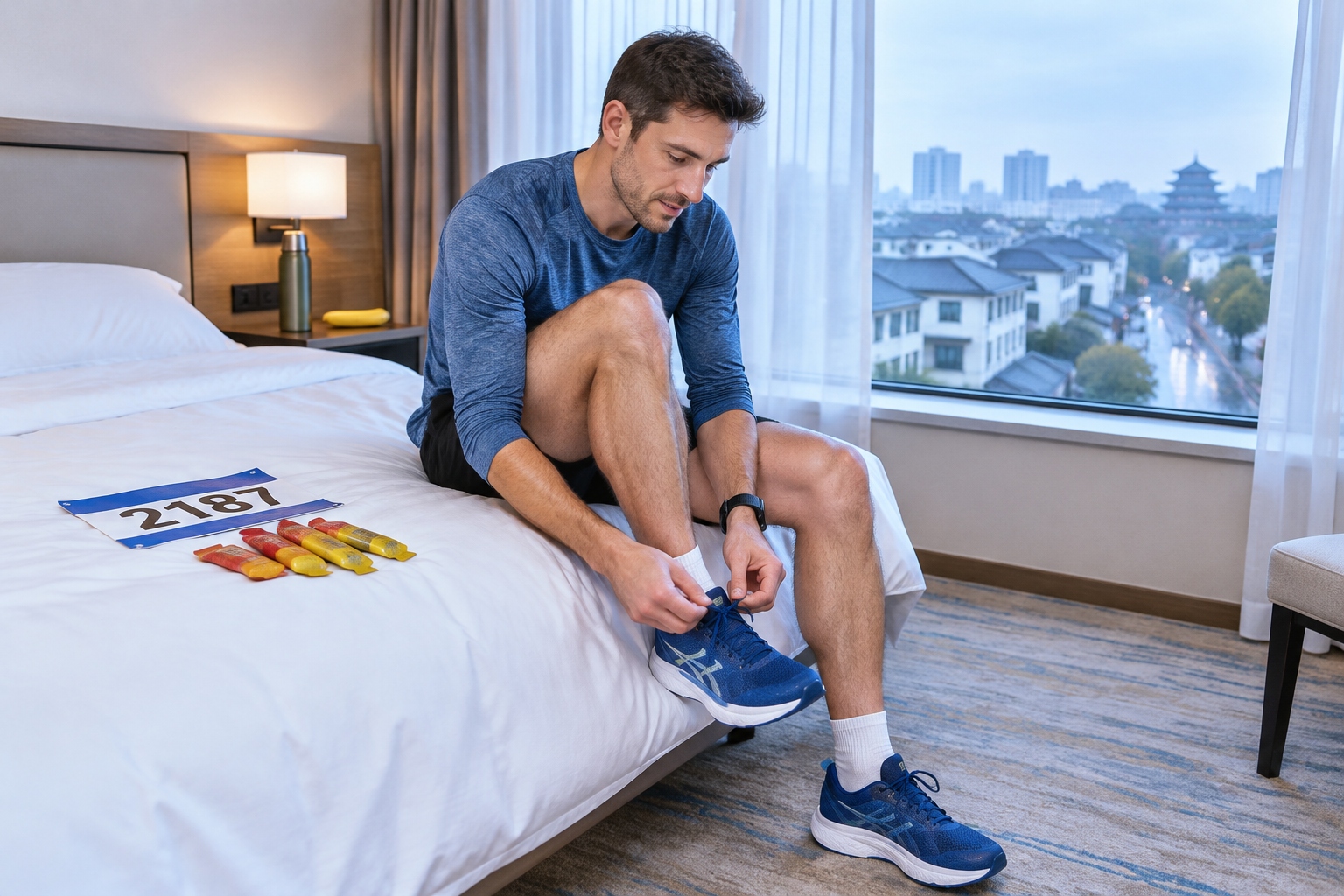

At 5:50 on Sunday morning, Daniel Mercer sat on the edge of a hotel bed in Wuxi, tying his left shoe by the light of the bathroom door. The room smelled faintly of chlorine from the tap. Outside, a street sweeper hissed past. On the duvet lay a race bib, four energy gels, a banana, and a room key card. He checked the weather: 18°C, light rain later. “Okay,” he said to nobody, and pulled the laces tight.
Mercer, 34, is British and teaches at an international school in Shanghai. He had come to Wuxi for the marathon, a two-night trip that began Friday afternoon and would end Sunday night. He is not an elite runner. He finished in 3:52, walked slowly through the finish area, ate a bowl of noodles, and got on a high-speed train home. Somewhere between the start line and the train seat, he opened a notes app and added up the weekend. The total was 1,862 yuan, about $259.
That number is the reason for this story. A race weekend in China can be cheaper than a concert ticket and a hotel night in many Western cities. It is also a useful way to see how a Chinese city absorbs thousands of visitors in 48 hours: the metro announcements, the convenience-store receipts, the volunteers at kilometer 30, the price of a bowl of noodles at 9 p.m.
The bill at a glance
Mercer kept every receipt, mostly because he wanted to know whether the trip was worth repeating. He did not include his international flight, because there wasn’t one; Shanghai to Wuxi is a 45-minute train ride. He also didn’t count the shoes he already owned. Here is what the weekend cost him:
| Item | Cost in yuan | Approx. USD |
|---|---|---|
| Race entry | 200 | 28 |
| High-speed rail, Shanghai-Wuxi return | 118 | 16 |
| Hotel, two nights | 760 | 106 |
| Food and drinks | 342 | 48 |
| Local transport | 58 | 8 |
| Running supplies | 268 | 37 |
| Race photos | 49 | 7 |
| Data eSIM and ATM fee | 67 | 9 |
| Total | 1,862 | 259 |
The biggest line was not the race. It was the hotel. The second biggest was food, because Mercer ate like a person on holiday rather than a person carbo-loading. The entry fee, the thing that had brought him to Wuxi, was smaller than the socks, gels, and electrolyte tablets he bought at the expo.
What the entry fee buys
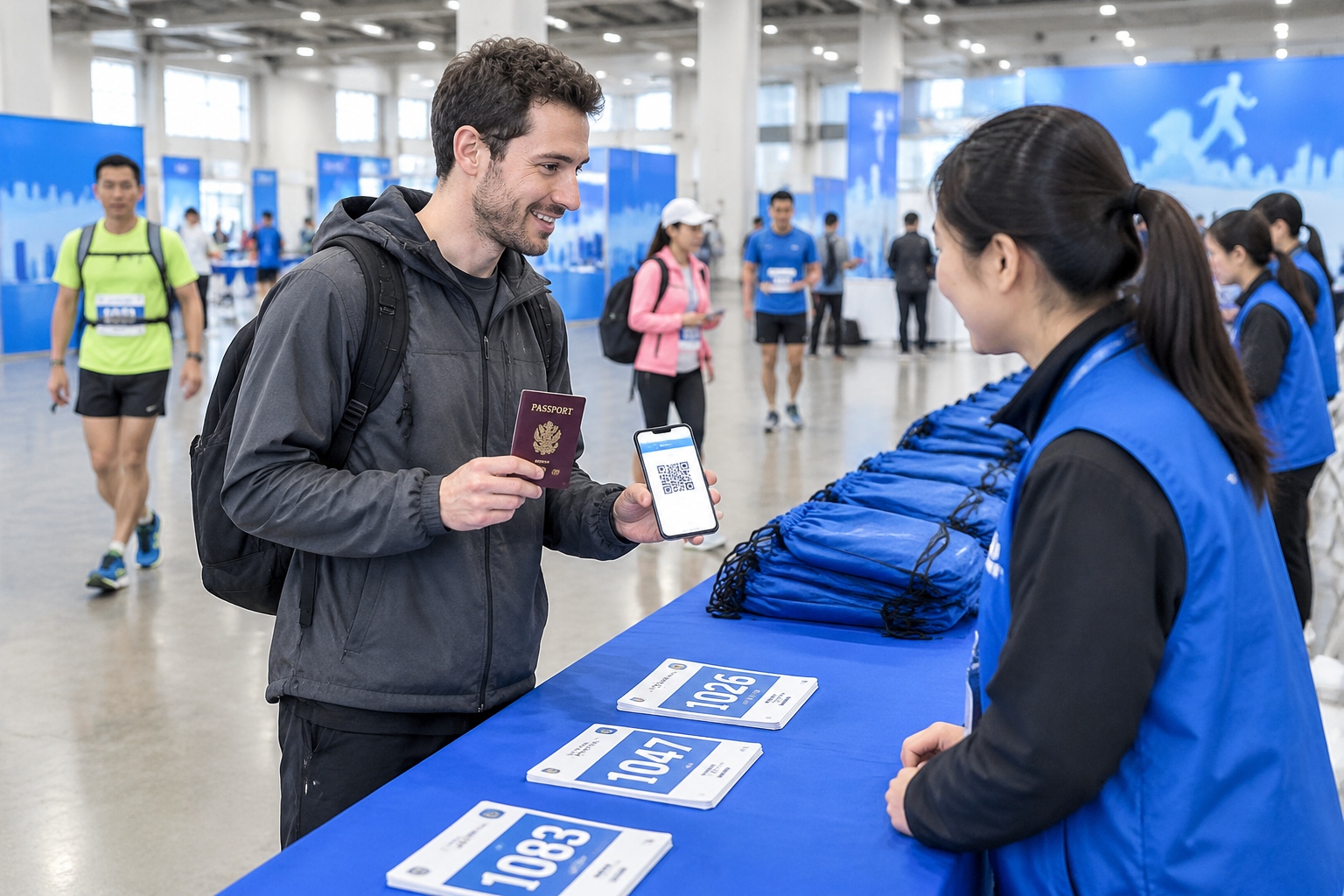
The Wuxi Marathon entry cost 200 yuan, about $28. Mercer registered with his passport on the race’s WeChat mini-program in January. He uploaded a photo of his passport, filled in an emergency contact, and paid with Alipay. The process took about ten minutes, though he had to switch to hotel Wi-Fi because one verification code did not reach his UK phone number. In February he received a confirmation message and a QR code for packet pickup.
Pickup was at the Taihu International Expo Center, a large hall with sponsor booths, a gear-check area, and volunteers in blue vests. He showed his passport and QR code. A volunteer checked his name against a list, handed him a bib with a timing chip, and pointed him toward a drawstring bag, a T-shirt, a small towel, a packet of local biscuits, and a folded course map. There was no deposit for the chip. He walked through the hall, bought two pairs of socks for 98 yuan, four gels for 60, electrolyte tablets for 48, a rain poncho for 12, blister plasters for 20, and a cheap foam roller for 30. The total was 268 yuan.
“In London, the expo is a shopping mall,” he said. “Here it was more like a town hall with snacks.” That was not a complaint. It was quick. He was out in 35 minutes, with time to walk along the canal before dinner.
Getting there, and sleeping near the start
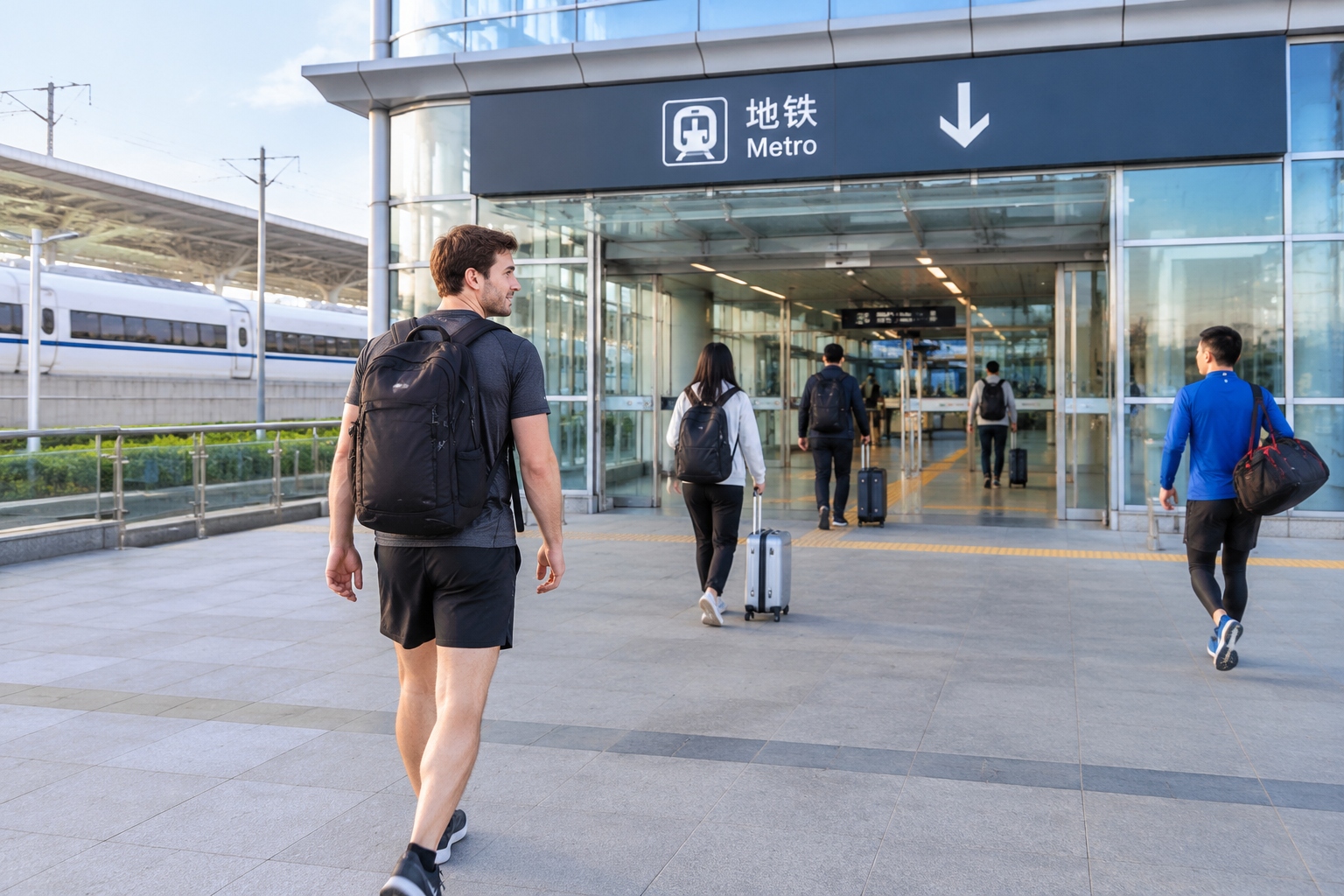
His high-speed train left Shanghai Hongqiao at 4:12 on Friday afternoon. The ticket cost 59 yuan one way. The train was full of people with small suitcases and backpacks; two other passengers were also runners. It took 45 minutes to reach Wuxi East. From there, Metro Line 2 carried him toward the city center for 4 yuan. The ride took about 25 minutes. He came up from the station into a street of pharmacies, noodle shops, and e-bike repair stalls. It was 6:30 p.m. and still light.
He had booked a business hotel a 20-minute walk from the start area. The room cost 380 yuan a night. For two nights, that came to 760 yuan. The room was small but clean, with a window that opened two inches, a kettle, and a breakfast room that started serving at 5:30 on race morning. He booked three weeks ahead. A week later, the same hotel was showing 520 yuan a night. Race weekends move prices in Wuxi just as they do in London or Berlin.
Local transport came to 58 yuan over the weekend: metro rides of 2 to 5 yuan, one 18-yuan taxi after the expo when he was tired, two shared bikes for 3 yuan, and a 15-yuan late-night taxi back from dinner. The metro was the easiest part. Stations had English signs and ticket machines with an English button. On race morning, volunteers stood outside the exit holding signs for the start area.
Eating in Wuxi, from congee to ribs
Breakfast on race morning was included in the hotel: congee, a steamed bun, a boiled egg, and coffee from a machine. Mercer also bought a banana and a bottle of water at a convenience store for 7 yuan. He ate the banana in his room and put the water in his bag. After the race, he walked slowly to a noodle shop near the hotel and ordered pork noodles for 28 yuan, an extra pork topping for 8, and soy milk for 6. The bowl arrived with a dark, slightly sweet broth and a pile of scallions. He ate it without talking.
His other meals were just as ordinary. Friday dinner was a sandwich, yogurt, and water from a convenience store: 36 yuan. Saturday coffee was 22 yuan. Lunch at the expo was a rice box for 38 yuan. Saturday dinner was the one proper meal: Wuxi ribs for 48 yuan, xiaolongbao for 18, greens for 22, rice for 4, and tea for 6. He shared it with a friend from Shanghai, and paid 118 yuan for both of them. Sunday on the train home, he had a sandwich and coffee for 33 yuan. Snacks, bottled water, and a peach from a fruit stall added 46 yuan. The food total came to 342 yuan.
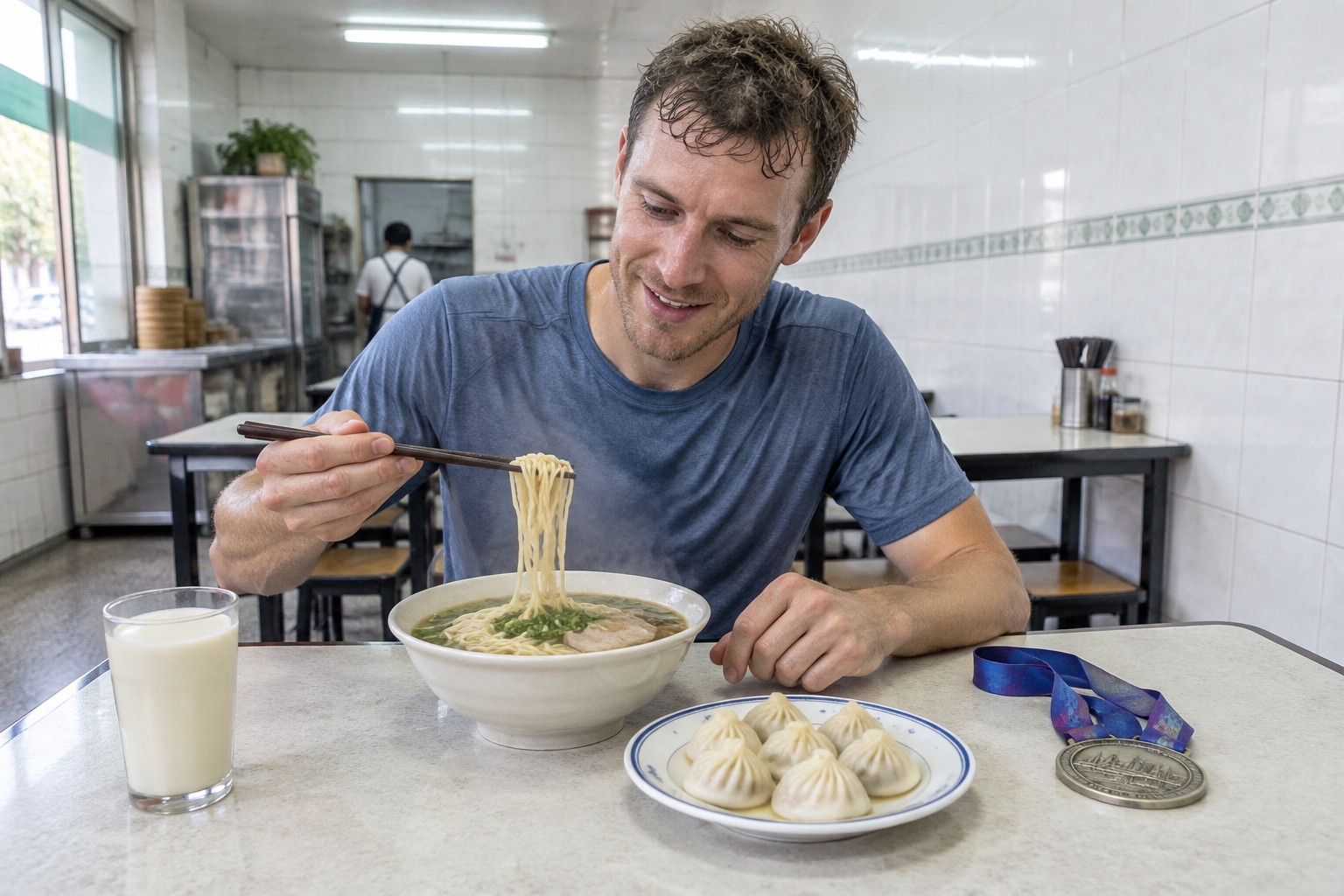
What surprised him was not the price of restaurant food but the range. A bowl of noodles cost less than a beer in Shanghai. A convenience-store rice ball cost 6 yuan. A small bag of local biscuits was 12. He could eat cheaply, or he could spend 100 yuan on dinner and still feel he had not gone overboard.
Paying with a phone, and the small snags
Mercer used Alipay linked to his Visa card. At the noodle shop, he scanned the QR code on the table. The cashier asked, “Alipay or WeChat?” He said Alipay. The payment went through in two seconds. On the metro, he opened the transport code in Alipay and held his phone over the gate. For a shared bike, he used the HelloBike mini-program inside Alipay. At a convenience store, he paid at the self-checkout with the same code.
There were two small snags. A fruit stall near the hotel had a personal QR code that would not accept his foreign card. He paid 12 yuan in cash, which he had withdrawn from an ATM. The ATM charged a 28-yuan fee, annoying but not fatal. His UK phone number also failed to receive one verification code when he tried to set up a second payment app, so he gave up and stuck with Alipay. A translation app helped him read menus and ask for no cilantro. The eSIM cost 39 yuan for 10GB of data. Those two costs, 67 yuan together, went into the bill under data and ATM fee.
This is the part that would have been impossible a decade ago. A foreign runner can land in a Chinese city, connect a foreign card to a phone, and move through a weekend of trains, taxis, noodles, and race packets without opening a local bank account. It is not seamless. The verification codes, the occasional cash-only stall, the menus without pictures, all remain. But the friction is now a series of small moments, not a wall.
The course, the volunteers, the public space
The race started at 7:00. The route was flat and wide, with long stretches along the lake and through newer parts of the city. Cherry blossoms were out in a few places, pale against the gray sky. Volunteers in rain ponchos stood at aid stations every 2.5 kilometers, holding out cups of water and sports drink. At kilometer 35, a woman in a red jacket handed out orange slices from a plastic box. A boy on the side of the road held out his hand for high-fives. Mercer touched it and almost cried, which he later blamed on the salt.
Roads were closed to cars. Residents stood on sidewalks in slippers and coats. Some held signs. Some just watched. The city had put up temporary toilets, bag-check tents, and medical points. After the finish, volunteers draped a foil blanket over his shoulders, hung a medal around his neck, and handed him a bag with water, a banana, and a piece of bread. He walked 15 minutes to the metro. Station staff directed runners toward the gates. The train was full of medals and tired legs.
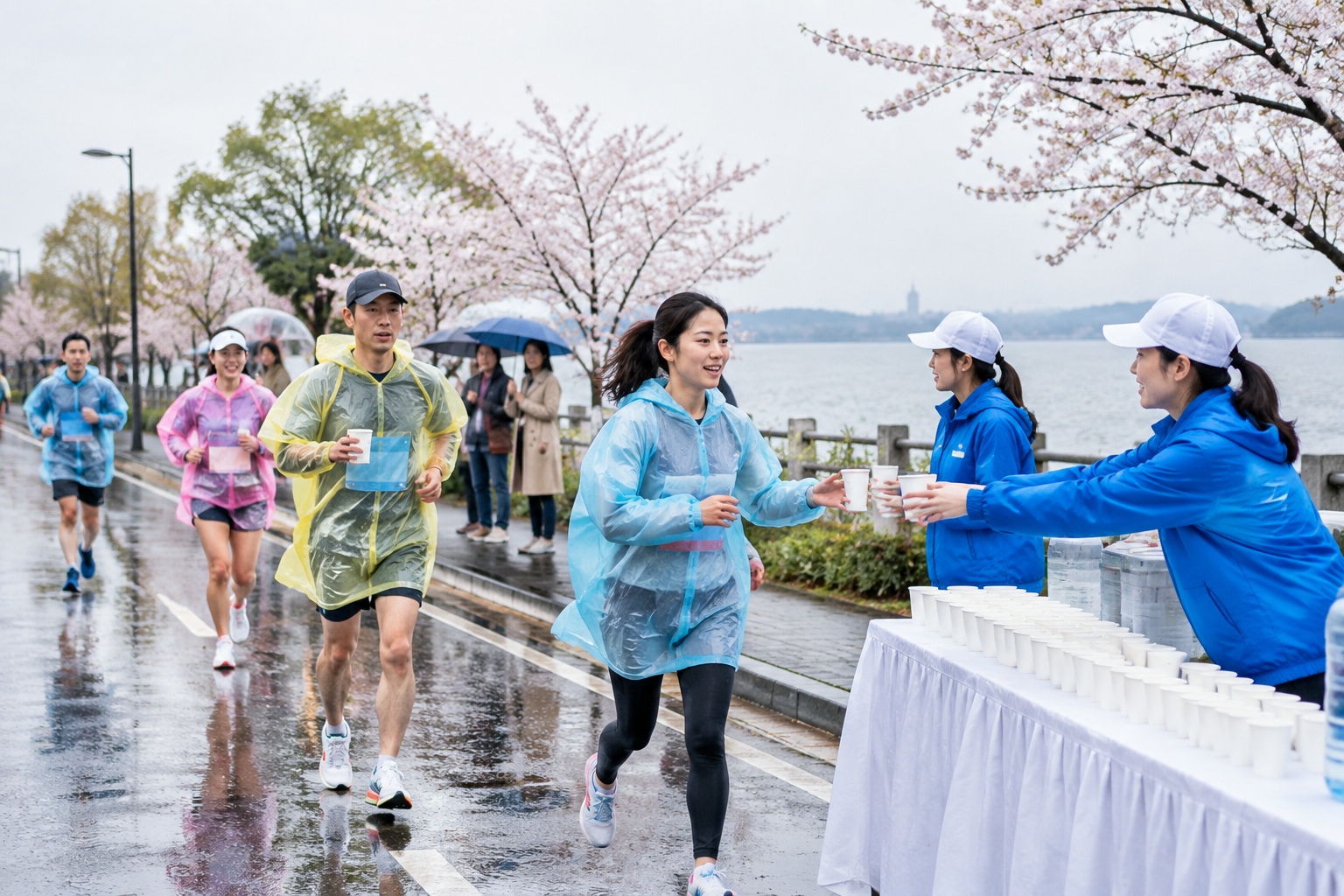
This is what a race does to a city’s public space. For a few hours, the usual traffic disappears and the streets become a stage. Then it is over, and the city goes back to buses and delivery bikes. The organization was not flashy. It was legible. Signs were where they should be. Volunteers knew the answers. That is not a small thing when you are tired and far from home.
Compared with races back home
Mercer has run London twice and Berlin once. London entry is about £70, Berlin about €150. Wuxi was 200 yuan, or roughly $28. The bigger difference was accommodation. In London, a budget hotel near the start on race weekend can cost £180 to £250 a night. In Wuxi, he paid 380 yuan, about $53. His two nights in Wuxi cost less than one night near the London start.
The atmosphere was different. London has bigger crowds, more noise, more international runners. Wuxi felt more local. There were fewer English announcements, though more than he expected. The expo was smaller. The course was faster and less crowded. He would not say one is better. He would say the bill is different, and the bill changes what kind of weekend you have. In London, he spent the weekend worrying about expense. In Wuxi, he ordered an extra topping on his noodles.
The bill, again
On Sunday night, on the train back to Shanghai, Mercer sat by the window with his medal in his backpack. He added up the weekend one more time: 1,862 yuan. The entry fee felt worth it. The hotel location felt worth it. The noodles after the race felt worth it. He would change a few things: book the hotel earlier, bring his own gels, learn the Chinese for no cilantro. He would also bring a friend next time, which would double the bill and probably make the weekend better.
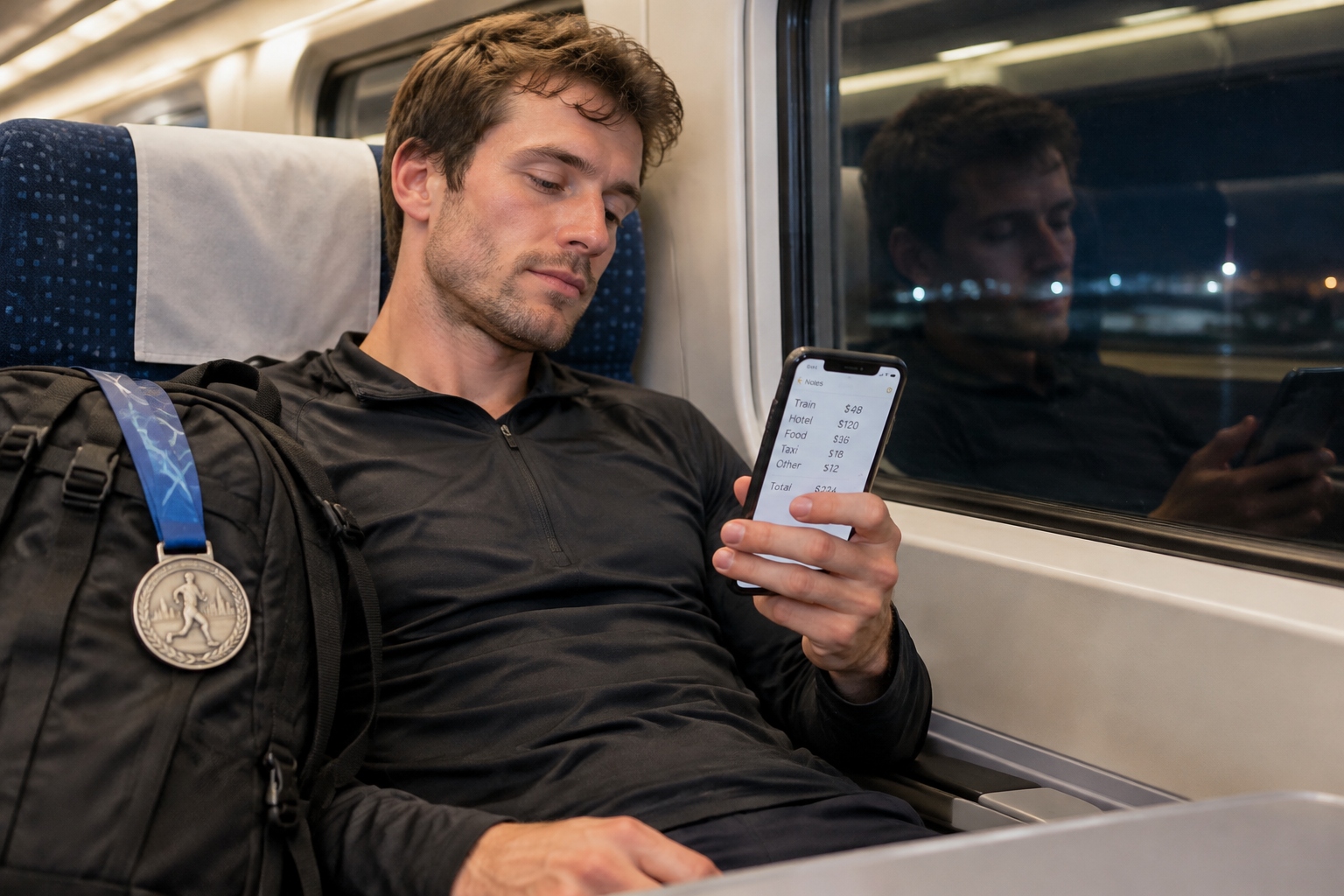
What he remembers is not the total. It is the rain starting at kilometer 28, the volunteer at the aid station holding out a cup, the boy with his hand out for a high-five, the woman at the noodle shop who pointed at his medal and said something he did not understand but smiled at. The weekend did not feel like a mega-event. It felt like a city doing something ordinary well. The bill was small enough that he could stop counting and look around.
Start the discussion at forum.chinacomes.com