


9:05 a.m., fourteenth floor, Shenzhen
The lift doors open and Markus Feld steps out first, because he doesn’t know any better. Chen Wei, the operations vice president who met him in the lobby downstairs, lets him go, then moves half a step ahead to reach the glass door before him, so the receptionist can see who is arriving. The floor smells of coffee and someone’s reheated breakfast. A badge printer whirs and spits out a card.
Feld is 46, a supply chain manager from Stuttgart, and this is his first visit to Shenzhen. He has prepared for the meeting for three weeks. What he has not prepared for is the order of things: who walks through the door first, whose name gets said first, who offers a phone and who scans it.
By 12:40 he will have learned more from watching than from any briefing document. Names here have been changed at the company’s request; the sequence is as it happened.
Who is introduced to whom
In the meeting room, Chen introduces Feld to the technical lead first, then the quality manager, then Liu Yang, the 26-year-old project coordinator — descending order of seniority, with the visitor receiving each name in turn. Ten minutes later the founder, Zhou Ming, walks in, and the whole sequence starts again: Chen stands, and Feld is introduced to Zhou, not the other way around. Zhou’s title is said in full — “our founder” — and then his name.
Rank is only one variable. A 58-year-old technical advisor in the corner, with no team and no budget, is greeted before a 33-year-old director who runs forty people. Age and tenure carry their own weight in the room, and Chinese colleagues track both without being told. Neither factor decides the meeting, but together they set who speaks when.
It also matters who is hosting. Chen controls the room: she decides who sits where, who is asked to present, when the water gets poured. Feld outranks nobody in this building — he represents the customer, and that customer status is real. It buys him the chair facing the door. It does not make him the host.

The handshake
Feld offers his hand to Zhou first. Chen gives a small nod of the head as she shakes. Zhou briefly cups Feld’s hand with both of his, which is warmer than a German manager expects and lands somewhere between greeting and welcome. Grips are softer here, held a beat longer.
Then the cards. Zhou presents his with two hands, text facing Feld. Feld’s comes out of a metal case, one-handed, and he fumbles it. He notices Liu Yang quietly turning the card right way up and sliding it into a shirt pocket rather than a back one.
The QR code, and who asks
Cards are exchanged, and then nothing happens for about ninety seconds — the part Feld almost misses. Nobody suggests WeChat. The cards sit on the table. People drink water.
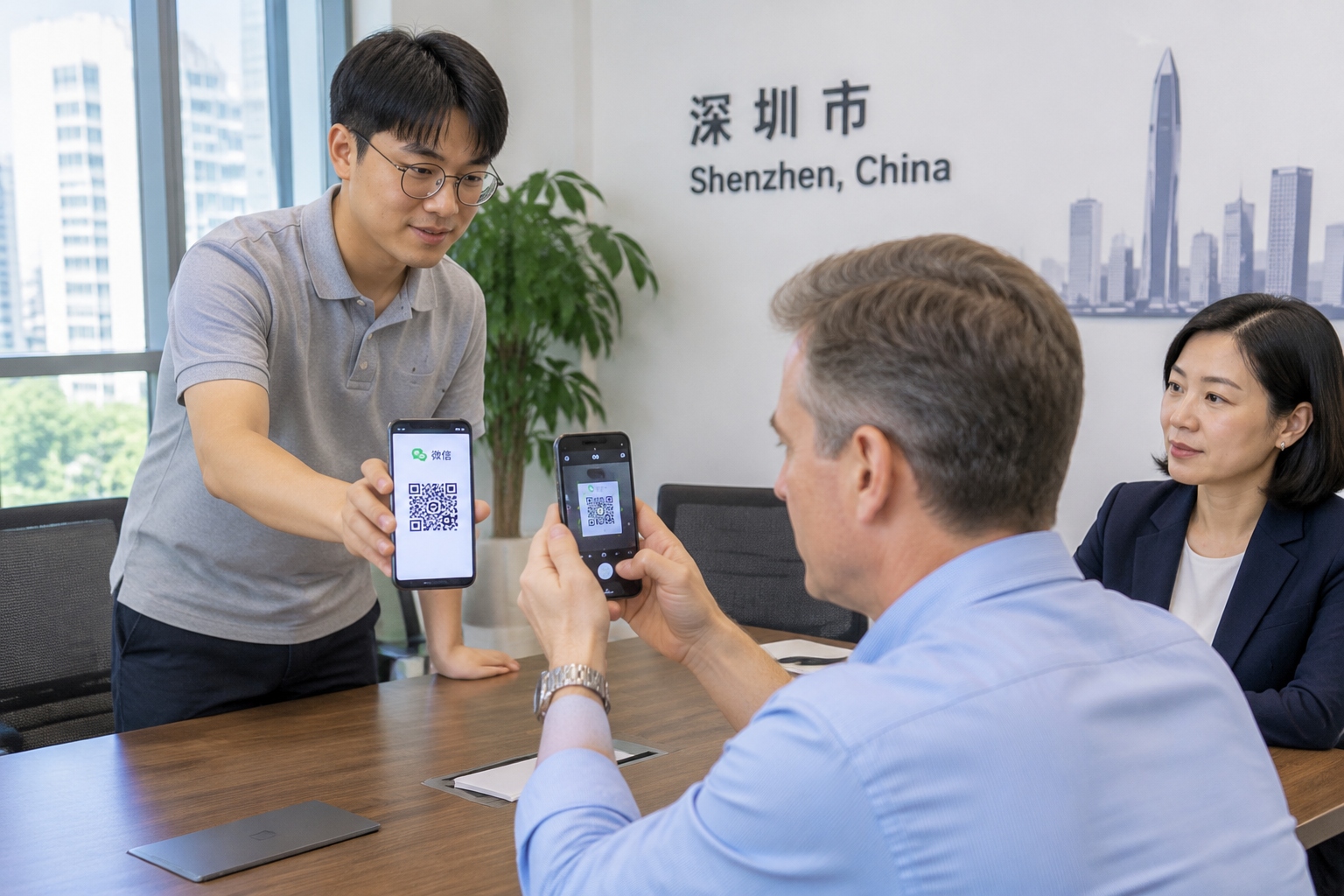
Then Liu Yang comes around the table. He is the most junior person in the room and the one who will actually handle Feld’s order for the next four months, which is exactly why he is the one who asks.
He holds his phone out at chest height, screen facing outward, the QR code already open and the brightness turned up. “Would it be convenient to add WeChat? I’ll be handling the follow-up.” Then he waits. He doesn’t say “scan this.” He doesn’t reach for Feld’s phone. He stands there with the code visible and lets the visitor decide — and if the answer had been a polite no, a work phone, a technical difficulty, he would have said mei guanxi and sat down.
That small pause is the whole etiquette. The person with less rank makes the request; the person with more rank decides. The request is phrased as a question about convenience, not a demand for contact. Feld scans, the little tick appears, and Liu Yang adds, “I’m Liu Yang, project coordination,” so the new contact isn’t a bare QR code and a nickname.
Chen does not ask. At the end of the meeting she opens WeChat herself, says she’ll send the deck over, and creates a three-person group with Liu Yang in it. The junior handles logistics; the senior keeps the relationship. Both of them now have Feld’s contact, through different doors.
Seating, water, and who answers
Feld is given the chair facing the door. He doesn’t notice. Chen does. Water is poured for him first, then for Zhou, then around the table — a staff member in a cardigan does it without interrupting anyone, and Feld’s cup never empties.
Chen opens the meeting, gives the context in about three minutes, and hands the detail to the technical lead. Zhou says almost nothing for forty minutes, then speaks last, for five, mostly confirming what has already been agreed. When Feld pushes hard on the delivery date, there’s a pause of maybe two seconds before anyone answers, and everyone’s eyes go to the far side of the table before coming back to him. The answer he gets is careful: “We’ll confirm this and get back to you.” It takes him until the second day to understand that this was a no.

The next morning, same room, different rules
The internal standup at 9:30 has none of it. People walk in mid-sentence, someone sits on the edge of the table, a 27-year-old engineer tells the 45-year-old hardware director his schedule estimate is wrong and the director shrugs. Two people are called Lao Wang and Xiao Chen. Nobody is introduced to anybody. Chen, who was formal to the point of ceremony with a customer the day before, interrupts, argues, and tells Liu Yang to hurry up.
The hierarchy has not disappeared. It’s still there in who signs off, who gets the last word, whose objection ends the discussion. But the ceremony belongs to the boundary between inside and outside. Within a team that has worked together for two years, the ceremony drops away — and dropping it is itself a signal of belonging.
A visitor who arrives on day one and concludes “everyone here is very formal” will be wrong by day three. The better reading: formality marks the edge of a group, not its interior.

What a visitor can actually do
Little of this is written down, and getting it wrong is rarely fatal. But a few things hold across most of the companies on Feld’s week-long schedule, from a 200-person hardware firm to a state-owned supplier’s sales office.
- Wait to be told where to sit. There is usually a right chair, and it is usually the one facing the door.
- Let the most senior host speak first, and let the most senior person close.
- If you’re unsure, ask your host contact quietly, outside the room: which seat is right for me? You’ll get a straight answer. The ambiguity is designed for the group, not for you.
- Exchange cards with two hands, text facing the other person, and put the card on the table or in a shirt pocket — not straight into a back pocket.
- When a junior colleague asks to add you on WeChat, the decision is yours. Saying yes quickly costs nothing and gets remembered.
- If you’re the visitor, offer to pay for lunch once. It will be refused, cheerfully and firmly, and the refusal is not about money.
12:40 p.m., the lift lobby
Liu Yang walks Feld down. He presses the button, holds the door, and stands in the corridor until the doors close — which Feld finds slightly awkward, then, by day three, expects.
In the lift, Feld says the thing he has been thinking since 9:15: it felt less like being ranked and more like being placed. Everyone in that room knew where they stood, and because they knew, nobody had to fight for it, and the meeting finished in ninety minutes instead of three hours. Whether that’s a good trade depends on which office you come from. But it is what the room is doing — and it is legible from the outside, once you know where to look. At the door, the water glass, and the phone held out at chest height.
Start the discussion at forum.chinacomes.com