
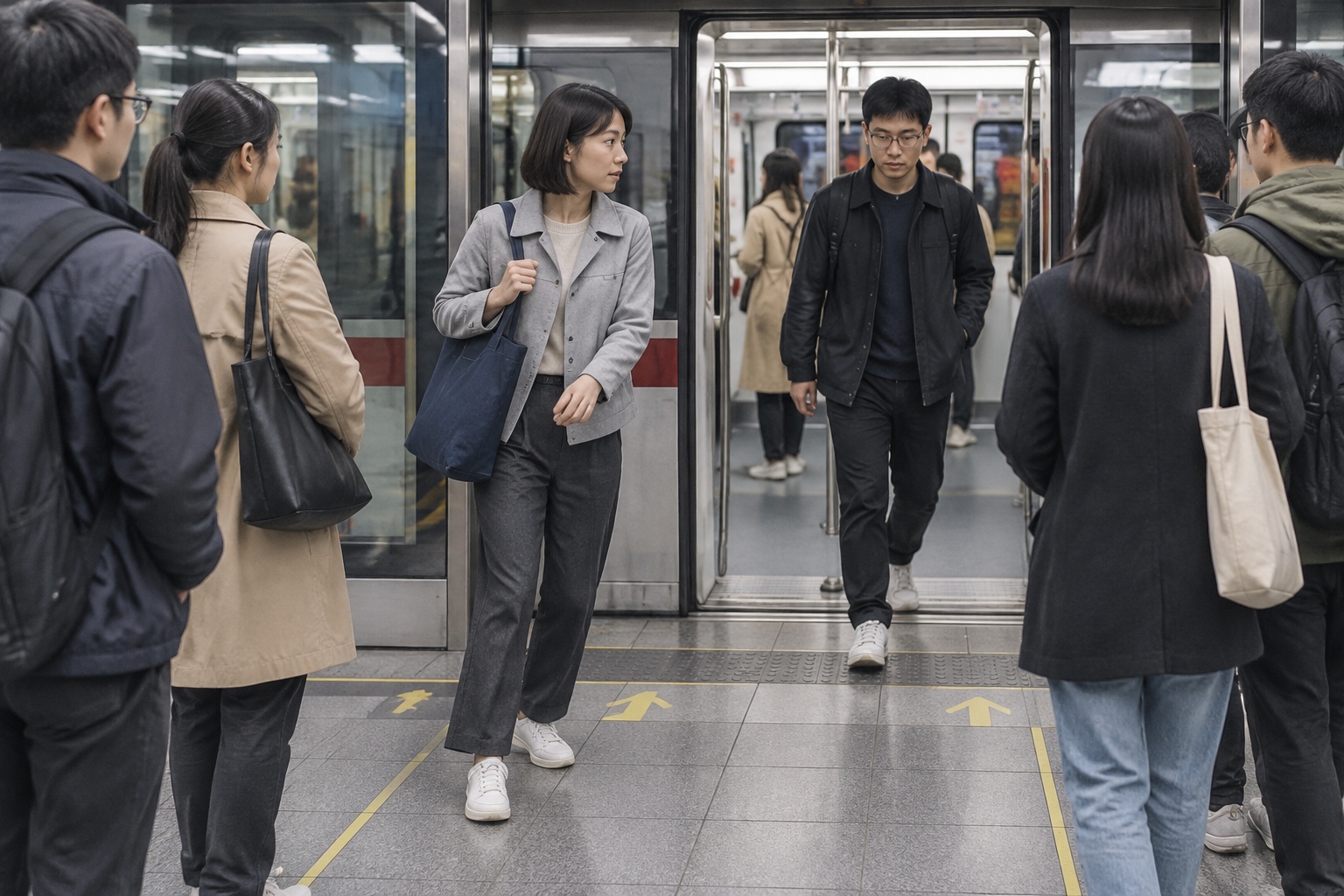

A train pulls into a Shanghai metro station, and Lin takes half a step back. Her shoes are already behind the boarding marks. She moves because a passenger inside has turned toward the door, and there is just enough room for him to step out if she brings her canvas tote against her leg. Behind her, the queue closes by about the length of a shoe.
Lin is an illustrative commuter, and the scenes and viewpoints along her route are reconstructed examples. She has booked an outpatient appointment before work. It takes her through three places where strangers have to read one another quickly: a metro platform, a train carriage and a hospital waiting area. She will take the metro again later that morning, when there is room to stand exactly where she wants.
On the Shanghai metro platform, the arrows leave a gap
The floor marks show where to wait on either side of the doors. A recorded reminder asks riders to let passengers off first. Both cues are easy to follow while the train is still approaching. When the doors open, the waiting lines have to hold their shape long enough for the people inside to get through.
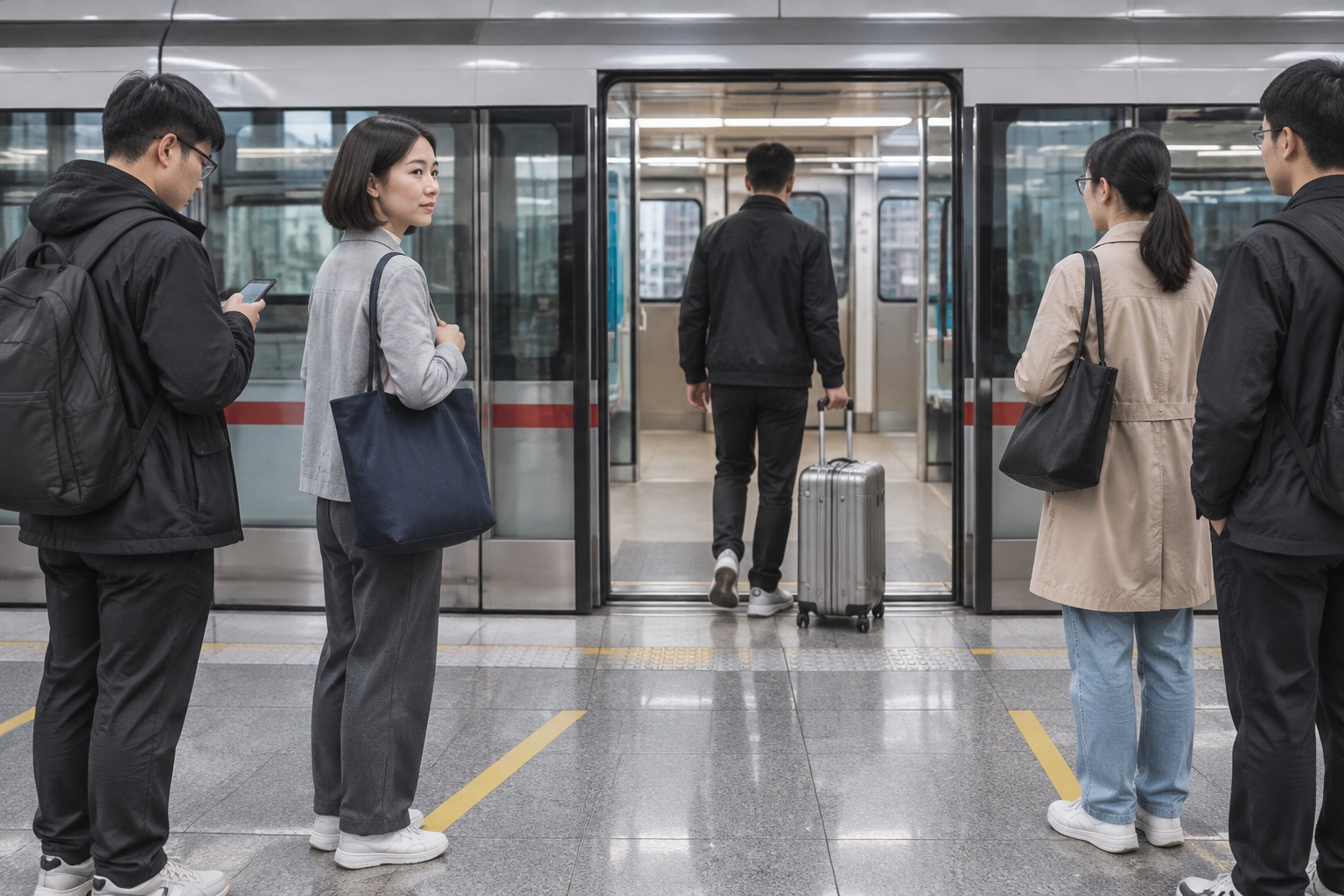
Lin is second in line. The person in front of her leans forward when the first passenger steps out, then settles back as two more appear. The last person through is pulling a small suitcase. Its wheels trail behind his feet, and the people at the front wait another beat. At the next door, someone starts boarding while a rider is still trying to get out. The rider turns sideways to pass. The same floor marks run along both doors.
At rush hour, someone can stand closer behind Lin than she would ordinarily choose, and she can still feel that her place in line is clear. She gets more alert when a shoulder draws level with hers near the front, where it becomes harder to tell whether a second line is forming or someone is moving ahead. Distance matters, but so does the direction from which someone comes close.
How a regular rider and a newcomer read the same crowd
Picture two people at Lin’s door just as the first passengers step out. One rides this line every weekday. The other has arrived in Shanghai recently and is learning this transfer. The regular sees a queue that is moving as expected. She knows the line will loosen when people start boarding, and she steps back as soon as she sees the suitcase handle. If a person beside her starts forward early, a short reminder to let people off first feels natural. She has heard that wording over the speakers many times.
The newcomer sees two lines and, for a few seconds, an inviting strip of empty floor between them. He steps back once he sees somebody coming through it. He is more likely to ask the person next to him whether this is the boarding line than to remind a stranger to wait. On the train, the regular might offer her seat when she sees someone steadying themselves against a pole. The newcomer might move to get up and pause when that person turns away. Both are looking for a sign that the gesture would help. Regular use gives one of them more practice recognizing those signs on this route.
Inside the carriage, the space by the door changes hands
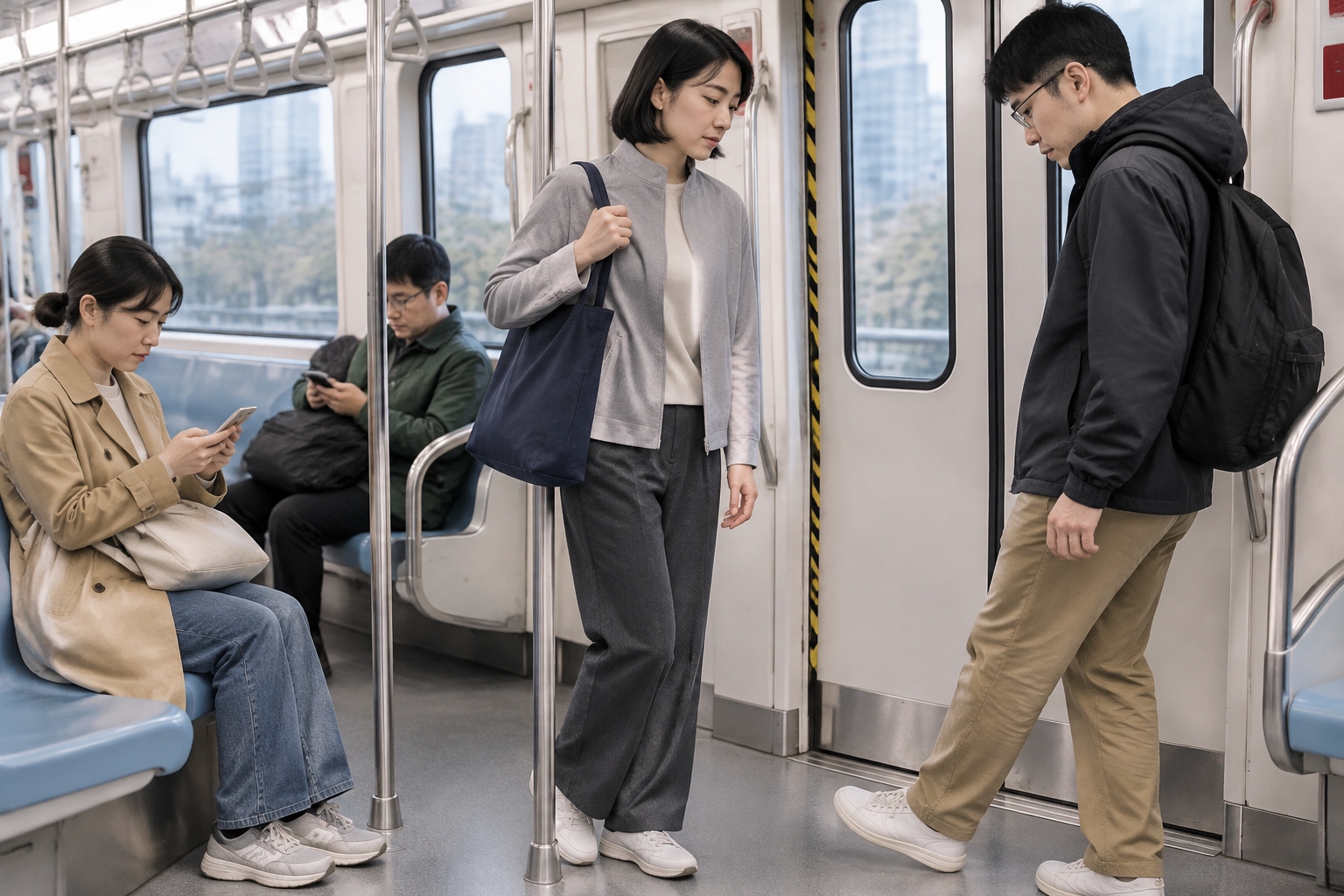
Lin boards and moves toward a pole. Along the carriage wall, a rider sitting on the bench draws his shoes under his knees to give her room to pass. The open patch by the door fills first. For someone getting off at the next station, it is a sensible place to stand. For someone boarding with several stops ahead, the same cluster can make the carriage look full even when there is standing room farther in.
As Lin’s stop approaches, she turns to face the doors while the train is still moving. One person follows her gaze and shifts a foot. Another keeps looking at a phone until Lin says ràng yíxià, a brief request to make room. At the station, a passenger near the door steps onto the platform to let others out, then gets back on. For a few seconds, the space beyond the door is part of that passenger’s route through the carriage.
Sound has its own cues. The Shanghai rail passenger code that took effect in December 2020 included a rule against playing audio aloud on electronic devices. A phone call poses a different question. Lin answers one in a low voice, then repeats the hospital entrance number a little louder as the train runs through the tunnel. When the train slows, her voice carries across the carriage and she lowers it again. The words and the number of listeners stayed the same. The background noise changed.
In the hospital waiting room, a seat is also a place to listen
At the hospital, Lin checks in for her outpatient appointment and looks for the screen that shows who is being called. In a waiting area with an electronic ticket queue, patients can remain seated until their turn comes. Lin still wants a chair with a clear view of the display. From the far end of a row, she would have to lean forward to see around people standing near the consultation rooms.
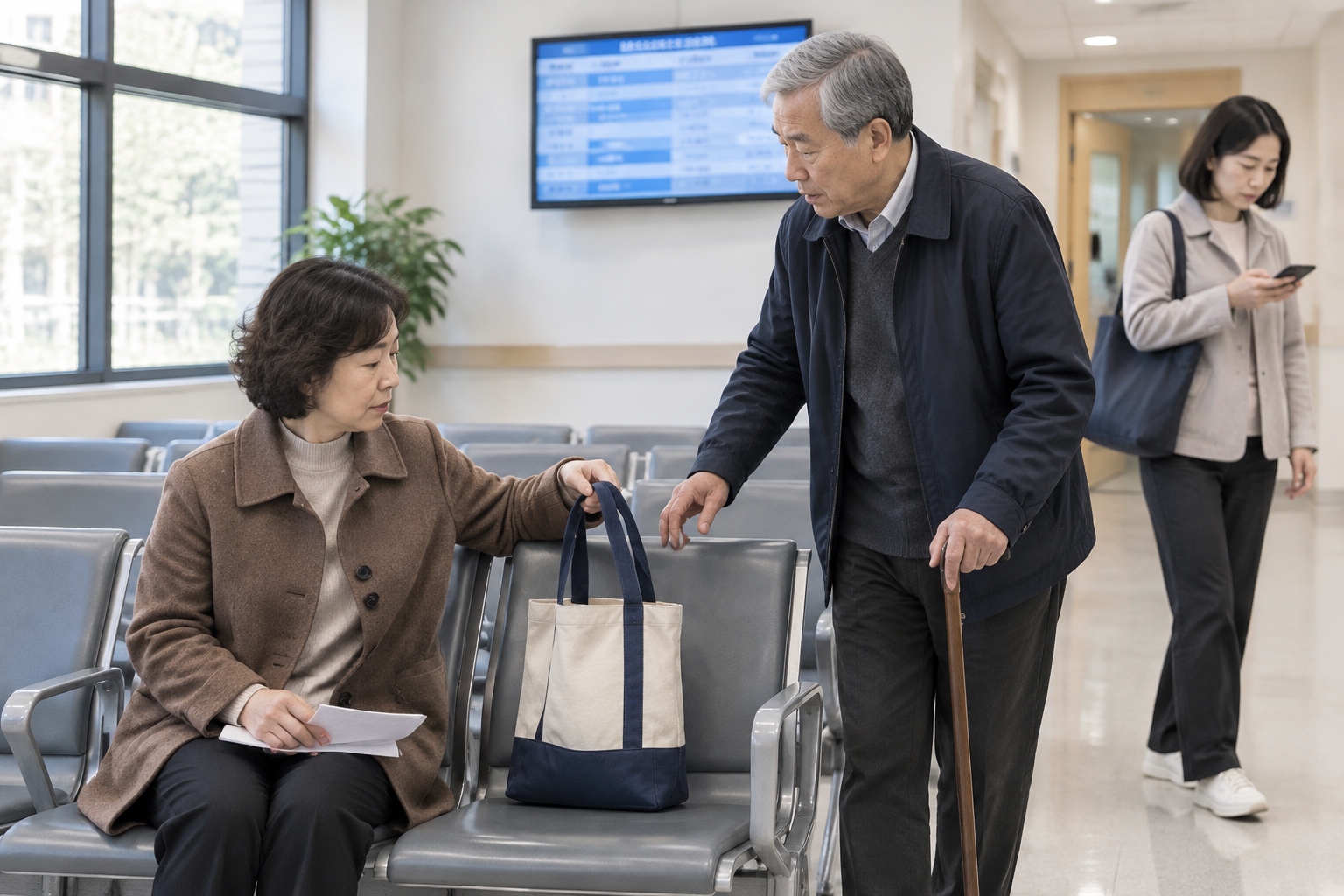
There are empty chairs at the back. Near the screen, one chair holds a tote and the next holds its owner, a woman with a folded test report on her lap. When an older patient approaches, the woman lifts her bag before he asks. He takes the seat and leaves his cane close against his shin. A companion looking for the right room stops in the aisle, then steps into the gap at the end of the row to finish looking at the appointment message. That small move lets two people pass abreast.
The waiting room has its own reasons for being loud. Someone trying to help a parent hear a nurse may need to repeat a room number. When it is Lin’s turn, she speaks quietly as she gives her name at the door. The next patient has already walked up behind her. The screen makes it possible to wait at a distance, but the arrangement of the chairs, the display and the doors still determines how much privacy that distance buys.
After rush hour, an empty seat changes the calculation
On her return to the metro in late morning, Lin can see the floor arrows all the way to the platform doors. The next rider leaves a gap behind her that would have taken up precious room earlier. Inside the carriage, she takes an empty seat and leaves one vacant place between herself and the next passenger. In the morning, that same vacant place would have disappeared as soon as someone saw it. Now several seats are free, and sitting immediately beside a stranger can feel unnecessarily close.
The extra room also changes how people ask to pass. At rush hour, Lin had announced herself before the train stopped. On the late-morning ride, a man with a shopping bag can walk from his seat to the doors without speaking. At the hospital, a relatively quiet corridor can still become crowded outside one consultation room when two patients and their companions gather at the same door. The available space is measured locally, sometimes in the width of an aisle or the few steps from a chair to a screen.
When Lin reaches her stop, she waits for a passenger to pass in front of her before she gets up. Earlier that morning she stood well before the doors opened. This time she can stay seated another second, and the passenger can walk straight through.
Start the discussion at forum.chinacomes.com