


Ten days, one factory, and an onward ticket to Bangkok
Elena Márquez landed at Guangzhou Baiyun airport on a Tuesday evening in November with no visa in her passport. She works for a mid-sized furniture company in Valencia, and she had come to see a supplier in Foshan, half an hour away by metro, and a second one in Dongguan. Her return ticket was not to Spain. It was a cheap flight to Bangkok the following Friday week.
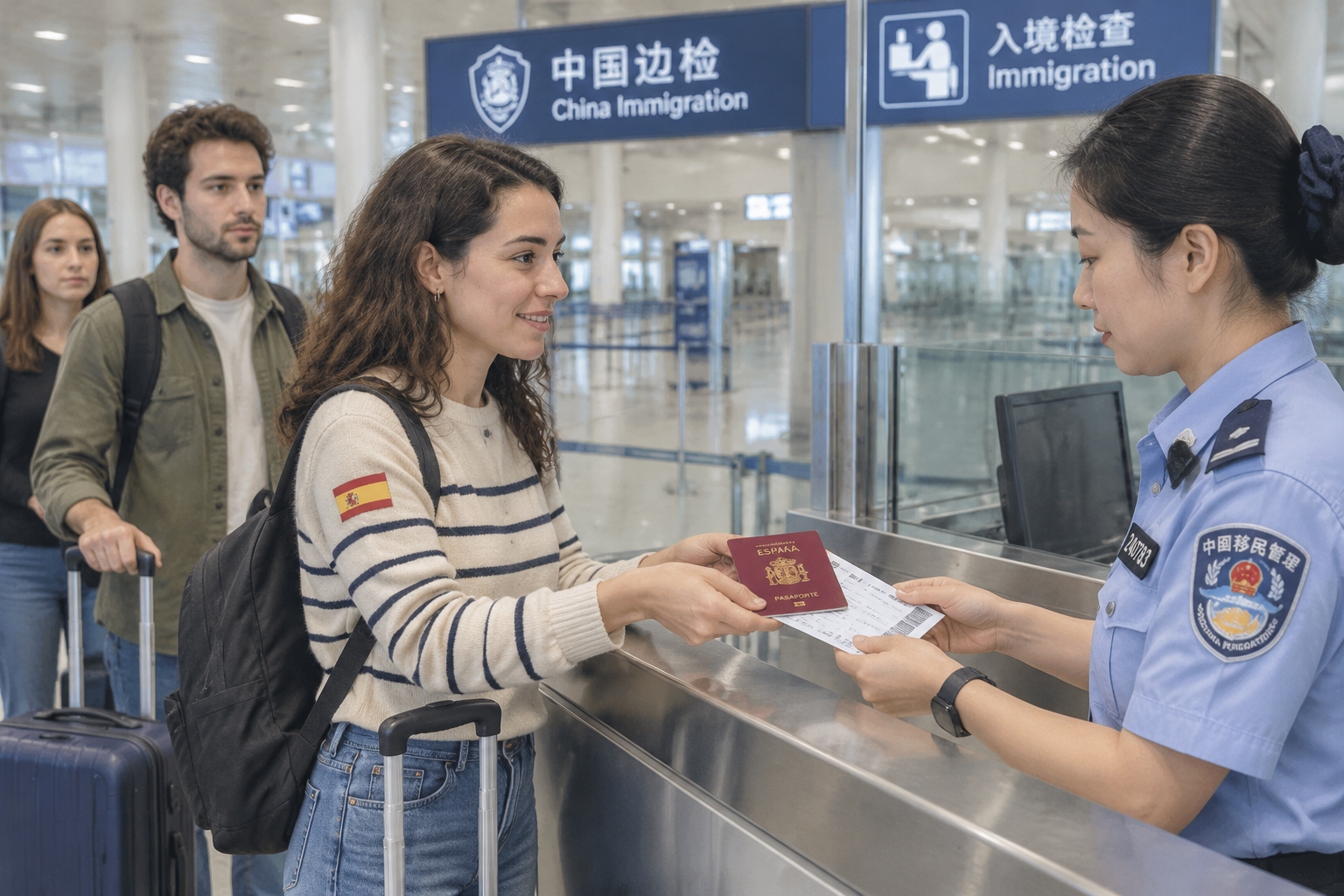
That itinerary — Spain in, Thailand out, China in between — is what let her walk up to the immigration desk and be stamped in for 240 hours. She paid nothing, filled in no form in advance, and waited for no approval. The only document anyone asked about was her onward booking.
Her case is a good place to start, because most coverage of China’s visa changes lumps two quite different things together: the short-stay transit rule that let Elena in, and the new “K” visa for young science and technology graduates. One is a ten-day window for meetings and factory visits. The other is an attempt to bring researchers and founders in for longer. They get described as a single act of opening up. In practice they are two rungs on a ladder, at different heights, with real gaps between them.
What the 240-hour transit rule actually allows
The rule took effect on 17 December 2024, replacing a 144-hour version. The logic is simple: if you are passing through China on your way somewhere else, you can stay up to ten days without a visa. The conditions are where people trip up.
Who it covers
Citizens of more than 50 countries, a list that includes most of Europe, the United States, Canada, Australia, New Zealand, Japan and South Korea. If your passport is not on it, nothing else here applies to you. Check the National Immigration Administration (NIA) list before you book anything.
Where you can go
You have to enter and leave through one of the designated ports — 60 of them, spread across 24 provinces and municipalities. Your movement is then limited to the area attached to the port you came in through. Usually that is the whole province or municipality; in some places it is a smaller zone, and a few neighbouring provinces are grouped into a single travel area (Beijing, Tianjin and Hebei, for instance, count as one). Enter in Guangdong and you can work your way around Guangdong. Take a train to Shanghai and you are, technically, overstaying.
The third-country rule
Your onward ticket must be to a third country or region, with a confirmed seat, departing inside the 240 hours. Hong Kong, Macau and Taiwan count as third regions for this purpose, which is why so many itineraries now end with a hop to Hong Kong. Flying back to where you came from does not qualify.
When the clock starts
Not when you land. The 240 hours are counted from 00:00 on the day after entry. Land at 9pm on a Monday and the clock starts at midnight, which in practice gives you close to eleven days.
What it is not
It is not a work permit, a study permit or a press visa. Meeting suppliers, attending a trade fair, inspecting a factory and signing contracts are all fine. Being paid by a Chinese company, enrolling on a course or reporting as a journalist are not — journalists need a J visa. The stay cannot be extended. When the 240 hours run out, you leave.

The second rung: the K visa
In August 2025 the State Council added a new letter to China’s visa alphabet. The K visa, in force since 1 October 2025, is aimed at young foreign graduates and researchers in science, technology, engineering and mathematics.
The change that matters is not the length of stay. It is the sponsor. Until now, the realistic route into China for a foreign scientist or engineer ran through an employer: a company or a university issued an invitation letter, and you applied for a Z (work) visa on the back of it. The K visa is designed to be applied for without a Chinese host. That means a 26-year-old robotics graduate in Pune or a postdoc in Milan can come and talk to companies, visit labs or test an idea before anyone has offered them a contract.
According to the official announcements, it covers education and academic exchange, business and entrepreneurial activity, and starting a company. What it does not cover is employment. A K visa is an entry document with a stay period attached — not a work permit, not a residence permit. If the trip turns into a job offer, the paperwork moves to the Foreigner’s Work Permit system, the A/B/C categories employers file for, plus a residence permit from the local exit-entry bureau. Some of that can be handled inside China; some of it still means a trip to Hong Kong and back. Ask the specific office in the specific city before you count on it.
Detailed document requirements are set embassy by embassy and were still being clarified through late 2025. Some posts ask for a verified degree certificate, some for a letter from a research institution, some for proof of funds. Treat any single checklist you find online as a starting point, and confirm with the embassy that will actually process your application.
Where the ladder does not connect
The two policies are usually described as complementary, and broadly they are. But the joints are worth spelling out, because this is where people get stuck.
A 240-hour entry cannot be converted into anything. There is no counter at the airport where you explain that the factory visit went well and ask to stay on. You leave, and you come back on the correct visa — which may mean a Z visa processed at a Chinese embassy abroad, a process measured in weeks.
A K visa is not a guarantee of work either. The employer still has to be eligible to hire foreigners, the position still has to clear the labour market process in most cities, and the standard work-permit rules still apply: a bachelor’s degree plus two years of relevant experience for the general B category, with waivers that depend on the employer, the city and whether you graduated from a Chinese university.
The map is also uneven. Exit-entry rules are administered locally, so Shanghai, Shenzhen and the Greater Bay Area run schemes that smaller cities do not. If a policy sounds generous on a national news site, the useful question is what the exit-entry bureau in the city where you actually want to live has published.
One more comparison is worth knowing. If your passport is on China’s unilateral visa-free list, you may already be able to enter for up to 30 days for business or tourism, with no onward ticket and no third-country routing. The list and the end date keep moving, so check before booking — but for many travellers that is the simpler door. The transit rule matters most for passports that are not on that list, or for people genuinely passing through.

What the ten days actually feel like
Elena’s week was not a policy seminar. It was factory floors, a supplier dinner in Shunde, two high-speed train rides and a great deal of WeChat. A few things she had to learn on the ground:
Hotels are required to register foreign guests, and smaller ones sometimes cannot, so confirm before you book. Train tickets can be bought with a passport at the counter and increasingly at the gate, though the manual lane is still the reliable option at busy stations. Mobile payment works if you link a foreign card to Alipay or WeChat Pay; a small fee applies above a threshold, and cash remains legal tender if a shop’s scanner refuses you. The NIA runs an English-language hotline, 12367, for visa and stay questions — worth saving before you fly.
A short checklist before you book
- Confirm your passport is on the transit visa-free list, and that the port you plan to use accepts it.
- Book an onward flight to a third country or region — not back home — inside 240 hours, with a confirmed seat.
- Check which province or zone your entry port allows you to travel in, and stay inside it.
- If you are going the K-visa route, read the checklist published by the embassy handling your case, and ask your host institution which city’s rules apply.
- Assume nothing converts. Short stay to work, and K visa to work permit, are separate processes at separate desks.
The ladder, honestly
Read together, the two policies do describe something real. China has built a graduated system in which a five-day look around, a ten-day supplier tour, a month of talks and a two-year research contract are no longer the same bureaucratic event. For a Spanish product manager, that meant a trip that would once have taken a month of planning happened in a week.
But a ladder is only useful if the rungs are close enough to step between, and some of them are still far apart. The gap between visiting China and working in China has narrowed at the bottom and stayed wide at the top. That is less a criticism than a description — and it is the thing to understand before you buy the ticket.
Start the discussion at forum.chinacomes.com