
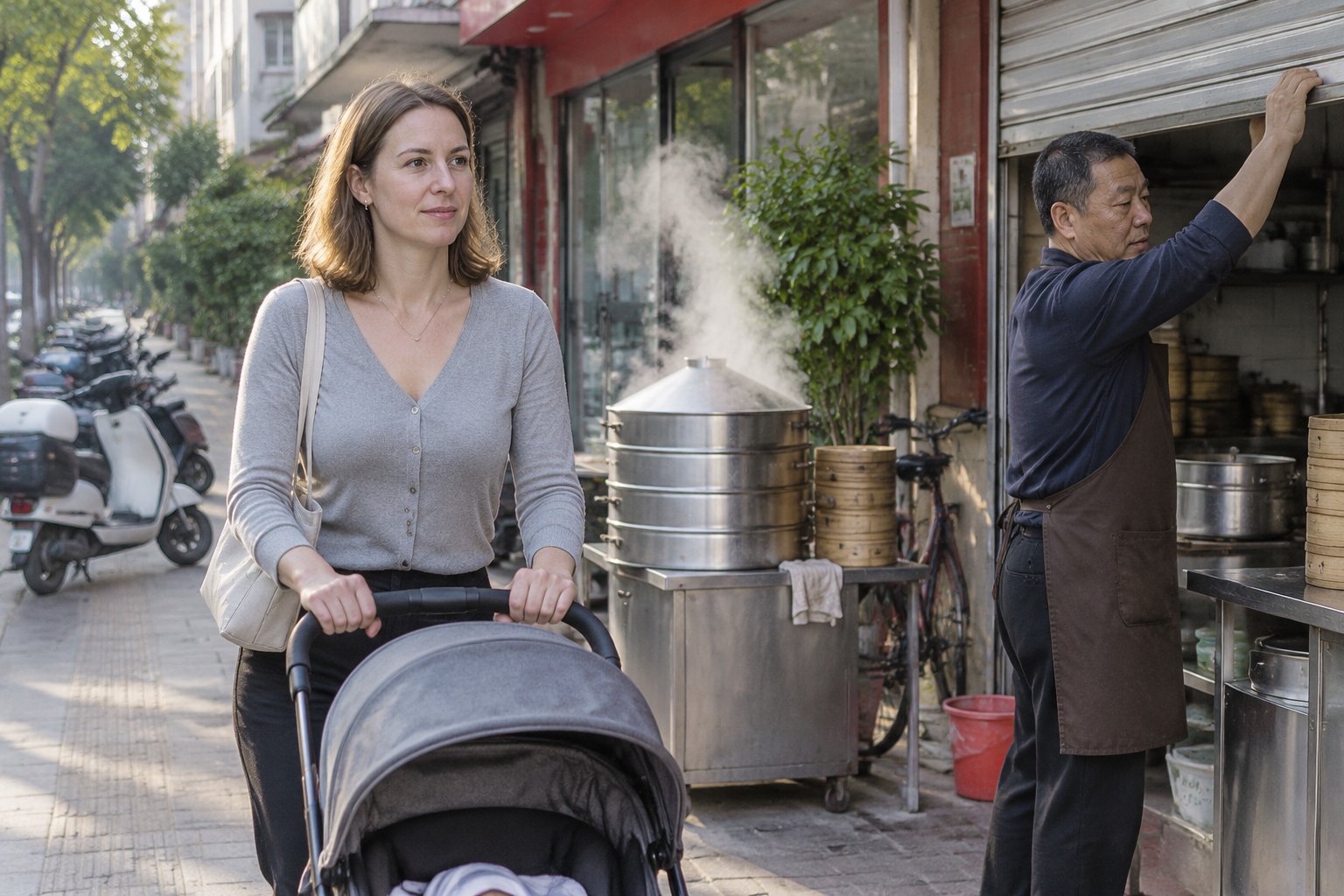

7:40 a.m., Hongshan
The metal shutters along the ground floor of Building 12 come up in a staggered rhythm, one shop after another, like someone waking a piano key by key. Steam from a rice-roll steamer fogs the glass of the breakfast stall. A woman in a gray cardigan pushes a stroller past it, says something in Russian to the child inside, then switches to Mandarin to order: “Liǎng bēi dòujiāng, bù jiā táng.” Two soy milks, no sugar.
This is Hongshan, a cluster of several dozen apartment blocks in Longhua District, in the northern half of Shenzhen. Nothing here looks like a postcard. There is no observation deck, no design museum, no glass tower with a rooftop bar. There is a wet market, three bubble tea shops, a primary school, a basketball court with a net that has been mended twice, and — by the community office’s own count — residents who hold passports from 54 countries.
The number is what got Hongshan into news reports. It is not the interesting part. The interesting part is what 54 nationalities look like at 7:40 in the morning: someone arguing about a parking space, someone learning which bin the fish bones go into, someone waiting for a form to be stamped before the office closes for lunch.
Some names in this story have been changed at the request of residents. Details come from several days of visits to the neighborhood’s streets, service center and market.
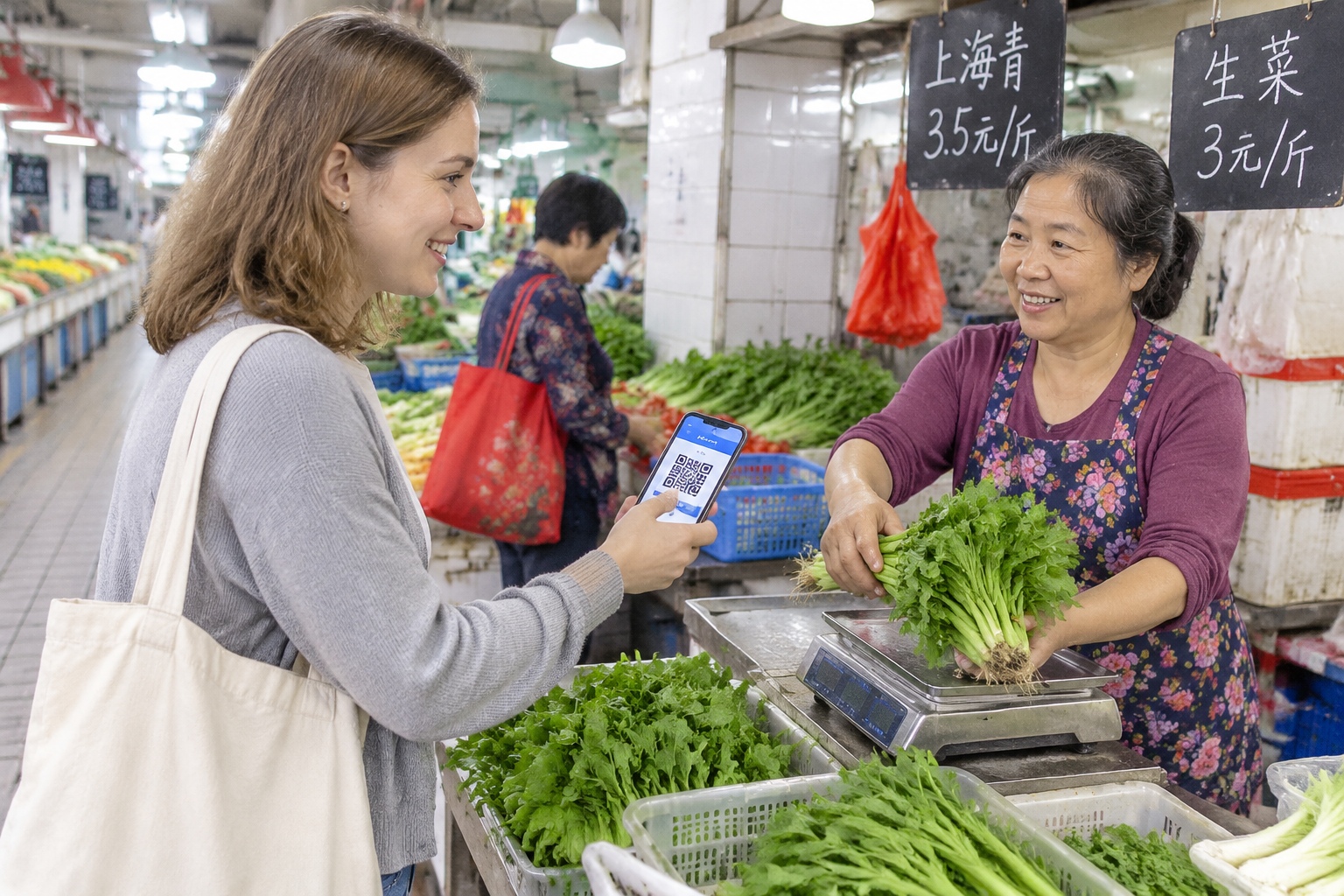
Inside the market, the change is measurable in small increments. Ms. Huang, who has sold vegetables from the same corner stall for eleven years, now writes prices on a whiteboard in a mix of numerals and pinyin, because half her regulars read numbers faster than characters. Two stalls down, a butcher keeps a separate board for cuts that do not touch pork. Four years ago neither board existed. Nobody organized a campaign; the shopkeepers simply noticed who was standing in front of them and adjusted.
Who fixes the stairwell light in Building 7
Ahmed, 41, has run a small restaurant on the ground floor of Building 9 for six years. He came from Yemen, learned Mandarin from his suppliers, and last spring was asked by the neighborhood committee whether he would serve as a louzhang — a “building leader” — for a block where roughly a third of the households include at least one foreign passport holder.
To understand what that means, you need a little background on how Chinese cities run at street level. Below the district government sits the neighborhood committee, and below that a grid system that slices the area into pieces of a few hundred households each. Grid staff know who moved in, who moved out, who is elderly and living alone. Building leaders are the layer beneath: unpaid or lightly subsidized volunteers, usually long-term residents, who relay messages in the building’s WeChat group and act as the first call when something breaks.
Ahmed’s version of the job is mostly translation — of a filing system into a human one. When the stairwell light in Building 7 stayed dark for four days, he photographed the corridor, posted it in the group, tagged the property manager by name, and the light was replaced the next afternoon. When two households spent a month arguing about cooking smells and late-night noise, he went up with a community worker and a translator, and they sat in both kitchens, one after the other, until the neighbors agreed on a window schedule.
He also does garbage sorting, which is less trivial than it sounds. Shenzhen made separated waste collection mandatory in 2020 — four categories, with fines for repeated non-compliance. The categories are not obvious to anyone who did not grow up with them. Ahmed printed a card with photographs of the four bins and the words he hears most often: fish bones, plastic wrap, batteries, medicine boxes. He slides it under doors when new tenants move in.
The translators nobody pays
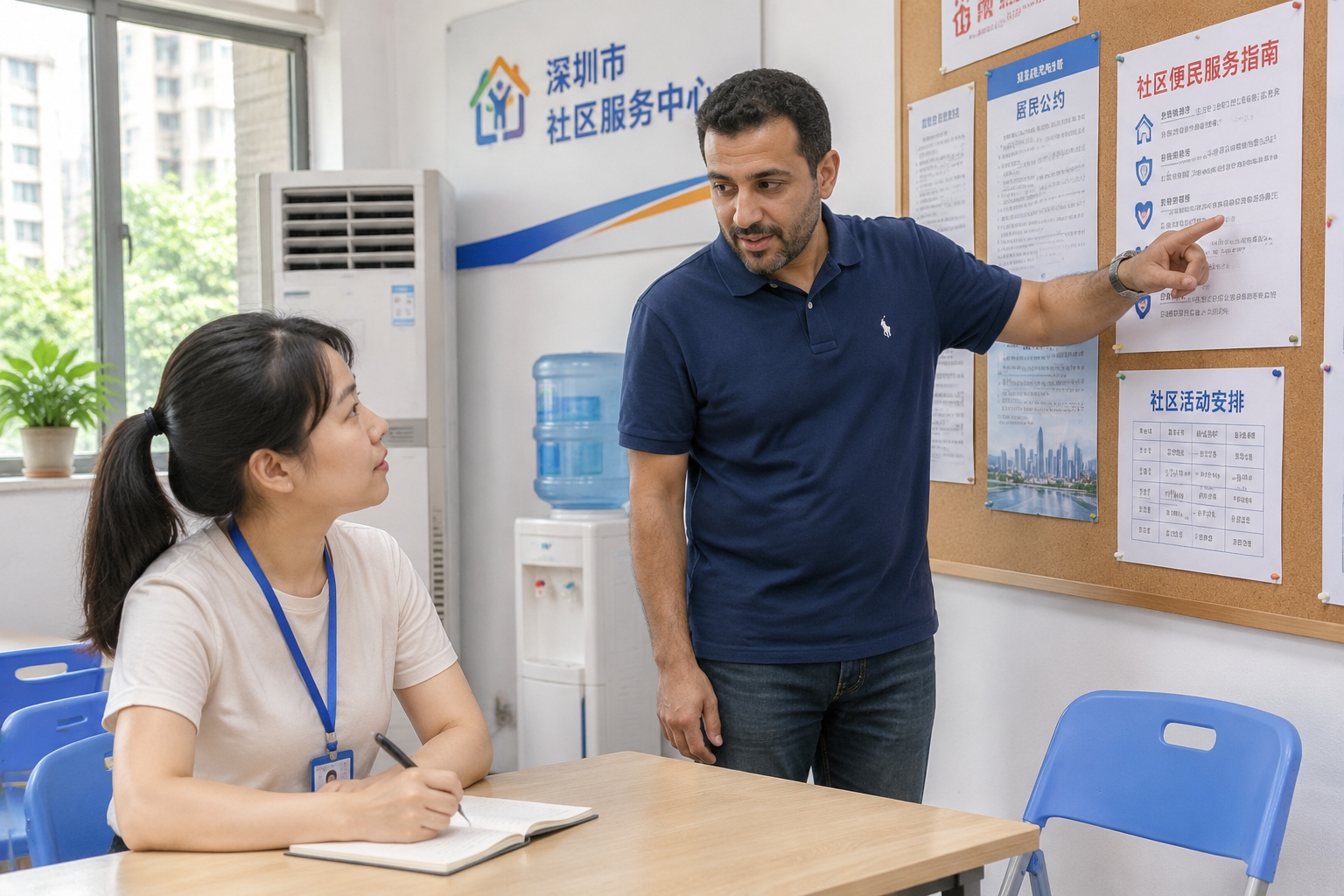
Two floors up in the community service center, a room with plastic chairs and a water dispenser serves as the neighborhood’s multilingual front desk. The volunteer roster rotates: a retired English teacher, two Korean graduate students, a Japanese engineer’s spouse, a Filipino primary school teacher, a Russian-speaking student from the university nearby, and a handful of Chinese residents who between them cover Arabic and French.
They translate documents that arrive in Chinese and matter enormously: a lease, a hospital appointment slip, a notice about a kindergarten vaccination round, a school form asking for a parent’s signature on a field trip. But most of the traffic is not documents. It is questions, and the questions are rarely about policy. Where do I take a child with a 39-degree fever at two in the morning? Why did my parcel get sent back to the warehouse? How do I tell the plumber the leak is under the sink and not behind it?
Community worker Liu Xiaoyu, 28, runs the roster. She says the team was not recruited through a campaign but accumulated: someone’s landlord asked, someone’s daughter volunteered at a weekend event and stayed. Their most-used tool is not a dictionary but a shared folder of screenshots — the water bill page, the hospital registration screen, the address field of the delivery app — each one annotated with a red box and an arrow.
One young man’s paper trail
Daniel, 24, arrived from Indonesia in 2022 to study business at a Shenzhen university. He liked the city enough to want to stay, and that decision turned into a two-year paper trail.
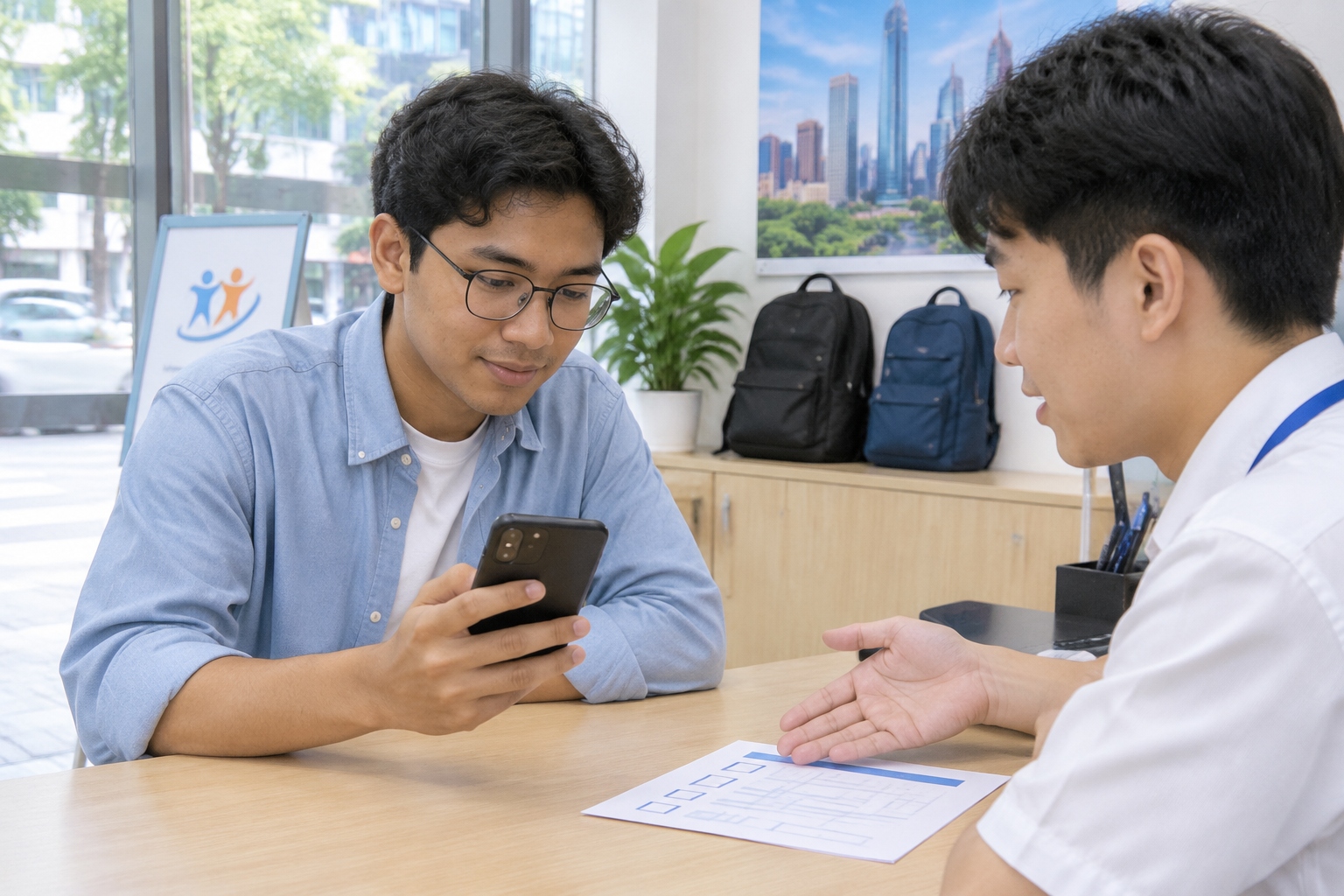
His first stop was the Bay Area Youth Service Station, a storefront operation in the neighborhood that runs three tracks for young people: settling into campus, integrating into local life, and finding work or starting something. Daniel’s first year was the first track — a Saturday Mandarin corner where students practiced ordering, complaining and apologizing, plus monthly neighborhood walks that went to the wet market and the civic center rather than to tourist sites.
The second year he moved to the employment track. A resume clinic rewrote his CV for Chinese hiring managers, who expected a photograph and a date of birth where his old version had neither. An information session walked a room of about twenty young foreigners through the three documents that decide whether you can work legally: the work permit, the residence permit, and registration of your address. Daniel’s biggest surprise was not the paperwork but the order of it. The address registration has to be done first, within 24 hours of moving in, and it is usually handled by the landlord.
He now works for a cross-border e-commerce company in Futian, selling small kitchen appliances to Southeast Asia. He still goes back to the Saturday Mandarin corner, this time as the person explaining the difference between “I want” and “I need”.

Thirteen categories, and the friction behind them
Most practical questions eventually end up in the same place: the i深圳 app, the city government’s service platform, which publishes a guide for foreign residents organized into 13 categories of high-frequency tasks. They cover what you would expect — work permits, residence permits, address registration, social insurance, healthcare, school enrollment, banking, mobile service — plus a few that surprise newcomers, such as how to register a bicycle, how to appeal a traffic fine, and where to get a health certificate if you handle food.
In practice the app is better than its reputation and worse than its marketing. The English interface genuinely exists, and the materials checklists are specific enough to be useful — a residence permit renewal, for instance, lists the passport, the valid work permit, the lease, the registration form and a photograph, in that order. One foreign resident I walked through it with finished his renewal in a single visit to the exit-entry hall, about forty minutes including the queue.
The friction sits in the seams. Some sub-pages still open in Chinese only. Address fields assume a Chinese-format address, so newcomers copy strings of characters they cannot read. And a lot of services are actually delivered through a WeChat mini-program rather than the standalone app, which is fine if you live inside WeChat all day and confusing if you do not.
What “international” actually means here
The usual measures of a global city are things you can count from a helicopter: consulates, exhibition space, foreign direct investment. Hongshan suggests a different measure, closer to the ground.
Does the woman pushing the stroller know the name of the man who sells her soy milk? When the stairwell light breaks, is there a person in the WeChat group who will answer? When a form arrives, is there a version of it a neighbor can read? When a child has a fever at two in the morning, is the clinic open, and is there someone at the desk who can explain what the doctor just said?
Shenzhen’s internationalization is usually told as a story about convention centers and skyline. In Hongshan it looks quieter: 54 nationalities sharing one waste-sorting schedule, one WeChat group, one basketball court with a mended net — and a set of small frictions that get solved, or don’t, one neighbor at a time.