

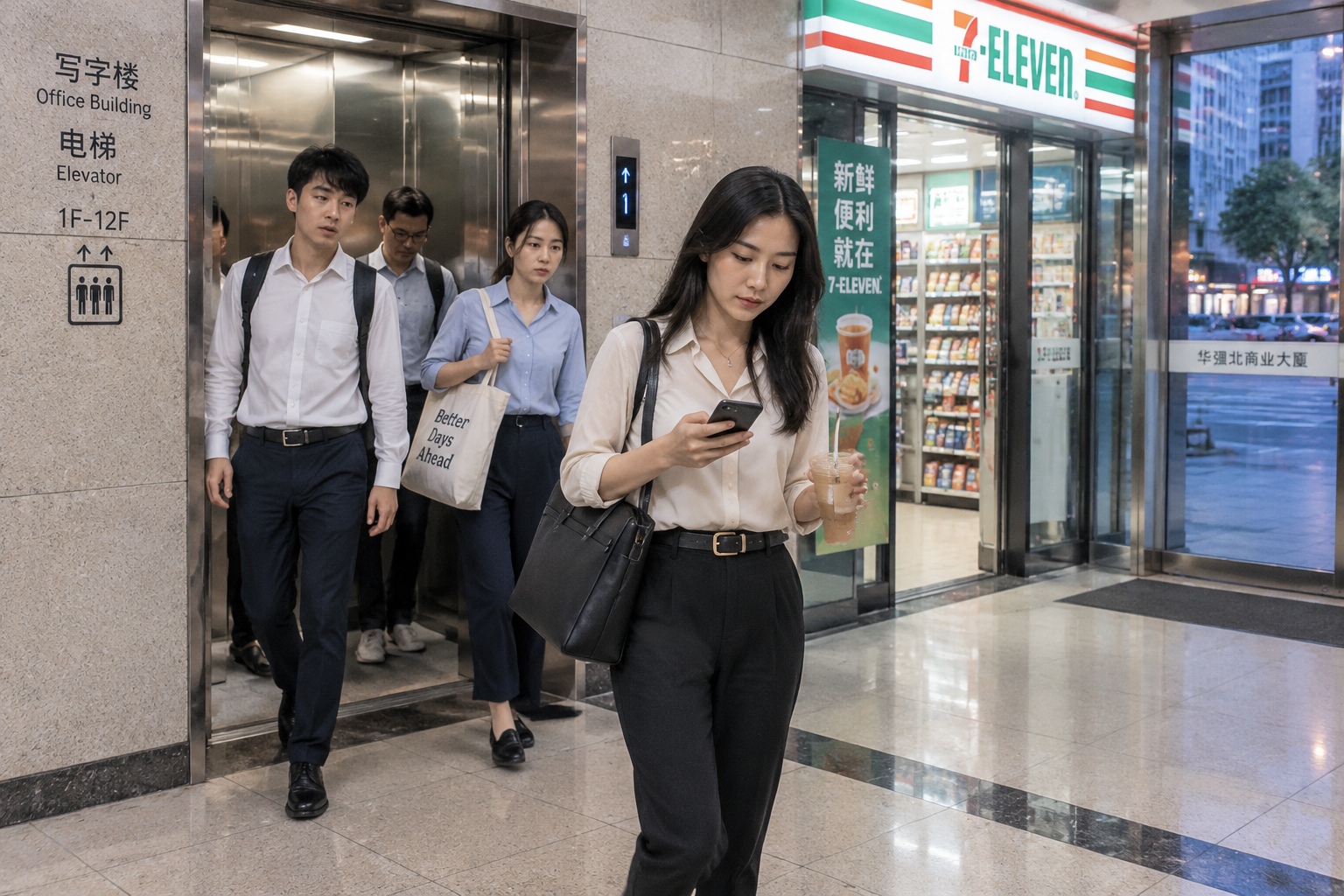
At 7:52 on a Tuesday evening, the elevator in a 1990s office tower near Huaqiang North Road smells faintly of hot metal and somebody’s takeaway noodles. Lin Xiao rides it up with her laptop bag pressed against her knees, phone in one hand, a half-finished iced Americano in the other. She has eight minutes to sign in, find a power socket, and get her laptop open before class starts.
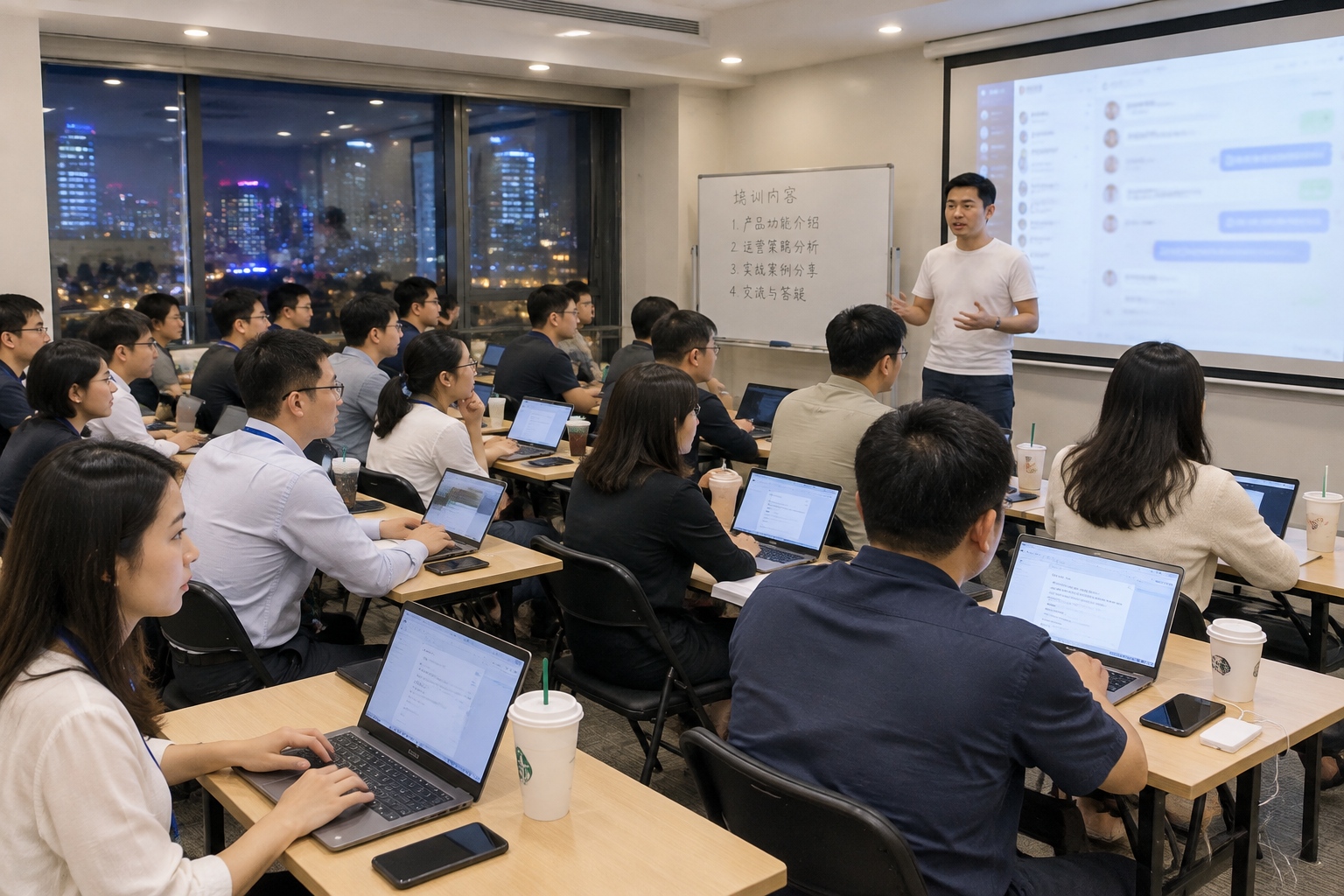
The room on the twelfth floor is not a lecture hall. Grey carpet, thirty folding chairs, a projector, and a whiteboard still carrying the ghost of this morning’s sales meeting. At eight o’clock, twenty-seven of those chairs are taken. Almost everyone has come straight from work. Two people are eating out of paper boxes. A phone keeps buzzing with a group chat its owner is deliberately ignoring.
Why the lights are on again
Night schools are an old idea in China. In the 1980s they were how factory workers and shop clerks made up the diplomas that had been interrupted a decade earlier — vocational classes, English, accounting, all of it squeezed into evenings after a full shift. The format faded as universities expanded and online courses arrived.
It came back in a different shape. Shanghai’s citizen art night school drew national attention in 2023 by offering twelve-session courses for 500 yuan; local media reported hundreds of thousands of people applying for a few thousand seats, mostly for calligraphy, jazz dance and vocal training. The appeal was less about skills than about a cheap, structured reason to leave the flat on a weeknight and sit next to other people.
Shenzhen’s version leans harder toward work. District youth leagues, community centres and private training companies all rent evening hours in buildings like this one, and no single body coordinates them. What they share is a price band that feels low-risk (usually 100 to 600 yuan for a short course) and a start time that assumes you finish your shift at 6:30 and eat something on the way.
What 199 yuan actually buys
The course Lin Xiao signed up for costs 199 yuan for four Tuesday evenings, 7:30 to 9:30, thirty seats, advertised through Xiaohongshu posts and a friend’s WeChat moments. The instructor is Zhang Heng, 31, a former advertising copywriter who now runs AI training sessions for small companies and, four nights a week, for rooms like this.
Session one is mostly demolition work: what a large language model is, and what it is not. It does not know your supplier’s prices, it does not browse reliably unless you tell it to, and it will invent a product specification without hesitation if the sentence looks better that way.
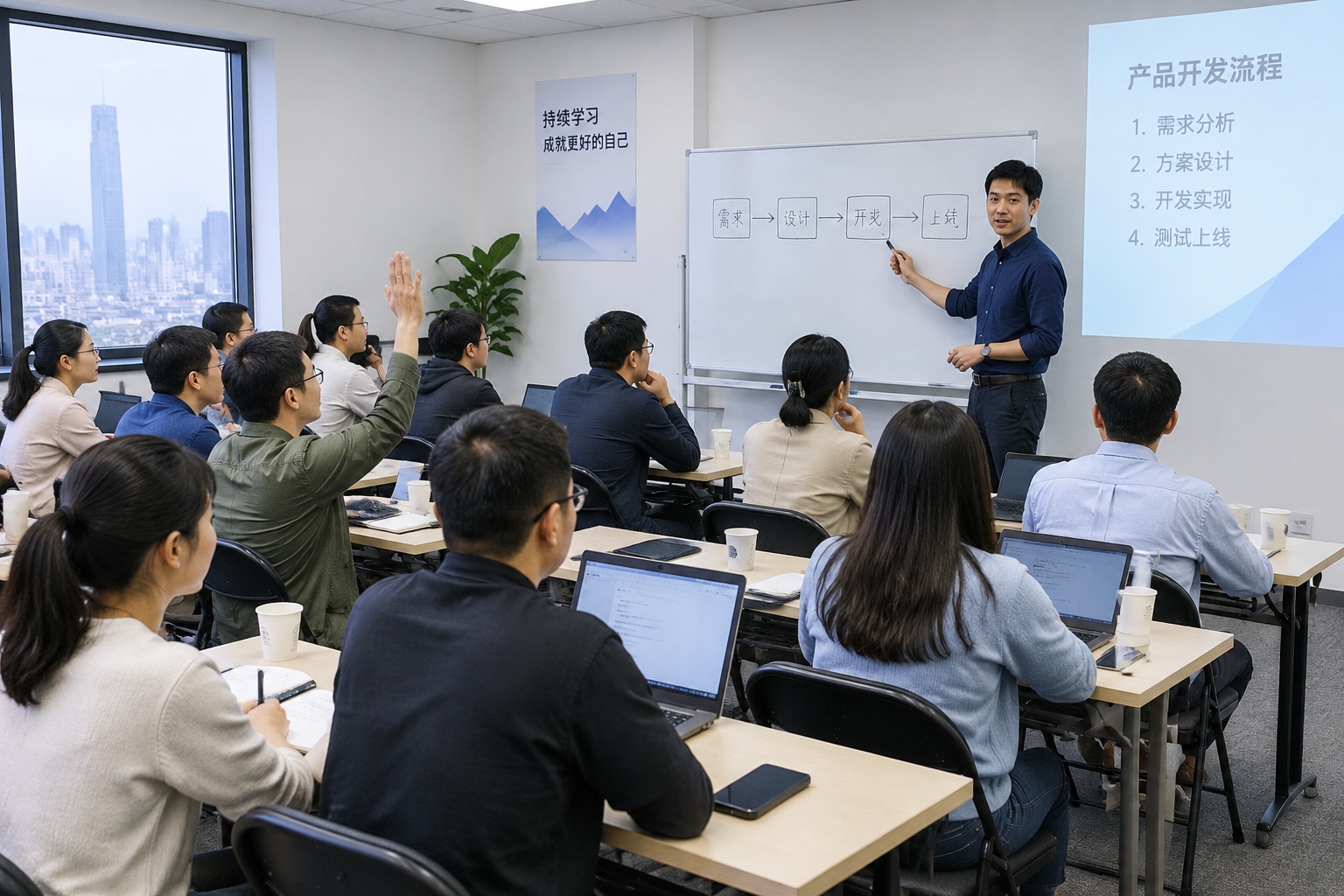
Session two is structure. Zhang puts a template on the whiteboard — who you are, who the reader is, what you want, what format, what to avoid — and makes everyone rewrite the same request four times. “Don’t type ‘write me a caption,'” he says. “Tell it who you’re selling to, what the price is, and what you refuse to sound like.”
Session three moves to images and short video: generating product visuals with Jimeng and similar tools, then cutting and captioning in CapCut. Session four is a small assembly job — one product page, one video script, one customer-service script, built in class and taken home in a folder.

Nobody walks out as an AI engineer, and Zhang says so in the first ten minutes. “You will not become a producer in eight hours,” he tells them. “You’ll learn which parts of your week can be handed over, and which parts will embarrass you if you hand them over.”
Who is in the room
Lin Xiao is 28 and works in e-commerce operations for a Shenzhen seller of phone accessories. She writes around twenty product descriptions a week, plus the copy for promotion pages. She is not afraid of being replaced; she is tired of finishing those descriptions at 11 p.m.
Chen Wei, 34, sells Bluetooth earphones on Taobao and Pinduoduo with two employees. He does his own customer service and his own product photography. He heard about the class from a supplier’s group chat and came to find out whether it could handle the repetitive half of his day.
Wang Min is 36. She left foreign trade in 2021 when her son started primary school and now wants freelance work she can do between 9 a.m. and 3 p.m. A logistics supervisor in his forties sits near the back; his company has just bought a system that nobody has explained to him, and he wants to stop nodding along in meetings. A design student at the front paid with her own money and is taking notes in two colours.
Their reasons overlap but do not match. One wants speed. One wants a side income. One wants to stop feeling behind. Only two people in the room raise a hand when Zhang asks who has paid for an AI subscription.
The arithmetic behind 199 yuan
Thirty seats at 199 yuan is 5,970 yuan per cohort. The training room rents for roughly 200 yuan an hour in this building, so eight hours of class costs about 1,600. The instructor takes 1,000 to 1,500. An assistant who handles the projector and the group chat takes a few hundred more. Add printing, bottled water and the platform commission on ticket sales, and the four-week course roughly breaks even — sometimes at a small loss.
That is the point. The 199-yuan class is not the product; it is the doorway. Zhang sells advanced workshops at 999 to 2,999 yuan, half-day sessions for companies at 8,000 to 20,000 yuan, and occasional one-on-one consulting. He estimates that 15 to 20 percent of a beginner cohort moves on to something paid, and that the rest of the advertising budget is better spent on Xiaohongshu than on the room itself.
Students do their own accounting, and not in the same currency. Chen Wei’s test is blunt: “If it saves me three hours a week, 199 is nothing. If I go home with a folder of prompts I never open, it’s a cinema ticket.” Lin Xiao’s test is whether she can leave the office before nine.
Where the models actually land
China’s three largest consumer AI assistants — Doubao from ByteDance, DeepSeek, and Alibaba’s Tongyi — are free at the tier most of these students use, and they work in Chinese well enough that the barrier is no longer language. The government’s internet information centre put the number of generative AI users in China at roughly 230 million by mid-2024, which is about one in six people online.
In practice, the work these tools absorb is unglamorous. A first draft of a product page. Ten variations of a customer-service reply, including one in dialect. A formula for a spreadsheet that has been broken for months. English emails to a supplier in Dongguan, translated and softened. Subtitles for a forty-second video, generated in a minute and corrected in three. None of it is a business. All of it is an hour back.
The limits are just as concrete. The model will confidently invent a battery capacity. It will write a promotion that breaks platform rules on absolute claims like “the best” or “number one.” Chinese regulation now requires AI-generated content to be labelled in many commercial contexts, which means a shop cannot quietly pass off a generated image as a photograph. And clients rarely pay more because a tool was used; they pay for the result and assume the tool is your problem, not theirs.
The side-hustle imagination and the payout
Nearly everyone in the room has seen the same kind of post: someone on Xiaohongshu claiming 8,000 yuan a month from AI-generated picture books, or a shop on Xianyu selling “AI poster design, 5 yuan, delivered in an hour.” The numbers are real in the way lottery wins are real — they happen, and they are not a plan.
What the class can honestly offer is the first step of a funnel: a working account, a set of templates, a rough sense of which platforms allow what, and thirty people to compare notes with. One student in an earlier cohort took small design orders on Xianyu, made about 800 yuan over a month of evenings, and stopped when the time per order dropped below what she earns at her day job. Another turned the same skills inward and got a raise by cutting her team’s content turnaround in half.
Zhang is unsentimental about this. “The tool is not the moat,” he says. “The client list is. I can teach you the tool in four evenings. I can’t give you clients.”
9:30 p.m., back on the street
Chairs scrape at half past nine. Zhang points at a QR code on the whiteboard for the class group chat and reminds them of the homework: take one task you did today, break it into three steps, and work out which step the model could have done. Someone asks whether there will be a session on agents. Someone else asks if the slides can be shared.
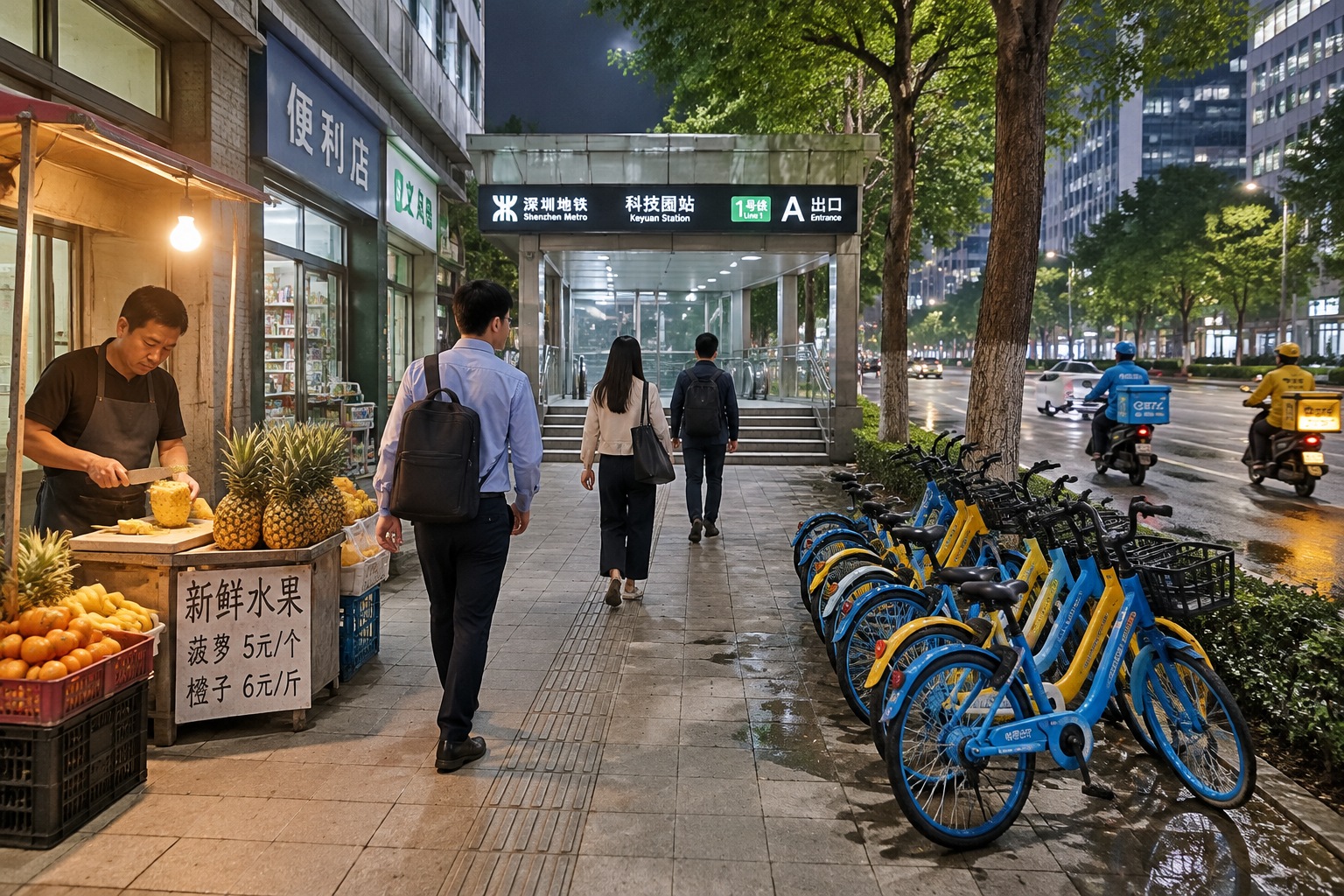
Downstairs, the fruit stall on the corner is still lit, the woman running it is cutting a pineapple, and a row of shared bikes has been left at angles across the pavement. Half the class walks toward the metro entrance; two people are still talking about a client who refused to pay for revisions. Lin Xiao has forty minutes to get back to Longhua. She is not sure the course will change her income, and she is not sure it won’t. She is fairly sure she will open her laptop again tomorrow night, and that this time she will type the request differently.
That is about the size of what 199 yuan buys in Shenzhen right now: not a new career, not a shortcut, but a couple of evenings in a warm room with twenty-six other people who suspect the ground is shifting and would rather find out how than pretend it isn’t.
Start the discussion at forum.chinacomes.com