

Three in the Morning on Pozi Street
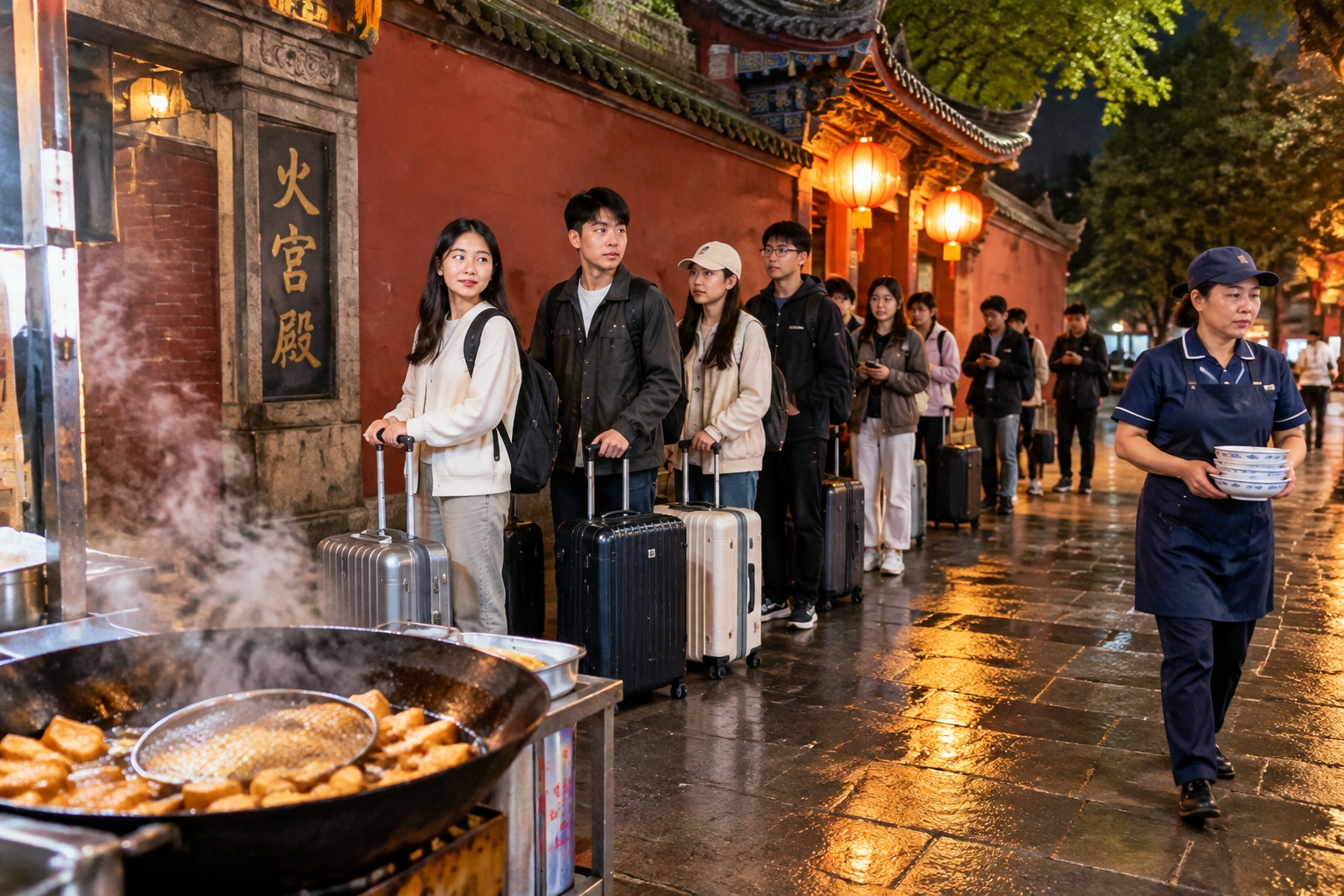
At 3:07 a.m., the air outside Huogongdian smells of two things at once: hot frying oil and lemon-scented floor cleaner.
On the north side of Pozi Street, a queue of about forty people bends along the temple’s red wall. A woman in a cream puffer jacket sits on her hard-shell suitcase, chin propped in her hand. Her friend stands over her holding a paper bowl of stinky tofu — black cubes glistening under the yellow lanterns — and eats one every thirty seconds without saying anything.
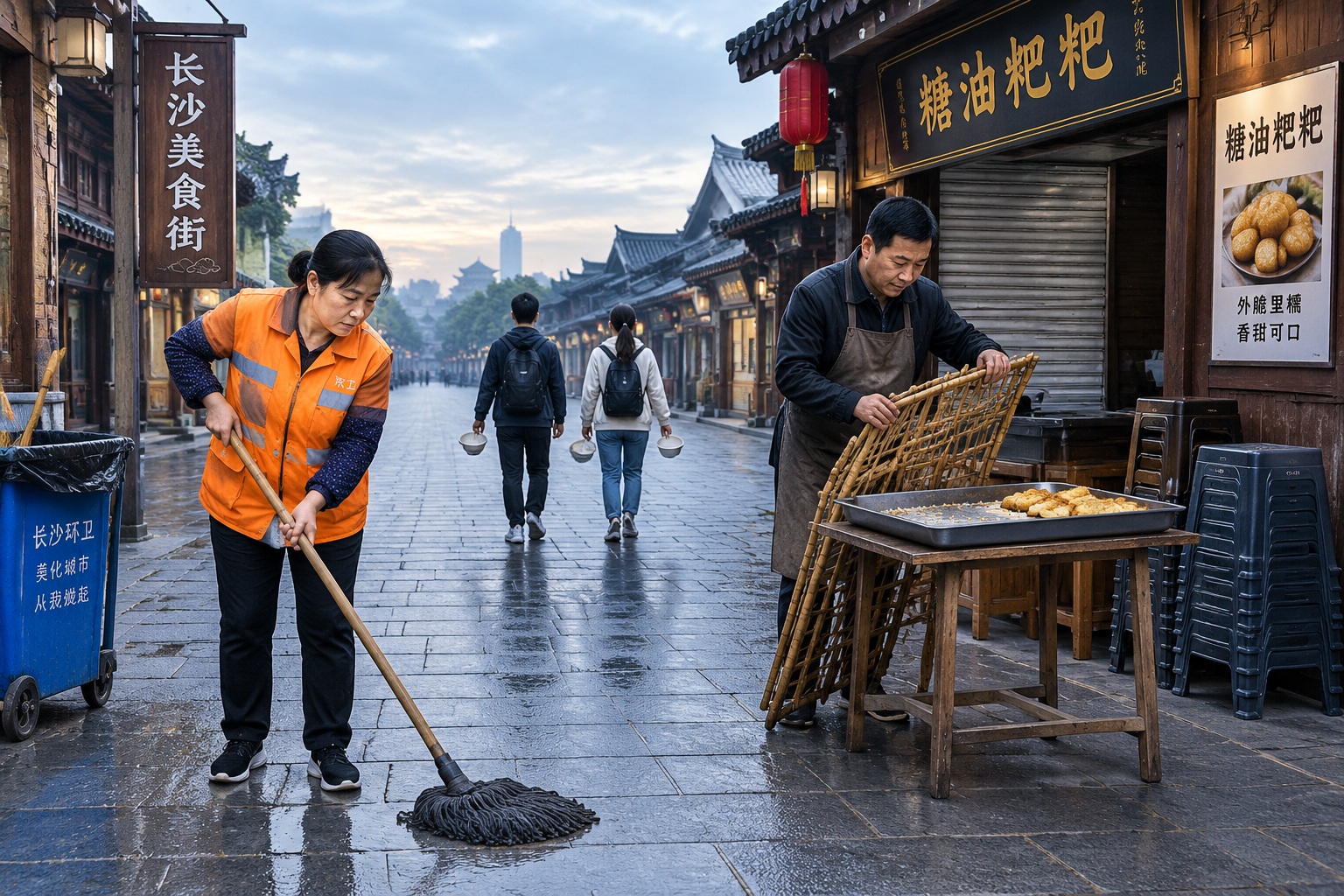
Behind them, two workers in navy uniforms push a steel trolley of dirty bowls toward a service door. On the corner, a man with a bamboo rack of tangyou baba — sticky rice dough fried and rolled in brown sugar — has already set up, though nobody is buying yet. He is 61, he says, and this is his third spot of the night.
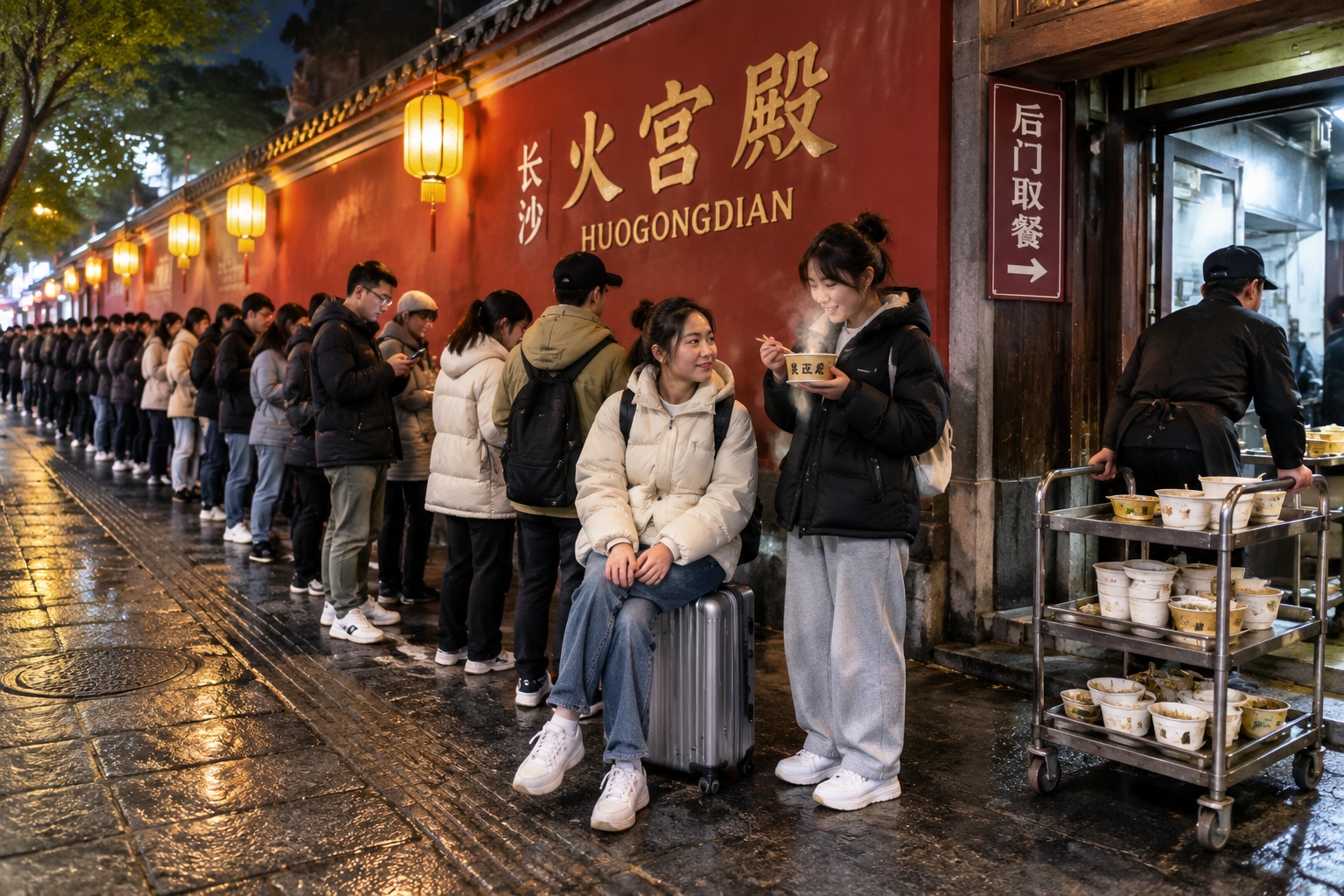
Nobody in this picture is doing the same thing. That is what makes three in the morning interesting here.
What Huogongdian Actually Is
For anyone outside China, the name needs unpacking. Huogongdian means “Palace of the Fire God.” It began as a Ming-dynasty temple — the site traces back to the 16th century — and there is still an altar and a coil of incense smoke at one end. But for most of the past century it has been better known as a snack hall: a big, noisy, tile-roofed complex where you can order a dozen Changsha specialties at once.
The menu is short and specific. Stinky tofu, fermented and fried to order. Tangyou baba. Sister dumplings. Pork blood in broth. Red-braised pig’s trotters. Rice noodles. Local guides like to mention that Mao Zedong ate here in 1958; the photograph is on the wall. The complex sits at the edge of Pozi Street, a pedestrian food lane in Tianxin district, about ten minutes’ walk from Wuyi Square, where Changsha’s two metro lines cross.
That location explains a lot. Huogongdian is not a hidden local secret, and it is worth saying plainly: it is a tourist site, and plenty of Changsha residents will tell you the stinky tofu one street over is better. But it is also a landmark that ordinary residents have walked past their whole lives, been taken to on school trips, brought visiting cousins to. It is both things at once. The argument over whether it is “authentic” misses how Chinese city centers actually work.
Why Tourists Are Still Queuing After 3 a.m.
A few places ahead in the line, two university students from Wuhan are sharing a充电宝 and a paper cup of milk tea. They arrived by high-speed train at 11 p.m. Their hotel check-in is not until 2 p.m. the next day. So they decided to skip the room entirely.
“We planned this city for 30 hours,” one of them says. “Sleep on the train home.”
This is a recognizable travel style in China now — young people call it “special forces travel,” cramming a city into a weekend with as little sleep and money as possible. Changsha suits it. The city has spent the past decade building a reputation as one of China’s most online-famous places to eat and stay out late: the tea chain Chayan Yuese with its permanent queues, the retro-food megavenue Super Wenheyou, the bar street on Jiefang West Road a few blocks away. Social media feeds the loop. A photo of a black tofu cube in a paper bowl, posted at 3 a.m., performs well.
Practical things matter too. The last metro trains leave Wuyi Square a little before midnight, and the first ones start again around 6:30. Between those hours you either go home or you stay out. For a visitor with a suitcase and no bed yet, staying out is the cheaper choice — and, at Huogongdian, the more entertaining one.
The Other Clock: People Who Are Working, Not Visiting
Inside, past the takeaway window, the kitchen runs on a different schedule.
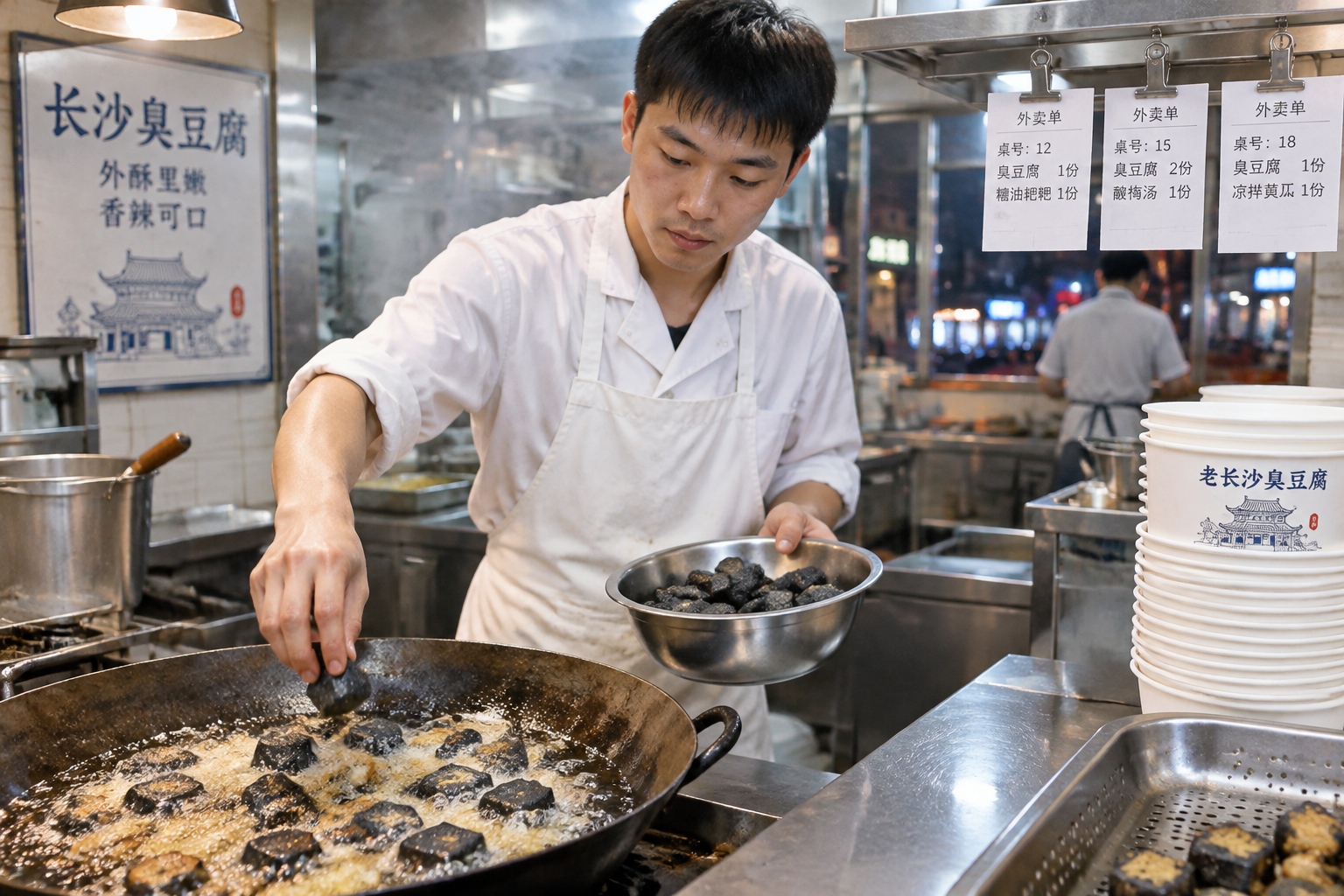
A cook who gives his name as Xiao Zhou started his shift at 4 p.m. He stands at a shallow wok of oil that has not been turned off for hours, dropping in trays of fermented tofu that hiss and turn. On a weekend night, he says, the counter sells 200 to 300 portions before dawn. His shift ends when the fryer is cleaned, usually around five.
“You get used to the heat,” he says, wiping his forearm with the back of his hand. “The hard part is the standing.”
He earns a bit over 5,000 yuan a month including overtime and meals — roughly $700, in a city where the provincial minimum wage is around 2,000 yuan. He is 24, from a county outside Changsha, and sends part of it home.
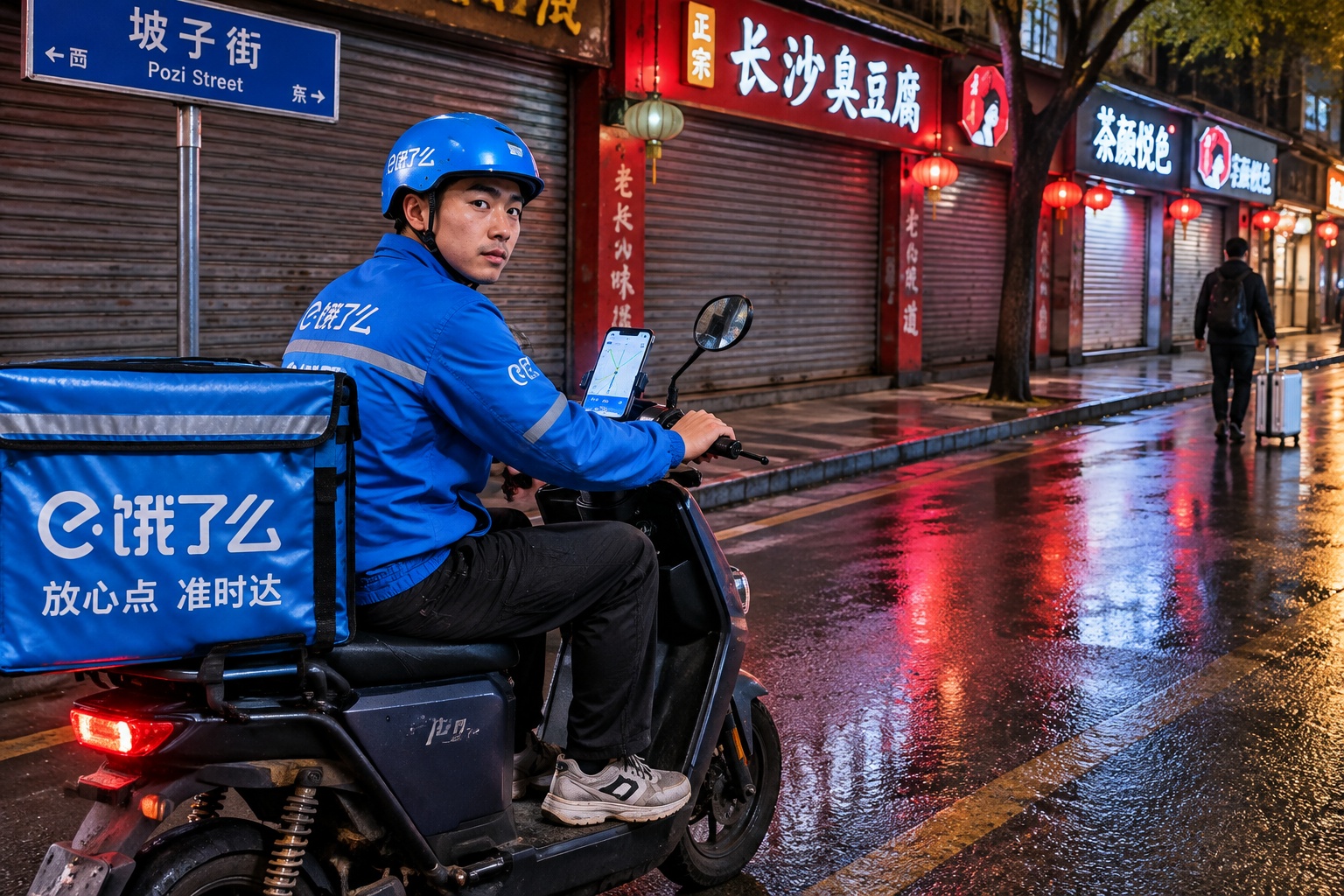
Outside, a delivery rider in a blue helmet pulls up at 3:20, phone mounted on the handlebars. He is 27, from Loudi, and chose the night shift on purpose: fewer cars, faster drops, and slightly better pay per order than in the daytime rush. He averages 30 to 40 deliveries between 9 p.m. and 4 a.m. His mother thinks he is asleep.
By the service door, a cleaner named Deng is working a mop across the tiles. She is 54, on shift from 11 p.m. to 7 a.m., and has done this route for six years. Her son is in middle school and sleeps at his grandmother’s on the nights she works. “The street is quietest at four,” she says. “That’s when I get the whole pavement done.”
How Changsha’s Night Economy Actually Runs
None of this happens by itself. Changsha began publishing formal night-economy plans around 2019, among the earlier Chinese cities to do so, and the visible results are small and unglamorous: shopfronts on Pozi Street that stay lit until 2 or 3 a.m., a handful of night bus routes, convenience stores that never close, and metro service extended on summer weekends and public holidays.
Behind that, there is a second layer of labor that most visitors never photograph. Garbage trucks work the pedestrian streets between 4 and 5 a.m., before the crowds thicken again. Security staff in reflective vests pace the crossings all night. Kitchen porters haul crates of tofu and cooking oil through side alleys while tourists queue at the front. The night economy is not just neon and spending; it is roughly a hundred thousand people in this city — cooks, riders, cleaners, drivers, vendors — working hours that most office workers never see.
It is also not romantic. The pay is modest, the hours are long, and the summer heat inside a frying station is close to unbearable. What looks like atmosphere from the queue looks like a shift from behind the counter.
Two Kinds of Time in One Courtyard
Stand at the gate for an hour and you can watch the two clocks run side by side.
Tourist time is episodic. It is measured in photos, in a first bite, in a story to tell. A group arrives, eats, films, leaves, and their night is complete. Worker time is repetitive. It is measured in portions, in the number of bowls left on a table, in how many hours until the 7 a.m. handover.
The same paper bowl of tofu sits at the point where the two meet. One person waits twenty minutes for it and remembers it for years. Another person fries several hundred of them in a night and, reasonably, never wants to look at one again.
After Three, Before the First Train
By 4:40 a.m., the queue is down to six people. The sky above the rooftops has gone from black to a flat grey. The tangyou baba vendor is folding his bamboo rack, counting the coins in his apron pocket with one finger.
At 5:10, the fryer is finally off. Zhou unties his apron, walks out past the red wall where two tourists are photographing their empty bowls, and unlocks a shared bike. He will be home before the first metro pulls out of Wuyi Square.
Start the discussion at forum.chinacomes.com