

Two kinds of conversation, one dinner table
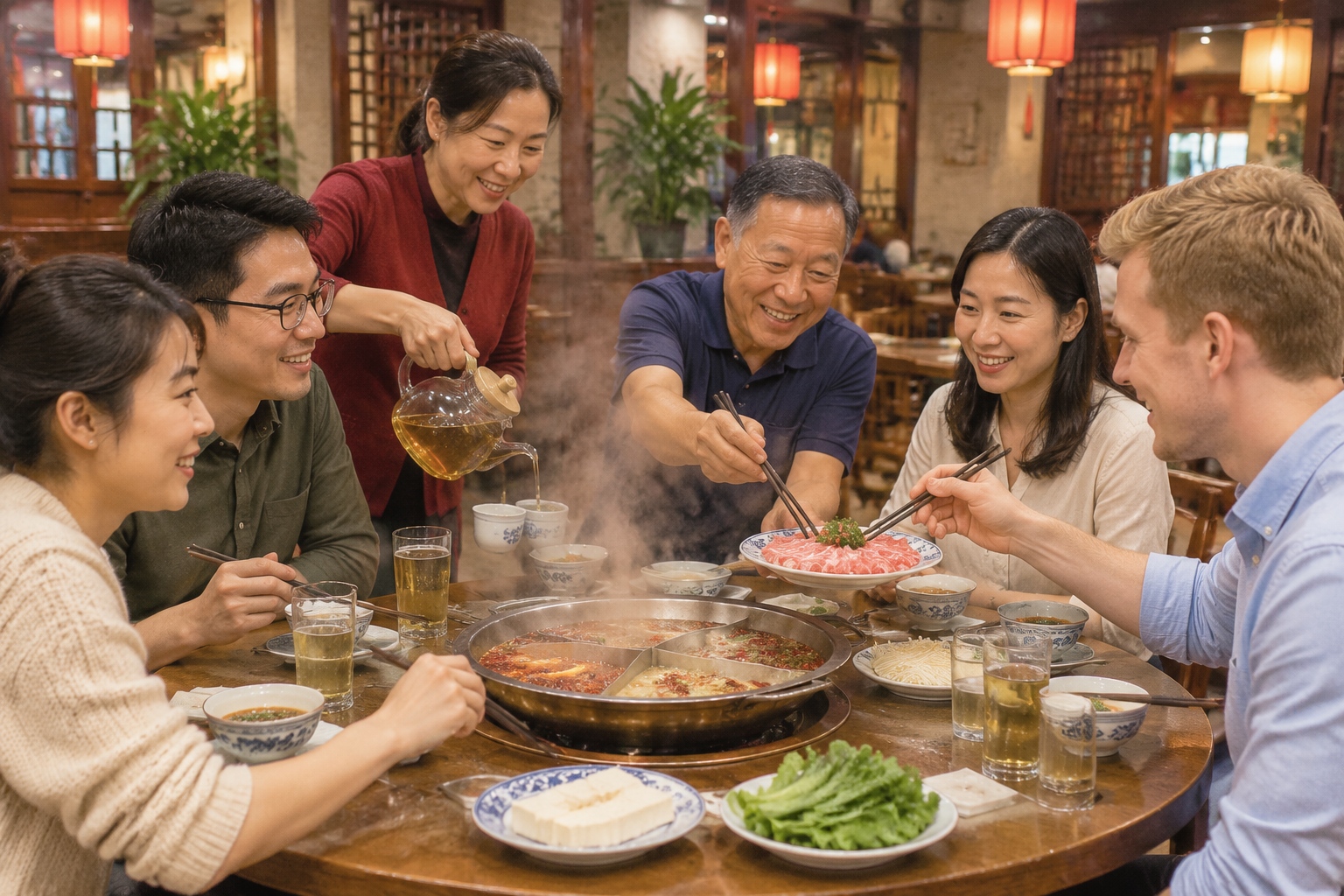
Last spring I sat at a round table in Chengdu, the kind of busy restaurant where the air smells of chili oil and the floor is slightly slick. There were seven of us. One was a Dutch visitor who had been in China for about three weeks. The rest were locals: a schoolteacher, a young couple who run a small design studio, an older uncle with a slow, dry sense of humor, and me.
The hotpot was still bubbling. Beer had been poured. Our visitor, wanting to be chatty, leaned forward and asked across the table: “So what do you all think about…” He didn’t finish.
It wasn’t that anyone interrupted. The table simply changed. The uncle smiled and started pushing mushrooms into other bowls. The schoolteacher asked if anyone needed more water. The topic slid off the tablecloth like a dropped chopstick, and nobody reached for it.
In Chengdu, a pause at dinner is rarely a wall. It’s more like someone gently closing one door and opening another. The rest of the evening was warm and loud; we talked about a new noodle place, a stolen bicycle, and a cousin’s wedding. By the end, our visitor had forgotten the awkward moment entirely — which, I suspect, is exactly how the others intended it.

This article is not a list of forbidden words. It’s an attempt to explain what I’ve seen: how Chinese people judge which topics can be raised and which ones are better left alone, and why reading the room matters more than memorizing rules. Visitors to China often ask me for topics to avoid. The honest answer is that it depends — on the table, the people, and how well you know them.
First dinners and close friends are two different countries
Dinner culture in a city like Chengdu is generous and noisy. You sit down, someone pours tea, and within ten minutes you know which person cooks best, who just changed jobs, and whose child is preparing for exams. The small talk has very few borders.
But familiarity and privacy matter. The same question that feels too personal at a first meeting can be entirely normal with people you’ve known for years.
Late-night barbecue with three close friends is a different kind of conversation. People may open up about politics, family conflict, money, or disappointment. The tone is loose. There’s no audience, no performance.
At a table of new acquaintances — especially if older colleagues or a boss are present — the conversation follows a different shape. People test the ground with humor, with stories, with a turn toward food or traffic. If you throw a heavy question into that room on day one, they may not be offended. They simply don’t know yet where to put you.
A friend who works in HR in Chengdu once explained her rule: “A first dinner is not for opinions. It’s for finding out who is funny and who remembers to fill the tea.” She was only half joking. At first meetings, conversation is often about building a mood, not exchanging verdicts.
Listen closely and you’ll hear how Chinese friends ask personal things in a spiral, not a straight line. They may start with something small — “Which district do you live in?” — and check the answer. If it’s short, they stop there. If it has a little color, they might ask the next question. This isn’t nosiness. It’s calibration.
Why politics and contested history are hard in a group
Many visitors imagine that certain topics are banned in China. Reality is quieter and more practical than that. The question is less about whether a topic is allowed and more about who is in the room, how well they know each other, and how easy it is to leave if the conversation goes wrong.
In a group, political and historical subjects create a particular friction because an answer can’t be a single line. People weigh who is listening. Colleagues? An elder? Someone they just met? They also weigh their own energy. Some conversations simply feel heavy, or like traps that will follow them out of the restaurant.
A middle-school teacher I know put it this way: “If I’m at a table with half strangers, I’d rather talk about food. Arguing about history makes me tired, and I still have to take a bus home with a colleague.” That sounds less like censorship and more like ordinary social management. She wasn’t afraid. She was managing the mood of a table.
Contested history also carries strong family stories, school stories, and internet arguments. People may not want to retell those stories over dinner precisely because they know where they can lead. A person can have strong views and still decide not to spend a meal defending them in front of a colleague.
The useful response for a visitor is not to assume a topic is forbidden, but to treat it as one that needs the right moment and the right people. With old friends who bring it up themselves, conversation can open and go deep. In a mixed group, it’s better to let a local set the pace. If they raise the subject, listen, ask honest questions, and don’t demand conclusions.
One more piece of context for non-Chinese readers: Chinese people are not a single opinion. Anyone who has spent an evening drinking with a noisy group of Chengdu twenty-somethings will have heard disagreements that are sharper than most visitors expect. But even people who disagree freely choose their audience. The subject isn’t always off the table. It’s simply one that asks for trust first.
When ordinary questions turn into a personal interrogation
This is where visitors step on land mines most often, and not only visitors. Small talk that seems open can slide into someone’s private life without anyone meaning harm.
Weight is a common example. It’s not unusual in China for a first comment about your body to come from someone you’ve just met — sometimes as a compliment (“You’ve lost weight!”), sometimes as gentle advice (“You’ve barely eaten lately?”). For a visitor who treats body size as personal, this can be startling. For someone who has been anxious about a medical result, it can sting.
Notice the difference in setting. A close friend in private might joke about weight. A relative at a family dinner might ask why you’ve gotten rounder, and be waved away as an occupational hazard of family life. But a colleague or a stranger on a first meeting is a different matter. The air goes stiff, and the people at the table can feel it.
Religion works in a similar way. China is home to many faiths and many degrees of observance. Someone may go to a temple on holidays, someone else is Christian, someone else is Muslim, and someone else mixes it all into family habit. In a mixed group, a question that begins as curiosity — “Do you believe in anything?” — can quickly turn into a probe: “What do your parents think? Why haven’t you tried it? What do you do on weekends?”
One-on-one, the same exchange can be a real conversation. People will tell you about a grandmother’s rituals, or how they came to a belief, or why they decided they don’t need one. The topic isn’t the problem. The number of listeners is.
Marriage follows the same pattern. Questions about marriage and children are ordinary small talk here, and often genuinely caring. But for someone who just divorced, or a couple that has chosen not to marry, or a person who wants children and can’t have them, the cheerful “So when is the wedding?” can land harder than the asker knows. The asker isn’t malicious. They’re following a script that usually works. But scripts don’t always land.
What makes the difference is not the question itself but whether the asker can stay calm when the answer is not a neat one. A person who asks “When are you having a second child?” and then hears “We’re not, actually” can let it rest there. That small pause is a gift. The follow-up is usually the problem.
Reading the small signals, and changing the subject
The people I’ve learned the most from are not those with the strongest opinions. They’re the ones who notice when the energy at a table drops by a degree.
There is a short list of signals I now watch for. Someone’s answers get short. Someone laughs and turns the subject to the restaurant’s soup. Someone starts pouring tea for others or pushing food onto plates. Someone answers a question with information about the weather or the metro instead of the question you asked. A shrug and a flat “Pretty good, I guess” that doesn’t invite a follow-up.
None of these is a refusal. They’re the way the table keeps moving.
The best move is not to announce “Let’s change the subject.” It’s to slide. Find something adjacent enough to feel natural, but safe enough to breathe in.
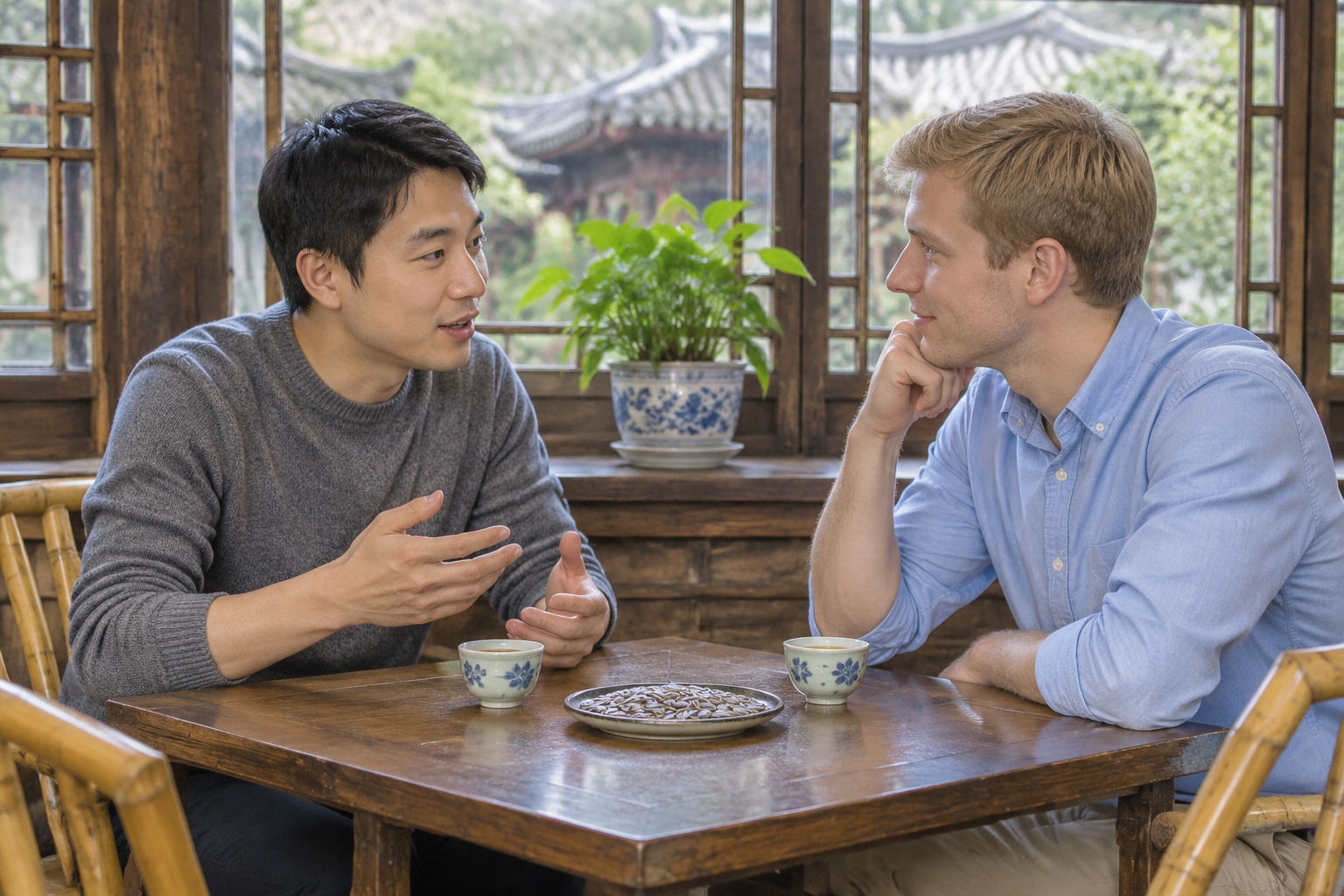
Three pivots I use again and again:
Food
“Have you been to this place before? What do you usually order?” This works almost every time in Chengdu. Everybody has a favorite noodle shop and an opinion about someone else’s. It turns the conversation toward memory and taste, and people relax into recommending something.
The commute
“How do you usually get to work? Subway or bike?” This is about ordinary daily life, not politics. And it tends to unlock complaints, which are a social glue. Traffic, a new bus line, the cost of parking — the table can run for ten minutes on this.
The weekend
“Where do you go on weekends that isn’t full of tourists?” This invites secrets and small hobbies. It changes your question from a probe into an invitation. People in Chengdu will argue about parks and teahouses for hours.
There is also a very local form of rescue: “吃饭就吃饭,别说不开心的事” — “We’re eating, let’s not talk about unhappy things.” It’s not a dodge; it’s a boundary around the meal. The longer, deeper conversation can happen later, in the kitchen, on a walk, one-on-one.
For a visitor, the simplest rule
After years of dinners, I don’t think about sensitive topics in China as a list of red lines. I think of them as a series of weather fronts. The same subject can be a sunny afternoon with the right person and a closed window at the wrong table.
For a visitor, the safest habit is to listen first and let a local set the pace. If someone brings up a heavy topic, ask an honest question and let them decide how far to go. And if someone shortens their answers or hands you the tea, treat it as a turn, not a rejection.

Our Dutch visitor did eventually get his conversation. On his last night in Chengdu, one of the local friends took him to a tiny barbecue place and they talked until one in the morning about work, family, and the strange business of living in a country that isn’t yours. He told me later that he learned more that night than in his first month of reading about China.
That’s the thing about conversation here. The table rarely ends where the topic lands. Usually someone asks if anyone wants a cold dessert, and the talk swings somewhere better. You don’t need to know the rules in advance. You need to notice the swing.
Start the discussion at forum.chinacomes.com