
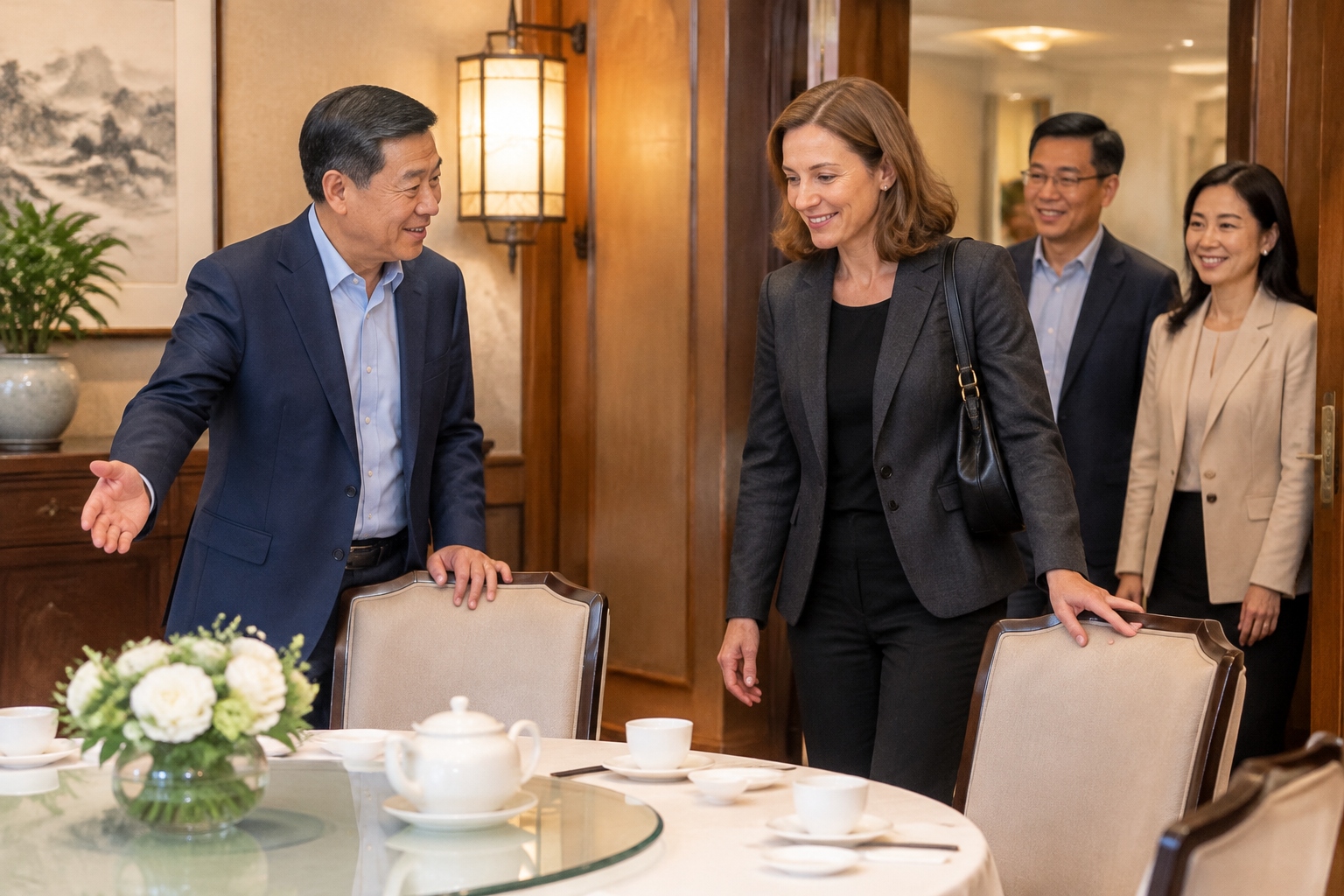

At 6:55 p.m. in a private dining room in Shanghai, the door is still open and the table is already set. A host in his late fifties stands near the entrance, one hand resting on the back of a chair. He is not looking at the menu. He is looking at the door. The first guest arrives, a foreign visitor in a charcoal blazer, and pauses. There are twelve chairs, a lazy Susan, and no name cards. The host smiles, lifts his palm, and says, “您坐这边。” She does not move immediately. Neither does anyone else. For a second, the room is a small stage of hesitation.
That pause is the subject of this guide. At a formal Chinese dinner, seating is not decoration. It is a practical language of respect, and you can learn to read it by watching the door, the host’s hand, and the order in which people sit.
The first two minutes: nobody sits at once
Watch a Chinese host greet guests and you will notice that the seating process has a rhythm. He may shake hands at the door, take coats, ask about traffic, and then guide people toward particular chairs. He rarely says, “Sit anywhere.” Even when he does, he is still watching where people go.
Guests, meanwhile, do not rush. They stand behind chairs, chat, and wait for the host or an older guest to move first. If you arrive early, it is fine to stand near the side of the table rather than in the middle of the room. If a staff member offers tea, take it and say thank you, but do not treat the tea as a signal to start the meal. The room is still arranging itself.
Reading the round table: door, host, and guest of honor
A formal Chinese dinner usually happens at a round table, often with a lazy Susan in the center. The round shape makes the hierarchy less obvious than a long Western table, but the room still gives you an orientation point: the door.
In many business banquets, the seat directly facing the door is the main position. The host sits there, because he can see who enters and because the position signals that he is responsible for the room. The guest of honor sits to the host’s own right. The second guest may sit to the host’s left. The seat directly opposite the host, with its back to the door, is often the deputy host or the person helping with toasts and logistics.
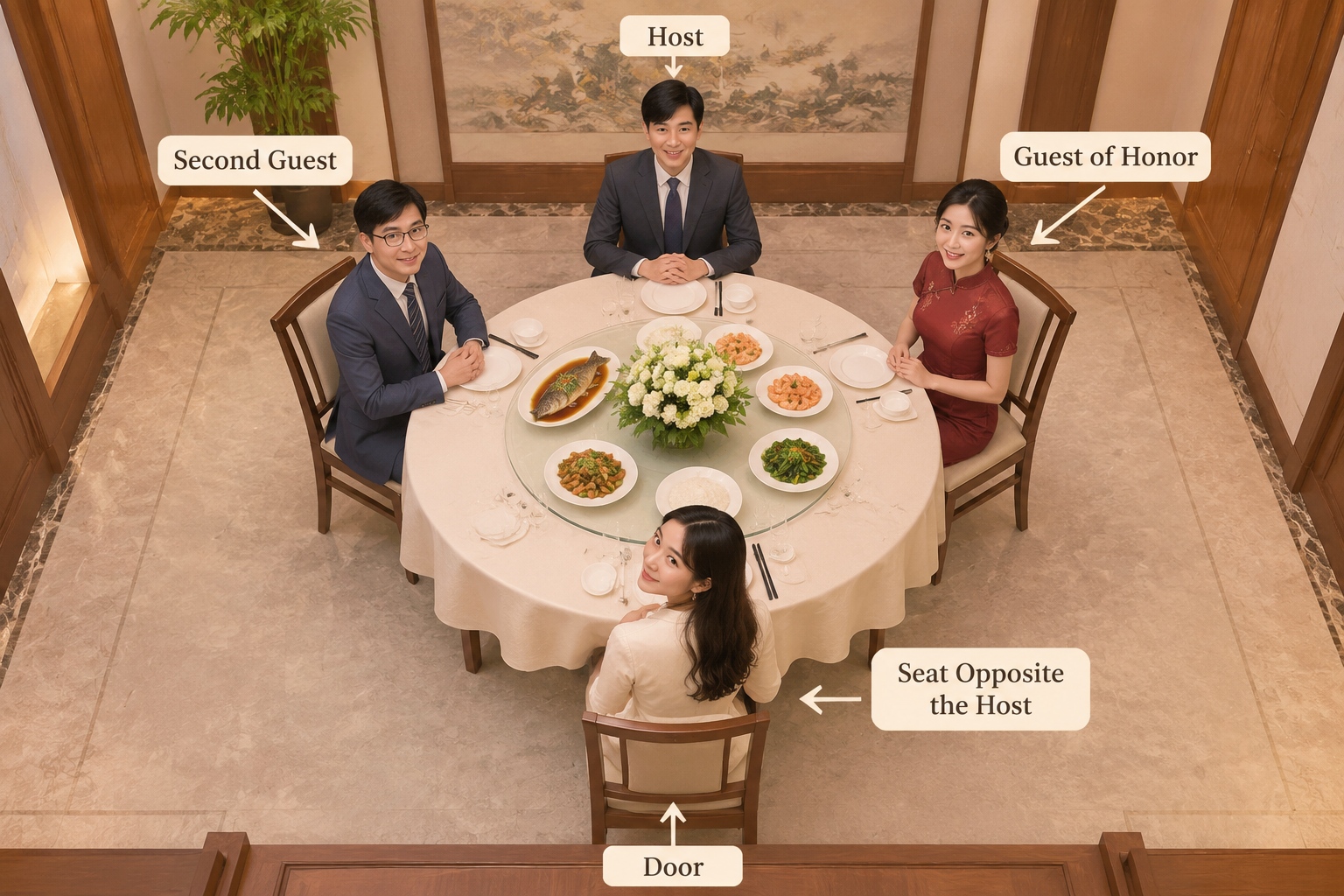
This is a common arrangement, not a national law. In some family dinners and regional banquets, the guest of honor takes the door-facing seat, while the host sits to their right or opposite. In rooms with a corner door, a screen, or a service entrance, the “facing the door” seat may be shifted. A large round table may also have a second important position near the host. Do not march toward the most impressive chair. Read the host’s hand.
If you are offered the main seat
The host may guide you toward a chair near the door-facing position. That can happen if you are the senior guest, the client, the guest of honor, or simply the visitor the host wants to welcome. Your first response should be warm, brief, and not a wrestling match.
If the host says, “您坐这里,” you can answer, “您太客气了,我坐这边就好.” It means: You are too kind; I am fine here. If he insists, do not refuse a third time. Say, “好,那我听您的,谢谢,” and sit where he indicates. Excessive refusal can slow the room and make the host feel that his arrangement has failed.
If you are not the guest of honor, do not accept a seat that clearly belongs to someone more senior. A simple “我坐这边更合适” is enough. Then wait for the host to finish placing people. The goal is not to win the best seat. The goal is to let the host do the work of hosting.
How to sit down politely
When the host says “请坐” or “大家坐吧,” that is the cue. It is not the moment you entered. Wait until the host or the principal guest begins to sit. If the host remains standing, stay standing. If he sits, sit.
Move your chair quietly rather than dragging it. Keep your bag off the table, put your phone on silent, and place your napkin on your lap. If there are name cards, do not move them. If there are no cards, do not swap places with anyone.
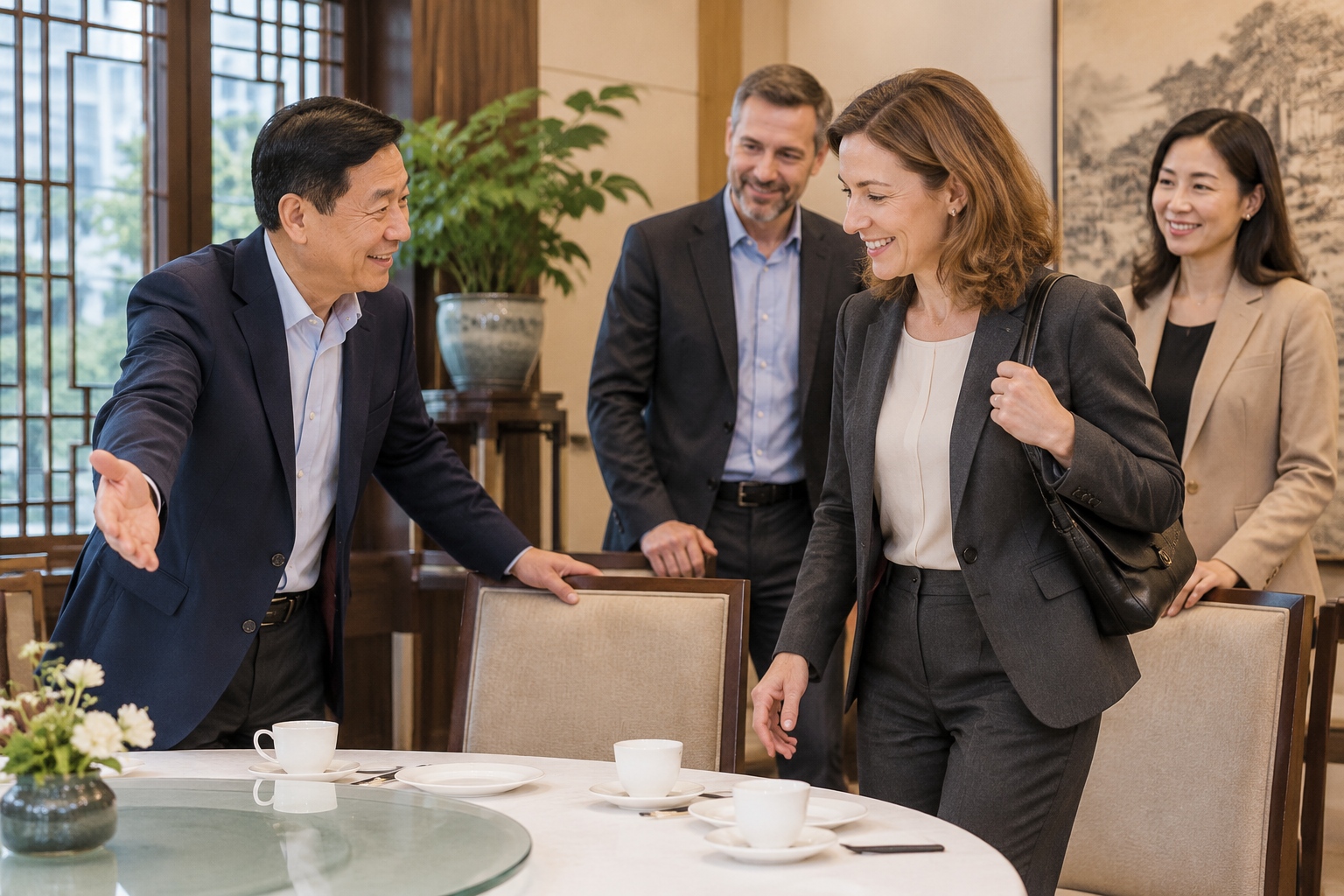
Once seated, you do not need to fill every silence. Let the host introduce the table if he wants to. If staff pours tea, a nod or “谢谢” is enough. Do not start eating the cold dishes before the host has welcomed the table. In a formal room, the small pause before the first bite is part of the meal.
When the meal actually begins
The meal begins with a cue, not with the arrival of food. The host may lift his glass for an opening toast. He may say “大家动筷子” or simply “请.” He may turn the lazy Susan toward the guest of honor and serve the first portion. Wait until the host or the most senior guest lifts chopsticks. If the host says “别客气,吃,” still wait one beat.
At banquets with an opening toast, do not eat before the toast. If there is no toast, the host’s chopsticks are the signal. Use serving chopsticks when they are provided. When you rotate the lazy Susan, check that no one is serving, turn it gently, and do not spin it. If you do not drink alcohol, you can keep your glass and say “我以茶代酒,” meaning you will toast with tea.
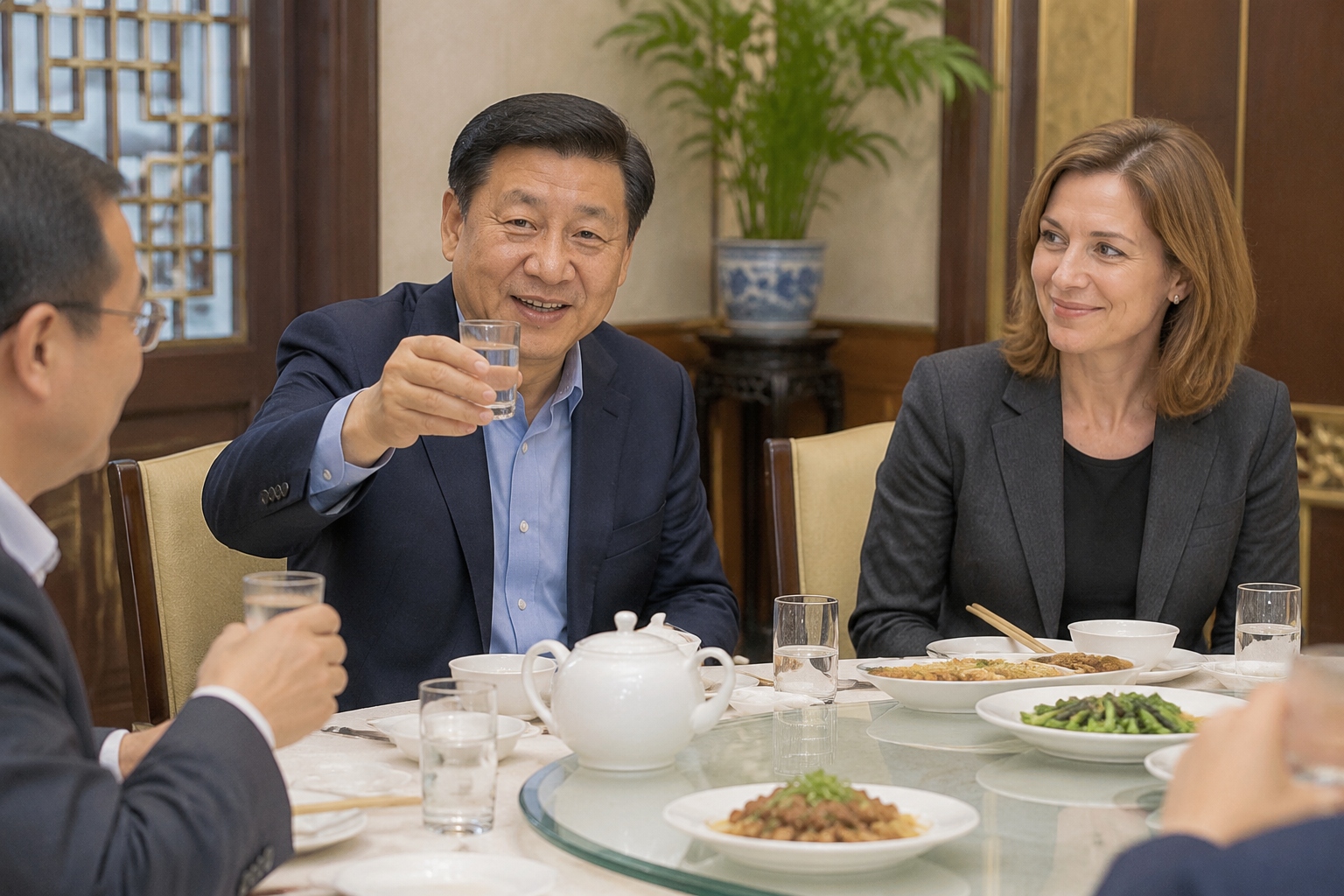
Much of this is not about rigid rules. It is about letting the host be the host. He decides when the table starts, who is served first, and when the first toast is made. Your job is to follow the rhythm without making a performance of it.
Regional variations worth knowing
China is large, and banquet seating changes with region, generation, and setting. In Shandong and parts of northern China, formal banquet seating can be especially detailed, with clear main-host and deputy-host positions. In Guangdong and many Hong Kong-style banquets, round-table seating still matters, but service and toasting may feel more relaxed. At a family dinner, age and generation may matter more than business rank. At a company dinner, the seating may follow the organization chart.
The room matters too. A door on the corner, a screen, a view, or a service entrance can change which seat feels like the main one. A seat with its back to the door is often considered less honored because the person cannot see who enters and may be exposed to service traffic. But if the table is oval or the door is off to one side, the “main” seat may not directly face it. Ask yourself who the host is orienting the table around, rather than which chair looks best.
A simple rule for foreign guests
If you remember one thing, remember this: at a formal Chinese dinner, do not choose your own seat. Enter, greet the host, and stand near a chair if staff shows you one. Wait for the host’s gesture. If you are offered a seat, accept with thanks after one modest line. Sit when the host or the principal guest sits. Start eating when the host invites the table to start.
The seat is not a test you can fail by not knowing every regional rule. It is a courtesy. The host is not trying to trick you. He is trying to place you well. Follow his hand, and you will be fine. At 7:05, the host finally sits. Tea is poured. He lifts his glass. Only then do the chopsticks move.
Start the discussion at forum.chinacomes.com