

Four questions before the fish goes cold
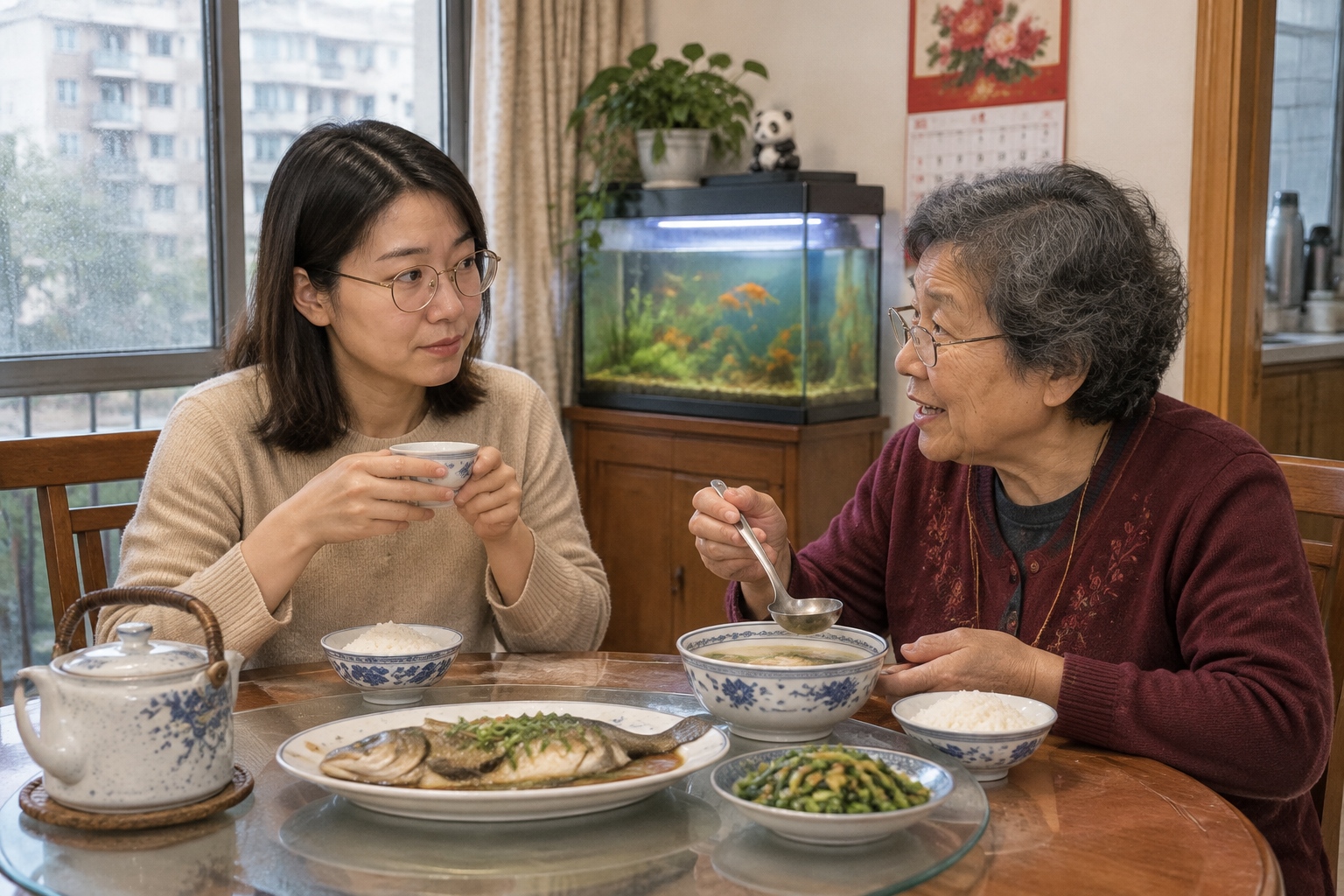
Lin Wei is 29 and works in logistics in Chengdu. On a Saturday in March she took the metro across town to her aunt’s flat for dinner: fourth floor, no lift, a fish tank bubbling in the corner, a rice cooker that plays a tune when it finishes, and a round table with a lazy Susan that seats eight even though nobody has ever needed it to.
She had been sitting down for about four minutes when the questions started.
“You’re twenty-nine this year, right?” Her aunt Mei, sixty-three and a retired middle-school teacher, was ladling soup. “Twenty-nine. So — is there anyone?”
Then, in roughly this order: how much does that job of yours pay now? Are you still renting? When are you planning to settle down? Do you two want children, or is it true what they say about your generation?
None of it was said sharply. The soup kept coming. That is the detail worth holding on to: the questions arrived inside the hospitality, not against it.

The asker: “If I don’t ask, it means I don’t care”
Aunt Mei does not experience this as interrogation. Ask her to describe the same dinner and she tells a different story, one about a girl who works too late, rents a flat nobody in the family has ever seen, and posts photos of meals rather than of people.
“How am I supposed to know if she’s all right?” she said later, drying bowls. “If I don’t ask, it means I don’t care. And then when something happens, everyone says, why didn’t anyone notice?”
Her frame of reference is not nosiness but logistics. She spent her thirties in a state-owned factory where housing was allocated, a wedding was partly a workplace event, and a colleague who knew your situation could put in a word for a nursery slot or a transfer. Family worked the same way, only more so. Information moved through relatives because relatives were the ones who could act on it — lend money, find a match, watch a child, show up at the hospital.
Seen from inside that system, a question is not a data grab. It is a hand extended. And an unanswered question is a hand left hanging.
There is also something simpler going on: she was asked the same things at twenty-nine, by aunts who were asked the same things at twenty-nine. The script is old, and most people who deliver it have never had a reason to examine it.
The asked: the question is small, the broadcast isn’t
Lin’s account of the same forty minutes is not about the questions themselves.
“I don’t actually mind being asked,” she said. “My mother can ask me anything. I mind what happens after.”
What happens after, in her experience, is that by Sunday night four relatives know what she earns, one cousin has a comparison to make at a wedding, and her mother has received a phone call that begins with “your daughter still hasn’t…”
She describes it as a credit system. A question draws on the relationship. From her mother, who has thirty years of deposits, almost anything clears. From an aunt she sees twice a year, the balance is thin, and the questions feel like a withdrawal on an account she never opened.

Same sentence, different weight
Chinese has a word for privacy — yinsi — and plenty of people invoke it. But in everyday life, the line is drawn around relationship far more than around topic. Which means identical words can carry completely different weight depending on who says them.
Take the most ordinary sentence in the language: ni qu na’er? — “where are you going?”
In the courtyard of Lin’s building, a neighbour of seventy steering a small pull-cart toward the gate will ask it and mean roughly what an English speaker means by “morning”. Any answer works, including “nowhere.” Nobody is keeping a log.
From a manager in an office corridor, the same five words can feel like a check on your calendar, because now the relationship includes a hierarchy.
From a friend at 11 p.m., they can feel like concern, because the relationship includes a history of you not sleeping.
Many readers in the US or Northern Europe operate with topic-based boundaries: salary, religion and health are fenced off by default, and closeness has to earn access to them. Chinese social life tends to fence by person instead: certain people may ask almost anything, and certain people may ask almost nothing, and the same question is normal from one and rude from the other. Neither system is more “private”. They place the lock on different doors.
Why these questions survive Chinese family life
There is a practical reason the questions cluster around marriage, housing and children: in China those three are financially tangled in a way foreigners often underestimate. A first flat in a big city is routinely bought with two sets of parents contributing, which makes a child’s marriage a household financial project. Grandparents provide a large share of weekday childcare, which makes a child’s fertility a scheduling question for the whole family.
Add density and contact. Most urban Chinese live in apartment compounds of a thousand units or more, with shared lifts, shared courtyards and shared stairwells, and elderly residents who spend hours a day in public space. Compare that with a fenced suburban house where a neighbour may not know your name, and the volume of casual inquiry makes more sense.
Add speed. About 370 million people live somewhere other than the town or city on their household registration, according to the 2020 census, and roughly one household in four is now a single person. People who moved for work left behind the relatives who used to know everything by proximity — and those relatives now check in by phone, with the same questions compressed into ten minutes.
You will find percentages online claiming how many Chinese people dislike these questions. Treat them carefully: figures in the 37% or 23% range that circulate in English-language commentary usually cannot be traced to a survey with a stated sample and a stated question, and “I’d rather a relative didn’t ask about my salary” and “I find relatives intrusive” are not the same measurement. Wording moves these numbers by tens of points. The qualitative picture — that younger urban adults increasingly want the option to decline — is well supported. The precise decimals are not.
The exit line, and what happens after it
Back at the table, Lin tried something she has been practising for about a year.
“姑妈,这个我还没定,定了第一个告诉你。” — Auntie, I haven’t decided yet. When I decide, you’ll be the first to know.
There was a pause of maybe three seconds. Then: “行,不问了。吃鱼。” — Fine. I won’t ask. Eat the fish.
That was it. No offence taken, no lecture. What surprised Lin the first few times she tried it was how often the boundary was simply accepted — and how much of her earlier dread had been about a reaction that never came.
Two hours later, at the door, her aunt handed her a bag of oranges and said one more thing: “你妈最近睡不好,你有空打个电话。” — Your mum hasn’t been sleeping well. Call her when you have a minute.
Which reframes the whole evening. Some of those questions were not Aunt Mei’s questions at all. She was doing intake for a worried mother who did not want to nag directly.

If you’re the one being asked
Visitors to China, and Chinese twenty- and thirty-somethings who have simply run out of patience, tend to make the same mistake: they treat a boundary refusal as a confrontation. It usually isn’t. What reads as rude is not the refusal. It is the coldness of it.
A few moves that work in practice:
Answer the feeling, not the number
“还行,够花” — it’s fine, enough to get by — closes the salary question more gracefully than a flat refusal, and almost nobody pushes past it.
Defer instead of denying
“还没定,定了告诉你” buys months and, more importantly, signals that you are not shutting the person out, only the topic.
Ask back
Chinese family conversation is expected to be reciprocal. Turning the question around — “and how’s your knee?” — is read as engagement, not defection.
Say what you will answer
“工作的事随便问,工资我就不说了” — ask me anything about work, I’ll skip the salary — works better than silence, because it keeps the relationship open while marking the door.
Two people, two reasonable readings
The dinner table in Chengdu holds both readings at once. For Aunt Mei, a question is a hand on the shoulder: I am still counting you as mine. For Lin, the same question is a door opening onto a room she did not invite anyone into — and the discomfort is less about the question than about who is standing outside the door.
Neither of them is confused about privacy. They disagree about where the lock belongs: on a list of topics, or on a list of people. Countries that settled this question differently — the US, Germany, Japan — are not more advanced, only differently arranged. China’s arrangement is under renegotiation right now, one dinner at a time, usually in the form of a sentence that begins with “auntie, this one I’d rather not say.”
Most of the time, the aunt says fine, and pushes the fish across the table.