
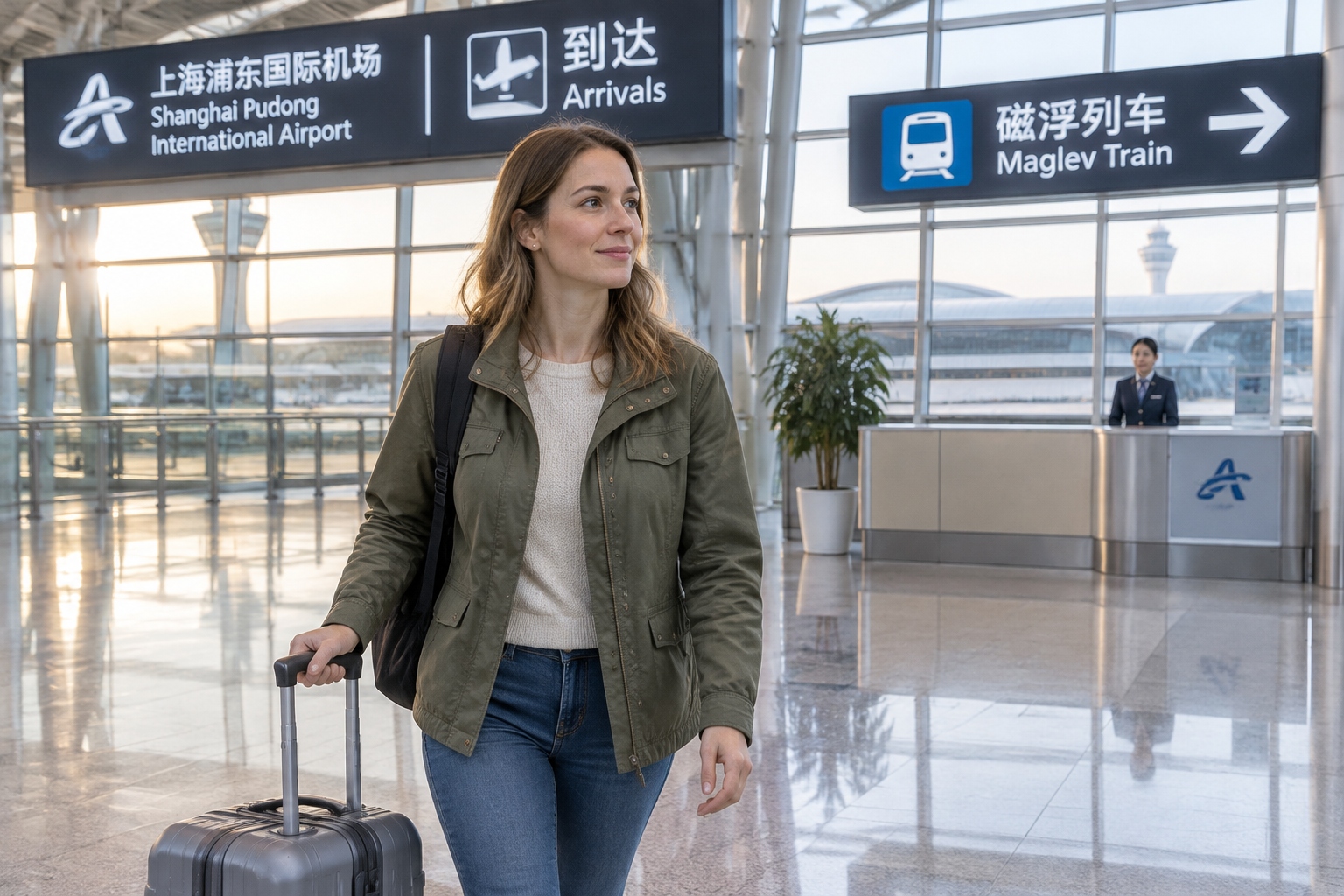

06:00 | Arrival
At 5:47 a.m., the arrivals hall at Pudong Airport was bright but thin on people. The stamp on her passport sounded quieter than she expected. Amelia Hartley, a 34-year-old market researcher from Manchester, was rolling a grey suitcase toward the maglev station.
She had come to Shanghai for a two-day conference. The first day was hers.
In the UK, much of what she had read about China came wrapped in warnings. She had texted a friend that she expected to feel disoriented, maybe a little uneasy.
What happened next was less of a shock than a sequence of small, ordinary surprises.
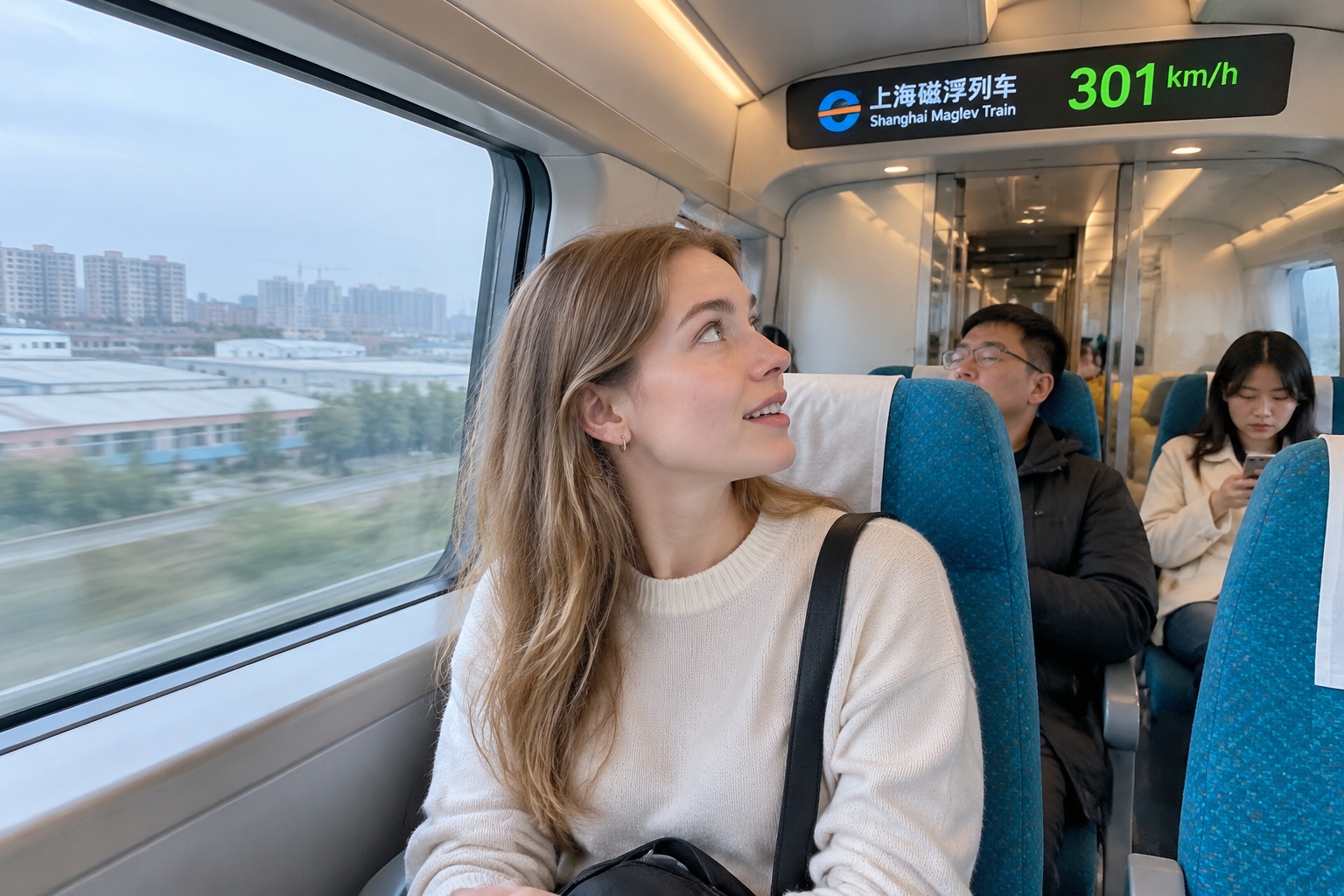
06:18 | The maglev: a morning that begins at 431 km/h
The carriage was nearly empty. She sat down and stared at the speed display above the doors. When the train hit its high-speed run — the maglev tops out at 431 km/h during certain periods — she leaned her forehead against the glass. Shanghai’s outskirts slid past: warehouses, new residential blocks, a floodlit football pitch.
Seven minutes and twenty seconds later, she was at Longyang Road. She switched to Metro Line 2.
The most British part, she later said, was that nobody checked her ticket. Nobody looked at her. Commuters looked at their phones, or dozed standing up. It took her a moment to realise she was indistinguishable from the morning crowd.
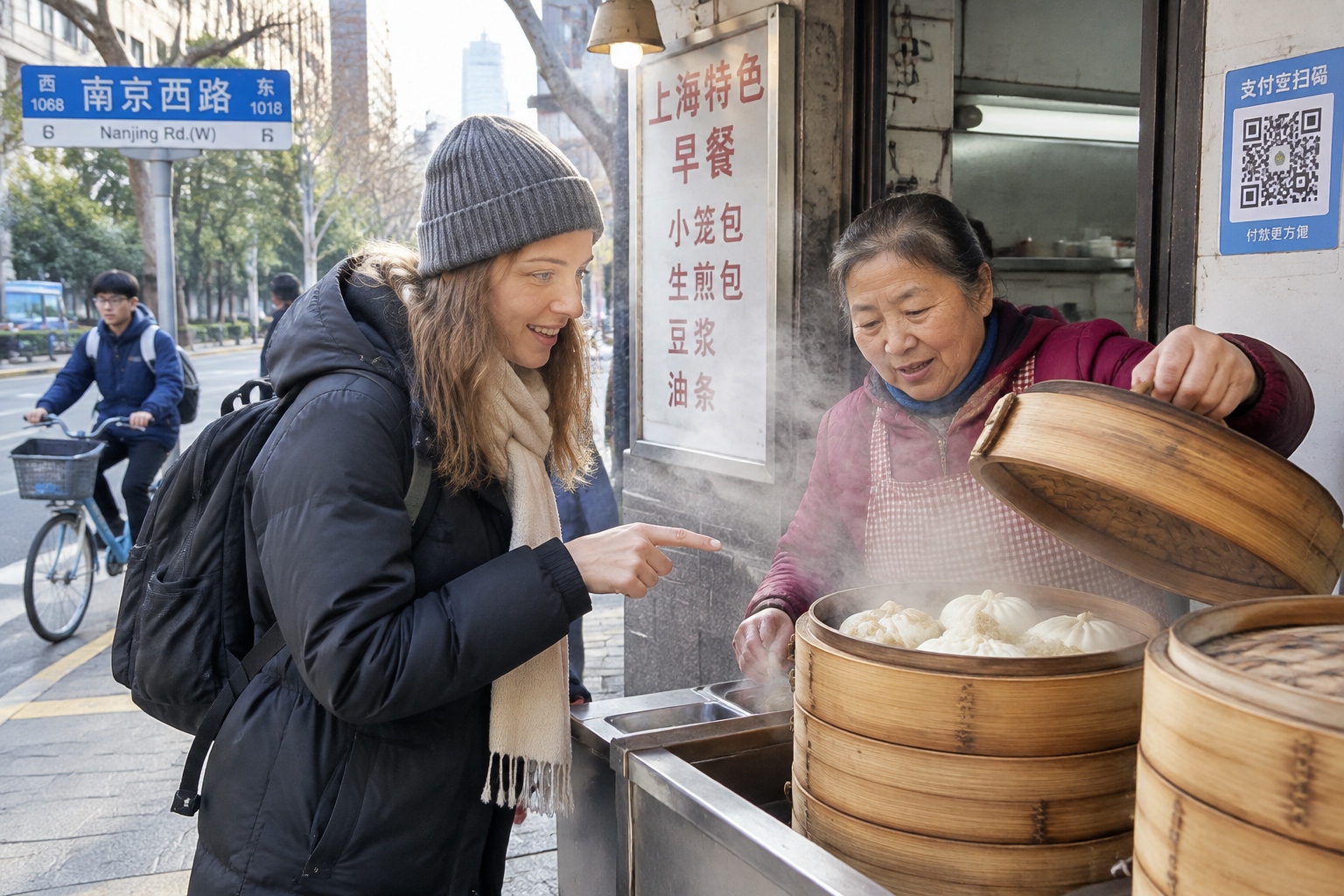
07:40 | Breakfast: a six-yuan encounter
She dropped her bag at a small hotel in Jing’an District, then walked two blocks. A corner stall had set up its steamers, and the vapour was visible in the cold morning air. The sign was red with yellow characters she couldn’t read.
She photographed it and ran the image through her phone’s translation app. Shengjian — pan-fried pork buns. She pointed.
The woman behind the counter, brisk and in her sixties, held up one finger — “one?” — and lifted the lid. The bottoms of the buns hissed in the iron pan. She handed over a paper tray with four buns.
Amelia tried to pay with Alipay, which she had downloaded before her trip, but the payment didn’t go through on the first attempt. The woman waited, patient, then pointed to a QR code taped to the wall. Amelia scanned it, typed in the amount. A chime. The transaction cleared. Six yuan — roughly 80 cents.
She ate the buns on the kerb. The hot soup burned her lip. A school bell rang nearby. A teenager in a uniform pulled up on a bicycle, said “morning” in English, and pedalled off.
She had prepared for a country that would be hard to parse. What she got was a breakfast that was too hot to eat quickly.
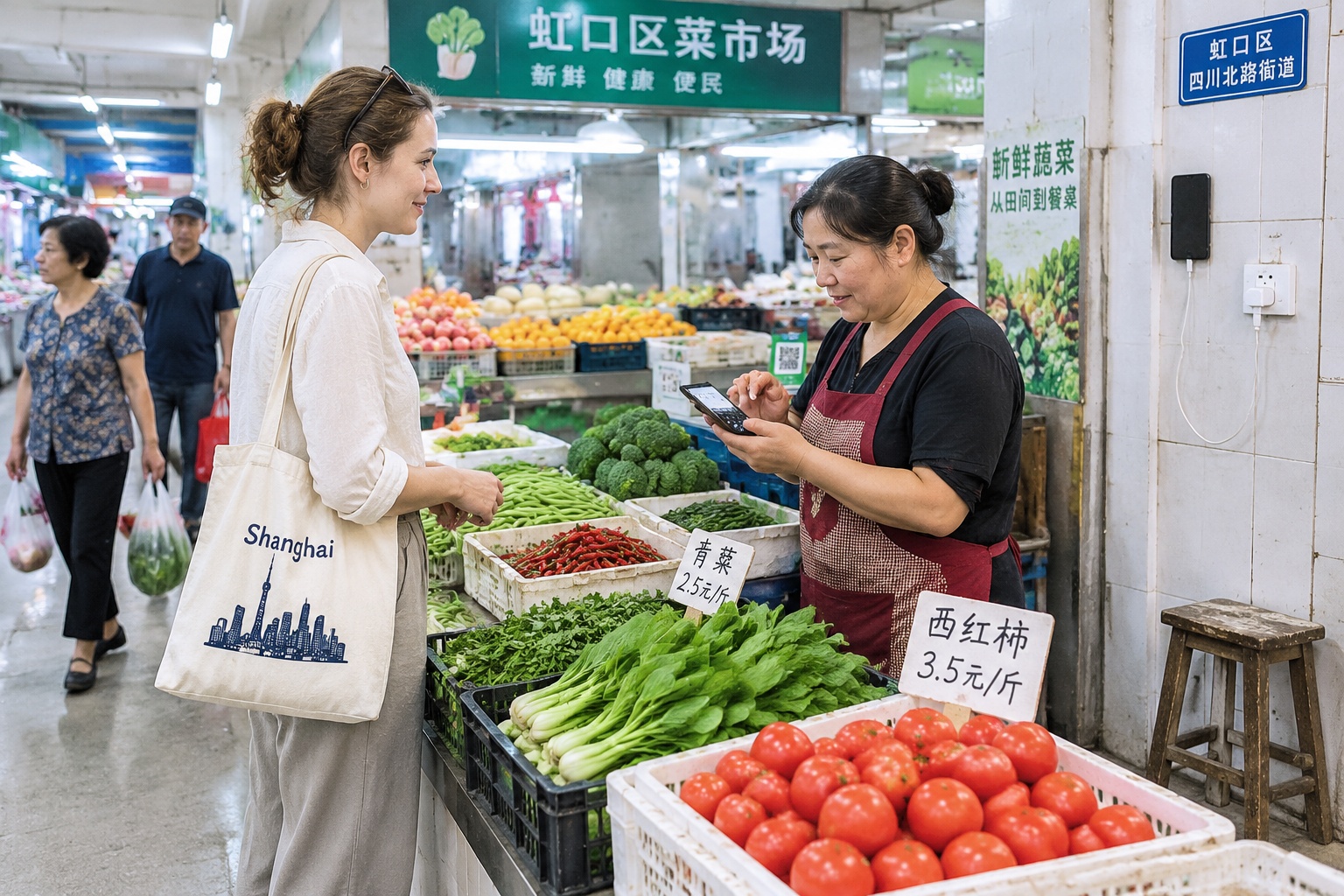
10:15 | The wet market and the limits of language
She had planned to go to Yu Garden. It was the only landmark saved on her phone. But a public toilet near the metro exit sent her in the wrong direction, and she ended up instead at a neighbourhood wet market in Hongkou District.
This was the part she would describe later.
Green vegetables were stacked in plastic crates. A fish seller wiped his knife on his sleeve. A tofu vendor was mid-conversation with a regular customer. Nobody paid her any attention.
She spent about twenty minutes choosing fruit. She paid with Alipay, which worked smoothly this time. The apple seller tapped the price into his phone calculator and held it up.
That’s when she noticed the charging spot. In her hometown, she wouldn’t expect to see a phone plugged into a wall socket at a market stall. Here, a phone sat charging directly from the wall, next to a folded stool and a pair of slippers.
It made China feel, she said, less “futuristic” than “practical” — small systems that keep daily life running.
13:30 | Suzhou Creek: an afternoon without a landmark
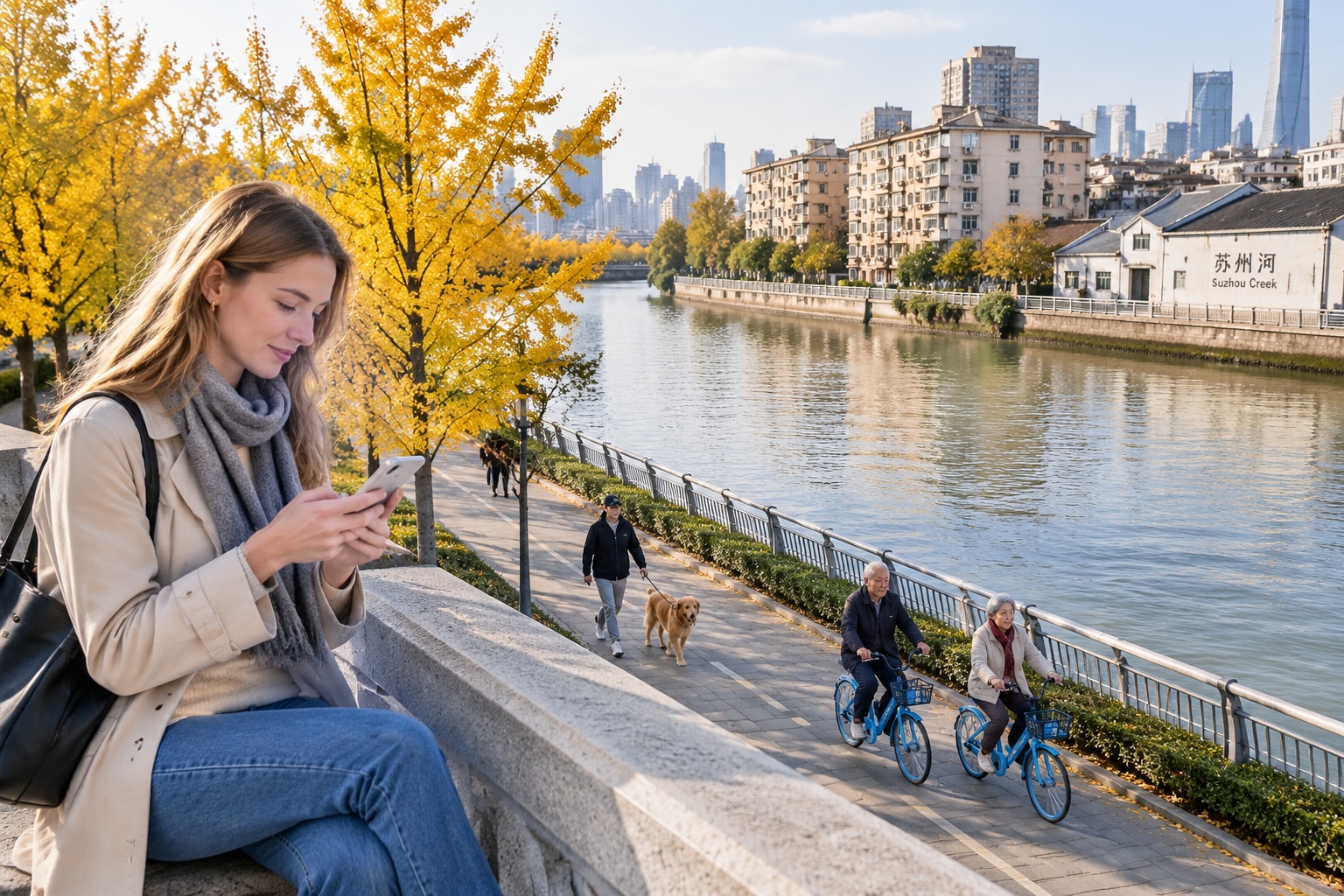
She skipped Yu Garden. A colleague had recommended the Suzhou Creek walkway — a path along the old industrial waterway, past residential blocks, small creative studios and a pocket park.
The ginkgo trees were turning yellow. Someone was walking a dog. An elderly couple cycled slowly on shared bikes.
She sat down on a bridge and took out her phone. She scrolled through the photos from the morning and realised none of them matched a travel guide. No skyline, no light show. Just steamers, QR codes, market stalls.
She wrote that she was starting to realise the impression of China came less from the grand things than the ordinary ones.
16:00 | A short high-speed lesson
She hadn’t planned to visit another city. But Suzhou is about 30 minutes from Shanghai by high-speed train. She bought a ticket, inserted her passport into the automatic gate, and the machine printed her seat information.
It was the opposite of what she had expected, she later said. She had assumed security would be cumbersome. Instead, the process of swiping a passport and boarding a train was smoother than Heathrow.
She arrived in Suzhou mid-afternoon. She walked a street with small bridges, ate a bowl of noodles, and was back in Shanghai an hour later.
But sitting in the carriage, she kept thinking: working between two cities, having lunch, coming home — it had become an ordinary thing.
21:40 | Late night, convenience store
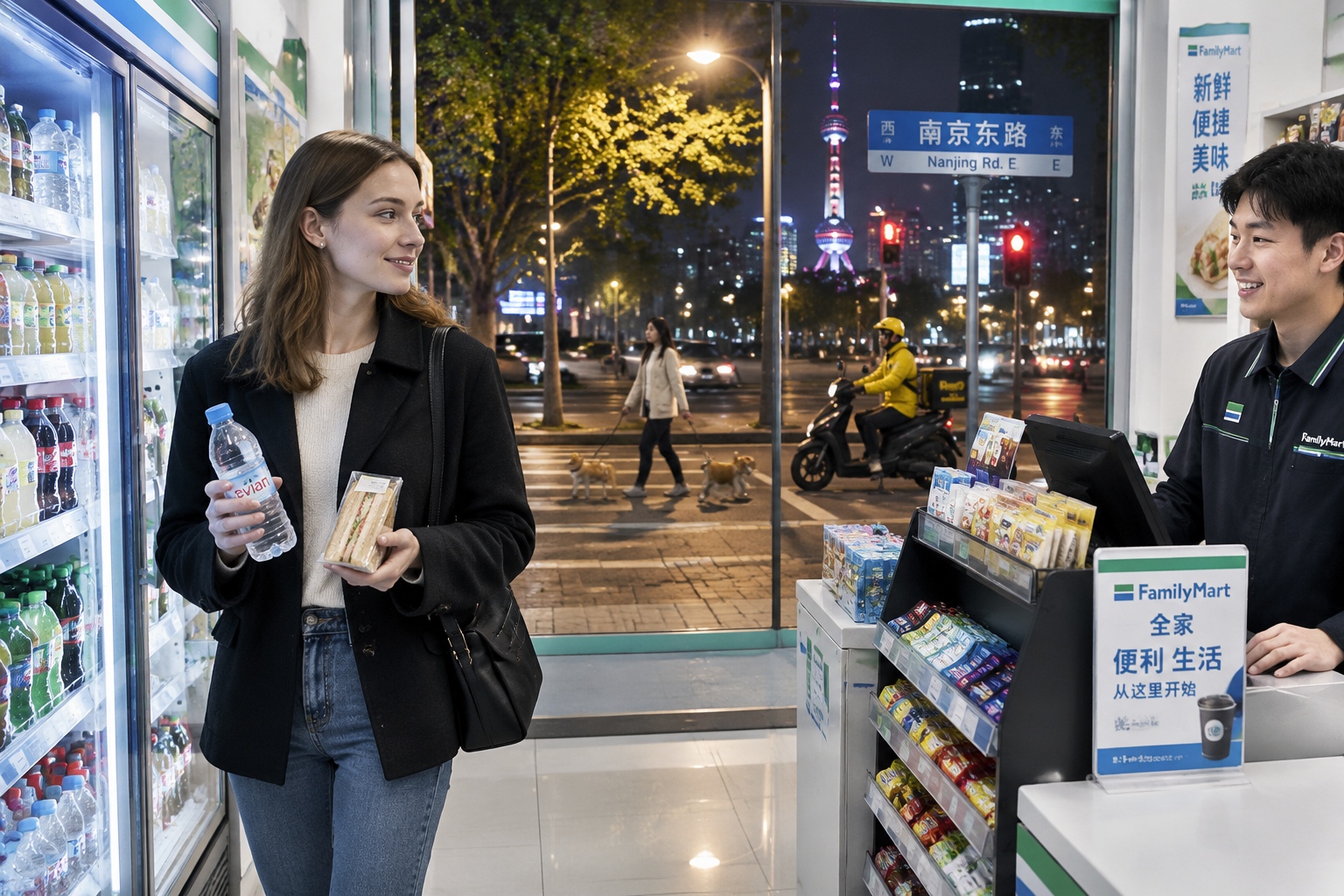
She got back to her hotel in the evening, dropped her things, and went out again. Half past nine at night. A convenience store on Wuding Road was lit up.
She bought a bottle of water and picked a sandwich for dinner. She paid with the same QR code she was beginning to know. The cashier yawned and smiled.
She walked back to the hotel. The street was quiet but not empty. A fruit stall was still open. A delivery rider waited at a red light. A girl walked her dog under a street lamp.
“I did feel safe walking around at night,” she said later, on a video call. “But it wasn’t something I was thinking about. I didn’t have to think about safety.”
06:20 the next morning | Before leaving
At six the next morning, she walked to a small park near the hotel. A group was doing tai chi. Someone was taking photos. An elderly man asked her to take a picture of him and his wife.
She reached the airport with no time to browse duty-free. At passport control, she scrolled through her phone and found the receipt for the six-yuan buns.
She told me — in a message later — that the part she remembered most from that day wasn’t the speed, or the scale she had read about. It was the small, quiet detail of a phone charging at a market stall in a neighbourhood she had never planned to visit.
What the 24 hours actually showed
China is often discussed through large numbers — high-speed rail mileage, mobile payment users, city populations. But 24 hours on the ground tends to register through smaller things: who stops, what’s visible, what’s already normalised.
A first-time visitor can still be surprised by a lot. She didn’t leave with a thesis. She left with 24 hours of specifics.