

Six Characters and a Two-Second Silence
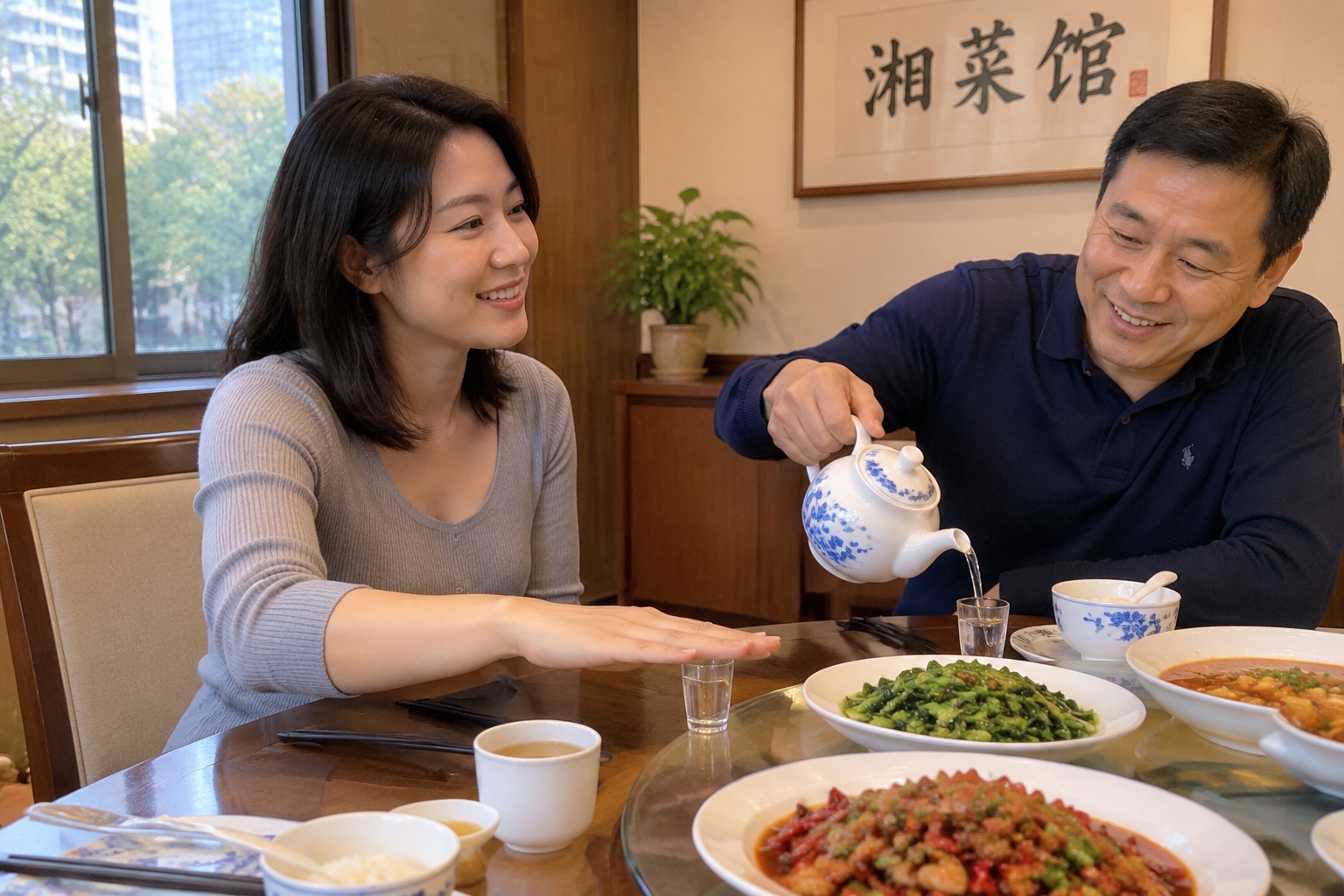
It was the third floor of a Hunan restaurant in Changsha, a Tuesday in November, and someone had just twisted the cap off a bottle of baijiu. A woman in her early thirties — a friend of a friend, someone I’d met twenty minutes earlier — put her palm flat over her glass and said: “谢谢,我今晚不喝酒。” Xièxie, wǒ jīnwǎn bù hē jiǔ. Thank you, I’m not drinking tonight.
Six characters and a thank-you. Then the room went quiet for about two seconds — roughly the time a table of ten needs to decide what kind of evening this is going to be.
What happened next is the part worth paying attention to. An uncle across from her said, “就一杯,意思一下” — just one glass, for the gesture. She smiled and shook her head. He poured her tea instead. Someone else pushed the plate of steamed fish toward her. Fifteen minutes later the table was arguing about property prices and nobody remembered the baijiu.
I’ve also seen the other version. Same sentence, same smile, and a man at the head of the table hears it as a verdict on himself, spends ten minutes circling back to it, and the evening ends with everyone slightly tired.
The Mandarin is not the hard part. I’ve met exchange students who could produce that sentence by their third month. What’s hard is that in a Chinese dining room, a no to the glass can arrive at the host’s ear as a no to the host — and that is what actually needs translating.
Why a Refusal Lands Differently Here
Some background, if you haven’t sat at one of these tables. Baijiu, the grain spirit that anchors most formal Chinese dinners, runs between roughly 38 and 53 percent alcohol. It’s poured into small glasses — around 15 millilitres, two sips — and the expectation is usually that you empty it. The host’s job is to keep glasses full; a table where glasses sit untouched reads to him as a table he failed to take care of.
Toasting, 敬酒, isn’t really about alcohol. It’s a small ceremony of rank, gratitude and belonging: you toast the person senior to you, your glass slightly lower than theirs, and you say something short. Refusing a toast therefore isn’t heard as a preference. It’s heard as information about the relationship.
The good news is that this has loosened considerably. China criminalised drunk driving in 2011, which gave everyone a bulletproof exit — “我开车来的,” I drove here, and the conversation ends. Younger Chinese drink less than their parents’ generation, and low- and no-alcohol options are now normal on a menu: non-alcoholic beer, sour plum juice, herbal tea. At plenty of company dinners now, the under-thirty employees order milk tea and nobody blinks. More women in the room has also changed things; a reason like pregnancy or medication is now accepted, often without a single follow-up question.
But I’d be lying if I said the pressure is gone. In older business circles — state-owned enterprises, some sales industries, some northern cities — a table can still push, and pushing can still be the point. So it helps to walk in with a script.
Three Lines You Can Use Tonight
1. The warm, direct no
“谢谢,我今晚不喝酒。” — Xièxie, wǒ jīnwǎn bù hē jiǔ. — “Thank you, I’m not drinking tonight.”
Say it at the first pour, before the glass is full, looking at the person doing the pouring. Smile once. Don’t apologise twice; over-apologising is what makes a table think there’s something to negotiate.
You do not owe anyone a reason. If you’d like to offer one, two phrases work without inviting further questions: “我开车来的” (I drove here) and “我最近在吃药” (I’m on medication lately). The second one is also a polite way of saying the reason is private. A vaguer “身体原因” — health reasons — is usually enough.
2. The tea toast
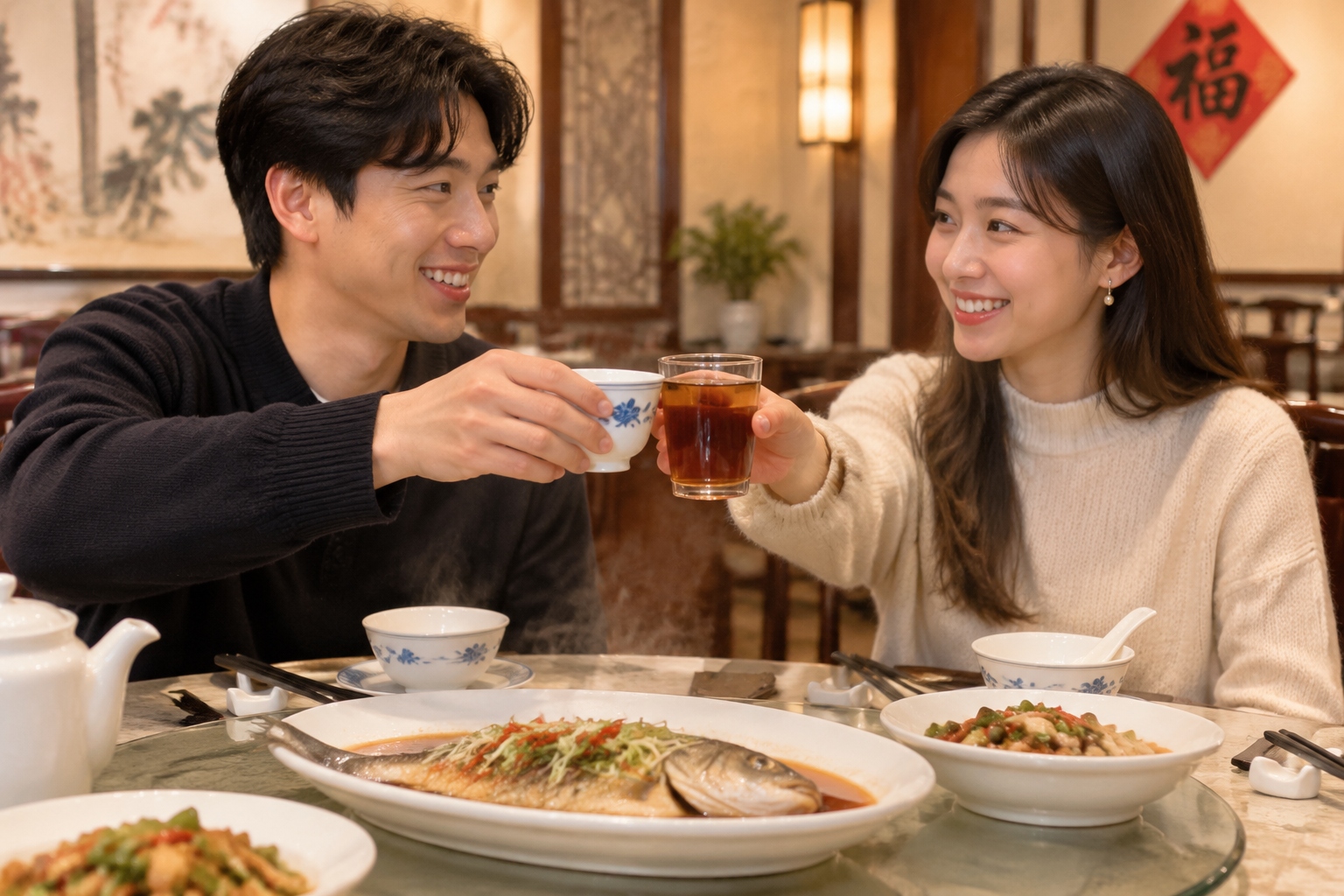
“我以茶代酒,敬您一杯。” — Wǒ yǐ chá dài jiǔ, jìng nín yī bēi. — “I’ll toast you with tea in place of wine.”
This is the sentence that saves dinners. 以茶代酒, “use tea in place of wine,” is a fixed expression that has been in Chinese for centuries. It says: the ritual stays, only the liquid changes. Hold your cup a little lower than theirs — the standard gesture of respect — then drink. You’ve participated fully. You just didn’t drink baijiu.
3. The repeat
“真的谢谢您,但我今晚确实不喝。我再敬您一杯茶。” — Zhēnde xièxie nín, dàn wǒ jīnwǎn quèshí bù hē. Wǒ zài jìng nín yī bēi chá. — “Thank you really, but I’m truly not drinking tonight. Let me toast you with tea again.”
This one is for round three, when someone tries again. The content matters less than the delivery: same sentence, same tone, same smile as the first time. A new excuse invites a new argument. A sentence repeated calmly, without irritation, is what closes the matter.
Two Tables, Two Different Moves
At home: tell the host before you arrive
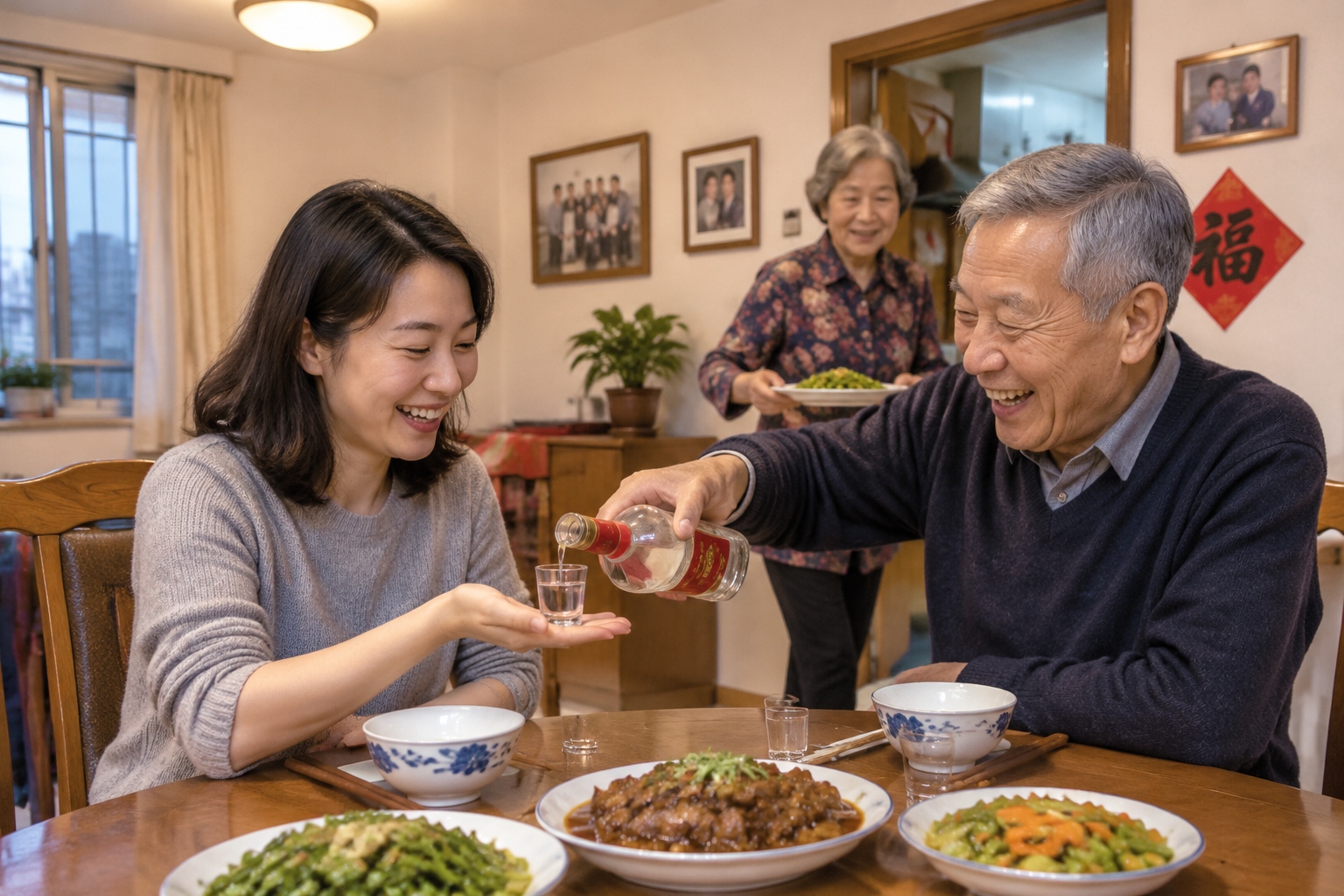
Family dinners are the easier case, and most people handle them the hard way — by defending themselves in real time in front of twenty relatives. Don’t. Send a message the day before.
— 大伯,我明天不喝酒啊,最近在吃药。
— 行,那你喝茶。
“Uncle, I’m not drinking tomorrow — I’m on medication lately.”
“Fine, then you drink tea.”
That’s it. You’ve given the host time to prepare, and more importantly you’ve recruited him. When someone else reaches for your glass at dinner, your uncle says “她不喝” before you have to. In a family, this is the cheapest solution available and almost nobody thinks of it.
At a business dinner: repeat on the spot
A private room in Shenzhen, eight people, a client you’ve met twice, a round of toasts going clockwise. You can’t always announce in advance. Here the repeat does the work.
— 小李,来,敬张总一杯。
— 张总,我以茶代酒,敬您。
— 茶不行,今天高兴,喝一点。
— 张总,真的谢谢,我今晚不喝酒。我干了这杯茶,您随意。
“Xiao Li, come, toast Mr Zhang.”
“Mr Zhang, I’ll toast you with tea in place of wine.”
“Tea doesn’t count. We’re celebrating — have a little.”
“Mr Zhang, thank you really, I’m not drinking tonight. I’ll finish this tea; you drink as you like.”
That last clause, “我干了,您随意” — I’ll finish mine, you drink at your own pace — is the standard formula, and it works just as well with tea. It removes the trap where the other person feels obliged to match you. If you want a reason, this is the moment to offer “我开车来的”; if you don’t, the sentence above stands on its own.

If You’re the One Holding the Bottle
Everything above puts the work on the person refusing. Half of it belongs to the host.
“好,那喝茶,一样。” — Hǎo, nà hē chá, yīyàng. — “Alright, tea then. Same thing.” Or: “心意到了就行” — the gesture is what counts.
Then change the subject immediately, to the food, with your chopsticks already moving: “来,吃鱼,凉了就腥了.” That small swerve is what tells the table the matter is closed. Nobody has to explain themselves, nobody loses face, and the evening keeps going. A guest’s no, accepted in one sentence, costs the host nothing.
What a Respected “No” Looks Like
The woman in Changsha could say six characters and be believed. Not because she said them perfectly — her Mandarin was ordinary — but because the table decided to hear them. Two people did the translating: she made her no clear and warm, and someone across from her accepted it and passed the teapot.
That’s the thing worth taking away. Refusing a drink isn’t refusing the person who poured it. Once somebody at the table says that out loud, everyone relaxes, and the evening becomes about the fish, the property prices, the cousin’s new job — all the things people actually came for.
Five years ago, the same six characters might have bought you ten minutes of debate. Tonight, more often than not, they buy you a cup of tea.
Start the discussion at forum.chinacomes.com