
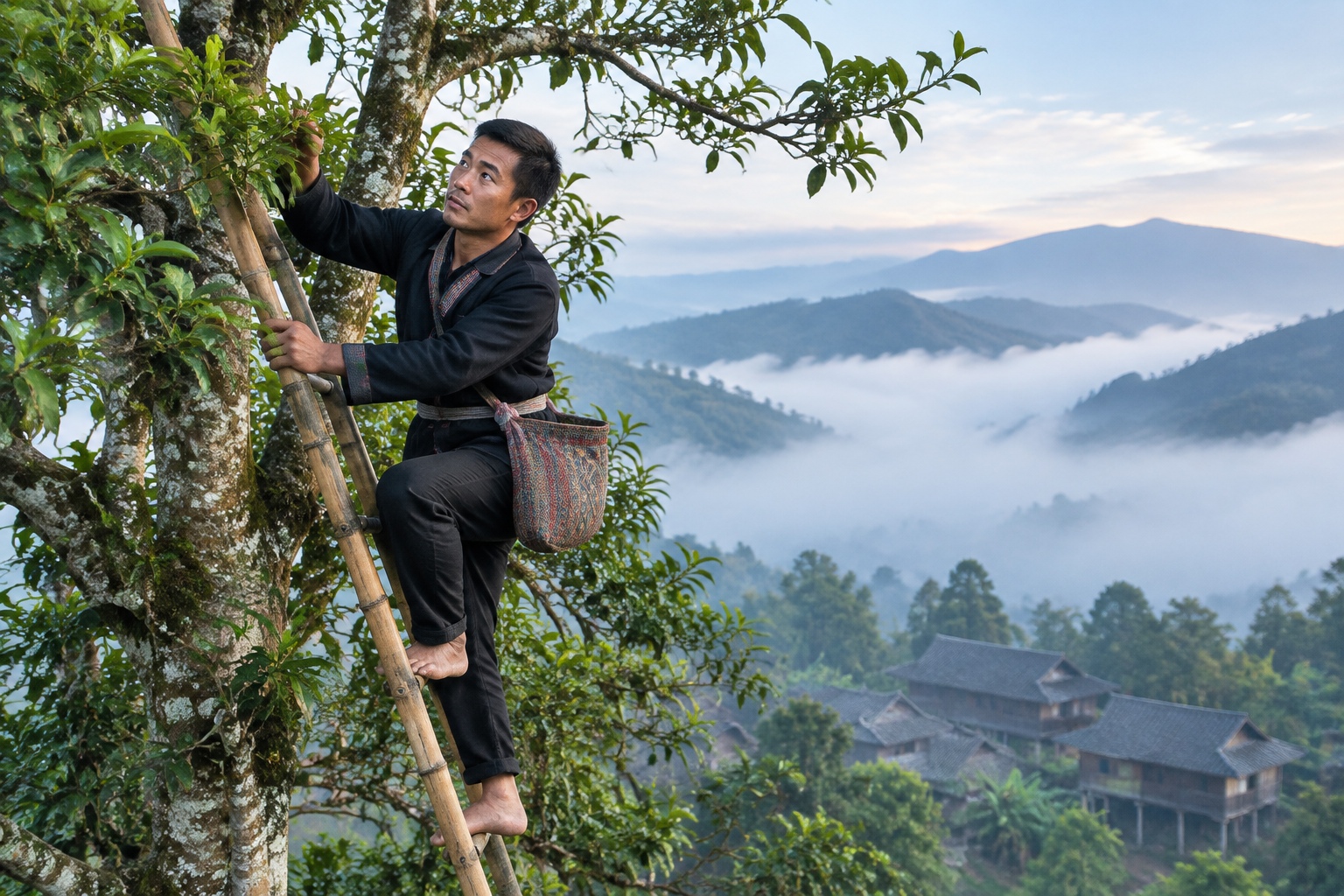

6:40 a.m., 1,500 metres up
At 6:40 in the morning, the fog on Jingmai Mountain is thick enough to drink. Ai Bao leaves his motorbike at the edge of the tea forest, pulls his jacket closed and checks the knot on the cloth bag hanging at his waist.
He is 47, a Blang farmer from a village of about 300 households, and he has spent thirty years climbing most of the same dozen trees. The ladder is bamboo, two poles and a row of rungs, leaning into the canopy at a shallow angle. He tests the second rung with his weight, then the fourth. From the ground, all you hear is the creak of bamboo and last night’s rain dripping off the leaves. Just after seven he calls down that the light is good.
What he picks is one bud and two young leaves, pinched off with a thumbnail and dropped into the bag. By tonight those leaves will be weighed, spread out to wither, fired in a wok, rolled by hand and dried in the sun. In a few weeks they will be pressed into a cake of raw Pu’er and shipped to Kunming, Guangzhou, Seoul or a tea shop in Toronto. The person at the far end of that chain will pay real money for it. The person on the ladder gets paid by the kilogram.
This is not a tea plantation
Jingmai Mountain sits in Lancang County, in Yunnan’s Pu’er City, close to the Myanmar border. The road up from the valley is roughly ninety minutes of hairpins, climbing out of banana and rubber country into a cooler belt of forest between about 1,100 and 1,660 metres.
What grows up there is unusual enough that UNESCO inscribed it in September 2023 as a World Heritage cultural landscape. It was China’s 57th site, and one of very few anywhere in the world listed specifically for tea. Nine villages sit inside the listed area, home to about 5,000 people, most of them Blang or Dai. Five patches of old tea forest surround the villages.
You would not mistake any of it for a plantation. There are no rows, no terraces, no bare red soil. Tea bushes and small tea trees grow as an understory beneath tall camphor, fig and other broadleaf trees that hold the shade and the humidity. Some of the older tea trees are several hundred years old; a few claims run past a thousand. Nobody planted them in straight lines, because nobody planted them in lines at all.
The difference shows up in the cup. A modern terraced garden yields more leaf per hectare and can be picked partly by machine. A forest like this yields less, and more slowly, which is one reason ancient-tree tea can cost ten times what ordinary tea costs, and sometimes far more.
The story the Blang tell about tea
Blang families here credit an ancestor, Pa Ai Leng, with leading them to this mountain and teaching them to grow tea. The version told over dinner goes roughly like this: he said that leaving his people cattle and horses was risky, because sickness could wipe them out; leaving them gold and silver was pointless, because it would be spent. So he left them tea trees, which would keep feeding their grandchildren.
It is a legend, not a land deed. But the way tea is treated here looks inherited rather than invented. Blang households still make sour tea, fermented leaves that are chewed or brewed, sour and slightly bitter, nothing like the sweetened bottled tea sold in cities. In April, villages hold the Sankang festival to honour the tea ancestor, with offerings at the tea forest and days of eating and singing. Dai families in the lower villages, who arrived later, brew in small clay pots over a fire until the leaves smell like roasted grain.
None of that is staged for visitors. It is simply what happens in April.
Who picks: a short season and a long ladder
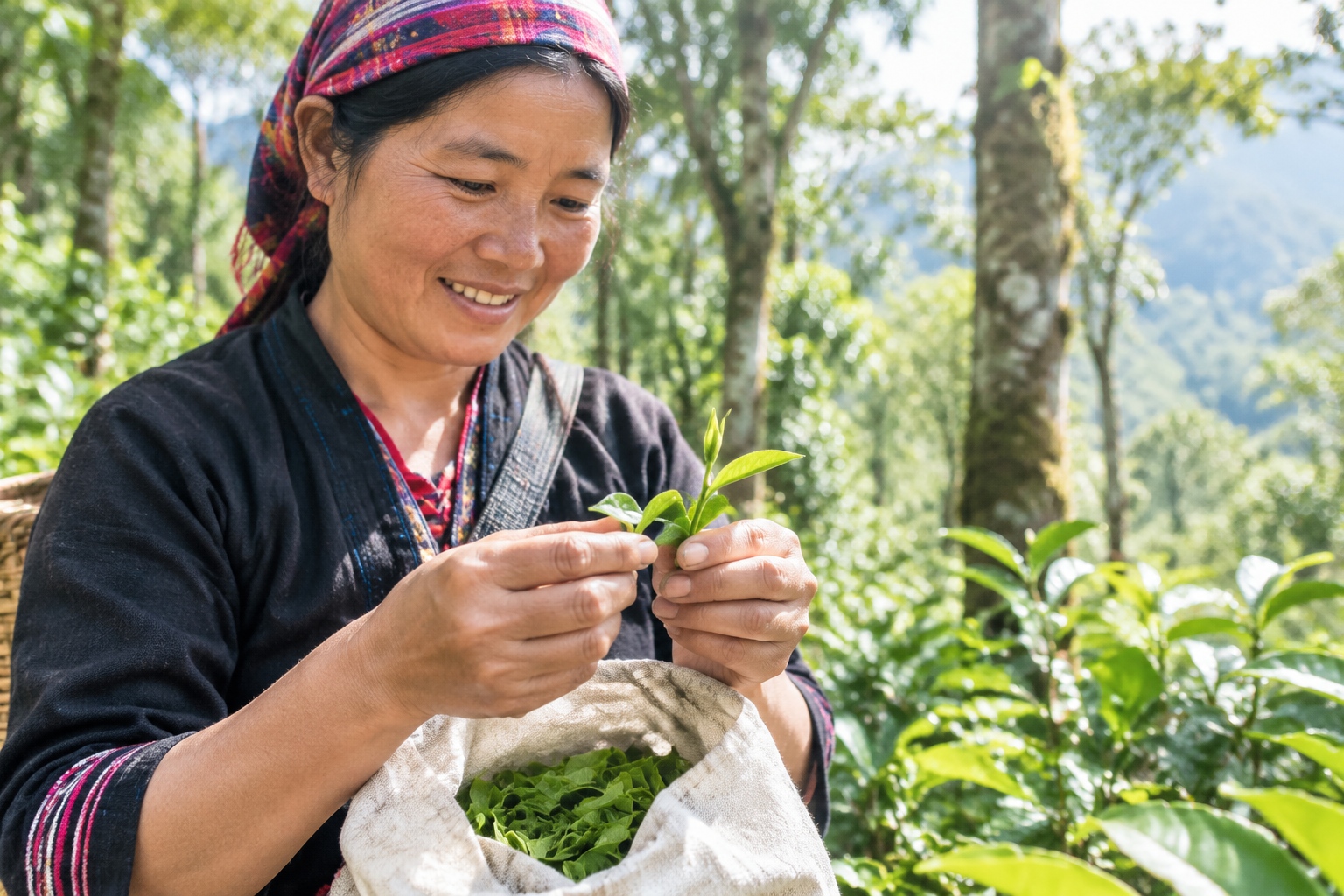
Fresh leaves convert at roughly 4.5 to 5 kilograms to one kilogram of dried maocha, the semi-finished tea that is later pressed into cakes. On tall old trees, a skilled picker might bring down six to eight kilograms in a long day, which is around one and a half kilograms of finished tea. The spring window is short: 40 to 50 days, with the best material in the first two or three weeks. There is a smaller autumn flush, and then the trees rest.
Families with more trees than hands hire pickers, often from lower villages or neighbouring counties, at about 150 to 200 yuan a day plus meals. On a busy spring day, a household with twenty pickers in the forest is spending three or four thousand yuan before a single leaf has been sold.
Price depends on which tree the leaf came from. Ancient-tree spring tea from Jingmai commonly trades somewhere between 1,000 and 3,000 yuan per kilogram of maocha, with exceptional lots going higher; tea from younger trees in the same landscape can sell for a tenth of that. Buyers walk the forest in March, taste from the wok, and negotiate on the spot, usually with cash or a phone transfer across a wooden table.
So the question of who picks your tea has two answers. The people who climb the trees are often not the people who own them, and the money divides accordingly. A household with a few dozen old trees in the family can clear more in one spring than a county schoolteacher earns in a year. Their neighbours with mostly younger trees make a fraction of that, and work just as hard.
Who processes: wok, hands, four hours of sun
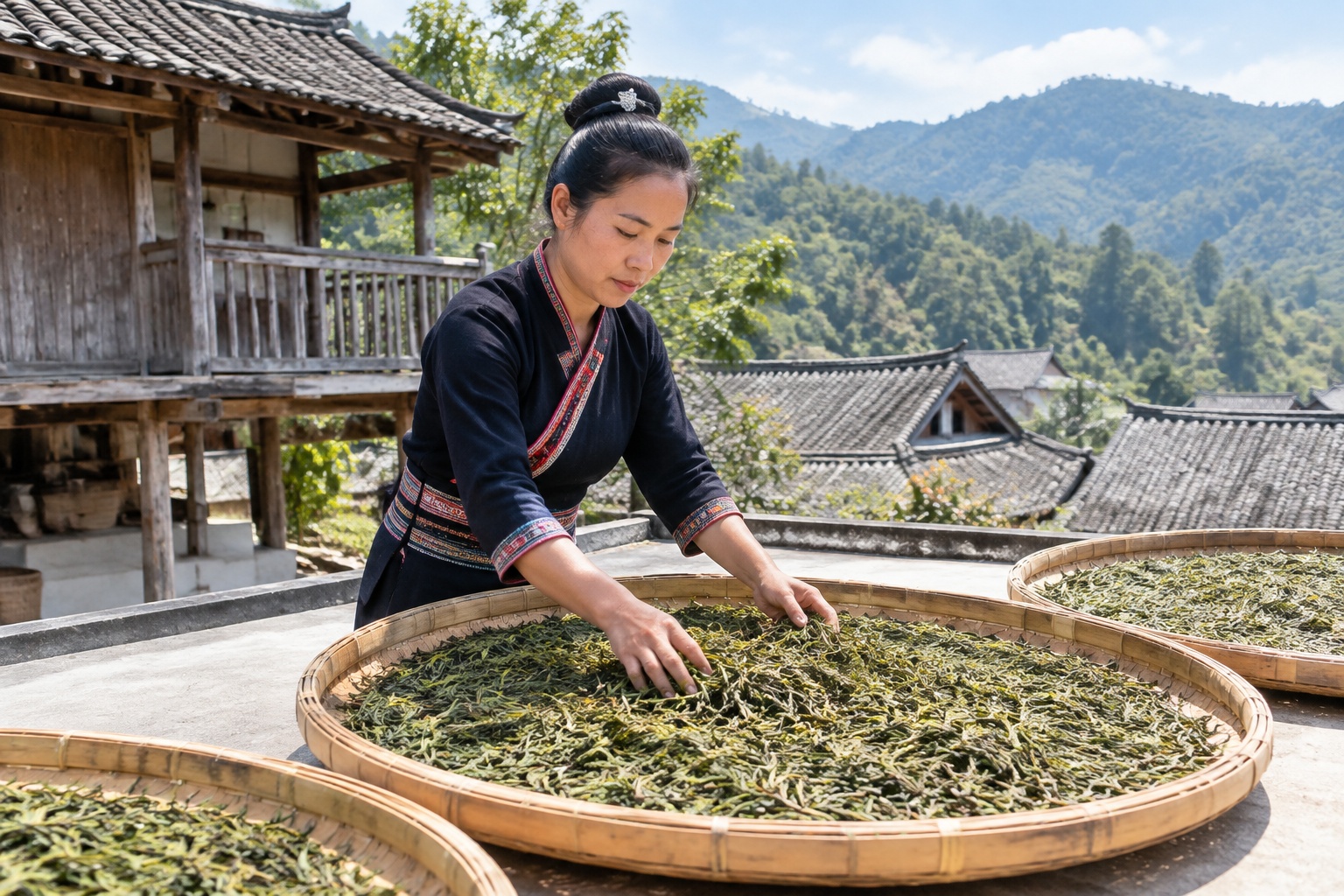
Tea does not wait. Leaves picked in the morning are spread out to wither by early afternoon, then fired in a heated wok, a step that stops oxidation and decides much of the flavour. Locals call it kill-green. It is done by hand, or by hand with a machine turning the wok, and the room smells like chestnuts and cut grass.
Next comes rolling, then the step that gives this tea its name: the leaves are spread on bamboo trays and dried in the sun rather than in an oven. Sun-dried maocha is the raw material for sheng Pu’er, the raw tea that ages for years and darkens from pale gold toward something closer to whisky. Only later are the leaves steamed and pressed into cakes, traditionally 357 grams, a number with at least three competing stories behind it.
Who guards: the rules that arrived with the label
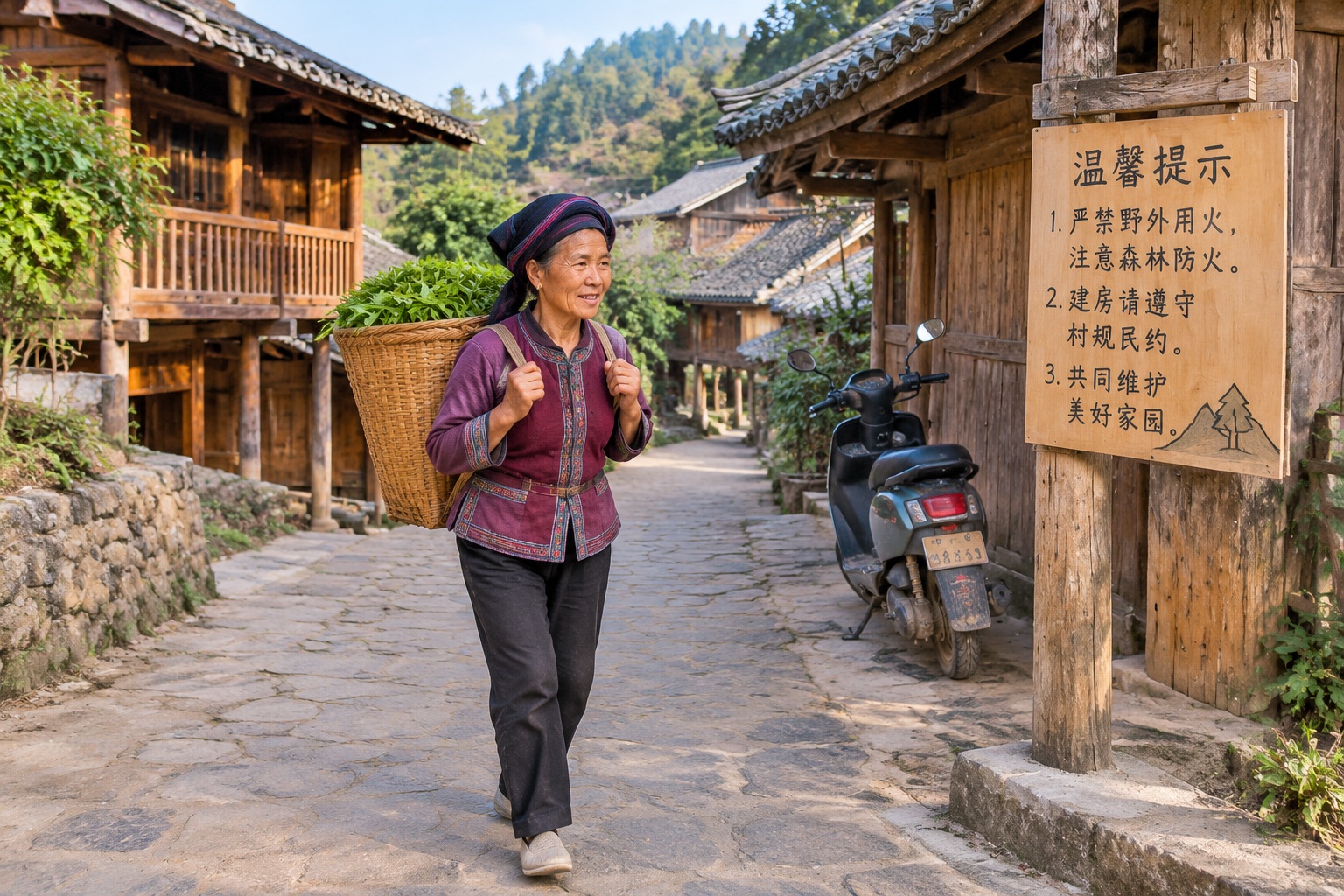
The World Heritage listing brought paperwork with it. Pu’er City adopted a protection regulation for the Jingmai landscape, and inside the core zones chemical fertiliser and pesticide are banned. Building height and materials are restricted so that villages keep their wooden stilt houses and small grey tile roofs, and new construction needs approval. Village committees run fire patrols through the dry spring, because a serious fire in this forest would take decades to grow back.
Not everyone is delighted. Some families say a roof repair can take months of forms. Others point out that the forest is still standing precisely because somebody said no to concrete.
Then the visitors came
After 2023, more people started arriving: tea buyers first, then tourists in rental cars. Guesthouses opened in converted houses in Wengji and Nuogang. Tea rooms appeared on ground floors, with tasting sets and price lists in Chinese and English. Young people who had gone to Kunming for work began coming back to run a shop, film short videos in the forest or beside a wok, and sell cakes directly to customers they will probably never meet in person.
The money is real, and so is the friction. Narrow village lanes were not built for tour buses; rubbish has to be trucked out; a village that lives off day-trippers risks turning its own front rooms into scenery. Some families now limit how many visitors they will take in a day, not out of principle, but because the tea still has to be made.
What that means for the cup in your hand
Jingmai tea is usually described with words like orchid, honey, and a bitterness that dissolves into sweetness after a few seconds. A young cake tastes sharp and green for the first year and settles down after three or four; a ten-year-old cake from the same village tastes rounder, darker, closer to dried fruit.
It is also a market with a forgery problem. Ancient tree is a claim, not a certification, and sellers have every incentive to stretch it. Some villages now issue origin cards, and some buyers ask for geotagged photographs of the specific tree. Those help. In practice, the most reliable guarantee is still a relationship: a family you can call, who knows which slope the leaves came from, and who will answer the phone next spring.
The next spring
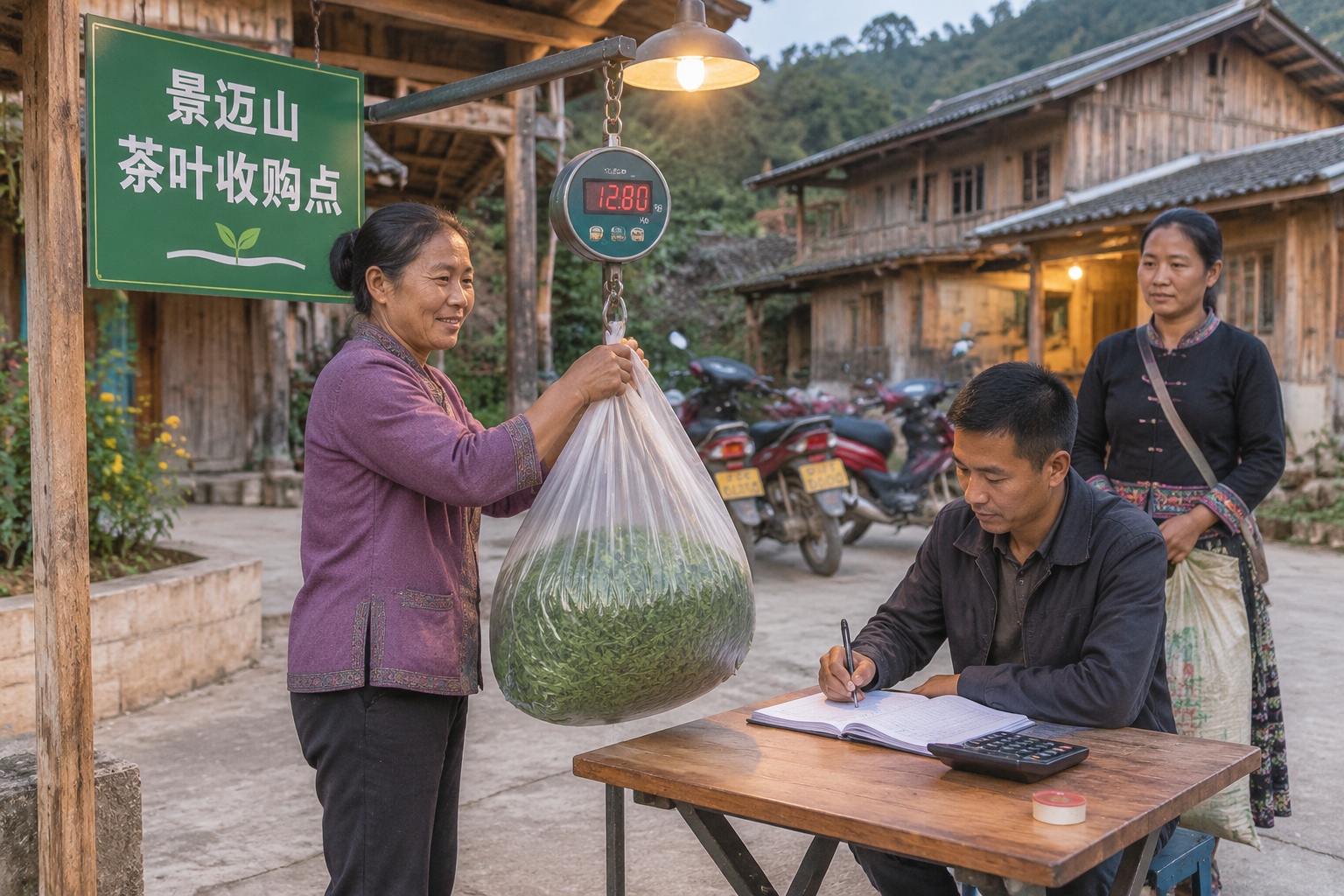
At dusk, the collection point at the edge of the village is busy. Ai Bao’s bag is weighed on a hanging scale, the number written into a ledger, the leaves tipped into a bigger sack that smells of rain and green apples. He will be up again at six. In the wooden house behind him, someone is already firing a wok for the evening batch, and the smoke mixes with cooking oil and the sound of a television.
Ask anyone here who will climb these trees in twenty years and you get a shrug, then a guess: the children, if the tea still sells. That is the whole arrangement in one sentence. The forest survives because it pays, and it pays because people keep climbing bamboo ladders in the fog at 6:40 in the morning.