
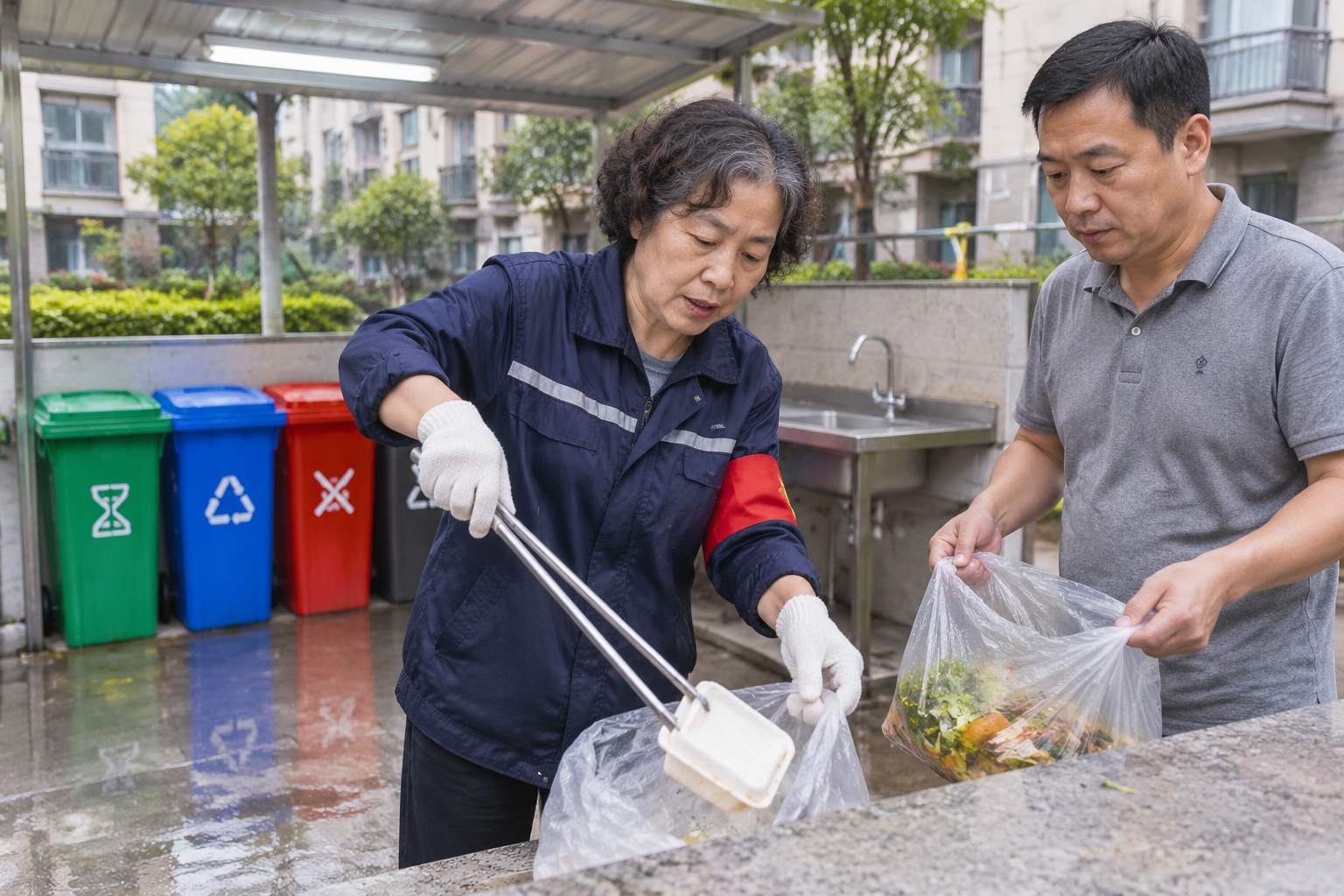
At 7:12 on a Tuesday morning, Chen Xiuying is holding a pair of long stainless-steel tongs and looking into a plastic bag that someone has just set down on the counter of the bin station. Rice noodles, a few bones, one squashed takeaway box. She fishes the box out with the tongs, drops it into the blue bin, tips the noodles into the green one, and says, without much heat, “Next time, give it a rinse.”
The estate she works in has eight towers and about 1,200 households, a fifteen-minute walk from the container terminals on Shenzhen’s eastern coast. The bin station is a roofed concrete pad with four colour-coded bins, a small sink, a laminated schedule (7:00–9:00, 19:00–21:00) and a wall-mounted fan that does not entirely deal with the smell. It rained overnight. The floor is wet, and the air is sour with a faint sweetness underneath.
Chen is 53, retired early from a garment factory, and works the morning slot six days a week. Most people drop their bags and go. A few stop to talk. One man in a delivery uniform asks whether the plastic film on his lunch box counts as recyclable. She tells him to put it in the black bin and keep the box.
This is not the Shenzhen that usually gets exported.
A city that is also measured in tonnes
The version most people outside China know runs on hardware: drones from Nanshan, phones assembled in Bao’an, electric buses rolling out of Ping Shan, a GDP of roughly 3.4 trillion yuan in 2023 and a population of more than 20 million. What is less visible is that the same city generates something like 30,000 tonnes of household waste a day, and that for most of the 2010s its landfills were the closest thing it had to a crisis.
In December 2015, a collapse at a construction-waste dump in Guangming New District killed 73 people. The disaster was about soil and debris rather than kitchen scraps, but it made a point that city planners could not ignore: a metropolis of Shenzhen’s density produces more waste than it has space to bury.
In 2019, China’s State Council launched a “zero-waste city” pilot — 11 cities and 5 special zones, with Shenzhen among the 11. On 1 September 2020, Shenzhen’s domestic waste classification regulation took effect, making separation mandatory. Four categories: food waste (green), recyclables (blue), hazardous waste (red), everything else (black).
What the UN actually noticed
In Yantian District, the coastline-and-port district where Chen works, roughly 230,000 people live in a space smaller than many European suburbs. Its household waste reduction and sorting programme was later written up as a case study under UN-Habitat’s Waste Wise Cities programme (in Chinese, 联合国人居署“智慧减废城市”). If you want the primary sources, search the English name rather than the translation.
The practice also appears in China’s Progress Report on Implementation of the 2030 Agenda for Sustainable Development (2023) (《中国落实2030年可持续发展议程进展报告(2023)》), filed under the goals on sustainable cities and responsible consumption.
What tends to surprise people who go looking for the case is how little of it is about bins. The recognised part is a chain of small, unglamorous mechanisms.
First, fixed time and fixed place: sorting only happens during two windows a day, when someone is there to watch. Second, a named person at every station — a supervisor like Chen, whose job is not enforcement but a kind of low-level negotiation, ninety seconds at a time. Third, backend capacity built before the front end was made compulsory: plants that can actually digest food waste, and a fleet of separate trucks.
That last point is the one residents test most often. Everyone in Shenzhen has heard the accusation that the truck comes and mixes everything together. In Yantian it mostly does not, and the reason is not moral but logistical: a mixed load of food waste would destroy the equipment downstream, so the streams have to stay apart from the moment the bag leaves the counter.
Follow the truck
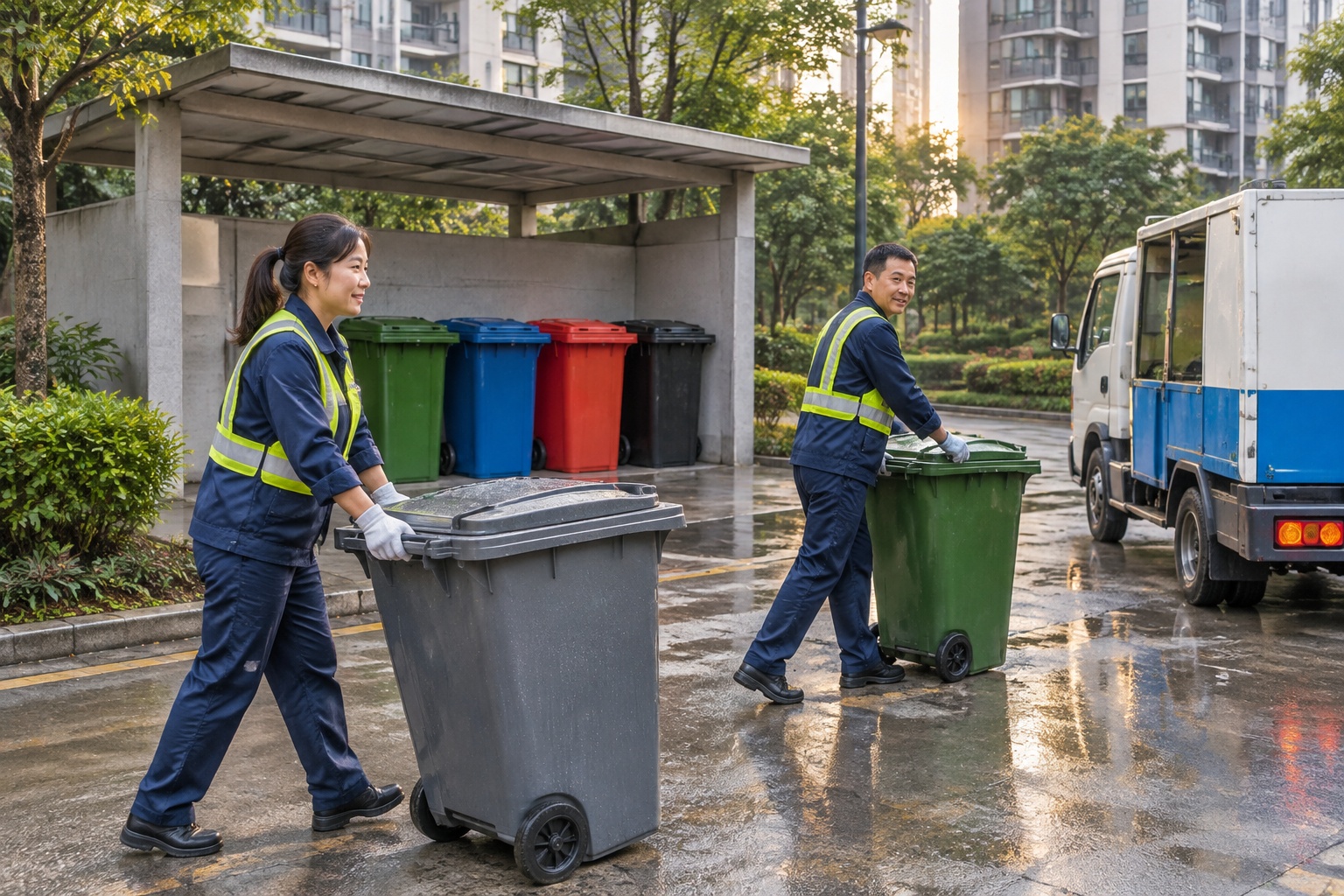
At 8:40, a small electric collection vehicle pulls into the estate — white and blue, about three tonnes, quiet enough that you hear the handbrake rather than the motor. Two workers in gloves and reflective vests wheel the bins out on a trolley. Food waste goes first. They weigh each bin on a scale built into the tailgate, and a reading pops up on a screen: 41.6 kilograms from tower three, 28.2 from tower five.
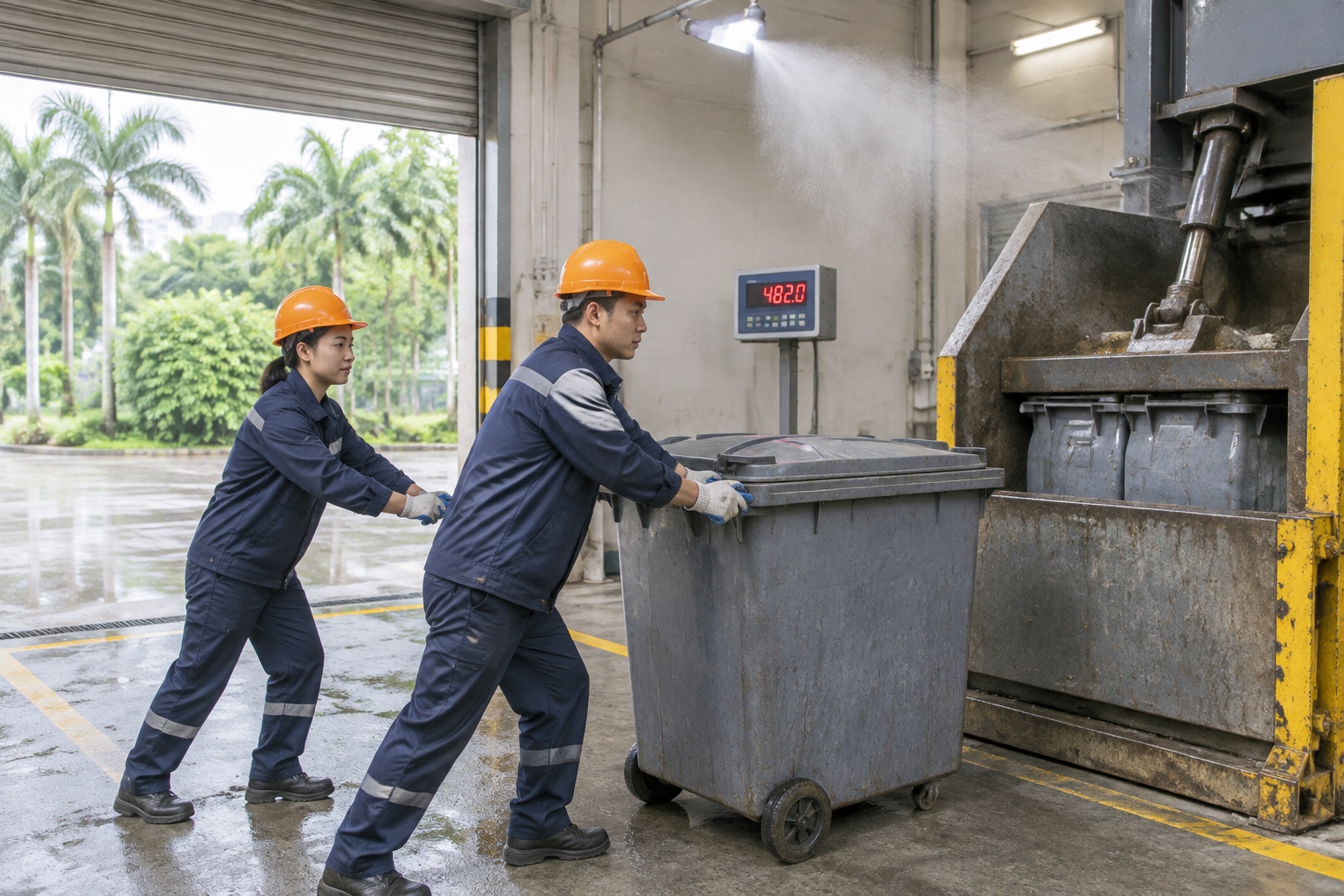
Different streams get different trucks. Food waste is collected daily, recyclables every other day, hazardous waste about once a month. Recyclables go to a sorting yard where cardboard, PET bottles and aluminium are separated by hand and by machine. Hazardous waste — batteries, expired medicine, paint tins — goes into a locked cage for regulated disposal. The residual black bins head for a transfer station, where a hydraulic press packs them into sealed containers and a misting nozzle sprays deodoriser across the bay every few minutes.
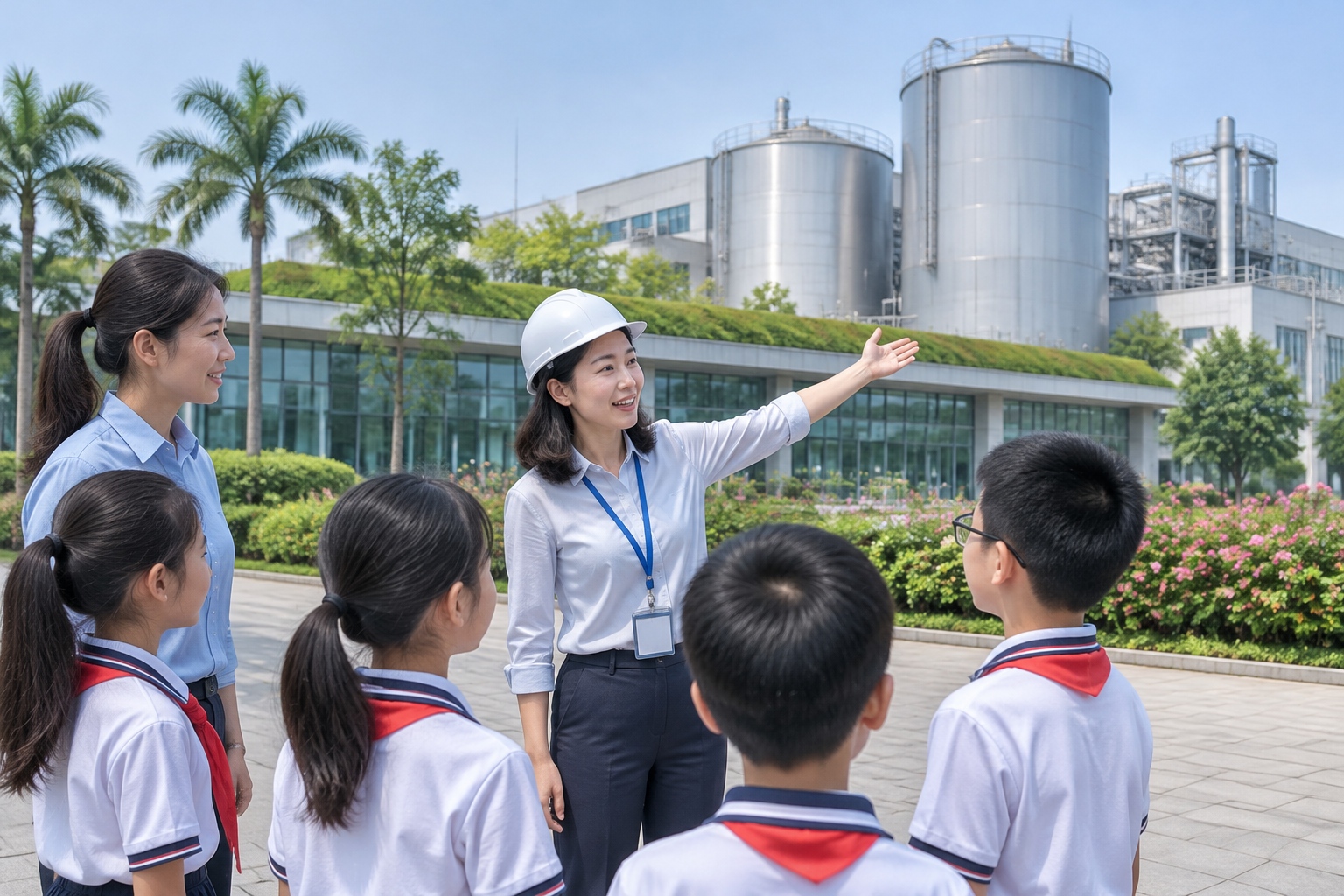
At the far end of the food-waste route is a treatment plant where the material is heated in sealed tanks, digested by bacteria and turned into biogas that runs generators, plus a residue that is composted. The residual waste that cannot be recycled goes to a waste-to-energy plant. Several of these have been built around Shenzhen since 2019, and a few are designed to be visited: there is a viewing corridor, an exhibition room, and at one of them a café. Residents who once blocked incinerators now bring their children to see where the rubbish goes.
The other half of the metabolism: water
Waste is only one output. The other one runs out of every tap and drain in the city.
Shenzhen Environmental Water Group (深圳环境水务集团) won a Gold Award in the International Water Association’s Project Innovation Awards (国际水协“项目创新奖”). The full English name of the body is worth noting, because the IWA’s case library is public and searchable, and the award entries are unusually concrete: pipe networks, pumping stations, the unglamorous engineering that decides whether a river smells.
The river that matters most locally is the Maozhou, on the city’s northwest edge. For years it was rated worse than Class V — the bottom of China’s five-tier water quality scale — and the standard joke was that you could tell which way the wind was blowing. A decade of pipe-laying, interception of illegal discharges and treatment plant expansion changed the colour. By the early 2020s, dragon-boat crews were training on it again, and the riverbanks had been rebuilt as a linear park that people actually use on weekday evenings.
Recycled water — treated to a standard that suits its next job rather than drinking — now supplies river channels, road cleaning, park irrigation and industrial cooling. City figures put the reuse rate at roughly a third, which is high for China and still leaves plenty of room.
The parts that do not fit on a poster
None of this runs itself. The supervisor system depends on people like Chen, who is paid a modest part-time wage and spends her mornings being politely contradicted. In the urban villages — the dense, low-rise neighbourhoods where a large share of Shenzhen’s migrants live — a single bin station may serve thousands of people, many of whom cook in shared kitchens and work shifts that do not match a 7–9 a.m. window.
Takeaway packaging keeps rising. Every new food-delivery habit adds a stream of greasy containers that nobody enjoys handling, and the recycling market for low-grade plastic is thin.
And “zero waste” is a translation that flatters. The Chinese term 无废 means, roughly, “as little waste as possible”, not “no waste”. Shenzhen still burns a very large amount of rubbish. The goal is to shrink what gets burned, not to pretend it disappears.
A second kind of speed
At 8:55, Chen hoses down the counter and wipes the laminated schedule with her sleeve. A woman in slippers drops by with a bag of orange peel, says thank you, and leaves without being asked. The truck has gone. The fan is still running.
Cities are usually described by what they make and how fast they make it. Shenzhen makes a great deal, quickly. But there is a second clock running underneath the first one: how fast a city can turn a bag of noodles back into something useful — electricity, compost, water in a river. On that clock, the numbers are less dramatic and the race is closer. Which is exactly why the UN, and a growing number of city governments, have started taking notes.