
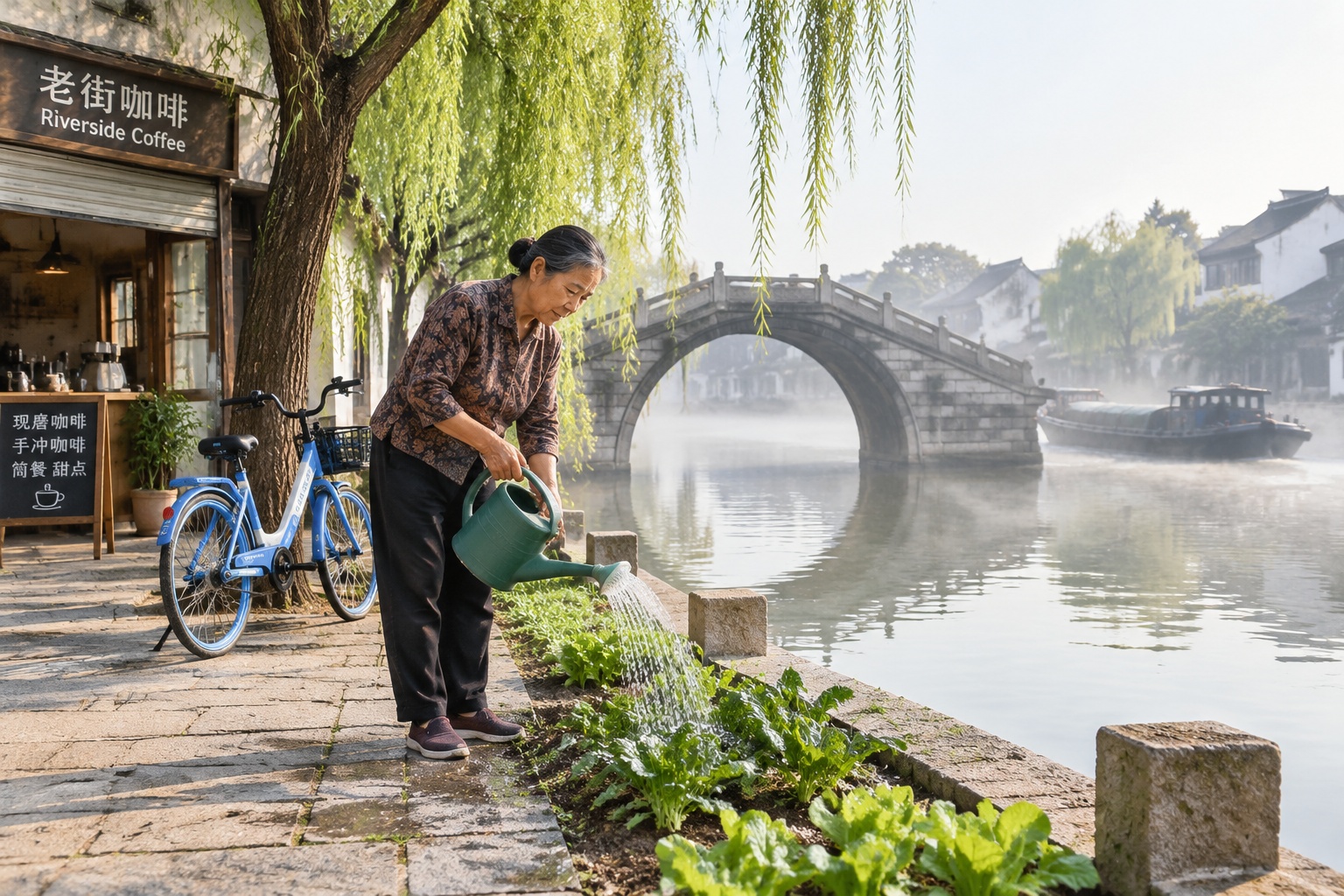

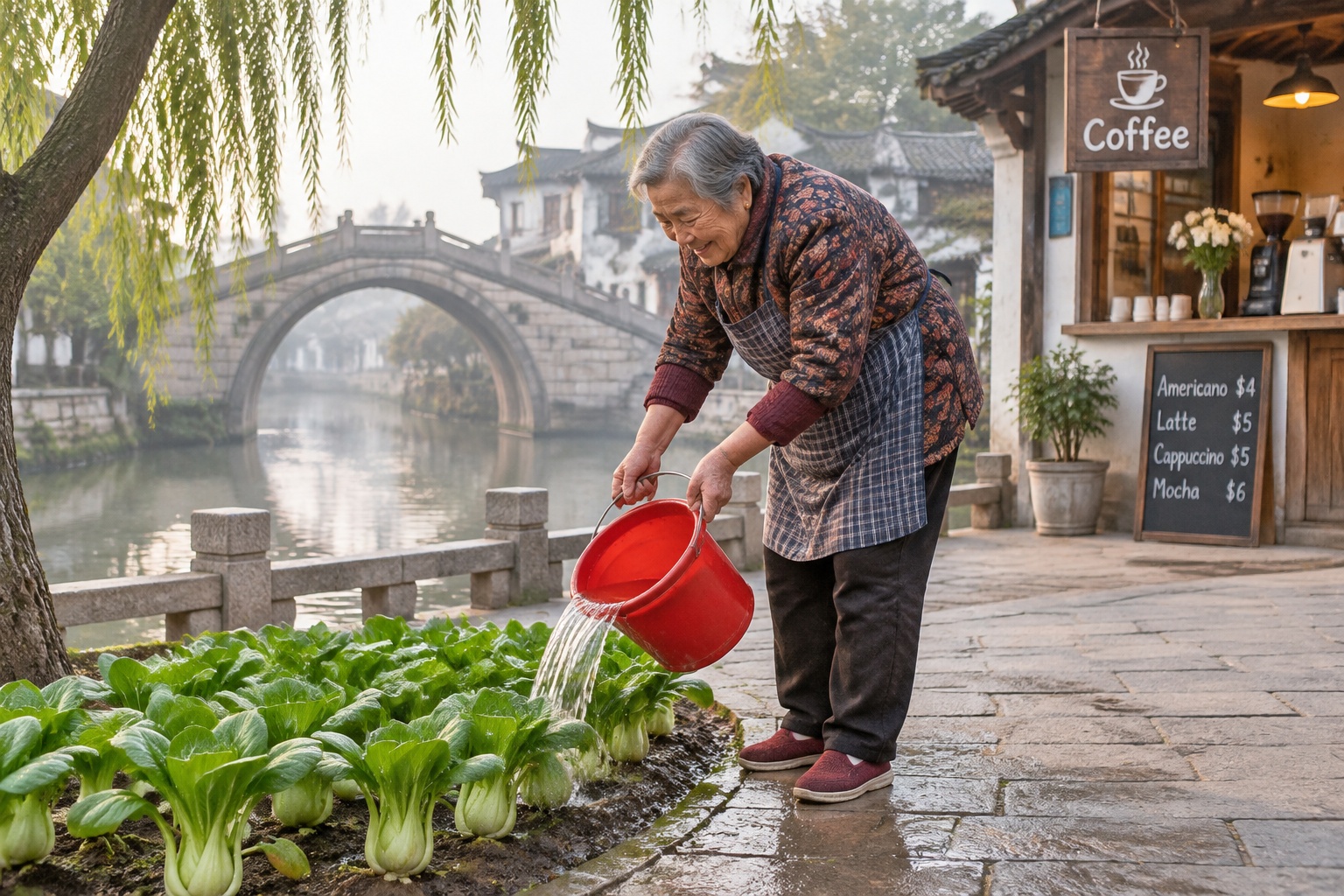
In Suzhou, early morning, mist still hanging over the water, an old woman in floral pajama pants waters a neat row of bok choy on the sidewalk using a plastic bucket. A few steps away, a coffee shop is rolling up its metal shutters, an espresso machine hissing inside. She stands beside a stone arch bridge that supposedly dates back to the Ming dynasty.
I’ve been walking along the canal-side path for over an hour. Before her, I passed a man hanging a birdcage outside his shop, two middle-schoolers in matching uniforms waiting for a bus, and a guy fixing bicycle tires under a sign that says “Ming-Qing Ancient Residence.” The contrasts aren’t arranged for tourists. They’re just how a Tuesday morning looks here.
You can’t see this from a cruise boat window.
The Grand Canal, which runs nearly 1,800 kilometers from Beijing to Hangzhou, is one of the oldest and longest artificial waterways in the world. China started digging it more than 2,200 years ago and kept extending it through various dynasties, linking five major river systems into a massive transport network. In 2014, it was inscribed as a UNESCO World Heritage Site. Some of the country’s wealthiest and most vibrant cities — Suzhou, Wuxi, Yangzhou, Hangzhou — essentially grew rich because of it.
But what makes the canal worth caring about isn’t its scale or its history. It’s the ordinariness. It works like a street.
Why walking or cycling beats a boat tour
Most foreign visitors picture the canal from postcards: weeping willows, stone arch bridges, wooden boats strung with red lanterns. That image exists. The area around Gongchen Bridge in Hangzhou, Pingjiang Road in Suzhou, Dongguan Street in Yangzhou — they earn their postcard fame. But they’re also the most crowded, most commercialized spots.
The real canal exists in the gaps between scenic zones.
In cities across eastern China, you can rent a shared bike with a scan of WeChat or Alipay, and ride for a full day for pocket change. Between Suzhou and Wuxi, the canal runs roughly parallel to the railway line. You pass small factories, old grain silos, residential blocks, vegetable plots, and wharves where barges are moored. Some stretches are quiet enough to hear water lapping against the bank.
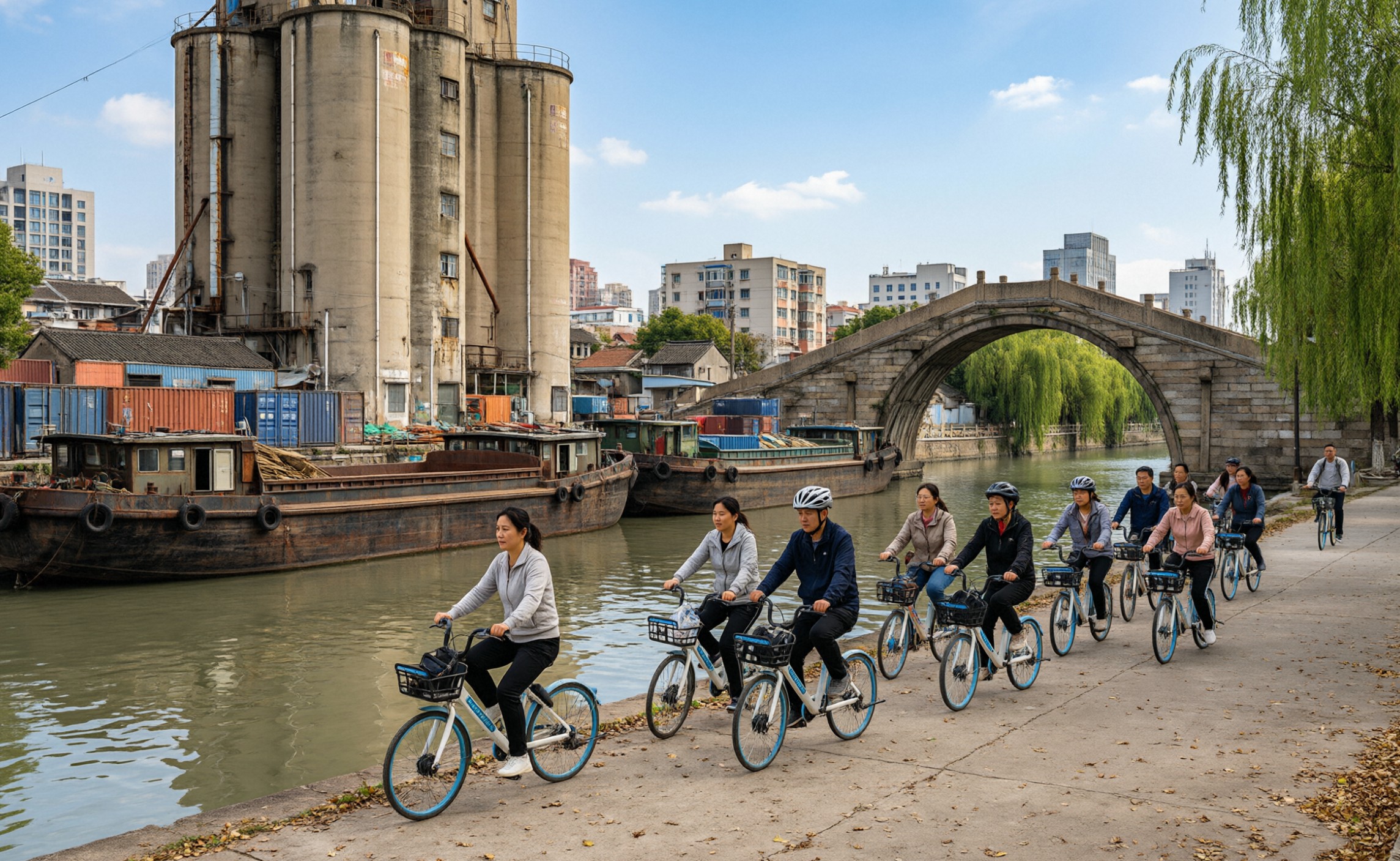
This isn’t an official “scenic trail.” No unified signs, no guidebooks. That’s the point. You ride over a patched-up road surface, swerve around an old tree, and suddenly find a stone bridge carved with the words “Rebuilt in the third year of Guangxu” — 1877, if you do the math.
In Wuxi, I stopped at a small convenience store for water and asked the shopkeeper how people here actually use the canal. She said — and I remember this — that nowadays, not many people really “use” it. But her father’s generation washed clothes and rice in the water. In summer, kids jumped off the bridges. Nobody jumps now, she said; the water’s too shallow. But then she added: in the evening, everyone still walks by the river.
Talking to locals beats any guidebook
If walking shows you the canal’s daily face, talking to people explains what it actually means to them.
In Yangzhou, I met an old man playing Chinese chess by the water’s edge. He was in his seventies, retired from a transport company. He told me that when he was young, the canal was crowded with boats hauling coal and grain, and the docks lit up at night. Then railways and highways expanded, and the boats thinned out. These days, the vessels on the canal are mostly tour boats or construction material barges. He didn’t sound nostalgic. He just shrugged: the river was still there, the city was still there, just living a different way.
In Hangzhou, a young man on an electric scooter told me he rides past Gongchen Bridge every day but “never really thought of it as a tourist site.” To him, it was a landmark, like a subway station. Once he brought a foreign colleague there, and the colleague took photos on the bridge for twenty minutes. He just waited and thought it was kind of funny.
These conversations don’t require special access. Sit by the river. Buy a bottle of water at a corner shop. Chat. Chinese people’s curiosity about foreigners tends to be direct — “Where are you from?” “How long have you been in China?” “What do you think?” Answering those questions usually opens the door.
History sits beside daily life, not behind glass
The canal corridor is packed with heritage sites. Baodai Bridge in Suzhou has fifty-odd arches and dates back to the Tang dynasty. In Yangzhou, the Ge Garden and He Garden once belonged to salt merchants. In Hangzhou, Tangqi Ancient Town preserves a large stretch of Ming and Qing architecture. But what struck me most was how little distance there is between the old things and ordinary life.
In Beijing’s Tongzhou district, a section of Ming dynasty city wall sits next to a residential compound and a courier station. In the morning, people practice tai chi on the open ground below the wall. In the afternoon, delivery workers sort packages there. Nobody thinks this is odd.
In Suzhou, people cycle across ancient bridges every day. Grass grows from the cracks in the stone. The railings are worn smooth from hands. The bridge’s purpose never changed — it’s still for crossing the river. Only the crossing method changed: from carrying pole loads to riding electric scooters.
This “history is beside you, not above you” quality might be the canal’s most honest face. It isn’t fenced off and ticketed. It’s embedded in the city’s fabric.
Everyday life along the waterfront
Ultimately, what moves people about the canal is its everydayness.
In the morning, someone’s washing vegetables by the water, walking a dog, doing tai chi. By mid-morning, vendors have set up stalls selling produce, flowers, breakfast. In the evening, commuters jog along the bank, old men chat on the bridges.
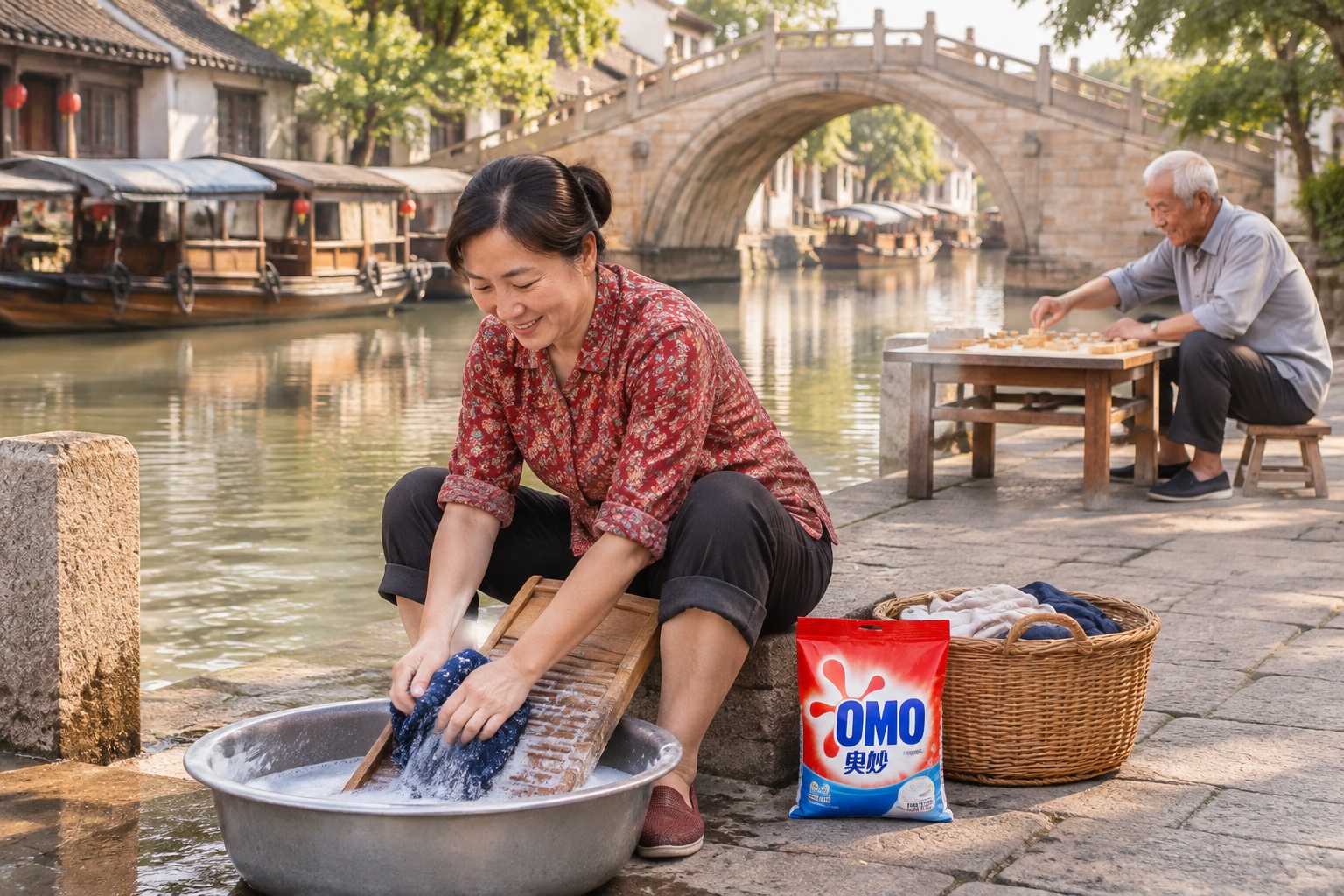
On a stretch of canal in Wuxi, I saw a woman washing clothes on the bank with a washboard, sitting on a flat stone, a bag of detergent beside her. She told me she has a washing machine at home, but on sunny days she prefers to come down to the river because “it’s cool by the water, and I can talk to the neighbors.”
Practical tips for walking the Grand Canal
If you want to walk a stretch of the canal yourself, here’s what’s useful to know.
Pick one section, don’t try to do it all. The canal is nearly 1,800 kilometers. Nobody walks it in one go. For a first visit, the Suzhou-Wuxi stretch is manageable — high-speed trains between the cities take about 20 minutes, and canal paths are relatively easy to find. Hangzhou’s Gongchen Bridge area works for first-timers. Yangzhou suits travelers looking for quiet.
Cycling covers more ground than walking. Shared bikes are everywhere in Chinese cities. Scan with Alipay or WeChat. Start around 7 or 8 in the morning: good light, fewer people, and the morning markets along the canal are just waking up.
Bring sun protection and water. Many canal paths have no shade, and summer sun is fierce. Convenience stores are dense, so buying water is easy, but carry a bottle anyway.
Use Amap or Baidu Maps for navigation. Google Maps doesn’t work well in China. Search for “canal” or specific bridge names, and check for nearby paths.
Don’t expect a unified sign system. Many sections have no tourist signage. Maps plus asking directions work better.
Best timing: spring (April-May) and autumn (September-October). Summer is too hot. Winter brings fog to some stretches, which cuts down visibility.
One last thing
On my last day walking the Suzhou-Wuxi stretch, I sat down by the canal in Wuxi to eat an ice cream bar. An old man was fishing nearby, his rod propped on the railing, his back against a tree, dozing. I asked if there were fish in the river. He opened one eye and said, there are, but they’re not easy to catch. Then he looked at me and asked where I was from.
I told him. He nodded. He said the canal was good — wherever you go, you can recognize it.
I don’t know if he was just making conversation, but I remembered it. For many people who live along the Grand Canal, it isn’t a “World Heritage Site.” It’s a river — one for walking, washing vegetables, fishing, chatting. To understand that, the best thing you can do is take a walk.