

Introduction: A Foreigner’s Day Without Cash
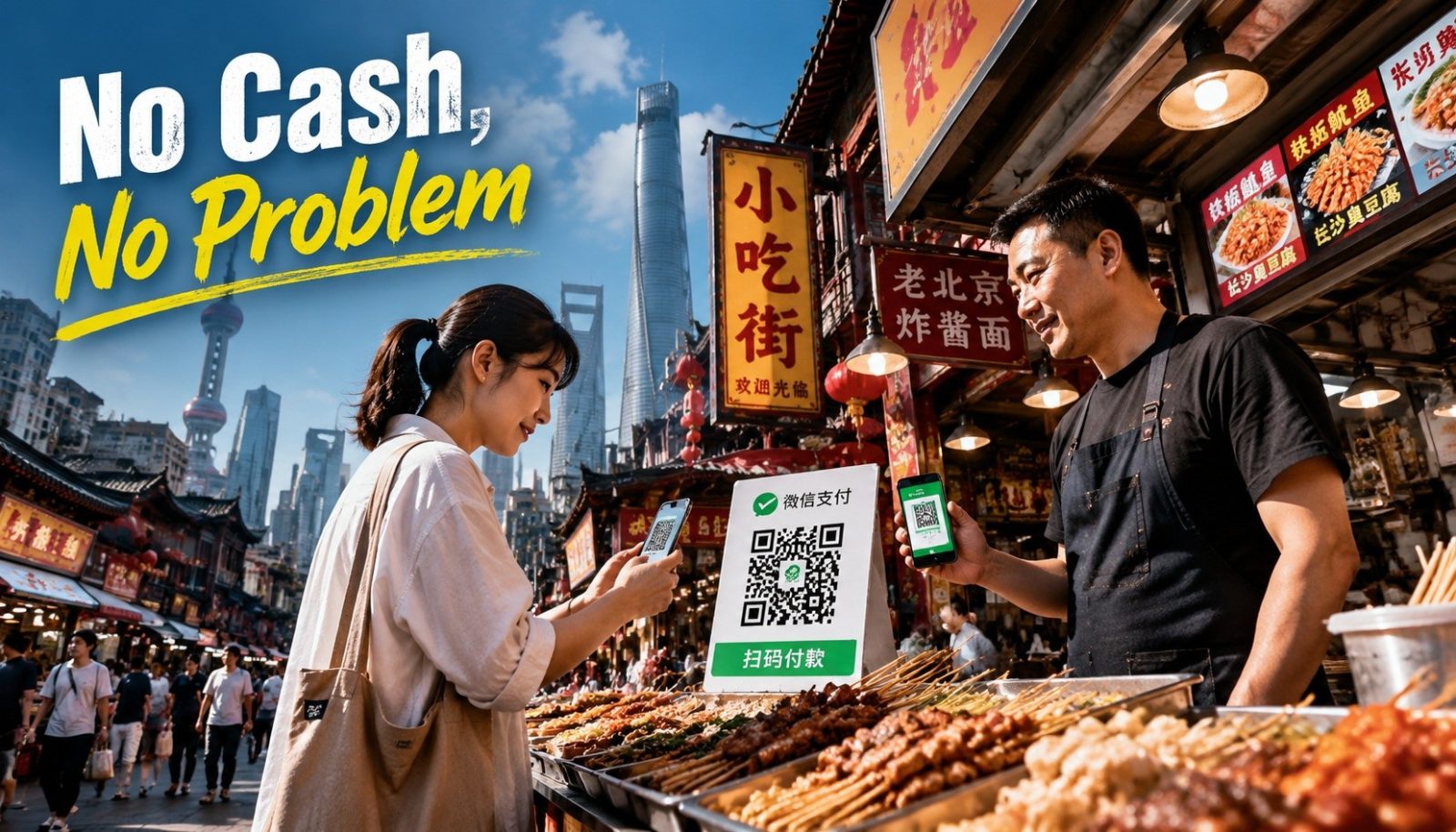
It’s 8 a.m. in Shanghai. Tom, a visitor from the UK, walks out of his hotel with only his smartphone. He scans a QR code at a street cart to buy a jianbing (Chinese crepe) for breakfast. Then he hails a taxi — payment via the ride-hailing app. At lunch, he splits a bill with a local friend by sending a WeChat red packet. By midnight, he has bought groceries, paid for a museum ticket, and even donated to a street musician — all without once pulling out a wallet. This is not a futuristic fantasy; it’s a normal Wednesday in any Chinese city.
Everyday Mobile Payment: From Street to Mall
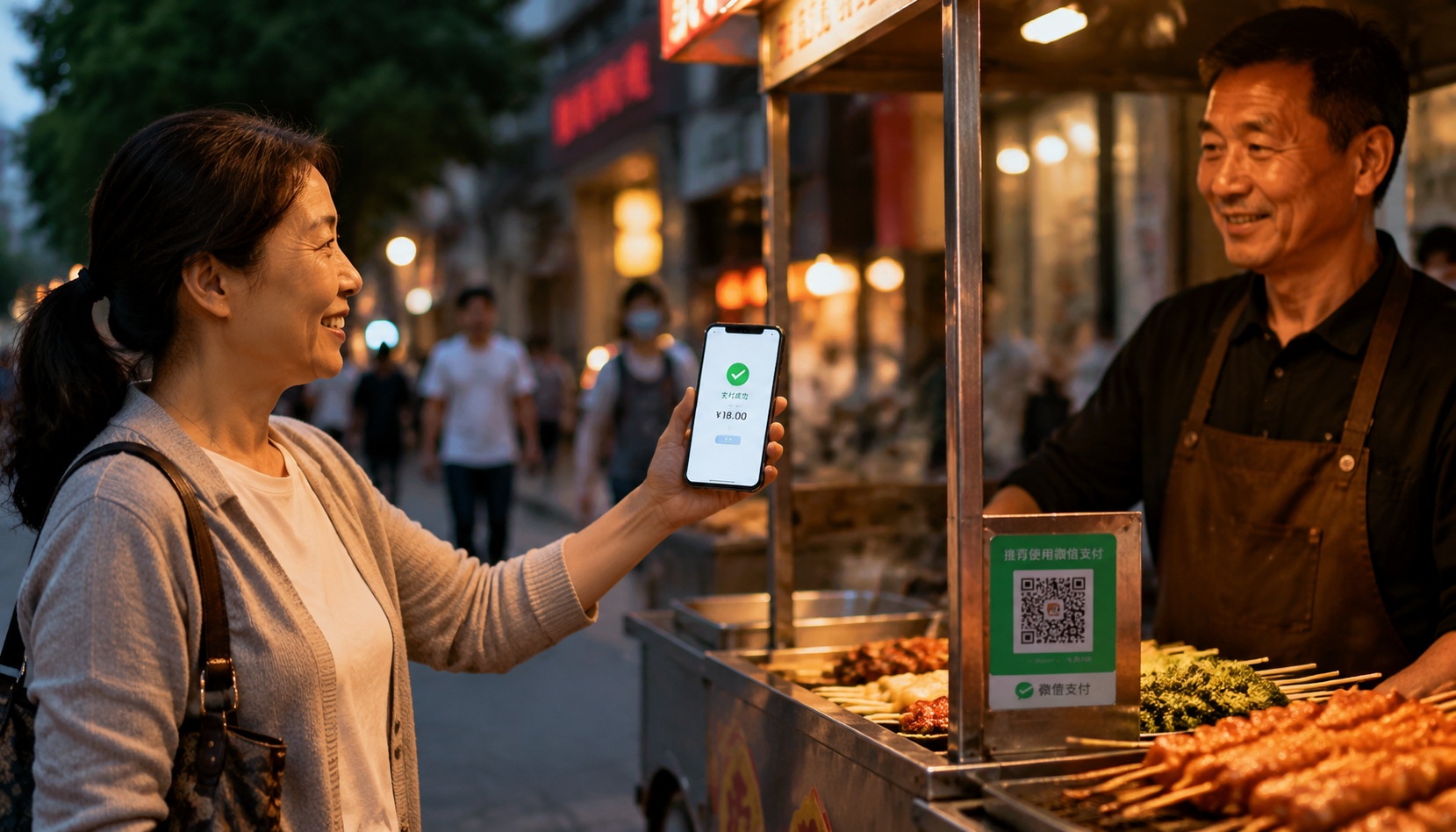
In China, the phrase “pay by card” is almost as archaic as “pay by check.” A 2023 survey showed that over 86% of urban consumers use mobile payment as their primary method. The scene is the same whether you’re at a high-end boutique or a tiny vegetable stall: the merchant shows a printed or digital QR code, the customer scans it with WeChat or Alipay, and the transaction is done in seconds. Even beggars on the street have QR codes pinned to their clothes. The era of “no cash” has reshaped daily rituals: giving red packets during Chinese New Year is now largely digital; parking meters are paid by scanning; and utilities, tuition, and rent are all settled via mobile apps.
This convenience didn’t happen overnight. It required a complex backbone that most users never see.
The Invisible Backbone: Networks, Standards, and Bank Systems
Behind every scan lies an intricate infrastructure. First, China has built the world’s largest 4G/5G network, covering over 99% of the population. Even remote villages and subway tunnels have reliable signals. Second, the QR code standard — a simple matrix barcode — was standardized early by Alipay and WeChat, making it universal. Third, the banking system underwent a radical overhaul: central bank regulations forced banks to open APIs to third-party payment platforms, enabling real-time fund transfers between accounts of different banks. This is why a payment from a China Merchants Bank account can reach a Bank of China merchant in under a second.
Additionally, China’s real-time gross settlement system (RTGS) processes billions of small transactions daily, far beyond the capacity of many developed countries’ systems. The result is a financial superhighway where every smartphone is a cash register.
Technology on the Ground: Smartphones, Biometrics, and Security
Smartphone penetration in China exceeds 70%, and almost all devices support the major payment apps. To ensure security, payments often require fingerprint or face ID verification. Alipay’s “ZhiMa Credit” system uses transaction history to assess user trustworthiness, reducing fraud. Moreover, the People’s Bank of China has implemented strict regulations on third-party payment platforms, requiring them to hold customer funds in reserve and undergo regular audits. As a result, the fraud rate for mobile payments in China is lower than that of credit card transactions in the US.
Another key enabler is the “real-name authentication” policy: every mobile phone number is linked to a national identity card, and payment accounts are similarly tied to real identities. This makes it nearly impossible to operate anonymously, dramatically reducing crime.
Social Impact: Empowering Businesses and Changing Habits
For ordinary people, the biggest benefit is convenience. No more worrying about forgetting cash or counting change. For small businesses, especially street vendors and farmers, mobile payment lowers the barrier to accepting digital money. A vegetable seller in rural Yunnan can now accept payments from tourists without a card reader — just a printed QR code costs virtually nothing. This financial inclusion has helped millions of microbusinesses formalize their income and access credit.
Mobile payment has also fueled new business models: bike-sharing, app-based food delivery, and online e-commerce all rely on seamless payment integration. The cashless ecosystem has become a foundation for China’s digital economy.
Challenges and the Road Ahead
Despite the dominance, gaps remain. Elderly citizens sometimes struggle with smartphone payments, leading to a digital divide. In response, the government has promoted “senior-friendly” modes with larger fonts and voice assistants, but progress is slow. Another issue is network blind spots: underground subway lines and remote mountain areas occasionally lack signal, though 5G expansion is addressing this. Cross-border transactions also remain complex: foreign visitors often cannot link their overseas credit cards to WeChat or Alipay without a Chinese bank account, although recent pilot programs now allow limited use for tourists.
Privacy concerns are another hot topic. While most Chinese accept the trade-off between convenience and data collection, international observers worry about surveillance. However, the public tends to prioritize efficiency over privacy, a cultural difference worth noting.
Conclusion: More Than Just Payment
China’s mobile payment revolution is not merely about replacing wallets. It’s a showcase of how a country can build a nationwide digital infrastructure — telecom networks, banking APIs, identity systems, and regulatory frameworks — that seamlessly integrates into daily life. For overseas readers, the lesson is that the smartphone in your pocket is only as powerful as the invisible grid behind it. China’s cashless society is a tangible example of how infrastructure investments can transform ordinary experiences.
Start the discussion at forum.chinacomes.com