
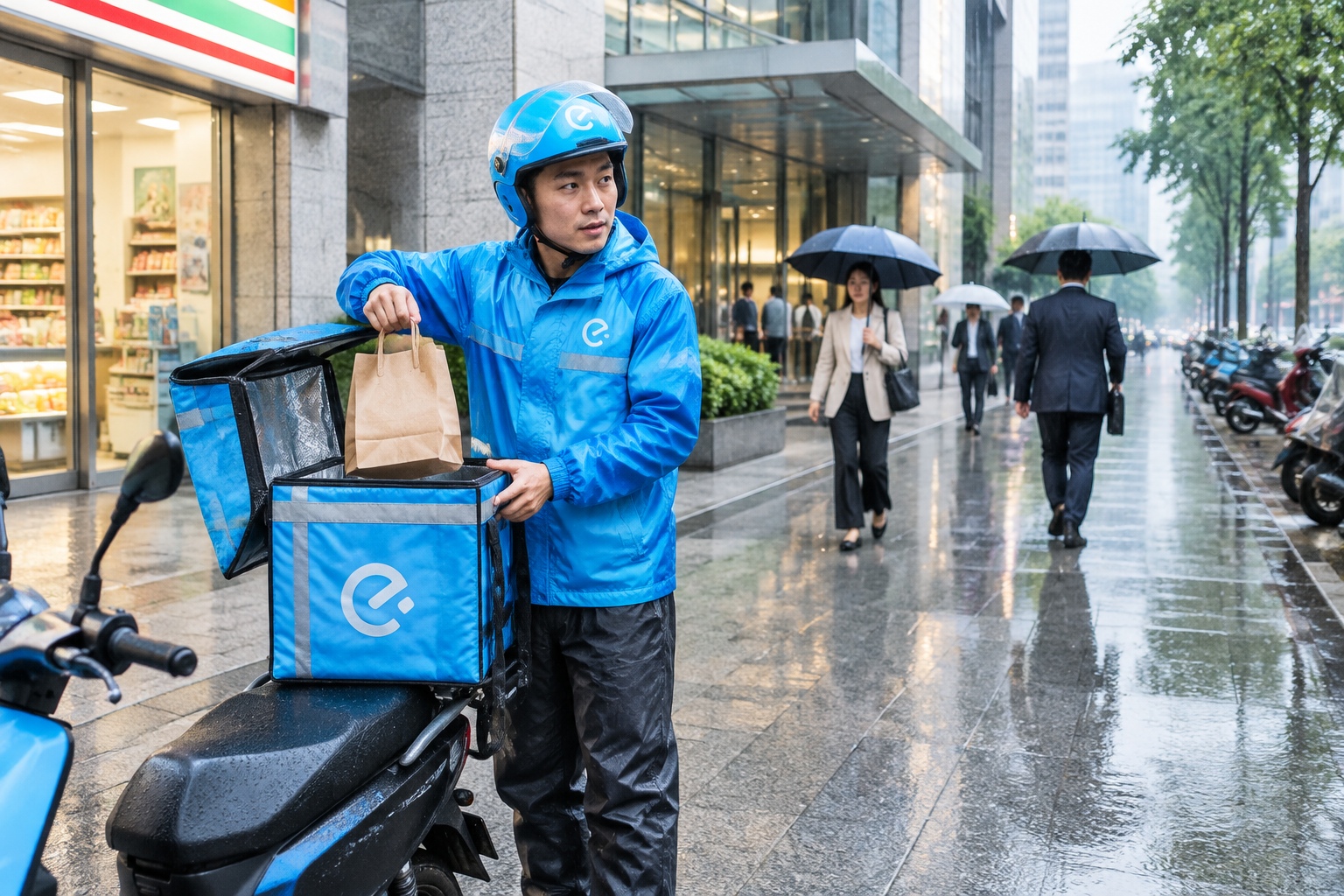

At 11:47 on a wet Tuesday in Shanghai, a man in a blue rain jacket stops his electric scooter on the pavement outside an office tower in Jing’an. He doesn’t lock it. He lifts a paper bag out of the insulated box behind his seat, checks the last three digits on his phone, and pushes through the revolving door. Four minutes later, a woman on the 14th floor picks up a call: her lunch is at the front desk.
She ordered at 11:21. The app gave her a countdown the second she paid — a small grey clock ticking next to a rider’s name, a photo, and a live map of a dot moving north along Chengdu Road. Ordered 11:21, delivered 11:52. Thirty-one minutes, in the rain, for a bowl of beef noodles that cost 28 yuan and a delivery fee of three.
For anyone who has waited seventy minutes for cold pizza in a Western city, this is the part of daily life in China that is hardest to explain and easiest to misread. So let’s follow it properly — not as a technology story, but as a physical one.
Why It Looks Impossible From the Outside
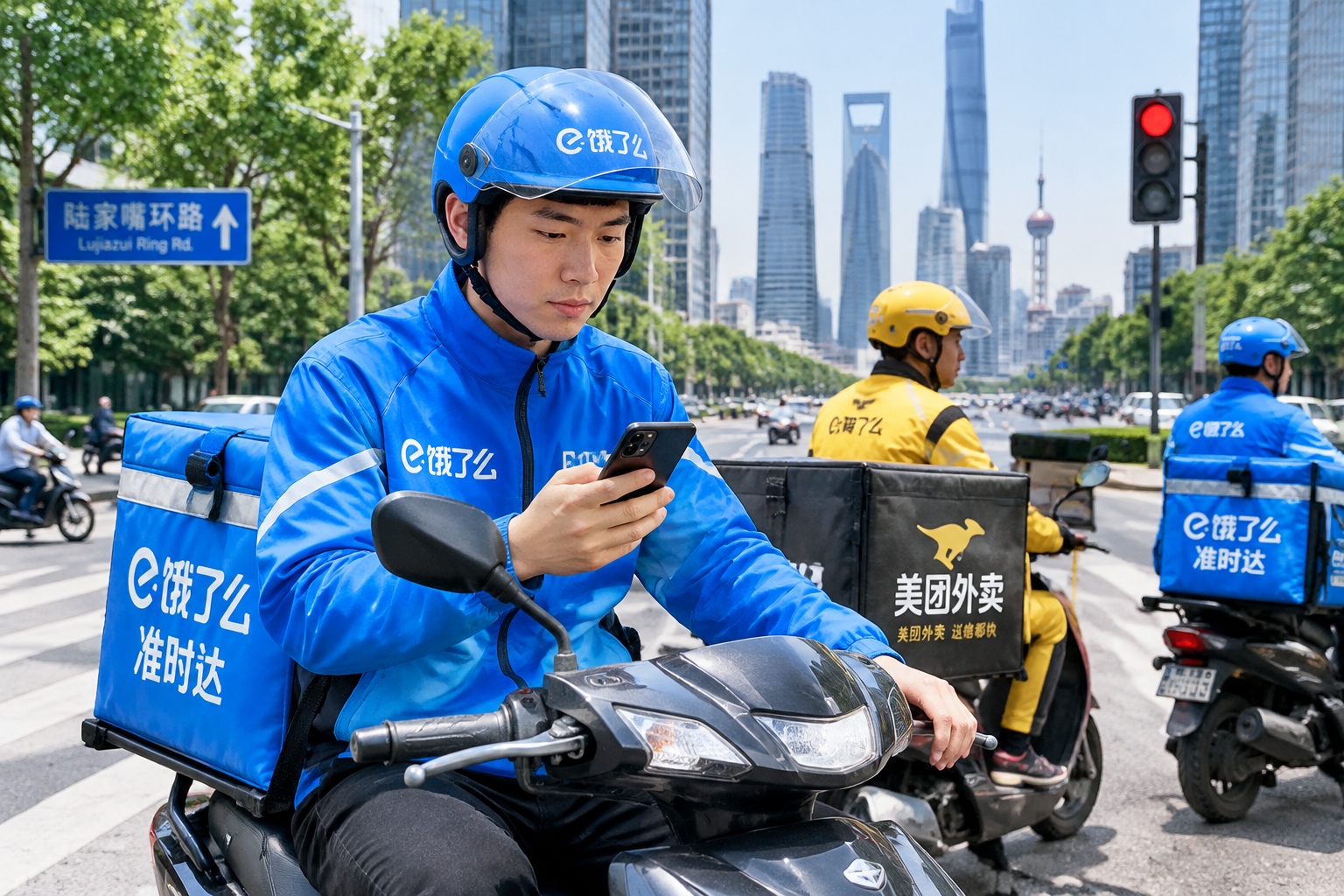
In most American and British cities, a delivery estimate of 45 to 60 minutes is normal. On a Friday night it slips past an hour. Thirty minutes is possible in Manhattan or central London, but it costs — a service fee, a tip, sometimes both — which means delivery becomes something you do occasionally, not something you do on an ordinary Tuesday because you can’t be bothered to cook.
In China, delivery is closer to a utility. Meituan’s annual report put its 2023 instant-delivery volume at more than 20 billion orders, and industry estimates put the whole market past 40 billion a year. More than seven million people earned money on Meituan’s delivery network in 2023 alone, according to the company’s own disclosures. In Shanghai, having noodles show up at your door in half an hour costs roughly what a subway ride costs.
So the obvious question: is this just cheap labor, or is it an algorithm squeezing people? Both answers get repeated constantly online. Neither is exactly wrong. Neither is the whole picture.
First, the Distances Are Genuinely Short
A delivery rider is not crossing a suburb. Look at where the orders come from: almost all of them sit within one to three kilometers of the customer. Inside that circle, in nearly any Chinese city, you’ll find dozens of restaurants, several residential compounds and at least one cluster of office towers.
Shanghai’s central districts hold roughly 20,000 to 30,000 people per square kilometer — comparable to or above Manhattan. Chengdu, Wuhan, Guangzhou and Shenzhen tell the same story. Delivery works here because the customer, the kitchen and the rider are already next to each other. The thirty minutes isn’t speed. It’s proximity.
Second, the Algorithm Schedules an Entire City
When you tap pay, the dispatch system does not simply pick the nearest rider. It estimates how long the kitchen needs to cook and pack, where each available rider will be eight minutes from now, how many orders can be stacked onto one route without breaking the promise, which intersections are slow, whether it’s raining, and how long the elevator takes.
Good batching is the difference. A rider carrying three orders from the same street to the same compound does the work of three trips in one. The arrival time you see on your phone — usually 30 to 38 minutes — is generated from that model. No manager sets it by hand.
But listen to the riders on this point: the algorithm is a scheduler, not a motor. It tells you what is theoretically possible. Somebody still has to go and do it.
Third, the Job Is Physical Skill
A rider I’ll call Zhang Wei, who works the lunch shift out of a station in Putuo District, stops using GPS for the last 300 meters. He knows which of the four gates at a compound opens for scooters, which building has the slow elevator, which security guard waves him through, and which office tower makes visitors register at a desk. That knowledge is worth minutes, and minutes are money.
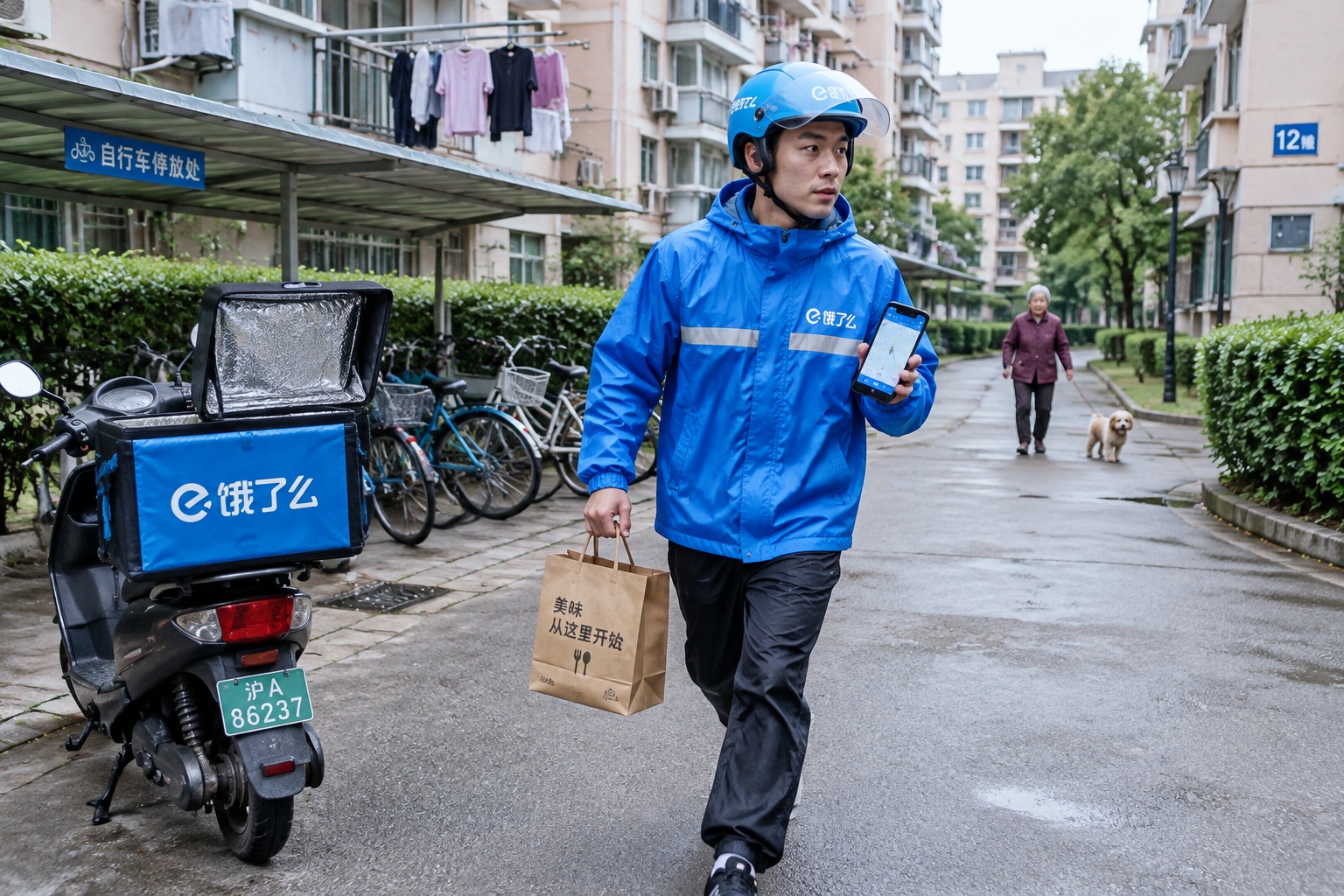
Under the national standard, his electric scooter tops out at 25 km/h — no faster than a fit cyclist on flat road. On a wet day he rides slower and gets wetter. He carries two phones, one for each platform, and a power bank in his pocket.
During a lunch peak he might clear fifteen to twenty orders in three hours. He is paid per order, usually a few yuan each, plus volume bonuses and a little extra for working in bad weather. A full-time rider in Shanghai putting in long days might take home 7,000 to 12,000 yuan a month, depending on hours, district and luck. In most cases there is no base salary and no paid leave. Every minute of that thirty-minute promise is produced by somebody’s legs and memory.
Fourth, the Kitchen Was Rebuilt for Delivery
The clock doesn’t start when the rider arrives. It starts when the order lands in the kitchen.
Look behind the storefronts: whole streets of small, cheap kitchens that serve almost nobody sitting down. Their menus are short and standardized, prep is done in advance, and packing takes seconds — sealed bowls, sealed bags, everything stackable and leak-proof. A typical dish leaves the pass in three to five minutes. In a traditional restaurant, that same dish might take fifteen, with the rider standing in the doorway getting rained on.
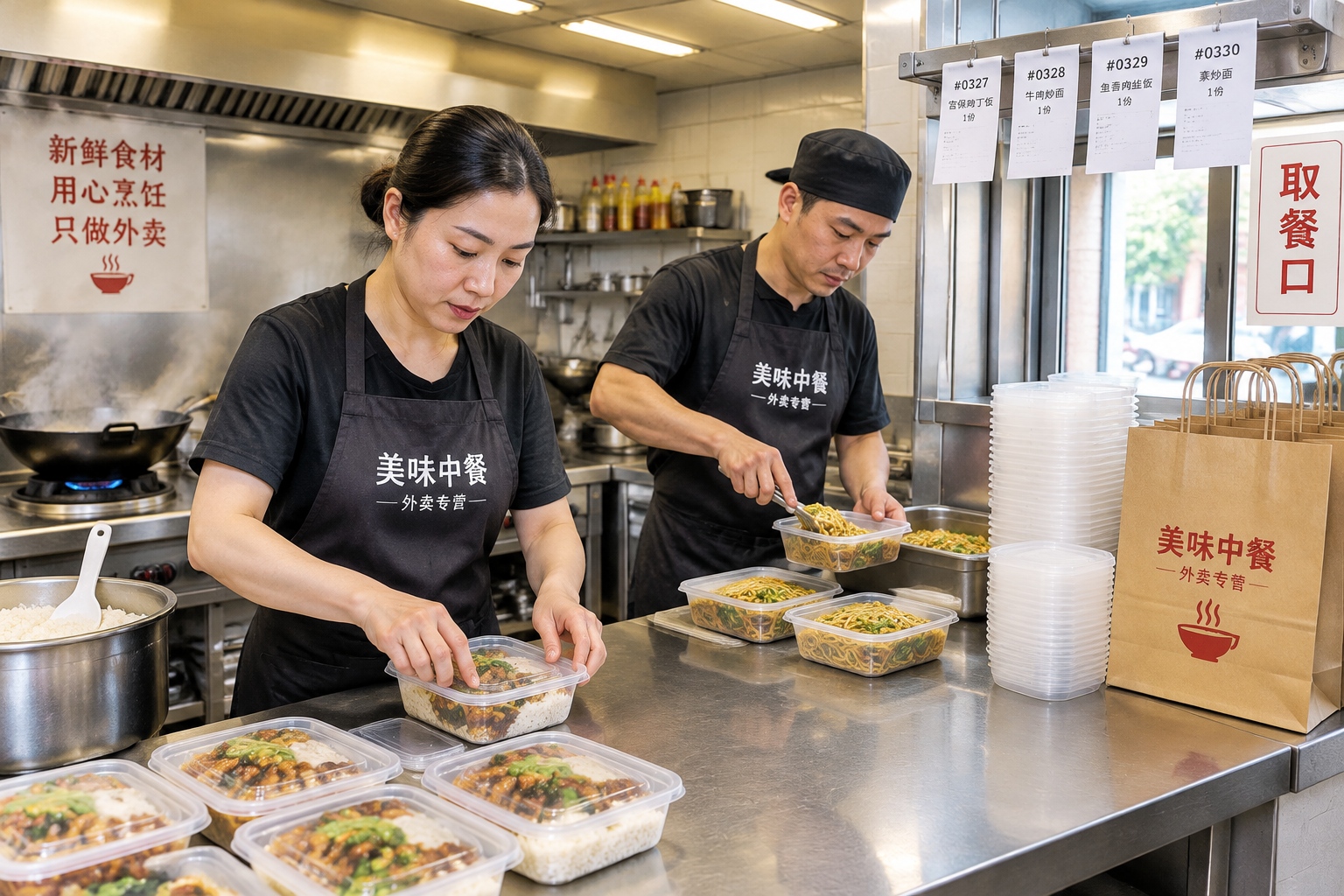
This matters more than people realize. China’s delivery speed is partly a restaurant-design story: the food itself was redesigned to travel.
Fifth, the City Is Wired for the Handover
Every step of the exchange has been smoothed by infrastructure. Mobile payment means no cash and no change. Addresses are detailed down to building, unit and gate code. Office lobbies and residential compounds have delivery cabinets where a rider can drop a bag in eight seconds and leave. There are rider stations with charging points, hot water and a place to sit; designated scooter parking; elevators riders are allowed to use.
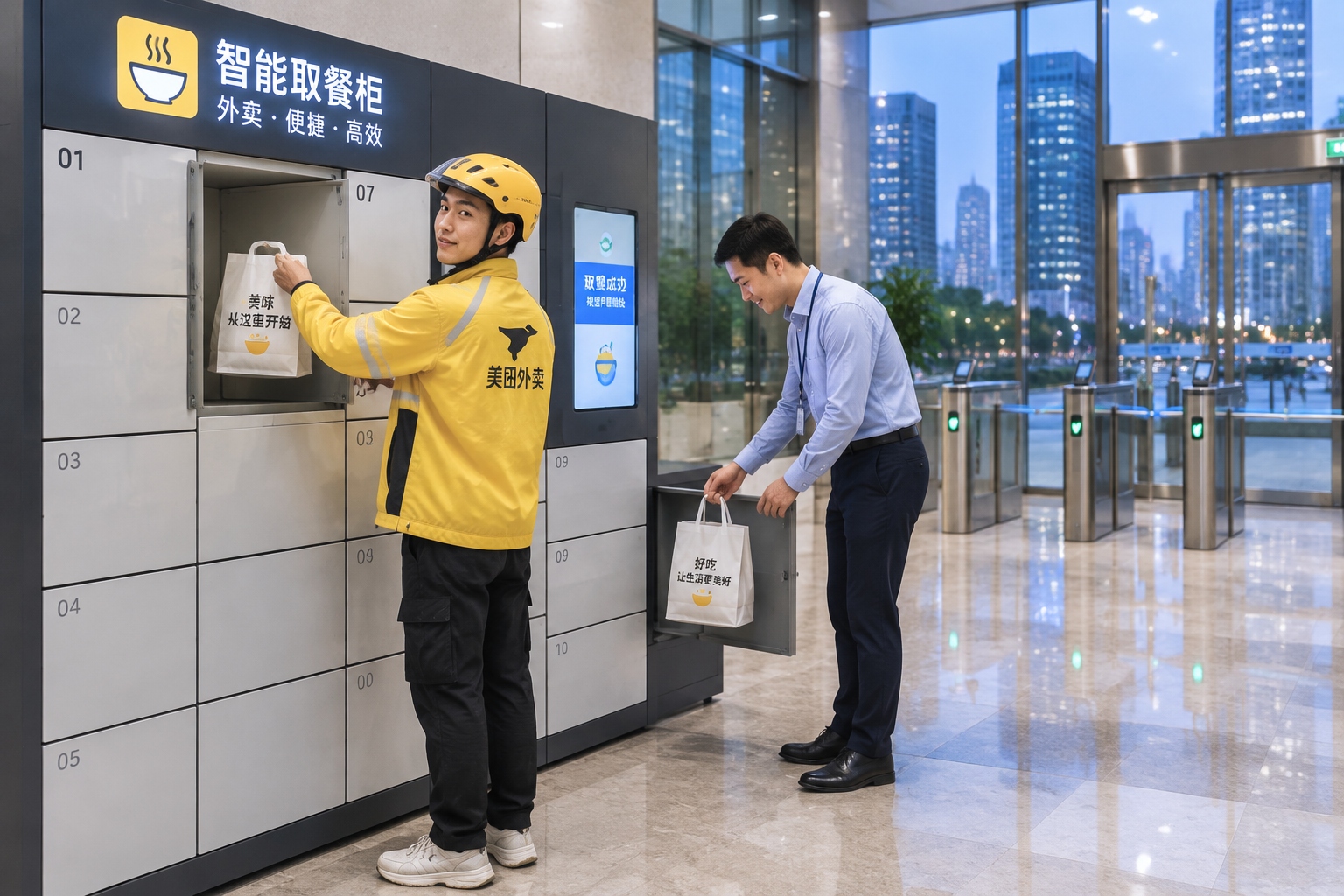
None of it is glamorous. It is the plumbing that makes a thirty-minute promise physically survivable.
What the Thirty Minutes Costs
Riders are among the most exposed people on Chinese roads. Time pressure, rain, night shifts and pay that rewards speed all push in the same direction.
In 2020, a magazine article about delivery riders’ working conditions titled Stuck in the System went viral in China and changed the public conversation. Since then, the government launched a pilot occupational injury insurance program for gig workers in seven provinces in 2022, covering millions of riders. Platforms softened some penalties. In 2025, after JD.com pushed into food delivery, both JD and Meituan said they would begin contributing to social insurance for riders.
None of that settles the argument. Riders still talk about long hours, deductions they don’t fully understand, and the fact that a bad month has no safety net underneath it. The thirty minutes is not free. It is paid for in risk, in weather, and in a labor model that is still being negotiated in public.
Why Other Countries Can’t Simply Copy It
You can build a delivery app anywhere. What’s hard to copy is the combination: population density that puts thousands of customers inside one kilometer; labor costs low enough that a three-yuan delivery fee makes sense; a restaurant industry dense enough to supply delivery-native kitchens; a payment and address system that removes friction; and customers who expect delivery to be nearly free.
In a low-density American suburb, the same order is a fifteen-minute drive each way. That isn’t an algorithm problem. That’s geography, zoning and a different labor market, all at once.
Then the Doorbell Rings
Back on Chengdu Road, it’s 1:30 p.m. Zhang Wei eats standing up, from a plastic box, next to his scooter. His phone is on the seat beside him and it will buzz again in about ninety seconds.
Thirty minutes is not magic. It’s density, software, standardized kitchens, cheap labor, and a person on a scooter deciding which gate to use.
Start the discussion at forum.chinacomes.com