
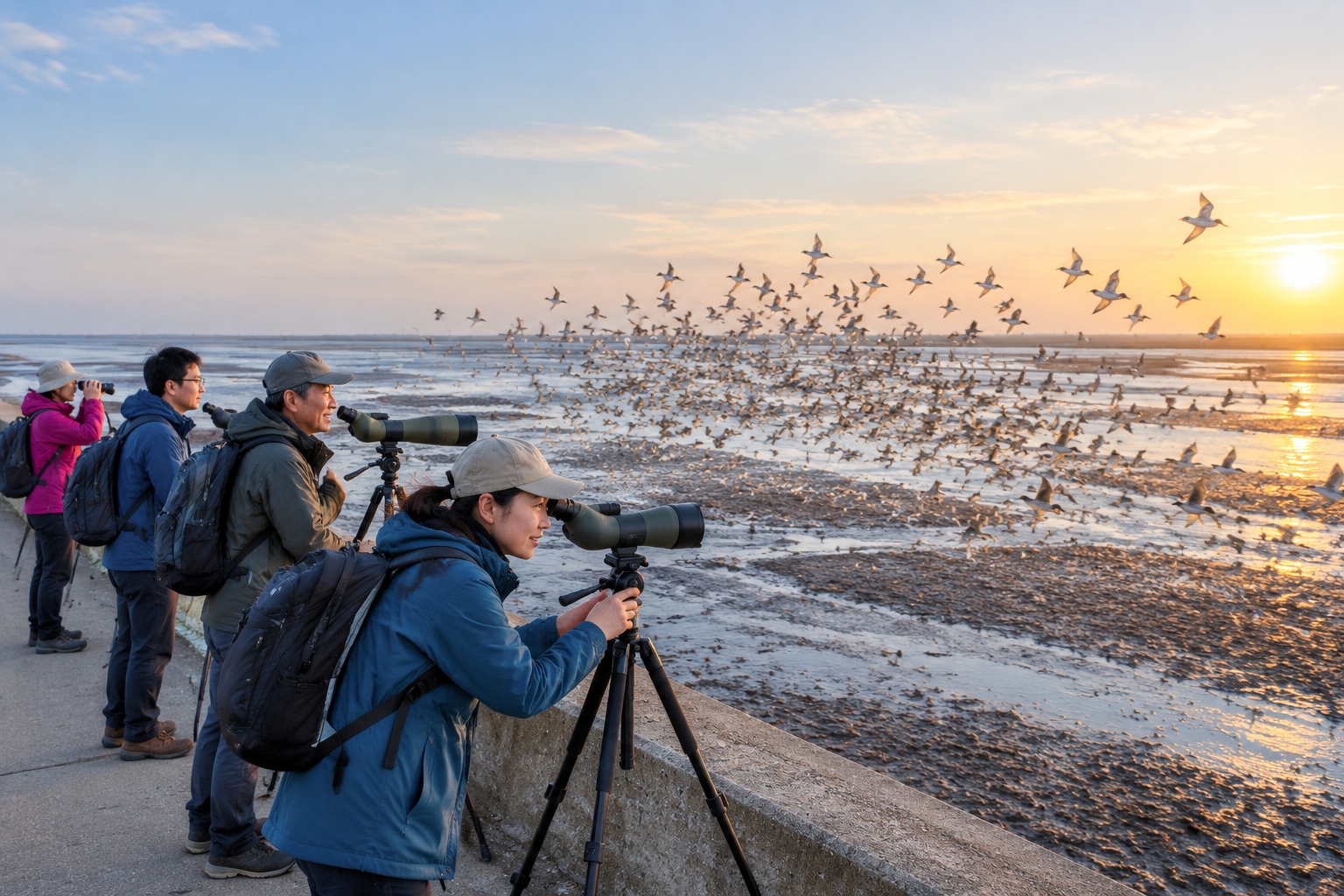

5:40 a.m. on the seawall, waiting for the light
The wind arrives before the view does. It comes off the flat carrying salt, iodine and the smell of exposed mud — the same smell as a harbor at low tide, but much larger, as if the whole sea had stepped back and left its floor behind. It is late April and still dark. I am standing on a concrete seawall at Tiaozini, a tidal flat on China’s Jiangsu coast. The nearest town, Dongtai, is an hour behind me. Shanghai is roughly three hours south by car, or two by high-speed train.
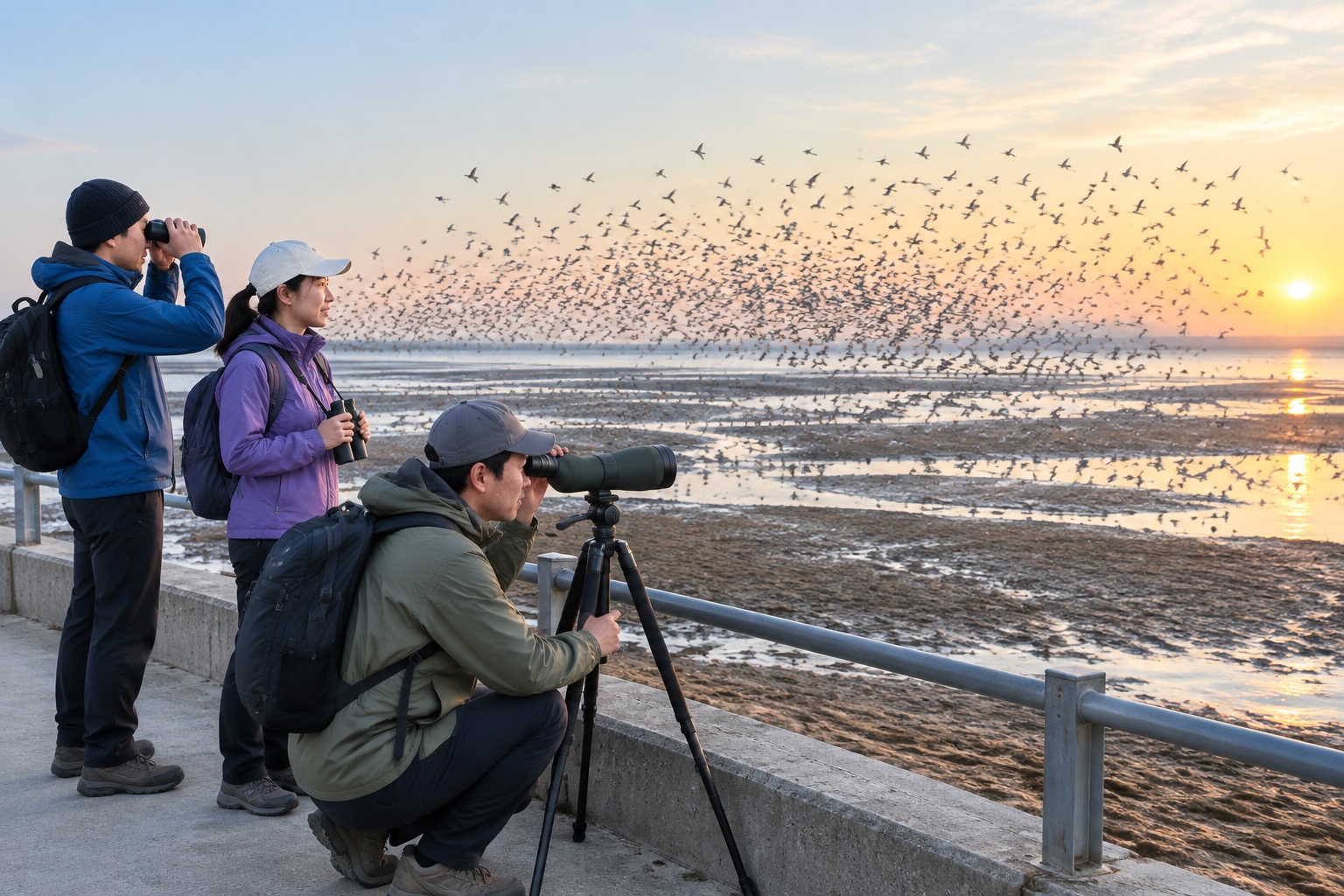
Eleven other people are on the wall with me, and nobody can use their binoculars yet. A man from Nantong has a spotting scope on a tripod and a thermos of tea. Somewhere out in the dark there is a sound like static — thousands of small birds, invisible, chattering on the mud.
Then the sky goes gray, then pale gold. And the flat, which looked like empty brown water, is not empty at all. It is covered in birds.
The nearest group is a few thousand dunlin, packed so tightly they read as one organism with a slight ripple running through it. Farther out, along the waterline, larger birds — godwits, curlews — stand like fence posts in a line. Around 6:15 something spooks them: not us, maybe a raptor. The whole mass lifts at once. The sound of ten thousand wings is not a whoosh; it is closer to applause, and then it folds and turns and settles again, gray on gray.
Chinese birders call this a bird wave. Photographers chase it for years. What surprises you, standing there, is how undramatic it is. The birds are not performing. They are eating, because they are on a schedule that does not care whether you got up early.
What the Yellow Sea wetlands actually are
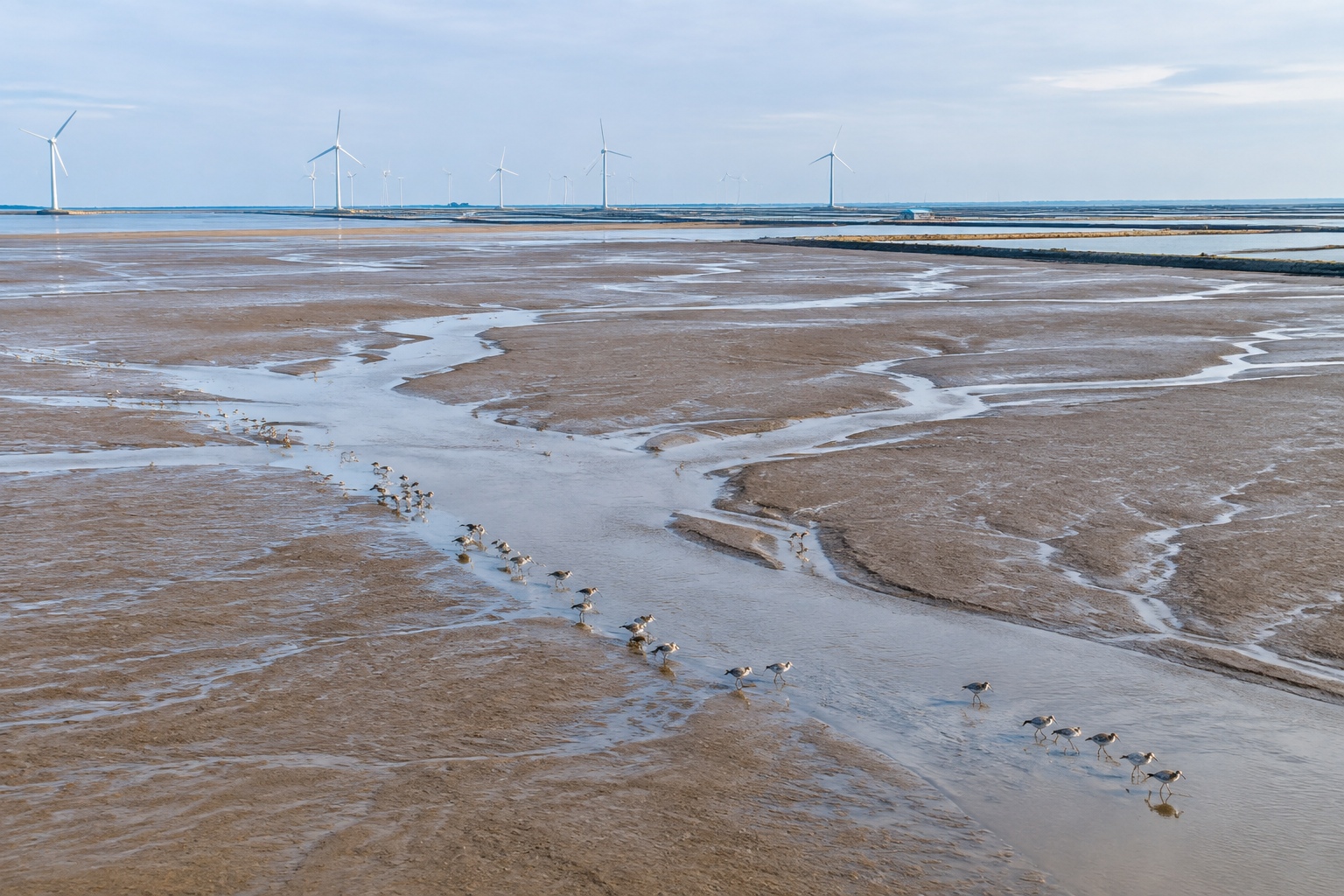
Start with the geography, because it explains everything else. The Yellow Sea, between China and the Korean peninsula, has some of the strongest tides in the world and takes in enormous amounts of sediment from the Yellow River, the Yangtze and smaller rivers. The result, along the Jiangsu coast in particular, is one of the largest continuous stretches of tidal mudflat on the planet — a flat, brown, unphotogenic landscape that most tourists would drive past at 100 km/h.
For birds, it is the single most important rest stop on the East Asian–Australasian Flyway, the migration route that runs from breeding grounds in Siberia and Alaska down to wintering grounds in Southeast Asia, Australia and New Zealand. Around 50 million migratory waterbirds use that route. Dozens of shorebird species depend on the Yellow Sea mudflats specifically, because there is almost nowhere else like them: temperate tidal flats with soft mud full of worms, snails and small shellfish.
Here is the number that makes the whole thing make sense. A great knot, a robin-sized wader, flies from Australia to the Yellow Sea — roughly 5,000 to 6,000 kilometers — without stopping. It arrives thin. Within a few weeks on these flats it must roughly double its body weight before flying on to breed in the Arctic. There is no alternative stopover. If the mud goes, the flight chain breaks, and it breaks for birds that winter on the other side of the world.
China recognized this in 2019, when a group of coastal sites centered on Yancheng was inscribed as a UNESCO World Heritage site: the Migratory Bird Sanctuaries along the Coast of Yellow Sea-Bohai Gulf of China. In 2024 a second phase extended the listing to more coastal sites, including Chongming Dongtan near Shanghai.
The birds you actually come for
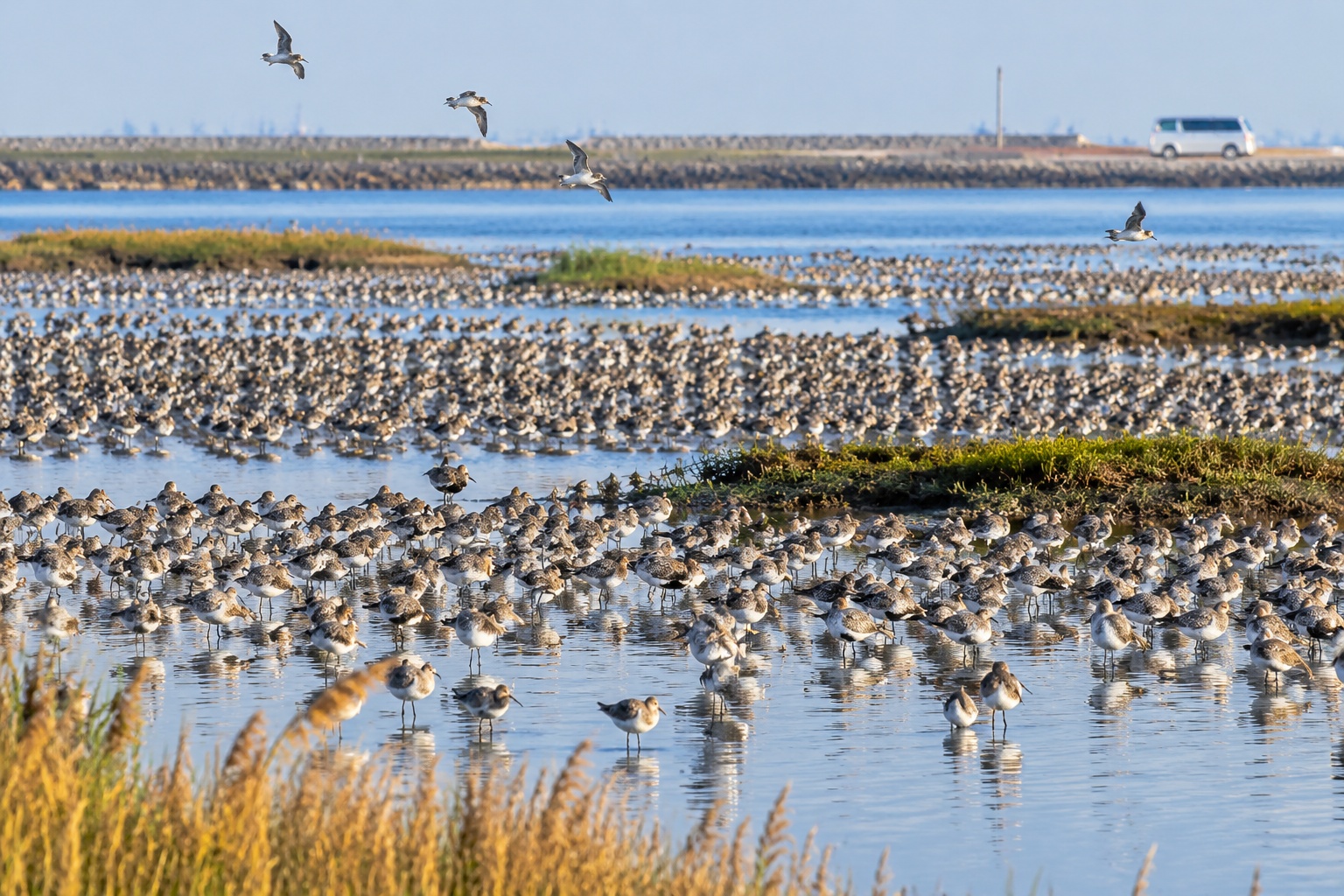
Migration season runs roughly April to May and August to October, and the species mix changes week by week. In one morning at Tiaozini you may see tens of thousands of dunlin, red-necked stint, grey plover, bar-tailed godwit, Eurasian curlew. In late April you have a real chance at great knots and Far Eastern curlews — the latter a big, long-billed bird that is now endangered.
The famous one is the spoon-billed sandpiper, a sparrow-sized wader with a beak that looks like a tiny spatula. Its global population is numbered in the low hundreds. It passes through this coast in a narrow window in spring and autumn, feeds on the outer flats, and is genuinely difficult to find: you need a scope, a good guide, a rising tide and luck. Some birders come for three mornings and leave with a photograph. Most leave with a story about the one that got away.
Winter is a different trip. From December to February, Yancheng’s reed beds hold red-crowned cranes, and the nearby Dafeng reserve has several thousand milu, or Père David’s deer — a species that was extinct in the wild in China and was rebuilt from a small herd kept in England in the 1980s.
The tide decides everything, not sunrise
This is the one thing first-timers get wrong. You do not plan a birdwatching morning around the sun; you plan it around a tide table for Dongtai or Jianggang.
Shorebirds feed on the flats when the water is low or rising. As the tide pushes in, they cannot stay there, so they fly to the highest dry ground they can find to rest and digest. That gathering — the high-tide roost — is where the spectacle happens. At Tiaozini, local managers built an artificial roost of about 720 mu (roughly 48 hectares), a shallow flooded field with islands, so the birds would not be forced into abandoned ponds or off the coast entirely. On a good spring day, tens of thousands of birds pack into a few hectares, a few hundred meters from the road. That is as close as you will get anywhere on this coast.
The practical consequence: tides shift about 50 minutes later each day. A great morning this week might be a dead afternoon next week. If you are booking trains and hotels around one morning of birding, check the tide first.
Two rules matter here, and local conservation staff enforce them. Do not walk onto the flats — the mud is deep, the creeks fill fast, and every flushed flock burns calories the birds need for a 6,000-kilometer flight. And do not fly a drone. It is banned at the reserves, it scatters birds, and you will be asked to leave.
The uncomfortable part
You cannot look at this coast honestly without the losses. Since the 1950s, roughly two-thirds of the Yellow Sea’s tidal flats have been reclaimed, converted into aquaculture ponds, ports, farmland and industrial zones. For shorebirds, that is one of the largest habitat losses of any coastal ecosystem in the last century, and the spoon-billed sandpiper’s decline tracks it closely.
The direction has changed. In January 2018, China’s State Council stopped approving new reclamation of tidal flats, which is why you now see older ponds being restored rather than new sea walls going up. Since 2020 there has been a national program to remove smooth cordgrass, a North American plant introduced for coastal stabilization that turns open mud into dense green meadow — good for the coastline, useless for a bird that feeds on bare mud. Scientists from Nanjing, Beijing and elsewhere work here every spring and autumn, counting birds with clickers on the seawall at dawn.
It is also not a simple story of nature versus people. The aquaculture ponds behind the seawall — for shrimp, crabs, clams — sometimes function as feeding habitat when the tide is out. Local governments in Dongtai and Yancheng now market the birds: birdwatching tourism, guesthouses, guides. Fishermen who once netted migratory birds now take visitors out to see them. That shift is real, and it is also fragile. The flats that remain are a fraction of what was there, and the most endangered bird on this coast is still sliding toward extinction.
Life behind the seawall
Most visitors see the wetland and nothing else, which is a mistake. The villages behind the seawall are working places, and the rhythm of the day matches the tide.
By 6:30 a.m., the shellfish market in Jianggang is busy. There are bamboo baskets of razor clams, bowls of tiny shrimp, and women sorting clams into sizes with wet hands. A breakfast stall does fish noodle soup for around 10 yuan — thick noodles, cloudy broth, a whole small fish on top. It is the best thing you will eat all day.
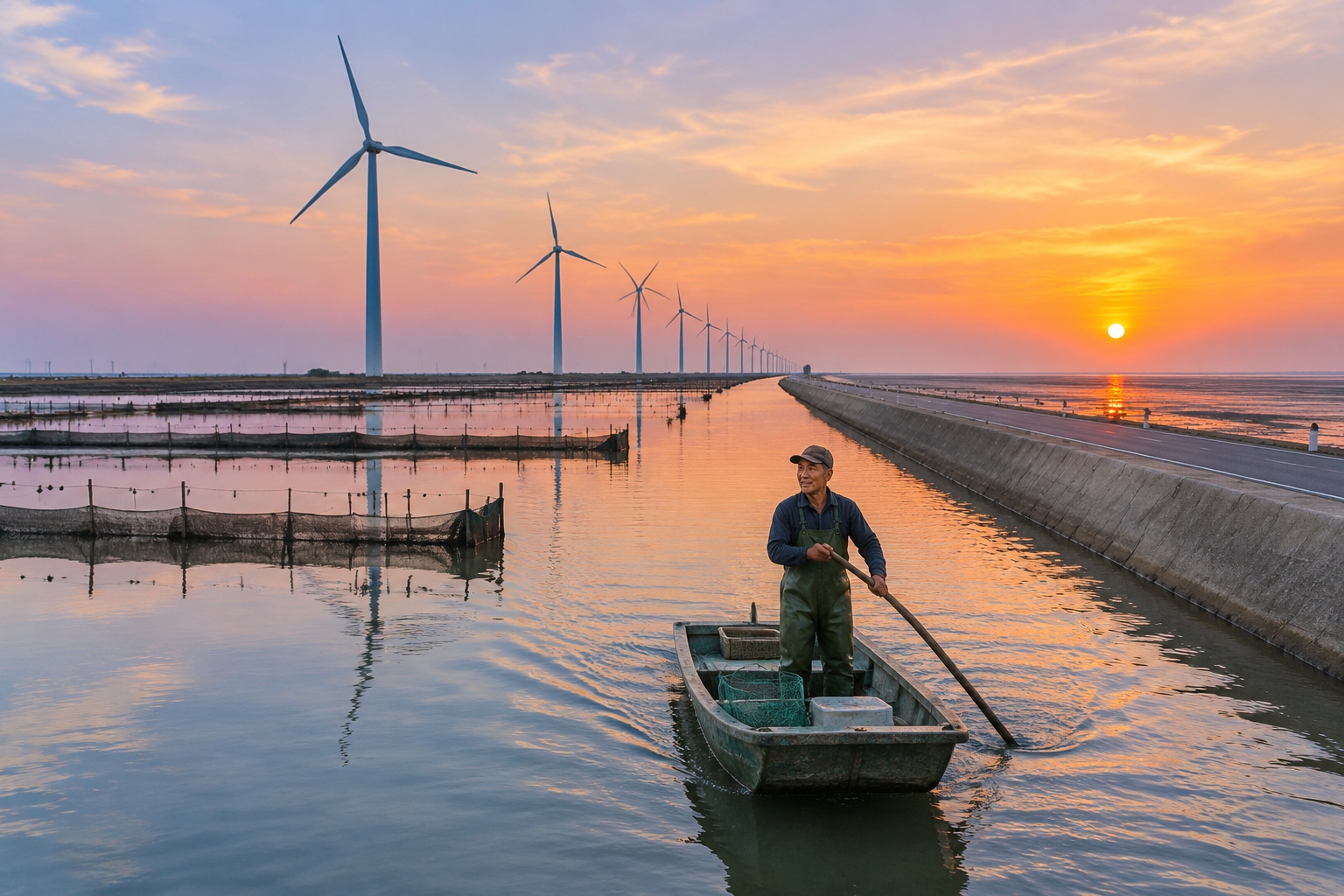
Out on the flats at low tide, clam diggers work with short hoes, bent over for hours, dressed in layers of old rain gear. Inland, wind turbines turn along the sea wall in long rows, and shrimp ponds shine like mirrors. It is a landscape of hard, ordinary work, and the birds happen to be the newest crop.

If you go: the practical version
Getting there is easier than the remoteness suggests. High-speed trains run from Shanghai Hongqiao to Dongtai in about two hours, or to Yancheng in roughly two and a half to three hours. From either station you need a car: 40 to 70 minutes to the Tiaozini wetland area. A hired driver for a half-day of birding typically costs 300 to 500 yuan; a birding guide, who will bring a scope and know where the spoon-billed sandpiper was seen yesterday, runs around 300 to 800 yuan a day. Confirm prices locally — they shift with the season.
A few things worth knowing before you book:
- Best months: mid-April to May and August to October for migration; December to February for cranes and milu deer.
- Check the tide table first, then book transport. High tide is the show.
- Bring: binoculars (8×42 is fine), a windproof jacket, warm layers even in April, sun protection, and shoes you are willing to ruin. A spotting scope is close to essential for the rare species; guides rent or lend them.
- Reservations: the managed wetland parks here often require booking in advance, frequently through a WeChat mini-program. If that is unfamiliar, ask your hotel to help — this is completely normal in China.
- Costs: entrance to managed wetland areas is usually in the tens of yuan, occasionally around 100. Food and lodging in Dongtai are cheap by big-city standards.
- Etiquette: no drones, no walking on the mudflats, no playing bird calls to attract birds, and no chasing a flock for a photograph.
An hour after high tide
By 9 a.m. the water is at its peak, and the noise drops. The birds have stopped flying. They stand in the shallow water in their tens of thousands, packed shoulder to shoulder, most of them asleep, some preening. A volunteer on the seawall clicks a counter and writes a number in a notebook. Behind us, a van delivers breakfast to the staff. Nobody is talking much.
Then the tide starts to fall, and the whole thing reverses: the flocks lift, spread out, and drift back onto the mud to feed, until the flat looks empty again — just brown water and distant specks that a casual visitor would never notice.
That is the honest version of watching migration in China. You get up at four, you stand in the wind, you see something most people will never see, and then it is over by lunch. Come back in September and the mud will be the same, the tide will be different, and the birds will be entirely new ones, halfway through a journey that starts in the Arctic and ends in Australia.
Start the discussion at forum.chinacomes.com