

A question at the museum
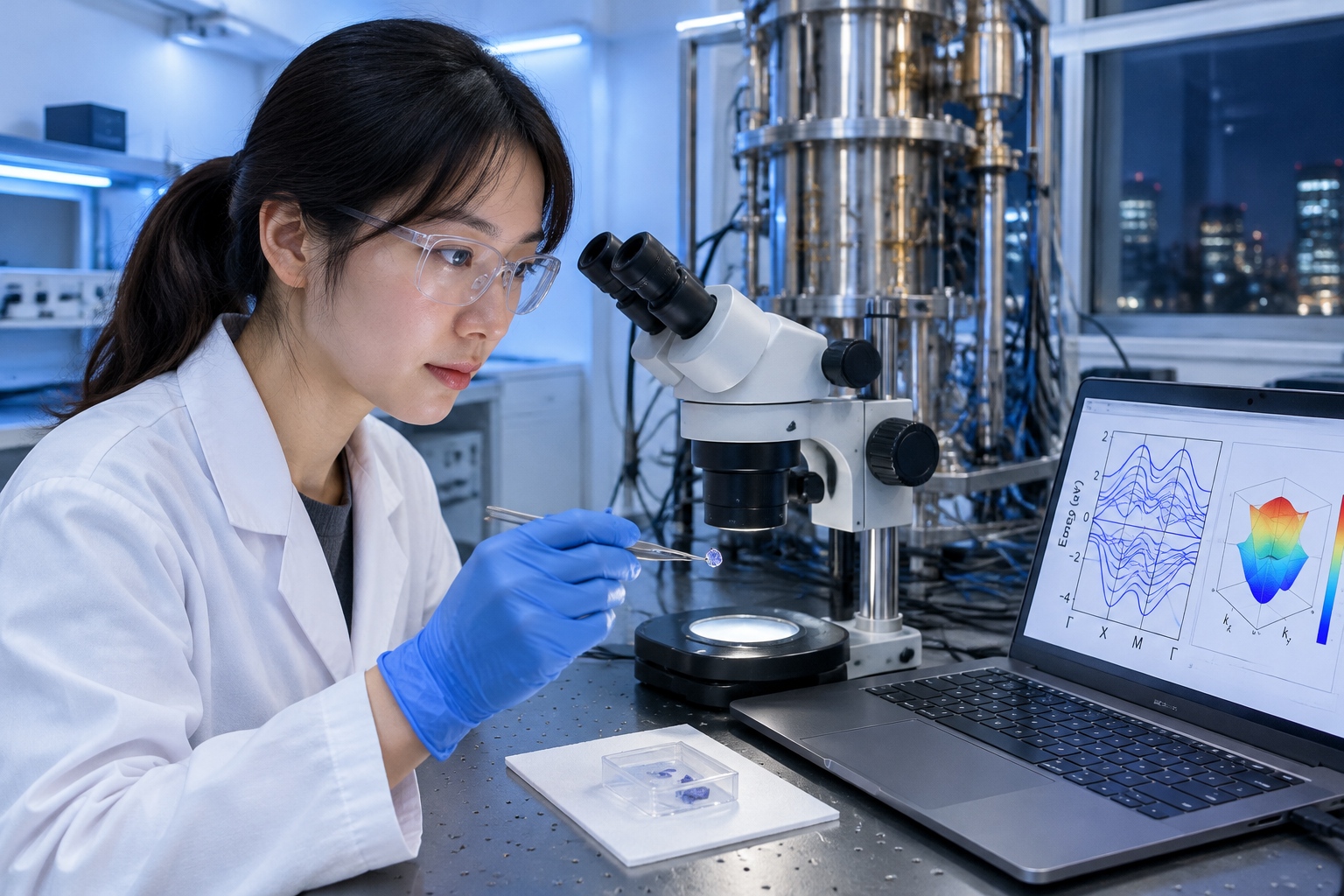
On a rainy Saturday at the Shanghai Science and Technology Museum, a father leans toward a display case and asks his daughter, “So the particle is inside this rock?” The label reads: Weyl fermion. The object is a dull, silvery crystal, not much bigger than a thumbnail. It is a fair question. The answer is both yes and no.
Why a crystal can host a “new particle”
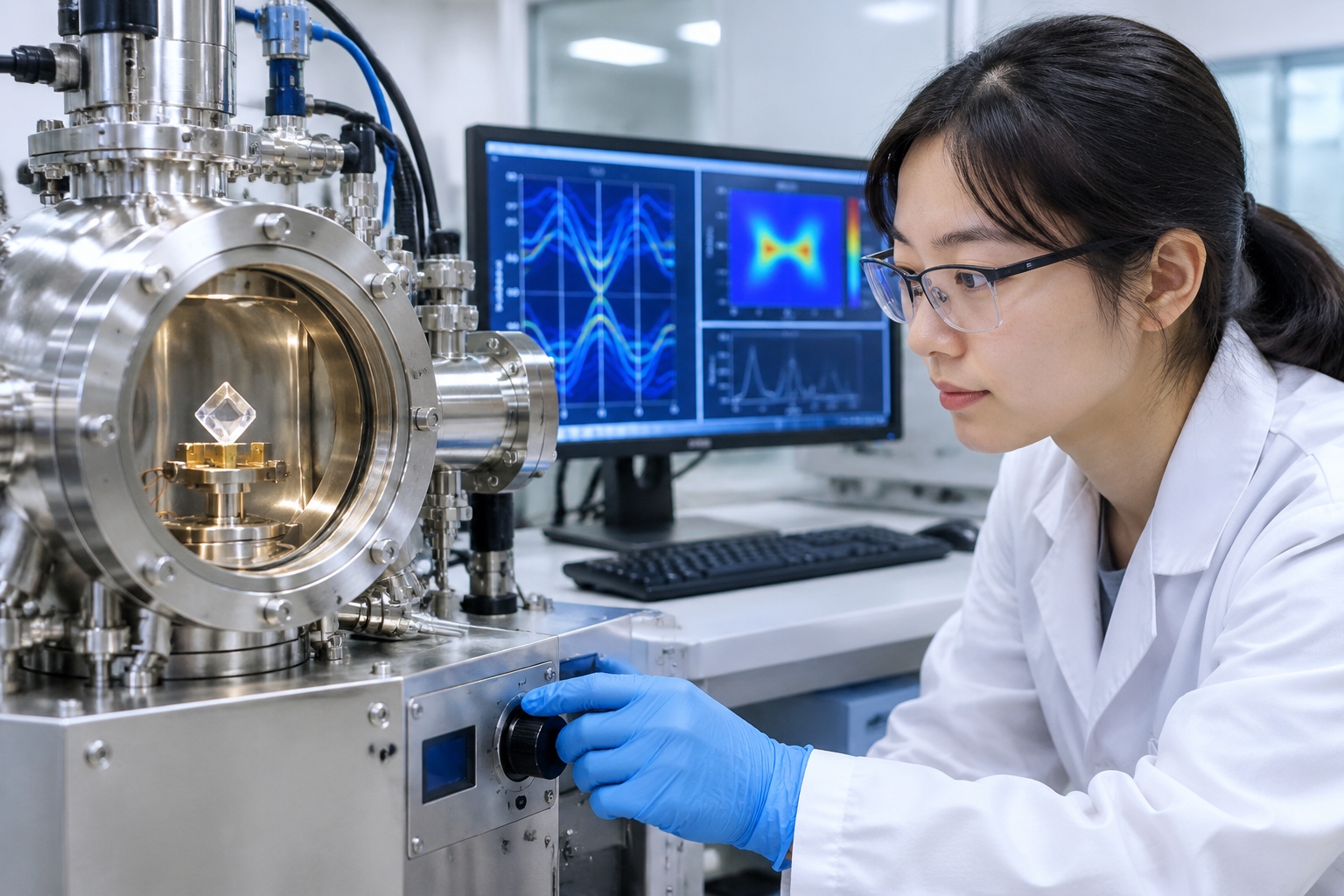
In 1929, Hermann Weyl wrote down an equation for a massless particle. For decades, no one found a Weyl fermion in vacuum. Then, in 2015, two independent teams reported seeing its signature in a crystal of tantalum arsenide (TaAs). One team was led by Ding Hong at the Institute of Physics, Chinese Academy of Sciences. The other was led by M. Zahid Hasan at Princeton. Their papers appeared within months of each other.
The Weyl fermion inside TaAs is not a new fundamental particle. It is a quasiparticle: a collective behavior of electrons in the crystal that obeys the same mathematics as a Weyl fermion. Think of a crowded subway platform. No single person is the crowd, but the crowd can surge in a wave that behaves like one object. In a crystal, electrons can do something similar. Their quantum states can meet at a point and disperse like massless particles. The crystal is the stage; the quasiparticle is the pattern.
This is why condensed matter physics can feel strange to outsiders. It does not smash atoms to find new building blocks. It looks at how many electrons, in a solid, can organize into states that were never seen in empty space. The material is not a container for a particle. The material and the particle are two sides of the same quantum arrangement.
Three roads meeting at one point
Weyl fermions are not the only unusual electronic state in crystals. In some materials, three electronic bands meet at a single point in momentum space. The result is a triple-degenerate fermion. In 2017, a collaboration including Chinese researchers reported evidence for this state in molybdenum phosphide (MoP). The team used angle-resolved photoemission spectroscopy, a technique that maps electron bands by knocking electrons out of a crystal and measuring their energy and angle.
The difference between Weyl and triple-degenerate fermions is a bit like the difference between a two-road fork and a three-road junction. Both are places where electronic roads meet. But the number of roads changes the rules. Triple-degenerate fermions give physicists another test case for theories that were once confined to particle physics. They also expand the catalog of topological materials—crystals whose electronic behavior is protected by deeper mathematical symmetries.
From crystal to collision: a different kind of hunt
Particle physics works on another scale. Instead of a crystal on a table, it uses an accelerator. Instead of mapping electrons, it smashes protons or electrons together and looks at what flies out. The goal is to find fundamental particles and to understand the forces that bind them.
The double-charm baryon: heavy cargo
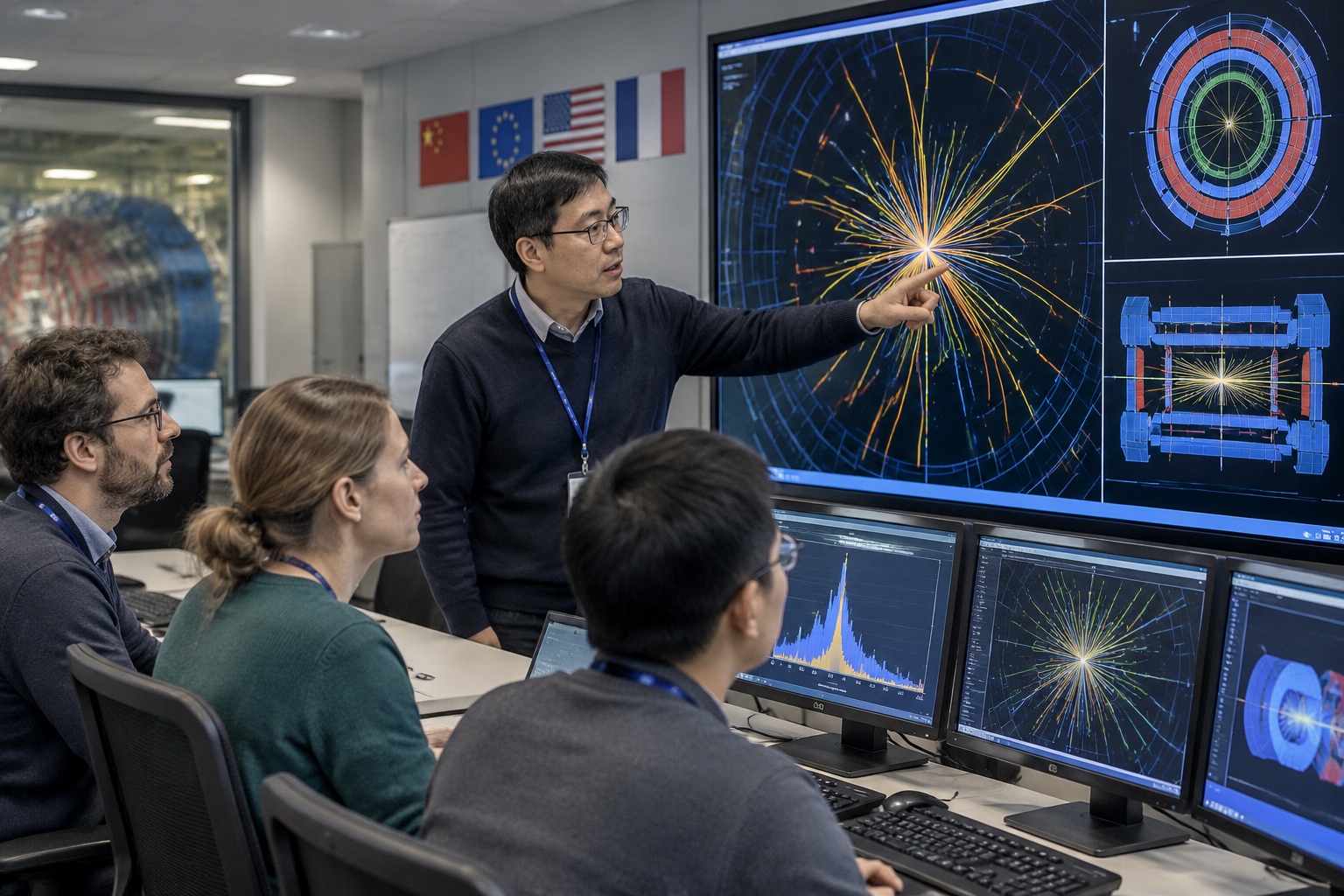
In 2017, the LHCb experiment at CERN’s Large Hadron Collider announced the discovery of the double-charm baryon Ξcc++. A baryon is a particle made of three quarks. Protons and neutrons are baryons. The Ξcc++ is unusual because it contains two charm quarks and one up quark. It is about four times as heavy as a proton. The discovery confirmed a particle that theorists had predicted for decades.
Chinese physicists are part of the LHCb collaboration. They work on data analysis, detector systems, and software. At home, China’s BESIII experiment at the Institute of High Energy Physics in Beijing studies hadrons in a different energy range. The double-charm baryon did not come from a Chinese-only lab. It came from an international experiment in which Chinese researchers play a real role. That distinction matters if we want to describe how science in China actually works.
How do you know it is real?
In both fields, a claim is not enough. Other people have to check it. For the Weyl fermion, two independent teams used different samples and different measurements. They saw the same signature: the telltale “Weyl cones” in the electronic band structure. For triple-degenerate fermions, follow-up studies examined related materials and tested whether the observed bands matched theoretical predictions.
In particle physics, the bar is even more formal. A discovery usually requires a statistical significance of five sigma—roughly a one-in-3.5-million chance that the signal is a random fluctuation. The Ξcc++ was seen through its decay products. LHCb collected more data, checked the mass and decay patterns, and confirmed the particle. The result was not a single event on a screen. It was a consistent pattern in millions of collisions.
What it means—and what it does not
These discoveries are not going to change your phone next year. That is not how basic research works. Weyl semimetals might one day inspire low-power electronics or topological quantum devices, because their electrons behave in ways that are unusually robust against disorder. But “might” is the honest word. The path from a crystal in a lab to a product on a shelf is long, expensive, and uncertain.
Triple-degenerate fermions are even further from application. Their value is that they give physicists a new platform to test quantum field theory in a solid. They also help researchers classify materials and predict new ones. For the double-charm baryon, the payoff is knowledge about the strong force—the force that binds quarks into protons and neutrons. The Ξcc++ is a rare laboratory for studying how two heavy charm quarks interact with a light quark. That is a hard problem, and the data are precious.
The Chinese part of the story
China’s role in these results is best described as a mix of homegrown labs and international collaboration. The Institute of Physics in Beijing has built a strong program in topological materials. Chinese universities and institutes train students in ARPES, crystal growth, and data analysis. At the same time, Chinese physicists work inside global collaborations like LHCb. They are not spectators. They are part of the machinery.
That matters for how we read headlines. “China discovers new particle” is a simple sentence. The reality is more interesting. Some discoveries are led by Chinese groups. Some are made by international teams with Chinese members. Some are verified by rivals and collaborators in other countries. Science is a network, not a scoreboard.
Back at the museum
At the display case, the father’s question deserves a better answer than “yes” or “no.” The Weyl fermion is not hiding in the crystal like a marble in a box. It is a pattern in the electrons—a pattern that behaves like a particle predicted almost a century ago. The double-charm baryon is not in the crystal at all. It exists for a fraction of a second in a collision, then decays.
Both are ways of seeing what is normally invisible. A crystal can host a particle-like state that was never found in vacuum. A collision can reveal a baryon that theorists sketched on paper long before anyone saw it. These are not applications yet. They are maps. And maps are useful precisely because they show places we have not been.
Start the discussion at forum.chinacomes.com