

7 p.m. in Haikou: a sale you hear before you see
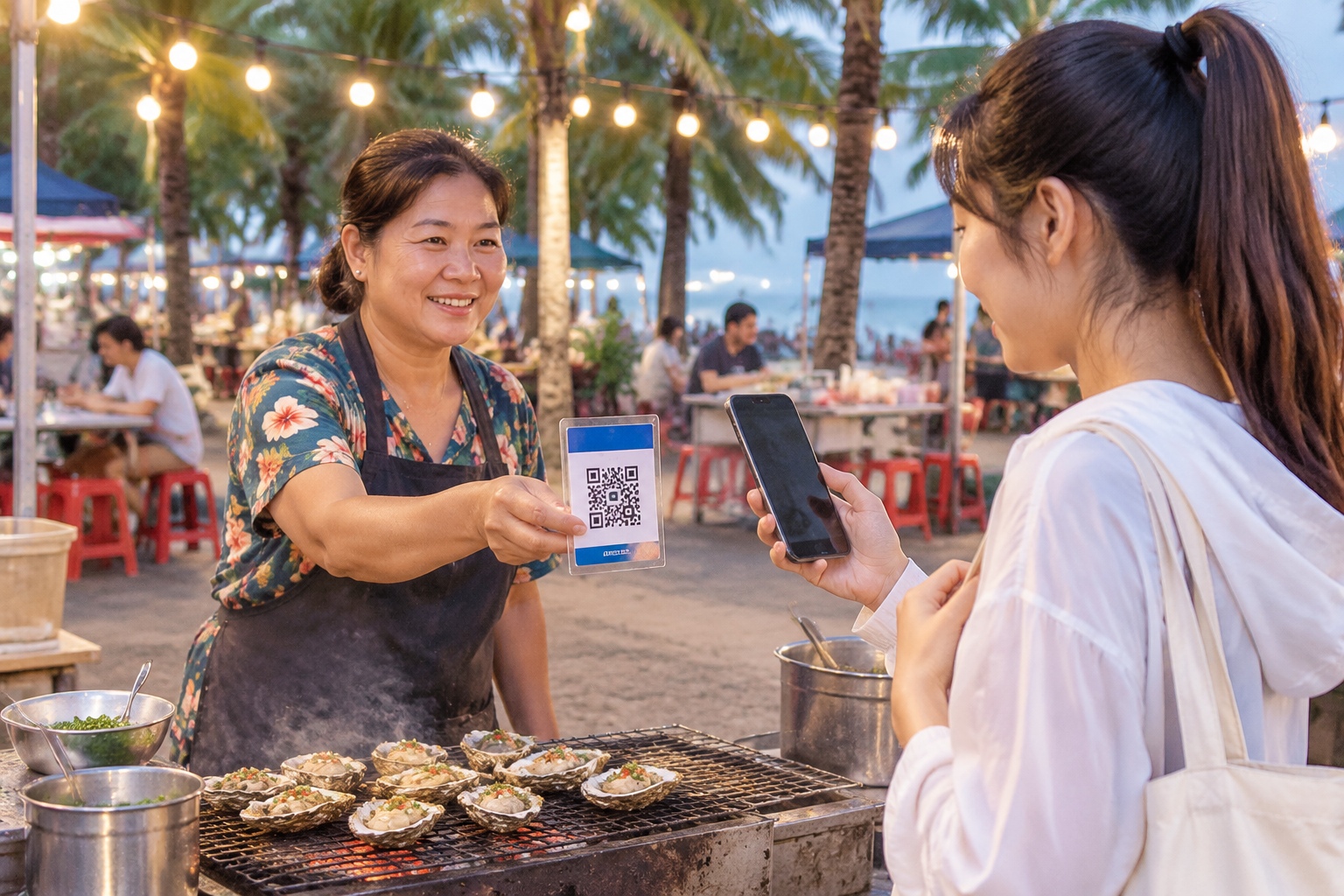
The lane outside the south gate of Hainan University starts to fill around six. By seven it is shoulder to shoulder, and the air smells of charcoal, garlic and coconut. A woman in her fifties, known to regulars as Auntie Wu, turns oysters on a grill with one hand and holds out a laminated card with the other.
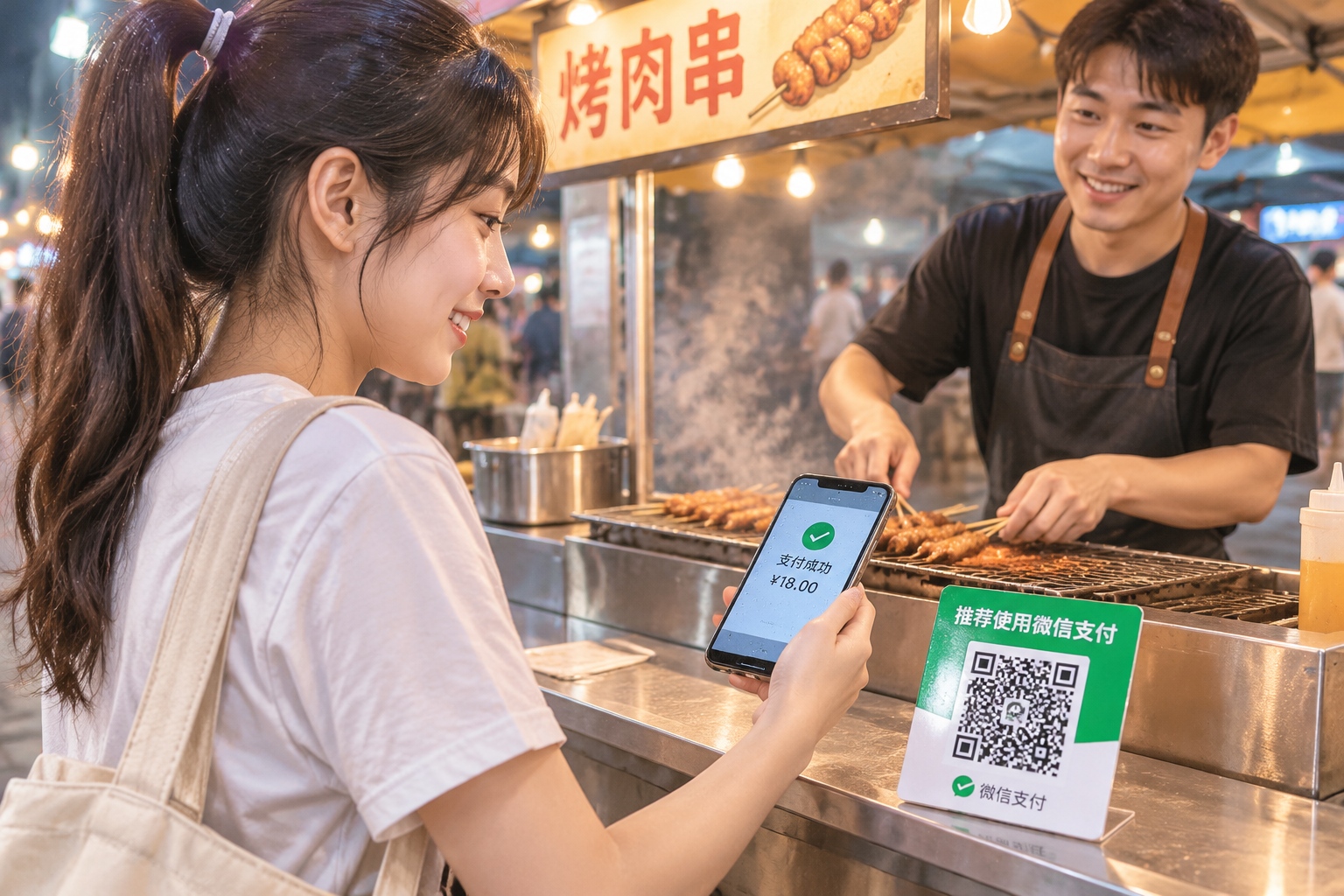
The customer, a student in a hoodie, does not reach for a wallet. She holds her phone over the card for about two seconds. A small black speaker clipped to the cart announces in a flat synthetic voice: “WeChat Pay, 16 yuan received.” Auntie Wu nods without looking up. The oysters keep turning.
That is the whole transaction. No coins. No change. No “do you have anything smaller?” The most common sound at a Chinese street food stall in 2024 is not a cash register or a shouted price. It is a recorded voice confirming that money has already arrived.
Where did the change box go?
Five years ago, Auntie Wu’s cart had a plastic tub behind the grill. It held one-yuan notes gone soft from handling, five-yuan notes clipped together, and coins that smelled faintly of garlic. Closing time meant twenty or thirty minutes of sorting dirty banknotes into stacks, then a trip to a convenience store or a bank the next morning to trade small notes for large ones.
The tub is still on the cart. It now holds skewers, a lighter, and a roll of plastic bags.
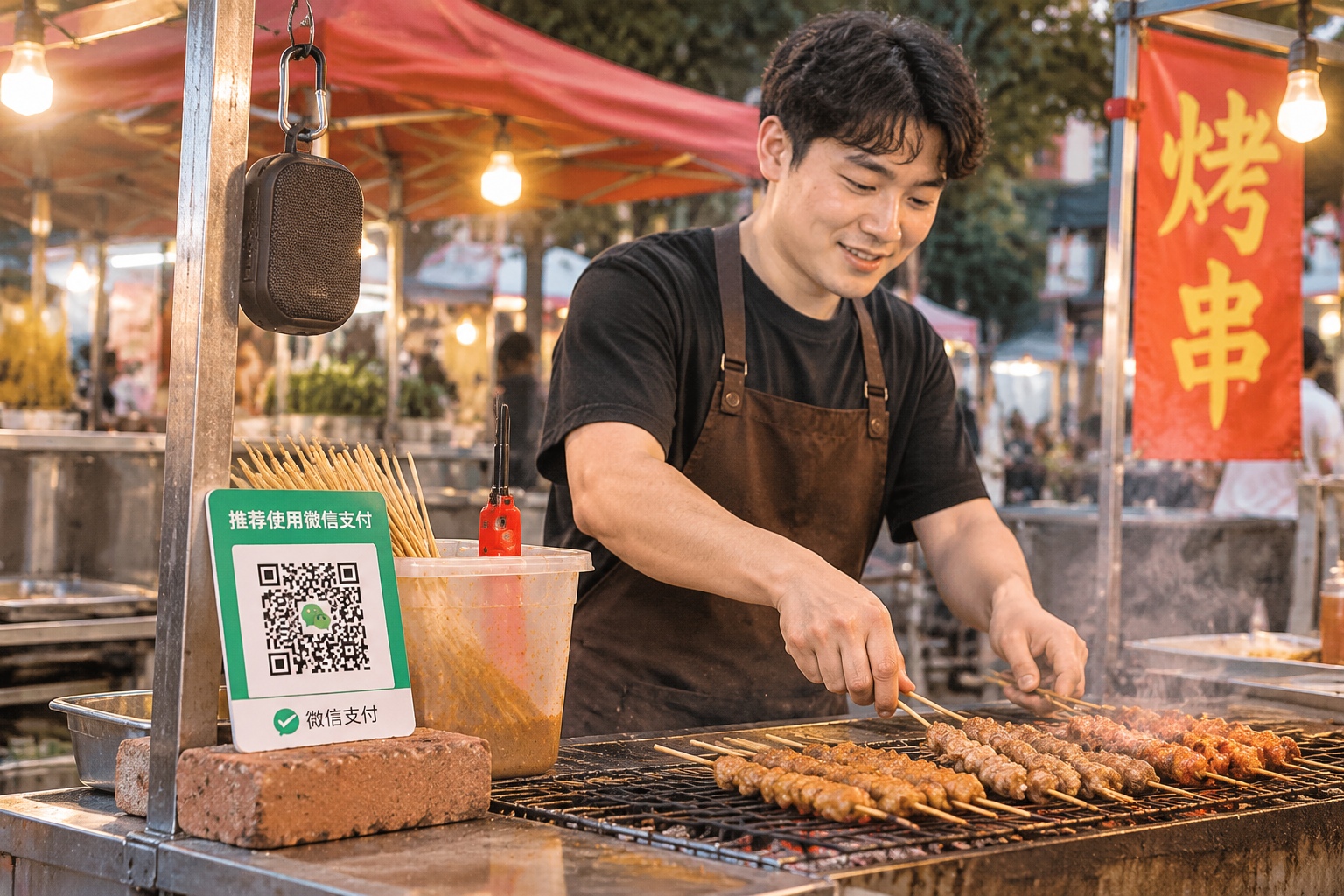
What replaced it is a laminated QR card, usually propped against a brick or taped to the side of the cart so the wind off the sea does not knock it over. Above the code are two logos: WeChat Pay and Alipay. One card takes both, plus UnionPay, because it is an aggregated code — a piece of plumbing most customers never think about and most vendors could not explain in technical terms. They just know they need one card, not three.
For the vendor, the change is less romantic than it looks on paper. Ending the night no longer means counting paper. It means scrolling: today’s total, the number of transactions, the average bill. Auntie Wu checks two things before she packs up — whether the total looks roughly right, and whether her phone still has battery.
What the QR code actually costs
Digital payment in China is often described as free. It is close to free for the customer, and cheap but not free for the seller.
Most small vendors use a personal QR code, which carries no per-transaction fee. Platform data suggests a large share of street sellers still operate this way. The cost shows up when money leaves the app: transferring a balance to a bank card typically costs 0.1 percent. For a 10-yuan bowl of Hainan noodles, that is one fen. Vendors do this arithmetic in their heads anyway, which is why some keep the balance in the app and spend it on supplies through the same app.
Stalls that register as merchants pay more — commonly quoted rates sit around 0.38 to 0.6 percent per transaction — but gain things a personal code cannot offer: refunds, transaction records, sometimes small-business loans based on daily turnover. Ask ten vendors and you get ten opinions about whether it is worth it.
Then there are the failures nobody posts about. Between eight and nine, when thousands of phones within a few hundred meters are all hitting the same cell, a payment can hang. The speaker sometimes announces a payment ten seconds after it happened, so experienced vendors glance at the screen too, not just listen. QR stickers get swapped by petty thieves, who paste their own code over the vendor’s and collect for a night; police in several cities have warned about this. Customers occasionally flash a saved screenshot of a payment screen instead of paying, which is why Auntie Wu’s rule is simple: she waits for the voice.
Regulators did not ignore the format. In 2017 the central bank introduced rules for QR payments, including a 500-yuan daily cap on scanning a static, printed code — an anti-fraud measure aimed at exactly the laminated card on Auntie Wu’s cart. It never mattered much in a night market where most bills are under 30 yuan.
The infrastructure behind one scan
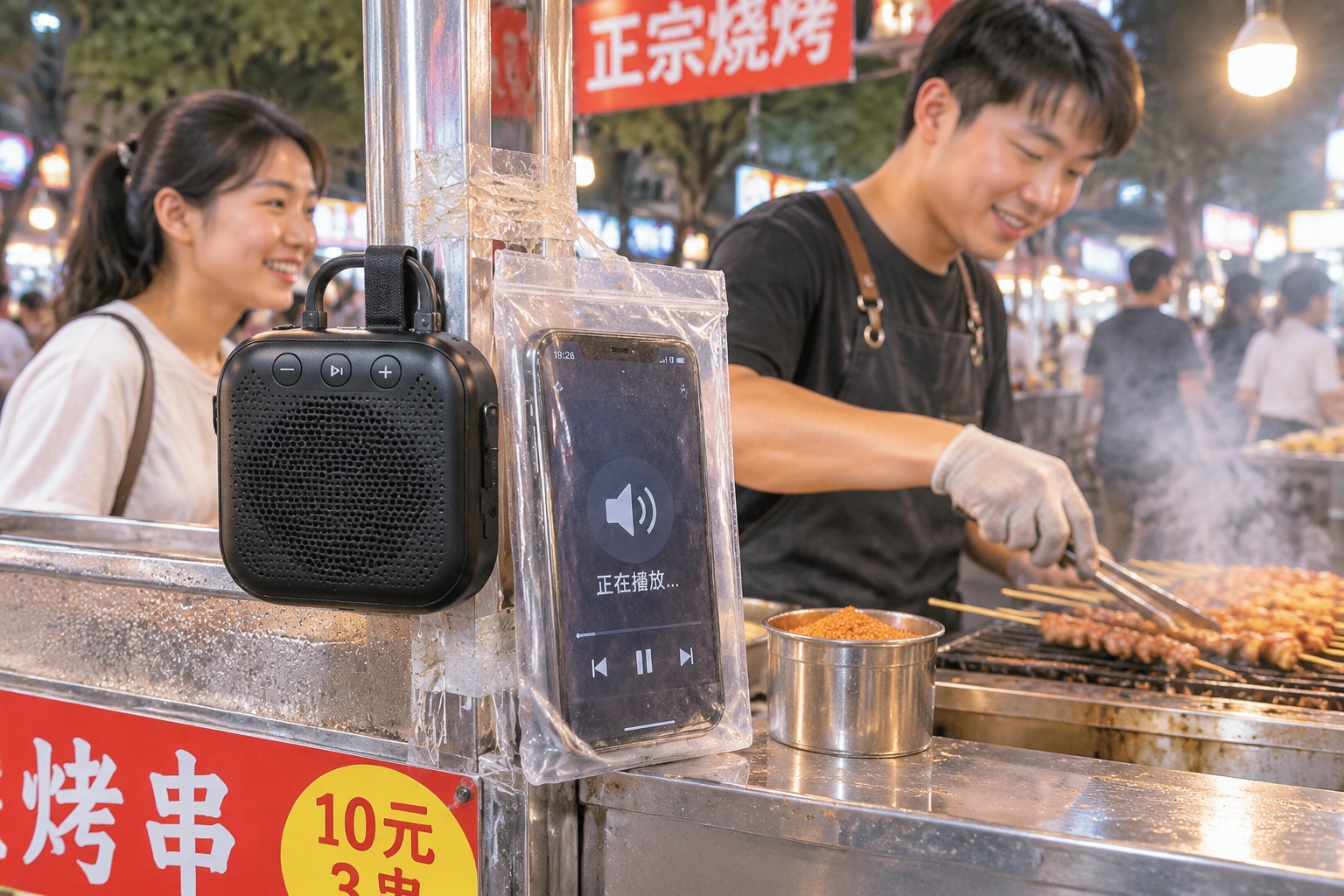
The two-second payment is not the product of a single clever app. It is the visible end of a stack that took more than a decade to build: dense 4G coverage and now 5G in ordinary neighborhoods, not just city centers; standardized QR formats so one code can serve several platforms; cheap Bluetooth speakers, often sold for the price of a few meals and sometimes handed out as a platform subsidy; and a settlement system that lets small merchants see money the same night.
The last layer is human. Auntie Wu learned to use this the way most people her age did — from a daughter, then from repetition. Her first year, she kept a handwritten notebook of totals to check against the app. She still does, roughly, on slow nights.
The scale is what makes the habit stick. China’s internet regulator counts more than 900 million people using online payments, in a country of 1.4 billion. Hainan itself has only about 10 million residents, but it draws tens of millions of visitors a year, and tourism is the island’s core industry. A payment habit that works for a local student also has to work for a tourist from Beijing who has not downloaded anything, and increasingly for one from Singapore or Moscow.
Cash has not disappeared
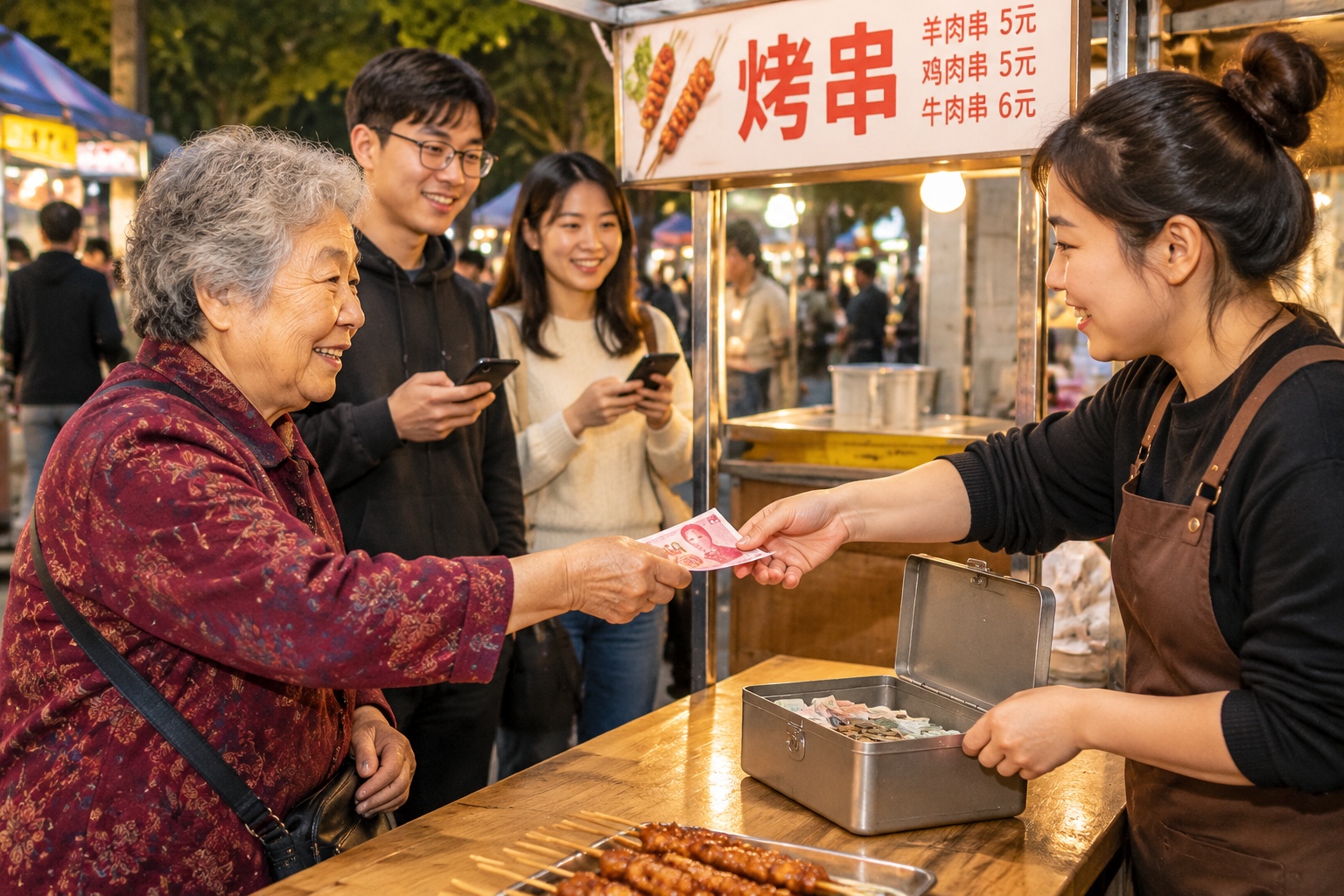
Walk the same market and you will still see banknotes. A grandmother buying two ears of grilled corn pays with a five-yuan note and waits for coins. A tourist who landed that afternoon and has not yet linked a foreign card to Alipay hands over cash because it is easier than troubleshooting at 9 p.m. in a crowd.
Auntie Wu keeps a few hundred yuan in a metal tin, mostly for these cases and for the nights when the network drops for twenty minutes. Chinese regulators have repeatedly reminded businesses that refusing cash is not permitted, and the central bank has penalized cash-refusing merchants in the past. On the ground, the practical reason is simpler: refusing cash loses you a customer in front of a queue.
What has changed is the default. Cash is no longer the way things are done; it is a backup that still works.
Faster transactions, the same small talk
Something that surprised me when I started paying attention: the payment got faster, but the transaction did not get colder.
Auntie Wu still rounds down. Ten-point-five becomes ten, and she waves away the difference before the customer finishes saying thank you. She still remembers that one regular does not want chili, and that another always buys two portions and takes one home for his mother. Students still stand at the cart talking about exams while the oysters cook. The queue still argues, mildly, about who was actually first.
The ritual of paying has changed shape, though. There is a small pause now — the customer holds up the phone, both look at the speaker, someone says “done” — and in that pause there is a new kind of shared trust in a machine that both sides have agreed to believe.
11:40 p.m., 12 percent battery
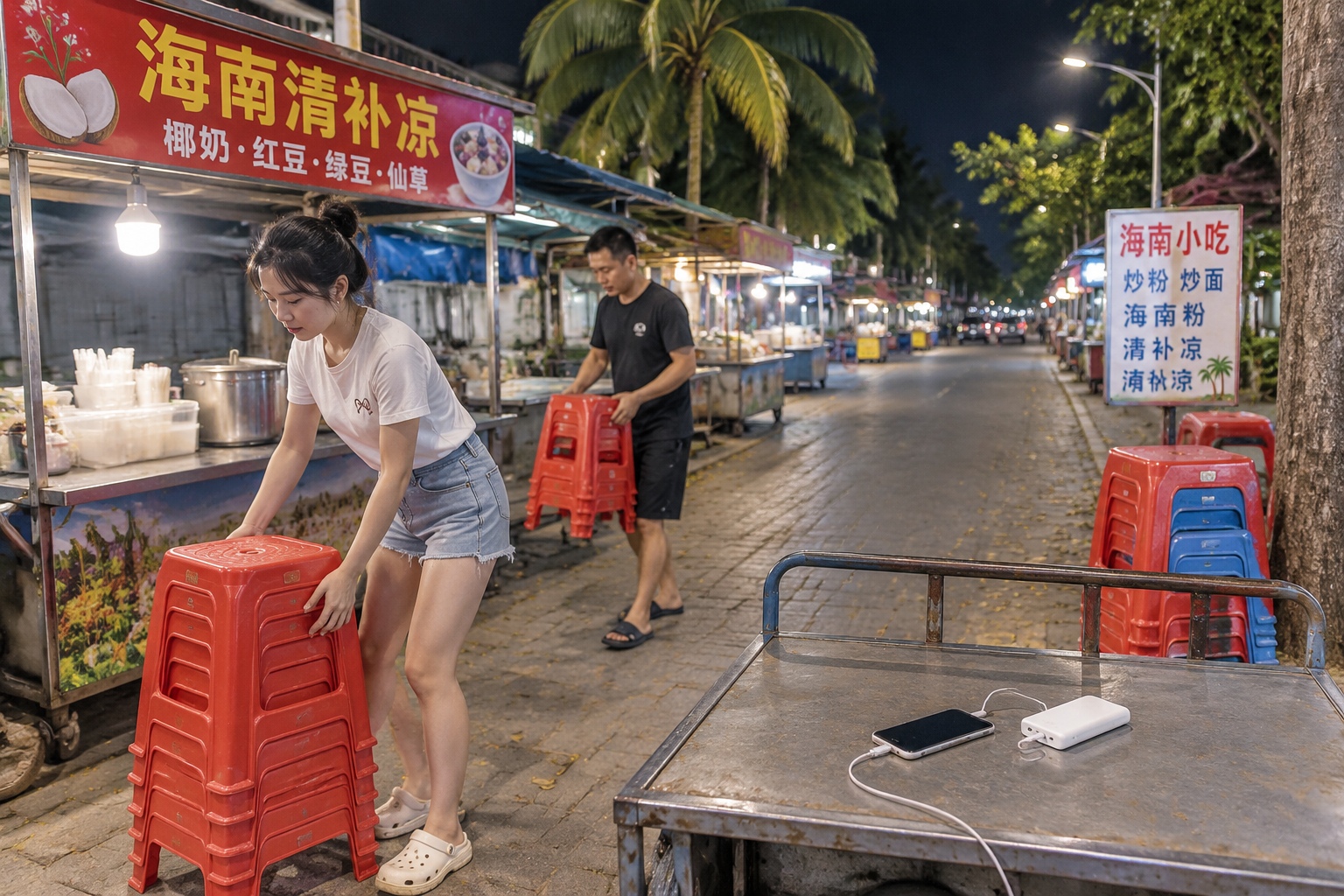
The crowd thins after eleven. Auntie Wu wipes the grill, stacks the plastic stools, and unclips the speaker. Her phone is at 12 percent. She plugs it into a power bank for the ride home, checks the day’s total one last time, and turns off the light above the cart.
The last thing I hear from that corner of the market is not a conversation. It is the automatic voice from a neighboring stall, still running: “Alipay, 8 yuan received.” Then the light goes off there too.