
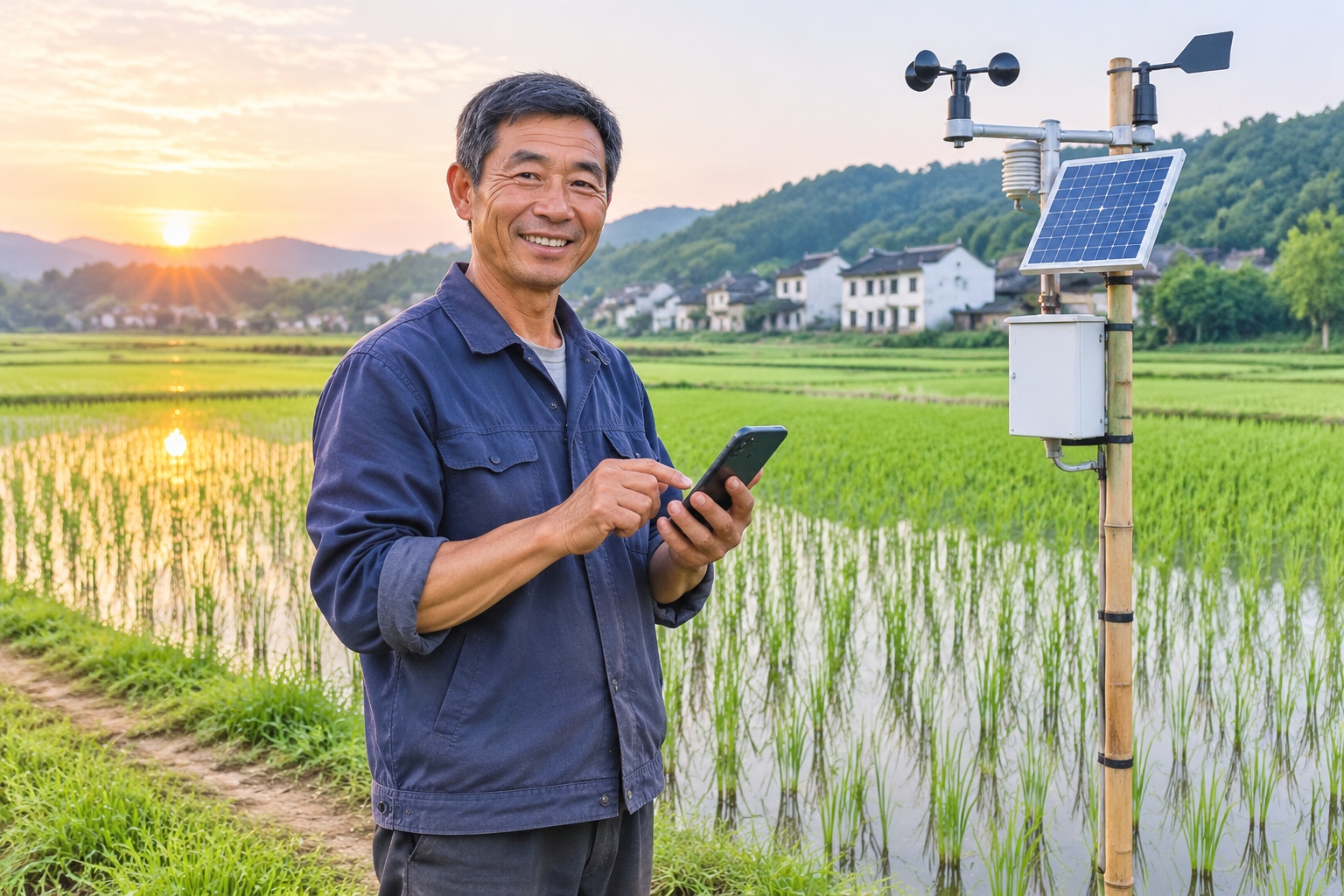

Just after five in the morning, Chen Jianguo stands at the edge of his rice field in Poyang County, Jiangxi Province, holding a phone that looks like it has more mud on the screen than his hands. He is not checking the weather forecast — at least not the one on TV. He is looking at a dashboard of soil moisture, wind speed, and a satellite image of his paddies, updated thirty minutes ago.
“The field is telling me it’s dry at the north end,” he says, wiping the screen with his shirt. “If I waited until I walked there, I’d lose half the morning.” He taps the screen once, and a pump two hundred meters away starts humming.
Morning: The Phone Is the First Tool
Chen, who is 52 and has farmed rice for three decades, used to start his day by walking the entire field, bending down to check soil with his fingers. Now he walks less, but watches more. A small weather station on a bamboo pole records rainfall, temperature and humidity every ten minutes. Underground sensors report soil moisture and nutrient levels at four depths.
“My grandfather used to say a farmer reads the sky. Now we read the numbers,” he says, showing me the app on his phone. The interface is simple, in large Chinese characters, because Chen jokes that his eyes are even older than his phone.
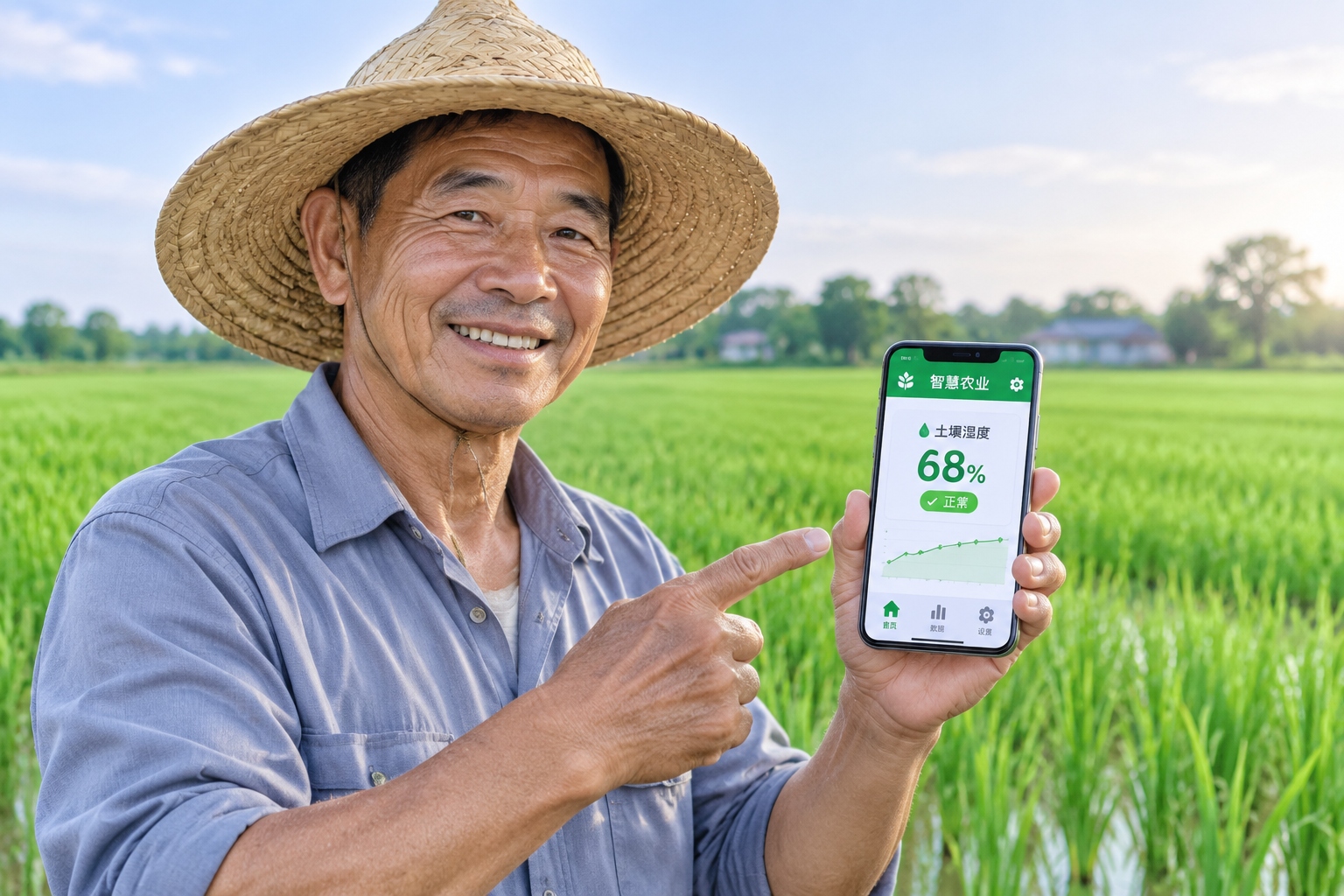
From Sickle to Drone
Chen’s family has been planting rice in this flat, lake-side plain for at least three generations. He remembers childhood summers when his father cut rice with a hand sickle, and the whole family spent days tying bundles and carrying them to a shed. Today, he hires a combine harvester that arrives with a young driver who navigates the machine using GPS.
The biggest change, he says, is not the machine itself, but the information that guides it. “When I started, I made decisions by guess and by habit. Now I can see which part of the field has more weeds, which part needs more fertilizer — it’s like having a doctor for each plant.”
That “doctor” is a crop-drone with a multispectral camera. Chen hired a local drone service team to scan his 120-mu field (about 8 hectares) at a cost of about 30 yuan per mu. The images show the normalised difference vegetation index — a measure of crop health. Green means well-fed rice; yellow or red means stress.
Midday: A Drone Overhead
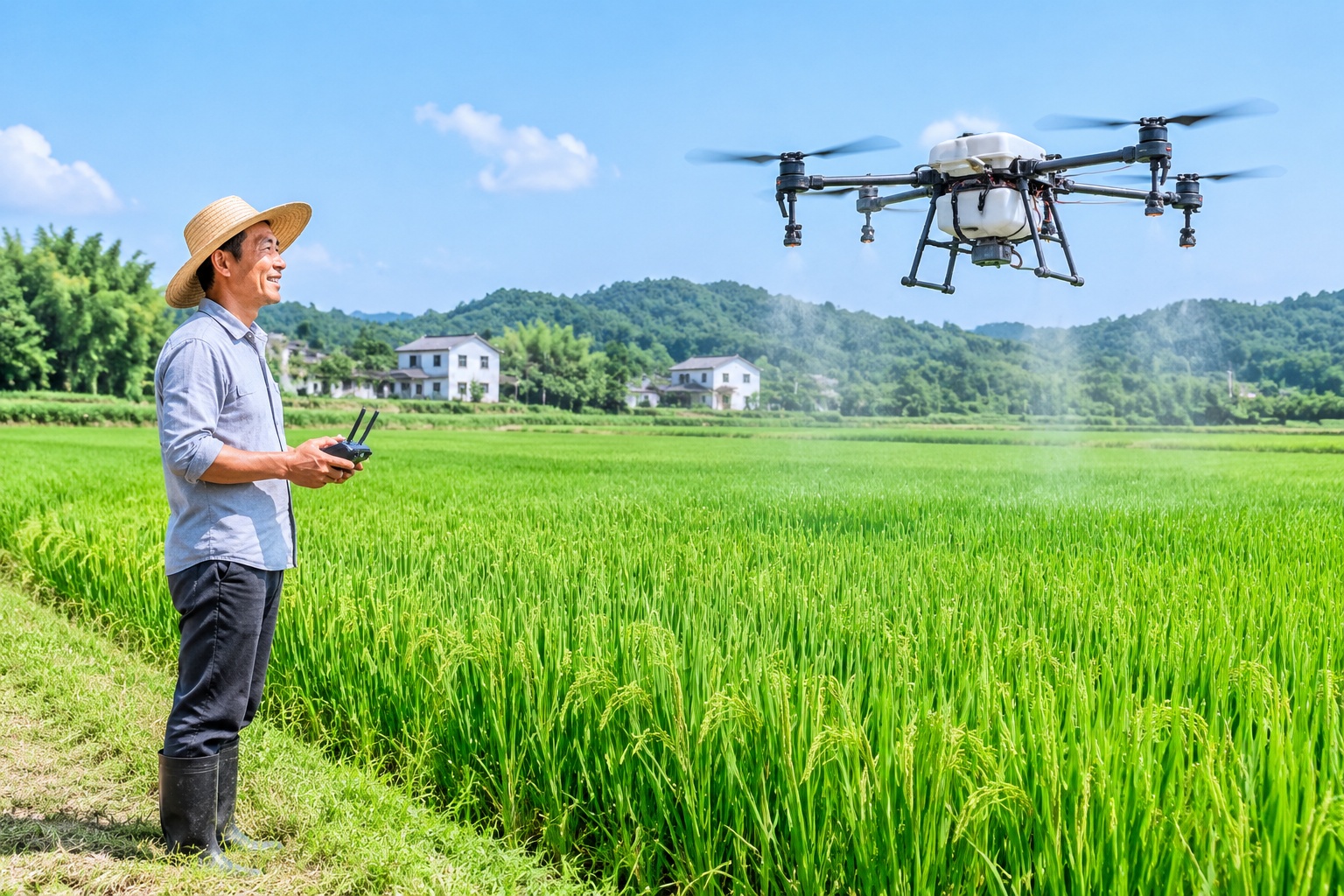
At 11 a.m., the drone team returns, this time with a spraying drone that carries a 20-liter tank of pesticide and fertilizer mix. Chen used to spend a whole day walking through the paddy with a backpack sprayer, his legs covered in mud and itching from the grass. Now the drone does the work in 40 minutes.
“People used to say farming is back-breaking,” he says, watching the drone hover low above the green waves. “Now, my shoulders are fine, but my fingers are tired from tapping the screen.” He laughs, but he’s serious.
Irrigation That Listens
After lunch, Chen walks to the northern boundary of his field, where he has installed a smart irrigation system. It’s not flashy — just a set of valves, a small solar panel, and a controller connected to the sensors. The controller decides when to release water, based on the moisture level at the roots, not on a timer or guesswork.
“Last summer, there was a drought, but the rice here barely suffered,” he says. “The system saved water and kept the plants alive at the critical stage.” On the edge of his plot, a neighbor’s field without smart irrigation looks slightly yellow. “I didn’t want to do it at first, because of the cost. But my son pushed me to try. Now I wonder why I waited.”
The Market in the Palm of His Hand
Chen used to sell his harvested rice to middlemen who arrived with trucks and bargained hard. Prices were uncertain, and he often felt he had no choice. Now, he uses a mobile app run by the local agricultural cooperative to check wholesale prices in real time. He can also sell directly to a buyers’ group for organic rice, and the cooperative sends a quality tester to verify his grain.
“I don’t know much about algorithms,” he says, tapping the screen. “But I know that yesterday the price on the Shanghai market was 2,100 yuan per ton, and the local price was 2,300. So I held on to the grain. Today, local is still higher.”
What Hasn’t Changed
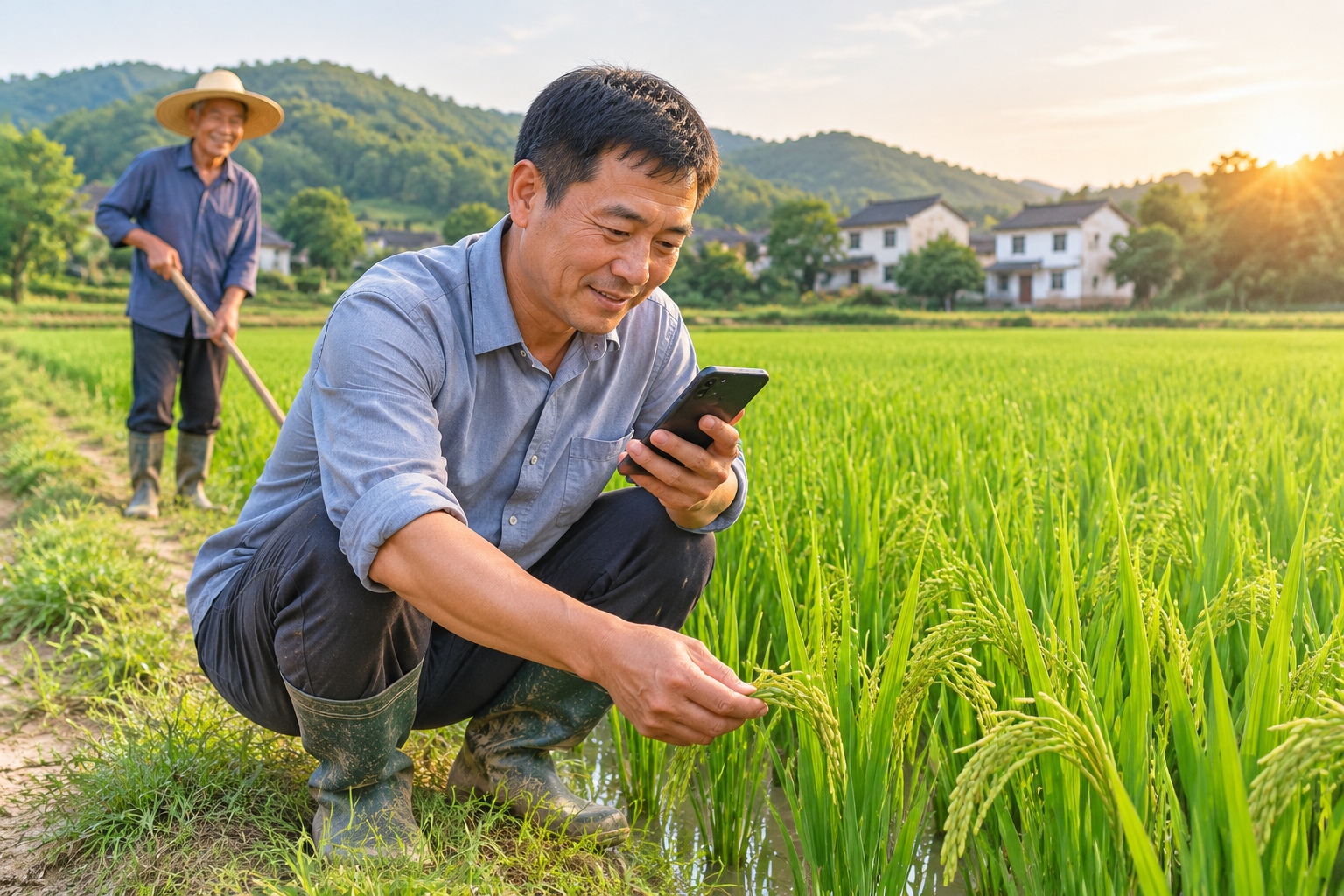
Despite the screens and sensors, much of Chen’s day is not digital. At 3 p.m., he walks into the field and squats down, using his fingers to pull soil apart and feel its texture. He inspects a few rice plants, looking for tiny yellow spots that indicate a pest problem. He also talks to his neighbors over the low mud wall.
“There are things a machine can’t tell you,” he says. “Like the smell of the soil after rain, or the way the rice rustles when the wind is just right. That’s not in an app.”
After Sunset: The Numbers Game
In the evening, Chen sits at his kitchen table with a glass of tea. His son, who lives in Nanchang, calls on a video chat to ask how the day went. Chen shows him the drone photo of the field, layered with colored maps from the crop-health app. The son, an accountant, uses the same app to check the cost summary for the season.
“He knows more than I do about the money side,” Chen admits. “He calculates that the technology costs about 20% more per mu, but it saves a lot of labor and reduces waste. This year, he says our yield is probably 10% higher than five years ago. I don’t need to count — I can see it from the size of the rice grains.”
When I ask him if he feels that technology has made farming easier or harder, he thinks for a moment. “Easier, yes, but also more complicated. I have to learn new things all the time. My grandson, who is eleven, already knows more about drones than me. But that’s okay — he’ll be the next farmer.”
He gets up to close the window as the evening breeze picks up. “You know, people think technology makes you distant from nature. But actually, it makes me pay attention more deeply. I look at the field every day, but now I see what I couldn’t see before.”
Chen’s day is not typical of every farmer in China — many still work with hand tools in remote areas. But in the flat, productive plains like Jiangxi, the tools and digital layers are spreading fast. For a farmer like him, the new day begins not with a stretch and a pair of boots, but with a phone and a question: “What does the field tell me now?”
Start the discussion at forum.chinacomes.com