
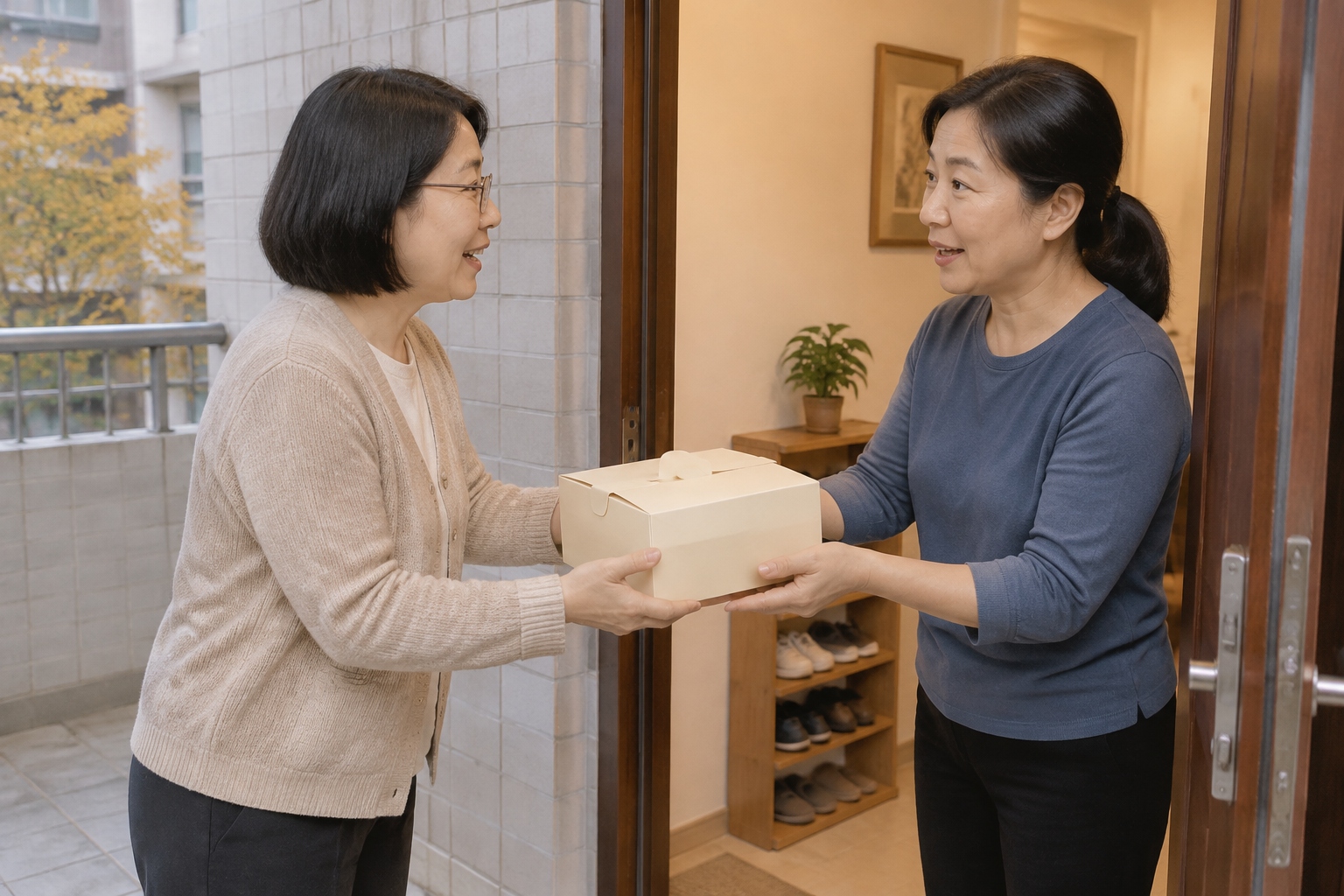

At the door of a Chinese apartment, a dinner guest takes a pastry box out of a paper bag and offers it with both hands. She chose the less-sweet pastries because she remembers what her host likes. Now, with the box suspended between them, she says xiǎoxiǎo yìsi (小小意思), the Mandarin equivalent of “It’s just a little something.” The host answers nǐ tài kèqi le (你太客气了), roughly “You’re too kind,” and reaches for the box.
If you’ve ever handed someone a bunch of flowers and said “Just a little something for the table,” you already know part of what’s happening. The guest has put thought into the gift and gives the host room to accept it with a simple thank-you. The exchanges below are illustrative dialogues, with speakers of different ages and in different relationships.
What 小小意思 and 不成敬意 mean when giving a gift
Yìsi (意思) often means “meaning,” as in “What does this word mean?” At the door, it’s closer to “a token of my good wishes.” The doubled xiǎo, or “small,” makes the offer sound lighter. The guest is giving the host a way to understand the gesture before the box is even opened. This can be something for everyone to eat after dinner, with no need for a gift in return on the spot.
Bù chéng jìngyì (不成敬意) has a more formal sound. A close translation would be “This hardly does justice to the respect I want to show.” The two phrases can go together in one breath, but they do slightly different things. Xiǎoxiǎo yìsi plays down the gift. Bù chéng jìngyì makes the giver’s respect explicit. “Please accept this small token of my appreciation” comes closer to the tone of the full expression in English.
That’s the narrow sense in which the Chinese title uses “self-deprecation.” The giver speaks modestly about their own offering. Listen to what happens when the host asks where the pastries are from. The guest can happily say she went across town to get them, or mention that she picked a less-sweet filling. The modest handover and the pleasure of having chosen well fit in the same conversation. The modest words are doing a job at a particular moment, when the recipient is deciding how to respond.

Where “a little something” works in both languages
Imagine arriving at a dinner in the United States with a jar of jam. “I brought you a little something” lets the host say “How lovely” and get back to checking the oven. A Mandarin-speaking guest can make the same move with xiǎoxiǎo yìsi. Both phrases can acknowledge the effort a host has made without turning the arrival into a lengthy exchange of thanks.
The reply is where a visitor may hear a difference. A Mandarin host who says nǐ tài kèqi le is acknowledging the trouble the guest took. Even “You didn’t have to bring anything” can accompany hands already reaching for the box, much as it can in English. A pause, a step back, or a clear explanation that the recipient cannot accept the gift calls for a different reading. Timing and body language help distinguish an expression of appreciation from an actual refusal. There’s no fixed number of times anyone has to offer or decline.
The English translation also depends on the relationship. “Just a little something” sounds easy at a friend’s house. At a farewell for a mentor, “We wanted to give you a small token of our thanks” may fit better. Mandarin has a similar range. The everyday phrase can stand on its own, and the more formal pairing can sound warm, stiff, or deliberately funny depending on who says it and where.
How gift-giving language changes with the occasion
A dinner invitation in your forties
Take the guest with the pastries. She’s in her forties and has been invited to a neighbor’s apartment for dinner. “小小意思,带了盒点心,等会儿一起吃,” she says. “Just a little something. I brought some pastries for us to share later.” Her neighbor might answer “你太客气了,快进来” (“You’re too kind. Come on in”). The sentence gives the gift a place in the evening. The neighbor can set it beside the kettle and open it after dinner. Offering the box with both hands looks attentive here, though a guest arriving with an umbrella and a shopping bag may manage the handover differently.
A café exchange between friends in their twenties
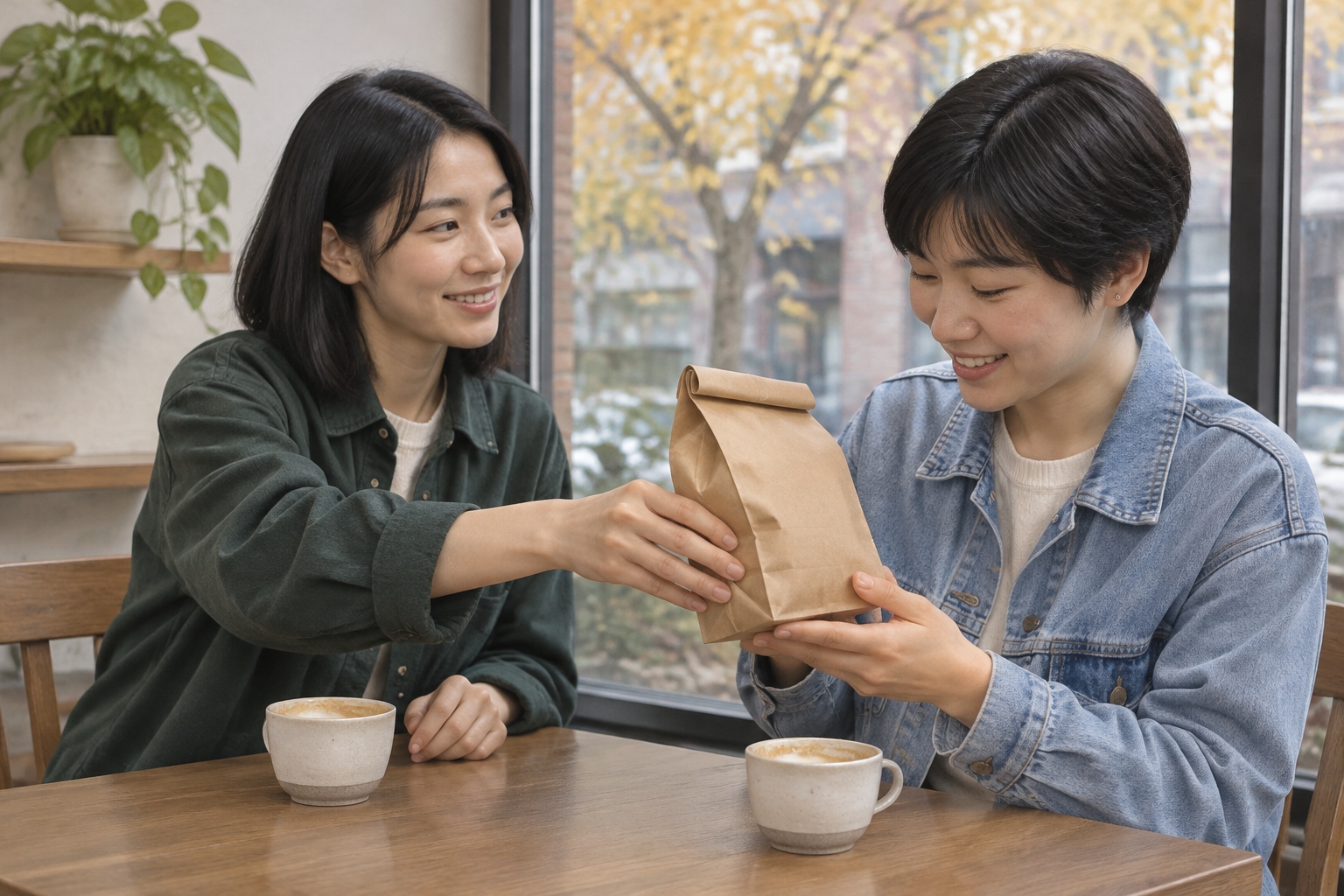
At a café, a woman in her twenties slides a bag of coffee beans across the table. “路过那家店,给你也带了一包,” she says. “I passed that shop and picked up a bag for you, too.” Her friend turns the bag over and asks whether it’s the roast they tried last time. The words “for you, too” make accepting it feel easy. The giver was already there and thought of her friend. She could say xiǎoxiǎo yìsi with a grin. The full xiǎoxiǎo yìsi, bù chéng jìngyì might get a laugh, as if the coffee beans were being presented at an award ceremony.
A more formal visit to thank a retired mentor
A former apprentice in his fifties visits the retired mentor who trained him. He brings tea and a card with a memory from his first week on the job. Here, xiǎoxiǎo yìsi, bù chéng jìngyì can sound at home, especially if he wants to mark the visit as a proper thank-you. The older mentor might respond nǐ yǒu xīn le (你有心了), or “That was thoughtful of you.” The reply recognizes the attention behind the tea and card. A speaker might also choose the more conversational “带了点茶叶,谢谢您当年带我,” meaning “I brought you some tea. Thank you for taking me under your wing back then.”
These examples put speakers of different ages in different settings. A young person can use the formal phrase when thanking a respected elder, and an older person can casually tell a friend “I saw it and thought of you.” Bù chéng jìngyì fits a visit where the giver wants to show particular respect or gratitude. The formality of a meeting alone doesn’t make a gift appropriate. At a workplace with a gift policy, the recipient may have to decline even a modest box of tea.
What to say when someone offers “a little something”
When it’s a gift you’re comfortable accepting, “谢谢,你有心了” (“Thank you, that was thoughtful of you”) is enough. You can add something specific if it comes naturally. “You remembered I like this kind” tells the giver that you noticed the choice. If you’re bringing the gift, a plain sentence like “带了点点心,大家一起吃” (“I brought some pastries for everyone to share”) works well on a casual visit. It tells the host what to do with the box and leaves the conversation free to move on.
Back at the apartment, the guest slips off her shoes while the host carries the pastries into the kitchen. Later, when someone asks who brought the less-sweet ones, the host can point to her and say, “She remembered.” There’s time to appreciate that detail once everyone is sitting down. At the door, “a little something” was enough to get the box from one pair of hands to another.