


On Thursday evening, Lin Yue has two versions of the same map open on her laptop. One follows the covered walkway behind the campus canteen. The other follows the path a student can actually take after the side gate closes. Across the table, Camille turns a printed copy sideways and traces the second route with her finger. Lin has already laid out the Chinese captions. Camille has the English copy open. Their group project is due at five the next afternoon.
This is a fictional account set at a university in Shanghai. The students, messages and project timeline are imagined.
The four-person team has spent nearly three weeks making a bilingual guide to its campus for incoming exchange students. Pressure was low enough at the midpoint that moving an internal deadline seemed reasonable. By Thursday, a change to one route means revising a map, two sets of directions and a slide for the class presentation. To see where the time went, go back to the first Monday, when the group divided up the work.
Week one: Two ways to get started
Lin, a Chinese undergraduate, takes the map and page layout. Camille, a French exchange student, takes the English directions and agrees to walk the routes. The other two teammates gather campus information and build the presentation. Everyone puts the Friday submission in their calendar. They also pick a Wednesday check-in for week two and aim to have a complete draft the following Tuesday.
Lin starts that afternoon. She sets up a four-page document, gives every route its own space and marks uncertain details in yellow. She can test whether Chinese and English fit on the same page before the wording is settled. The layout also gives the student building the presentation something to work from. When Lin shares the file that night, she expects the group to start dropping material into it.
Camille makes a list of turns and entrances on her phone. On her first walk, she notices that the name the group has been using for a building is missing from the sign at street level. She wants the directions to rely on things a newcomer can see, such as the canteen doors or the blue noticeboard. She plans to write the final English copy in one sitting after a second walk. In the meantime, her notes stay on her phone. Lin can see the empty boxes in the shared document. She has no way to see how much work has gone into filling them.

Week two: A check-in moves the draft deadline
At the Wednesday meeting, the team pulls up the guide on a classroom screen. Two routes already have draft directions. The third takes new students from a dormitory to the campus clinic. The shortest path goes through a side gate, and the group has asked the campus facilities office to confirm its evening hours and clear that route for the guide. They expect an answer by Friday. Camille has written two possible sets of directions, one for each route.
On both options, the final turn depends on which gate a reader comes through. The answer will also determine how much space Lin needs for the clinic map and which screenshot goes into the slides. The team agrees to move the complete draft from Tuesday to Wednesday of the final week. That date is theirs to change. The course deadline, Friday at five, stays put.
The group leaves the meeting with one date in the chat and two understandings of it. Lin expects a reviewable draft on Wednesday, including provisional text for any route still in doubt. Camille reads Wednesday as the day to finish the guide if confirmation arrives in time. The person making the slides assumes the map will be ready to copy that evening. Nobody asks which version of the file will count as a handoff.
Final week: The answer arrives, and the work piles up
Friday passes without an answer. On Monday, the teammate who contacted the office sends a follow-up. Late Wednesday afternoon, the office confirms that the side gate closes at six and clears the longer route through the main entrance for the guide. That gives the team a route a newcomer can use in the evening. It also puts the first confirmed set of clinic directions less than two days from submission.
Lin draws the longer route as soon as the message comes through. Camille plans to walk it Thursday after class to check the landmarks. Lin needs the final English copy to fit the captions and finish the layout. The teammate building the slide deck needs a stable map. All three tasks are still doable, but they now have to happen in sequence, around classes that were already on everyone’s calendar.
By Thursday evening, Camille has checked the detour and found a problem with one instruction. The stairs she had used as a landmark are easiest to see when approaching from the side gate. From the main entrance, the canteen doors are a better cue. Lin moves the label and redraws the arrow. In the slide deck, a screenshot still shows the old turn. The teammate who pasted it in has to reopen the slides and replace it.
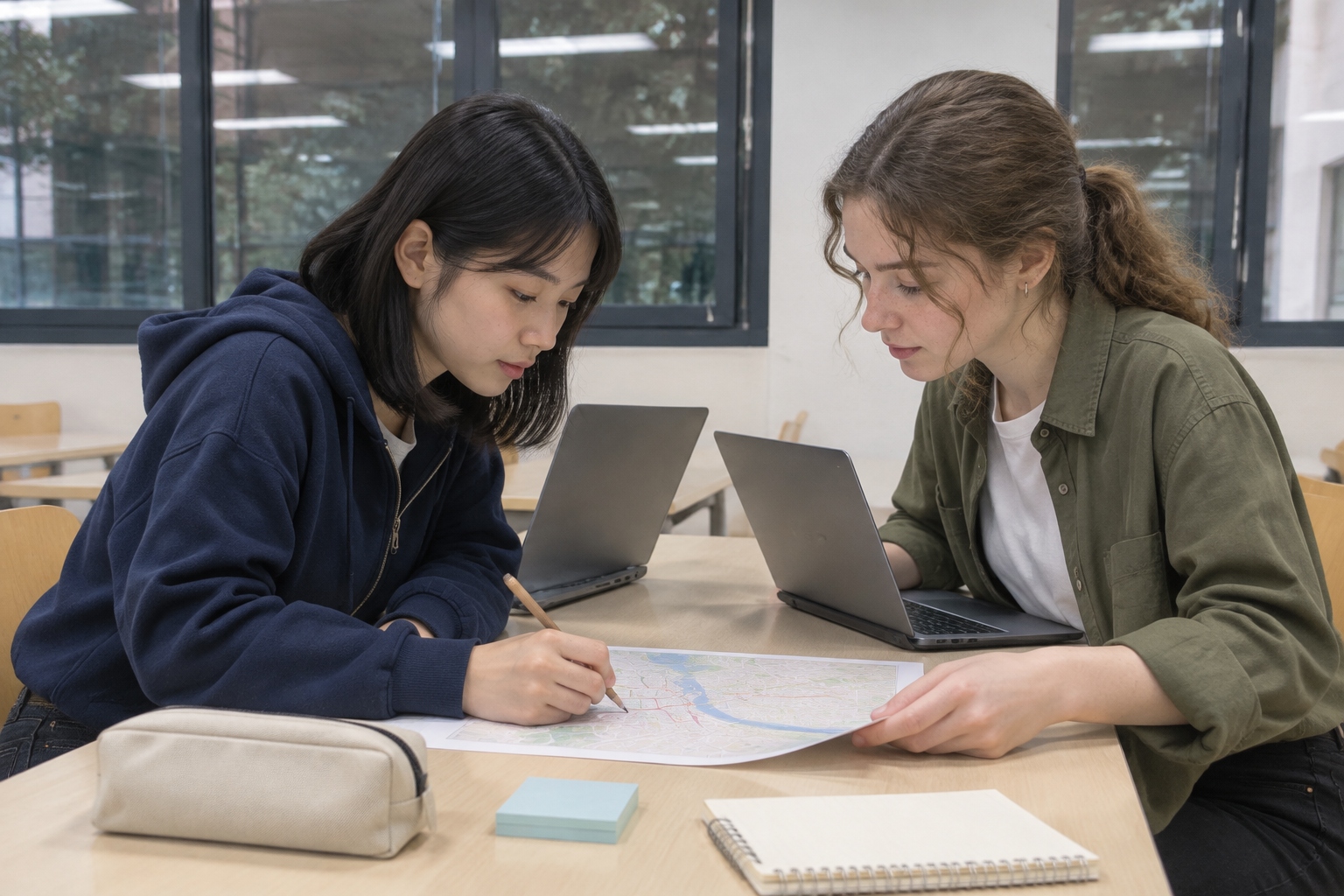
The rework makes a small question harder to ask. When Lin checks whether the English is ready, she is trying to decide whether she has time to go back to her dorm for dinner. Camille hears a request for a finished file while she is still checking the wording against the map. She can see why Lin needs it, and Lin can see the value of the extra walk. Each still has to guess when the other’s part will be usable.
Friday: One last handoff before submission
On Friday morning, the group sets a cutoff of noon for edits to the route. After that, anyone who spots an error leaves a comment in one shared document. Lin makes the corrections there, and the slides draw from the same map. Camille reads through the exported PDF and catches an English direction split across two lines just before the word that tells the reader where to turn. Lin widens the text box. At 4:42 p.m., a teammate uploads the PDF and slides and posts the submission receipt in the group chat.
The receipt settles the question of whether they made the deadline. At their next class, they talk about the time they had spent waiting on one another. Lin brings up the empty clinic page. Camille shows the two sets of directions she had written while the gate hours were still pending. Either version would have given Lin a better idea of how much text to allow for and let the slide maker see which part of the map could still change.
The next assignment gets clearer checkpoints
For their next assignment, Lin keeps her early layout and Camille keeps a block of time to write once the details are checked. They add two things to their schedule. One is a date for sharing work that other people can already use, even if parts are provisional. The other is a time to switch to an agreed fallback if a decision from outside the group is still pending. They also put a name beside each handoff, so the person waiting knows whom to ask.
The change fits the problem this team ran into. The office’s answer determined which route they could publish. The team still controlled when to share the two drafts, when the slide maker could take a screenshot and how much time to leave for checking the export. At the next check-in, Camille puts her unfinished notes in the shared document. Lin sees one line flagged for a second visit and leaves room for it. The teammate building the slides starts with the pages already cleared for use.