


Alex
“你刚才讲得特别清楚。”
“You explained that really clearly.”
Lin
“哪里哪里。”
“Oh, you’re too kind.”
Alex
“真的。我之前一直没弄懂那张图。”
“I mean it. I’d been struggling to make sense of that chart.”
Lin
“那就好。你要的话,我把那页发你。”
“Glad it helped. I can send you that slide if you like.”
Chairs scrape back in a Shanghai meeting room. Lin, a 28-year-old analyst, closes her laptop halfway and smiles as she says nǎli nǎli. Alex, a British colleague, pauses. He meant to tell her that the presentation helped him do his job. For a second, he wonders if she thinks he’s just being nice. Once he mentions the chart, Lin offers to send the slide. By the time they reach the door, they’re talking about who else could use it.
The dialogue and the recollections below are fictional examples of everyday exchanges. Published research provides the background for the discussion of how compliment responses have changed.

What ‘哪里哪里,’ ‘不敢当,’ and ‘谢谢’ can signal
哪里哪里 (nǎli nǎli)
Word for word, it’s “where, where?” In response to praise, it can sound like “Oh, you’re too kind” or “Oh, hardly.” The repetition is a familiar way to play down a compliment. Lin’s quick smile and the fact that she stays in the conversation make the first translation a better fit here. “Oh, hardly” captures more of the uncertainty Alex hears. Someone who translates it in their head as “Where did you get that idea?” may hear a challenge where the speaker intended warmth.
不敢当 (bù gǎn dāng)
“I hardly deserve that” gets close to the wording. Compared with nǎli nǎli, bù gǎn dāng can sound more formal or deferential. Imagine a junior employee hearing a visiting client call her the company’s top expert. With a smile and a quick mention of the engineers who helped, she can acknowledge the client’s goodwill while easing away from a grand label. Between close friends, the same phrase delivered with a mock-serious face might be the punch line.
谢谢 (xièxie)
“Thank you” works perfectly well in Mandarin. It can express pleasure, acknowledge the effort someone made to say something kind, or simply keep a busy conversation moving. An answer such as “谢谢,我改了好几版,” or “Thanks, I went through a few drafts,” lets the speaker show that the work mattered to them. “谢谢,大家一起做的,” or “Thanks, we worked on it together,” accepts the praise and shares the credit in the same breath.
How the relationship changes the reply
Ask Lin, in this imagined account, to remember praise from another colleague and she thinks of a message from a teammate her own age. “The new layout is much easier to read,” he wrote in their work chat. She typed “谢谢!” and asked whether the chart labels were big enough on a phone. In the meeting room, Alex had caught her on the way out with other people still within earshot. The message came directly to her and gave her a specific piece of feedback she could act on. The two replies can come from the same person on the same afternoon.
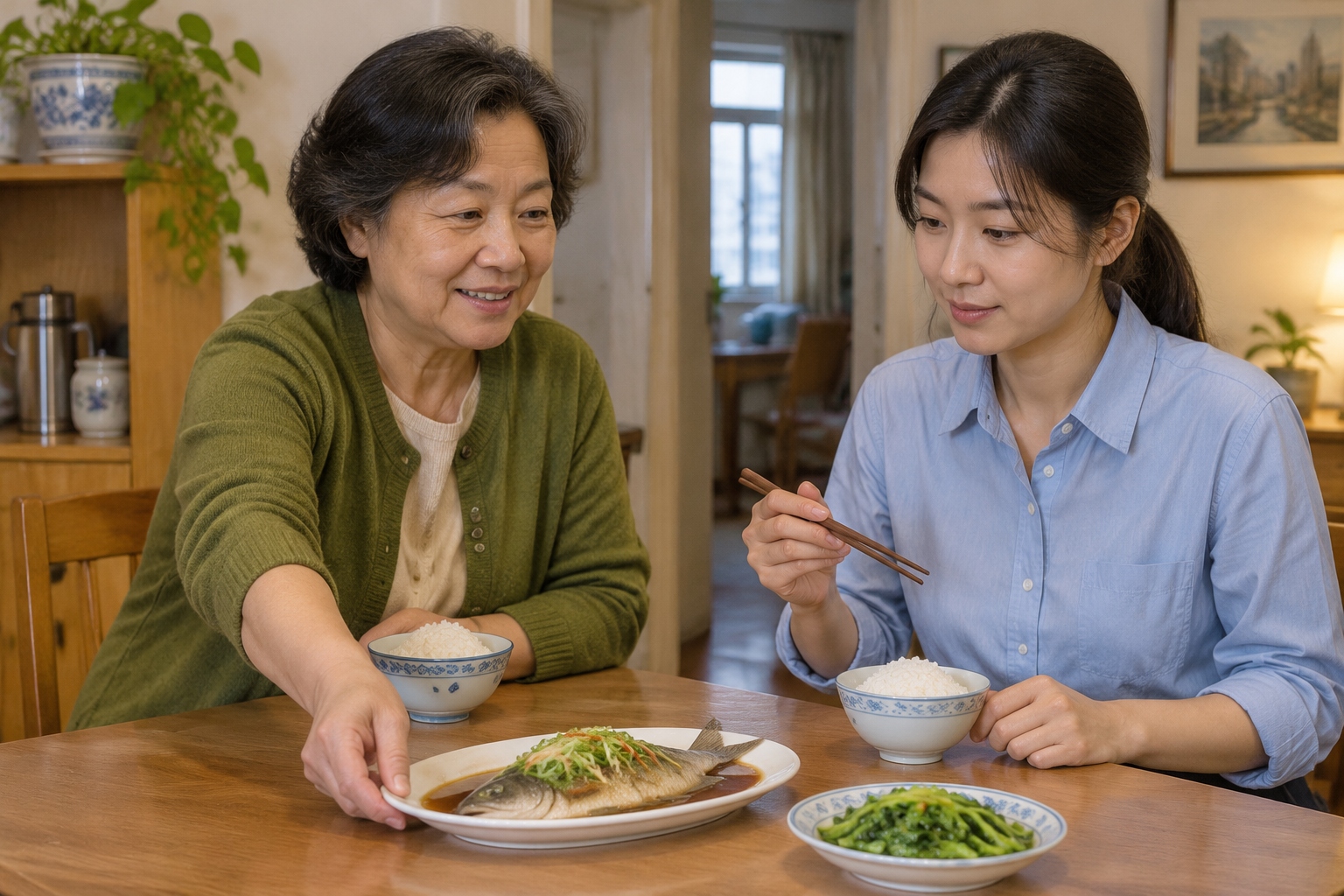
At dinner with friends, Lin remembers telling her friend’s 57-year-old mother, Auntie Zhou, that the fish was delicious. Zhou answered “哪里哪里,家常菜,” roughly “Oh, it’s just home cooking,” and turned the plate so Lin could reach the best pieces. Later that evening, a friend complimented Lin on her jacket. Lin said thanks and pulled up the shop on her phone. At the table, Zhou had a guest to look after. The jacket compliment naturally led to a conversation about where to buy it.
The age comparison gets more interesting when the roles change. In the same imagined family, Zhou has spent years doing alterations. When her niece says a hem hangs beautifully, Zhou says “谢谢” and shows her how she kept the stitching from puckering. Her niece can see the work up close, and Zhou is happy to take credit for it. A younger colleague can be just as quick to downplay praise when it comes from a boss in front of the whole team. Who is listening, what is being praised, and who did the work can matter as much as age.
Why the same words can send different signals
If you’re used to a workplace where a compliment is usually followed by a quick “thanks,” the surprise may be what happens in the next second. You’ve offered an assessment of someone’s work. They may hear that assessment and also hear an invitation to agree in front of other people that they did especially well. A modest reply can make that second part easier to handle. English has its own versions. Think of “I had a good team” after a manager praises a project, or “Oh, it was easy” when someone thanks a friend for going to a lot of trouble. The Mandarin formulas can be harder to recognize when you’re hearing them for the first time.
Linguists have documented changes in the replies people choose. Rong Chen’s 1993 study reported more frequent rejection or downplaying of compliments in its Chinese sample than in its American English sample. In a 2010 follow-up, Chen and Dafu Yang found much more acceptance in their Chinese sample than the earlier study had reported. The researchers elicited responses to scenarios, so their findings tell us about replies people chose under study conditions. They leave open how often you’ll hear each answer over lunch today. The two papers are Responding to Compliments: A Contrastive Study of Politeness Strategies Between American English and Chinese Speakers and Responding to Compliments in Chinese: Has It Changed?, both in the Journal of Pragmatics.
What the person does next often gives you more to go on than the phrase alone. Lin stays to talk about the slide. Zhou moves the fish within reach. If someone gives a tight smile, starts packing up, and changes the subject, you can let the conversation move with them. Even with familiar wording, some praise lands awkwardly. A comment on a colleague’s appearance in front of the team may get a short reply because the attention itself is uncomfortable. You can ease the moment without having to decide exactly what they meant.
Two natural ways to reply to ‘哪里哪里’
Keep the compliment going with one specific detail
“真的,你刚才举的那个例子,我一下就听懂了。”
“Really, that example you gave made it click for me.”
It’s easier for someone to respond to a detail than to a louder version of “You’re amazing.” You’ve told them what helped you and given them something concrete to talk about, if they feel like it.
Let their modest reply stand and move the conversation on
“那我再夹一块。”
“Well, I’ll have another piece, then.”
At Zhou’s table, that’s enough. She can call it home cooking, and you can take another piece. She slides the plate a little closer, and someone at the other end asks for the rice.