
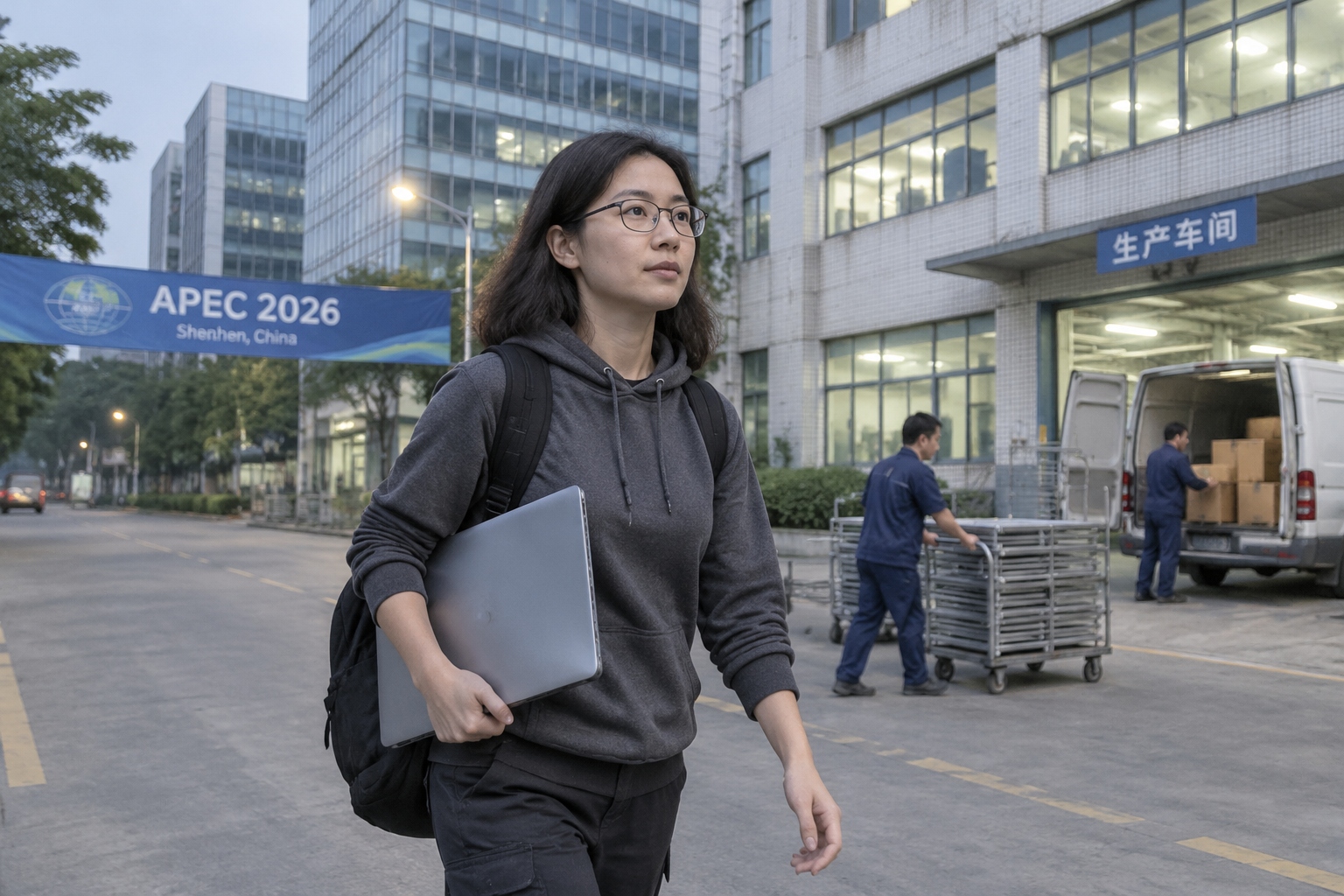

11 p.m., Outside the Meeting Room
Shenzhen, November 2026. The last day of APEC week. The motorcades have gone. On the third floor of an unremarkable industrial building in Nanshan, the lights are still on.
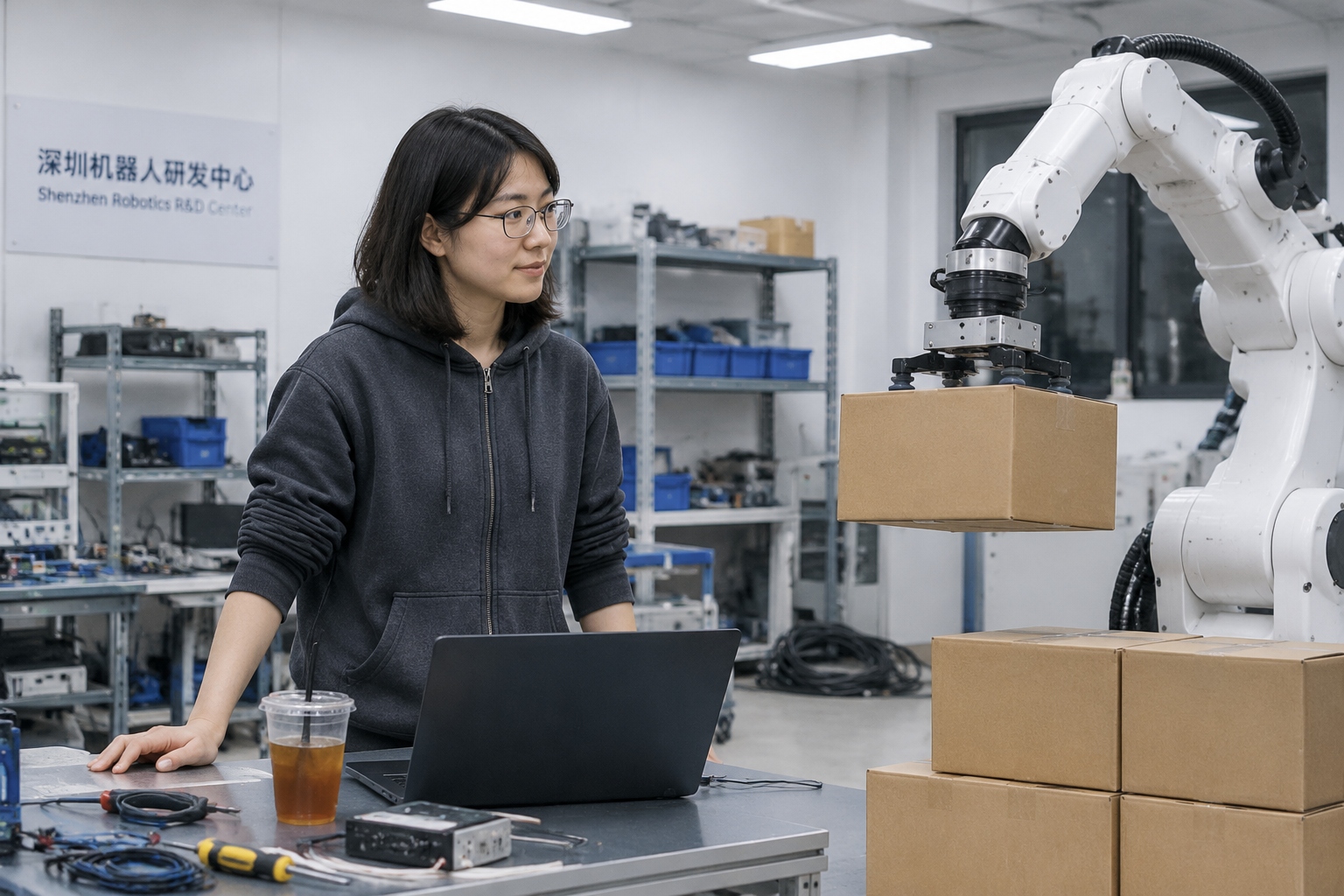
Lin Fan is 32 and testing a robotic arm. Its job: pick a cardboard box out of a messy pile of unlabelled cartons. This is attempt number 14. She holds a laptop in one hand and a cup of tea that has gone cold in the other. Her phone lights up with a message from her mother asking whether she has eaten dinner.
For a city that has just hosted the leaders of nearly all the major economies around the Pacific, this is not much of a scene. That contrast is the point. APEC was a few hours of interruption. Debugging the arm is a Tuesday.
For readers outside Asia, APEC is the annual summit of leaders from Pacific Rim economies. In 2026, China hosted it and chose Shenzhen. What television showed was a convention centre, motorcades and a red carpet. What people here saw was a temporary traffic diversion.
44 Unicorns, Most of Them Off the Tourist Map
The most common way to measure a startup city is the number of unicorns, meaning private companies valued at more than $1 billion. Shenzhen currently has 44.
The more interesting figure is what those companies do. The city’s list clusters in hardware and deep tech: semiconductors, robotics, new energy, life sciences. Beijing has the platform giants. Shanghai has fintech and biopharma. Shenzhen leans toward the end of the business closest to the factory floor, the part that needs parts, jigs, production lines and shipping.
That is not an accident of history. Shenzhen sits against Dongguan and Huizhou, the electronics manufacturing belt, and against Hong Kong, which supplies universities and capital. In most cities, seeing a supplier means booking a slot and crossing town. Here it often means crossing a street. Proximity changes how often a company can afford to try something.
Three Companies, Three Technologies Grown From Local Soil
X Square Robot: An Arm Learning to Grab
X Square Robot was founded in 2023 and is headquartered in Shenzhen. It builds general-purpose robot models along with the hardware that runs them. The goal is not a machine that repeats one motion, but one that handles an unfamiliar box on an unfamiliar shelf: teach it once, and it adjusts.
This kind of company has to grow near a supply chain. An arm needs motors, harmonic reducers, torque sensors, custom grippers and machined aluminium housings. Every one of those can be found within an hour or two of the workshop. Hardware iteration here is not counted in quarters. It is counted in weeks, and in a crunch, in days.
Hai Robotics: Machines That Climb the Shelves
Hai Robotics was founded in Bao’an in 2016 and makes automated case-handling systems for warehouses. Its robots climb the racking, pull boxes of goods down and carry them to a picking station. This is now part of daily operations in large warehouses around the world.
Most of its customers are overseas. In the US, Japan and Europe, warehouse labour has been tight for years, and automation has moved from a nice option to a line item that has to pencil out. The machines leave an industrial park in Bao’an, go into containers, and turn up in warehouses in other countries. Most people who work alongside them have no idea which street in Shenzhen they came from.
Yunsilicon: A Chip That Takes Work Off the CPU
Yunsilicon was founded in 2019 and designs DPU chips, short for data processing units. In plain terms, a DPU takes networking and storage tasks off the CPU so servers can spend their compute elsewhere. It is a crowded global field, with Nvidia and other American suppliers in the lead.
Chip designers are usually far from their customers. Yunsilicon is not. The server makers and cloud operators it works with are in the same city, so the gap between a test board and a working deployment can be measured in minutes rather than flights.
Fitting the Prototype, the Parts and the Ship Into One Hour
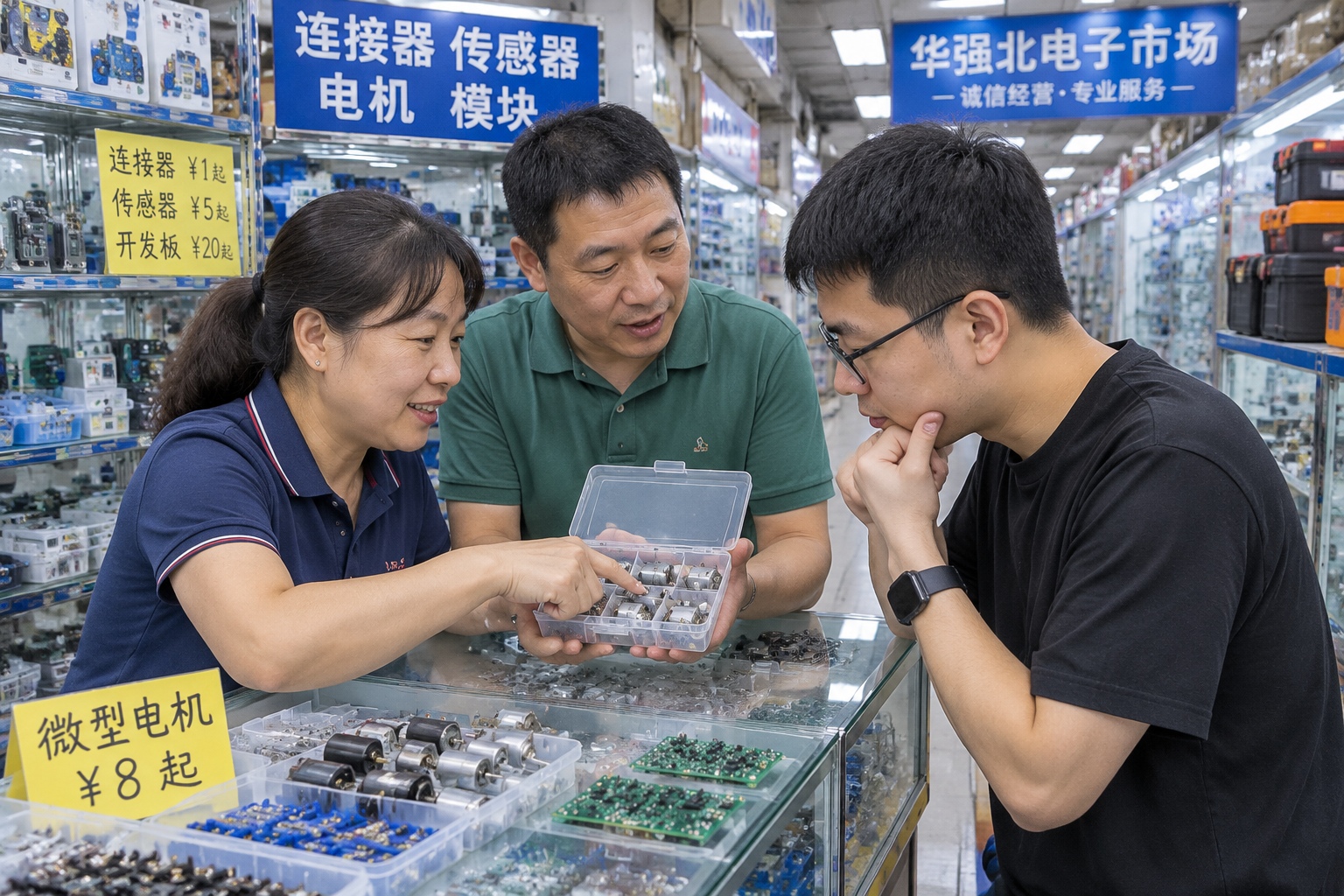
This is the loop, roughly at city scale. Huaqiangbei, an electronics market district of dozens of buildings packed with counters, supplies almost any component you can name, from connectors to sensors. Factories in Bao’an, Longhua and Guangming handle machining, injection moulding, PCB assembly and prototype builds. The ports at Shekou and Yantian send finished goods out. Shenzhen Bao’an and Hong Kong airports move the urgent things.
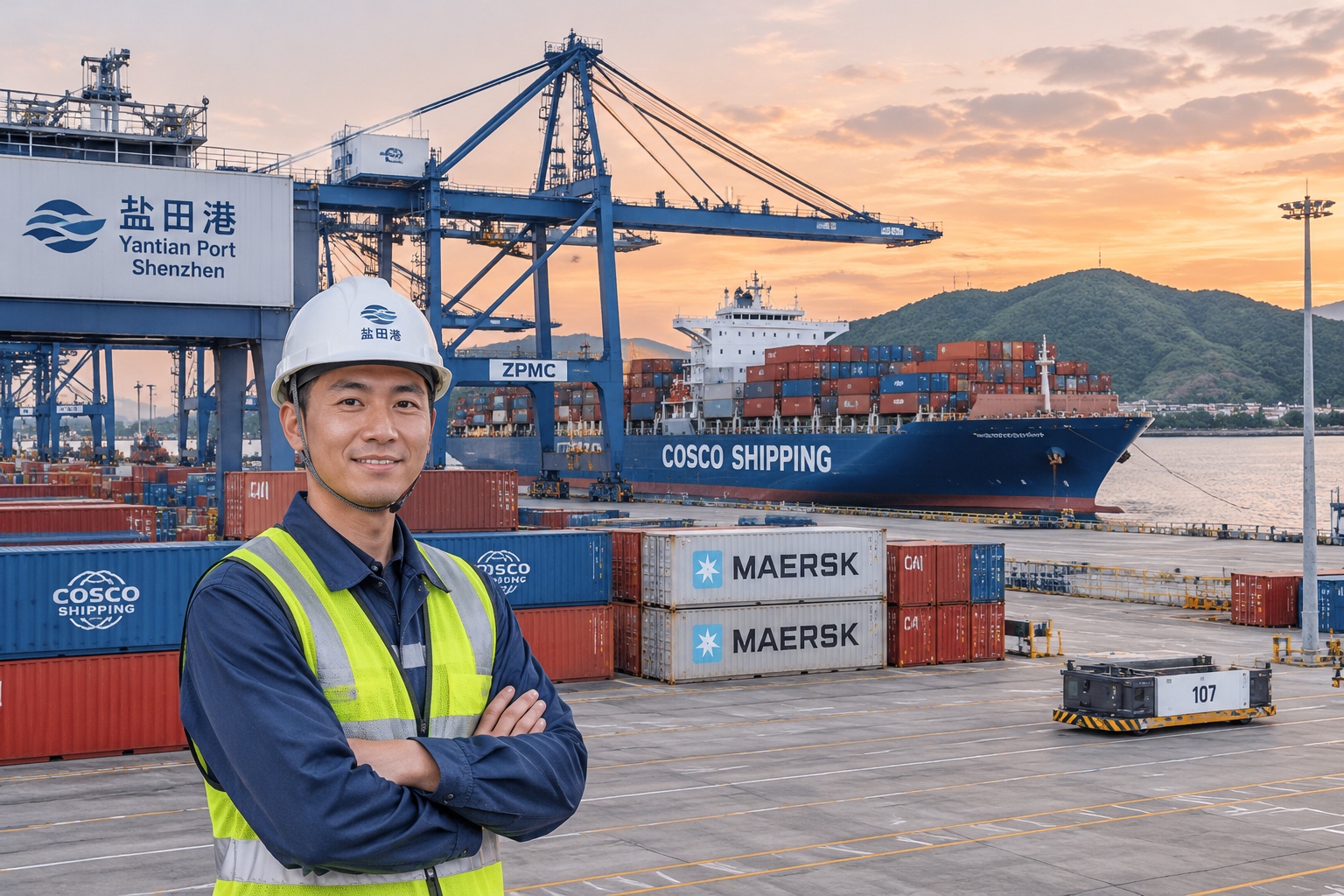
One concrete distance: from Hai Robotics in Bao’an to Yantian port is about 50 kilometres, a little over an hour by road. From Yantian, a container ship reaches Los Angeles in roughly 13 to 16 days and Rotterdam in 25 to 30. Something on a lab bench on Monday can be in a European warehouse by the end of the month.
For many hardware founders, this is the least understood advantage of Shenzhen. In plenty of Western cities, the route from drawing to first prototype involves weeks of courier time and emails about specifications. Here the supplier is across the road or two streets over. That changes behaviour, not just speed: you can afford more attempts, because failing is cheap.
Rules in the Conference Room, Products on the Street
The APEC agenda mattered, of course: trade rules, supply chain resilience, the digital economy, AI governance. For four days, leaders talked about frameworks.
Then the meetings ended and the corridors emptied. The arm is still being tested. The robots are still climbing the racks. The chips are waiting on validation. The ships leave Yantian on schedule.
That may be the most useful thing about Shenzhen for outsiders right now. Not what it has already built, and not the skyline, but the frequency with which it retries. Plenty of cities hold a summit once a year and announce a vision. Shenzhen spends the year adjusting parameters.
If the conference rooms are where the rules are discussed, a few blocks away those rules are being turned into products, loaded into containers and shipped into other people’s lives.