
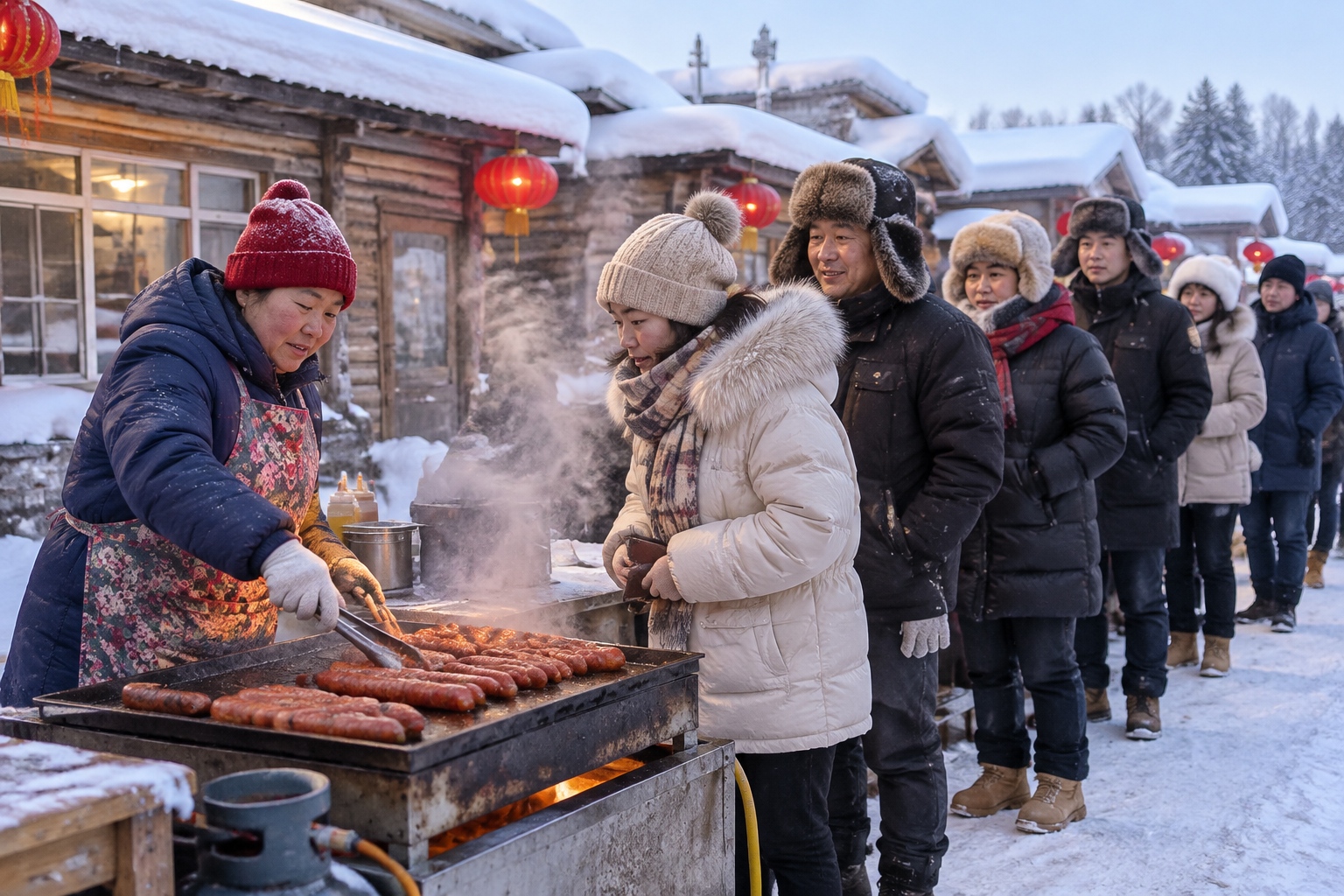

6:50 a.m., minus 31, and there is already a queue
The weather app on my phone says -31°C. By that point it has stopped being a number. It is a feeling in the sinuses, a squeaking sound under your boots, the reason your scarf is pulled up over your nose and your glasses fog from the inside.
I am standing at the edge of Xuexiang — “Snow Town” — a village in Hailin, part of Mudanjiang prefecture in Heilongjiang, the northeastern Chinese province that runs along the Russian border. Snow here piles up one to two meters deep and stays for months. That is the entire local industry: people fly and drive for hours to look at snow, walk on it, and photograph it glowing under red lanterns after dark.
At 6:50 a.m., nobody is photographing anything. About twenty people stand in a loose line in front of a stall where a woman is grilling sausages over a gas flame. Steam rises, smoke blows sideways in the wind, and everyone stamps their feet. It is the warmest thing in sight.
“We don’t have winter at home”
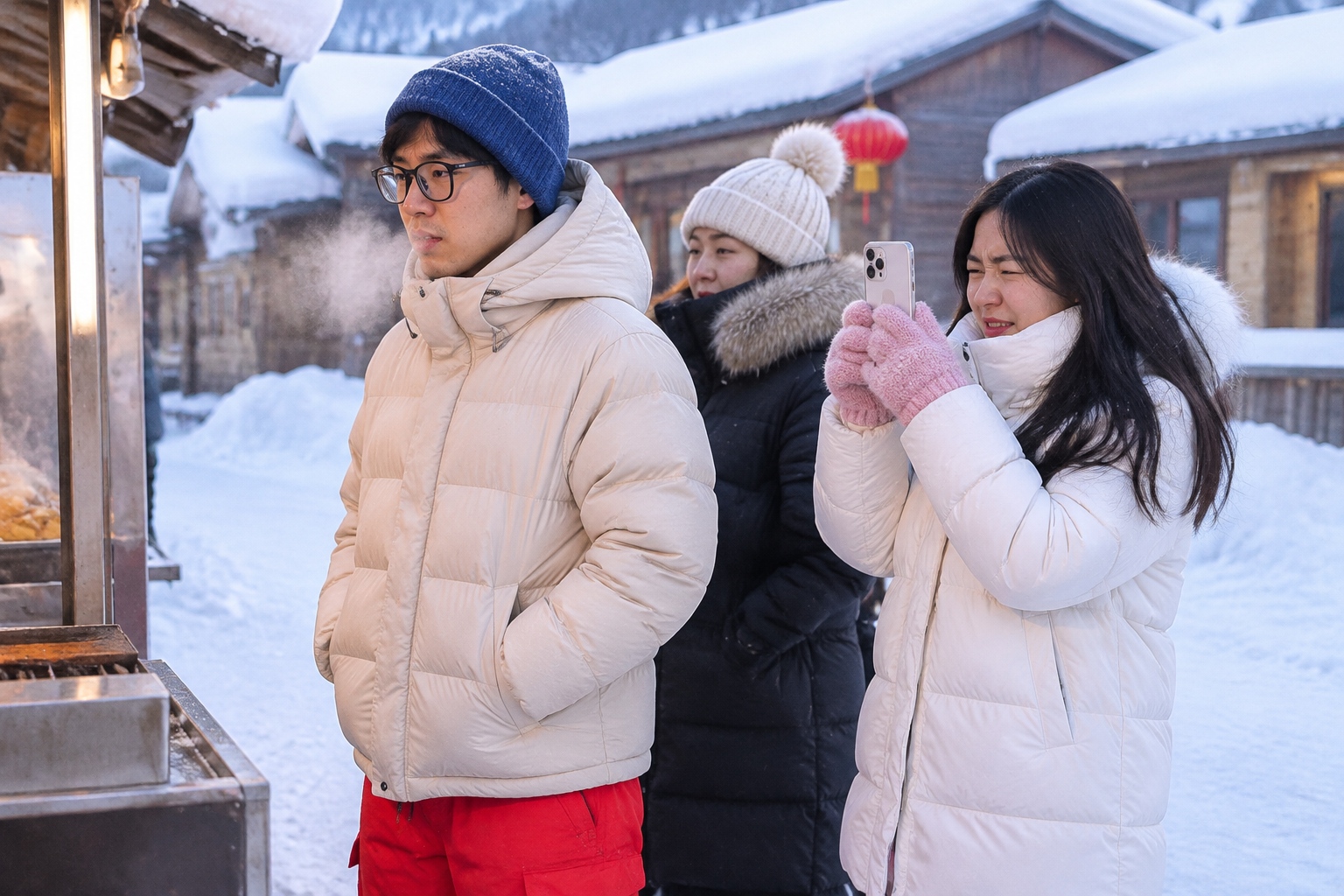
Chen Yu, 27, is third in line. He flew four hours from Guangzhou to Harbin, then sat in a car for another five. He is wearing a cream puffer jacket over two fleece layers, and a pair of red snow pants he rented at his guesthouse for about 50 yuan (roughly $7).
“In Guangzhou it’s maybe 15 degrees in January,” he says, shifting from foot to foot. “I have never felt my phone get cold before. It just died. At 40 percent.”
He orders two grilled sausages — one for himself, one for his girlfriend, who is standing ten meters away filming the queue with her gloves off. She is visibly regretting that decision. Chen hands her the sausage and she holds it against her cheek for a second before taking a bite, which is what almost everyone does here: the paper wrap is warm, and that is half the point.
Behind him is a family from Shenzhen with a nine-year-old who has discovered that if you throw a cup of hot water into the air at -30, it turns to vapor before it lands. They will try this three more times before breakfast.
The locals are in the same line, for a different reason
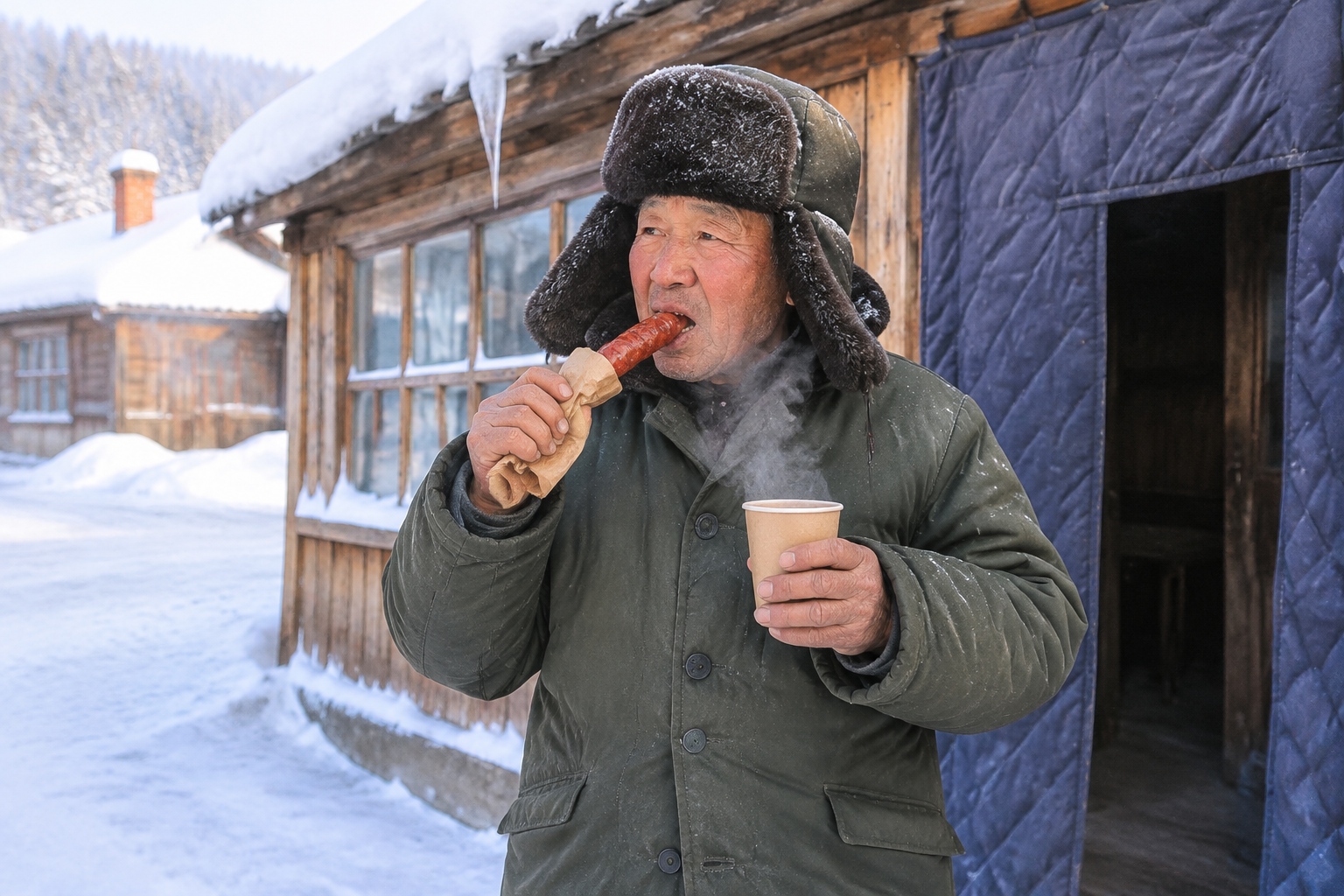
Uncle Zhao, 61, joins the queue at 7:05 without looking at the menu board. He works maintenance at a guesthouse up the road and has lived in this valley his whole life, back when it was a forestry village with no visitors at all.
“Two sausages, one porridge,” he tells the woman at the grill. Then, to me: “I eat here because I don’t want to wake my wife at six to cook.”
He remembers the change in concrete terms. “In 2005 there was one bus a day. Now in winter there are more outsiders in the village than people who live here.” He eats standing up, holding the sausage in the paper, and is gone in six minutes.
That is the thing about this line: it looks like a single crowd, but it is two crowds overlapping. Tourists are here for twenty minutes of novelty on a trip they saved for. Locals are here because it is 7 a.m., they are hungry, and the grill is the closest hot food to work.
What’s actually behind the counter
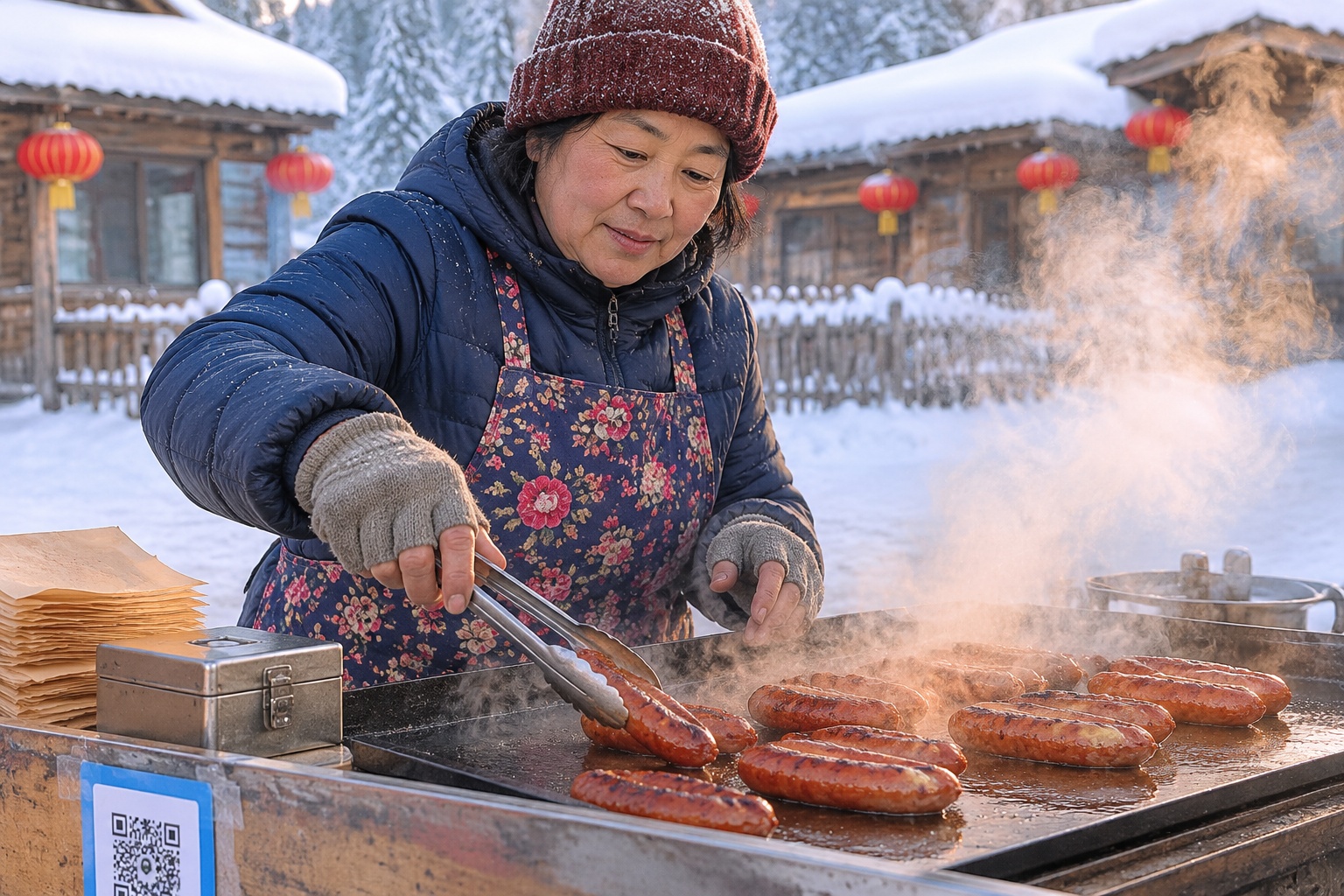
The woman at the grill is Liu Jie, 52, in a navy down jacket over a floral apron, a red knit beanie pulled down to her eyebrows, and wool gloves with the fingertips cut off so she can work the tongs. She lights the gas at 5:30 and sells until about 9:30. On a good winter day she moves 300 sausages.
Her menu, as posted on a laminated board with slightly fuzzy photos:
- Grilled red sausage — 15 yuan (about $2)
- Vacuum-packed red sausage to take home — 25 to 35 yuan
- Millet porridge — 5 yuan
- Steamed pork buns — 3 yuan each
- Hot soy milk — 4 yuan
- Tea eggs — 3 yuan
Red sausage — hongchang — is a Harbin institution. It arrived with the Chinese Eastern Railway and the Russian and European workers who built it around 1900, and it has been smoked, garlicky and slightly fatty ever since. It keeps well in cold weather. It is salty, which matters when you are sweating under three layers and losing salt. It can be eaten with your gloves on. And grilled over an open flame, split so the skin blisters, it tastes like exactly the right thing to be eating outdoors in the cold.
Snow Town is a five-hour drive from Harbin, so the sausage travels here in boxes and is part of the local winter menu in a way it simply isn’t in, say, Shanghai. “In summer nobody wants this,” Liu says. “In summer I don’t even have this stall.”
The small logistics of a minus-30 morning
What surprised me most was not the cold but the workarounds built around it.
Phone batteries fail fast in this weather, so the QR payment code is laminated and taped to the front of the counter. Almost everyone pays by WeChat or Alipay — but Liu keeps a cash box too, because a dead phone is not a rare event here. People carry power banks in an inside pocket, next to their body heat, and pull the cable out through a zipper.
Gloves are a whole taxonomy. Tourists wear mittens and then take them off to use their phones and instantly regret it. Locals wear gloves with the fingertips cut away, or thin liners under thicker ones. I saw one vendor with a heat pack taped to the back of her hand.
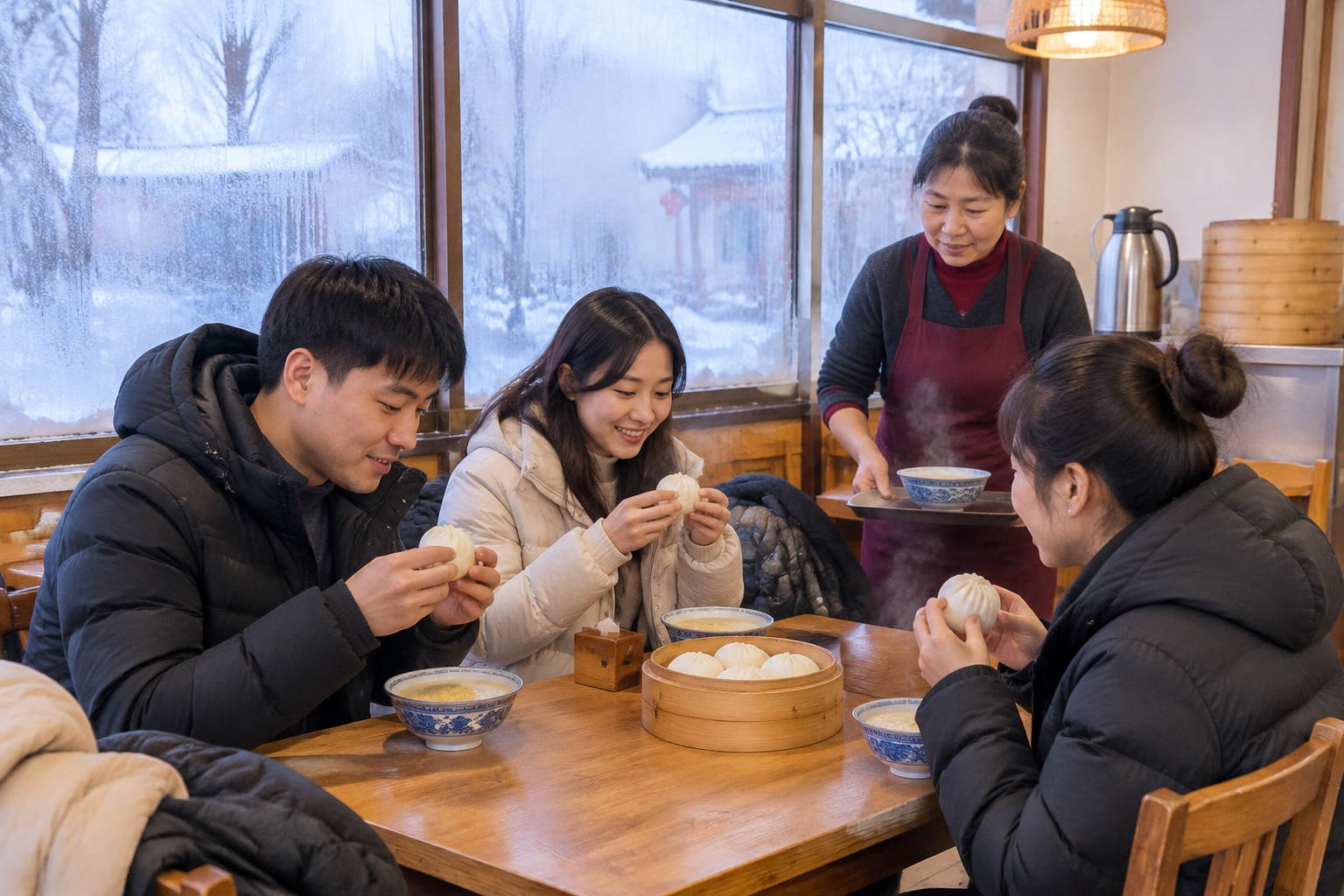
Then there is the infrastructure that keeps a village functioning at this temperature: heavy quilted door curtains on every entrance, so you push through a wall of fabric to get in or out; double doors in shops; boots with thick soles because the packed snow on the main street is polished to something like ice; and heating that runs constantly, which is why the inside of a 40-yuan noodle shop is 24 degrees and everyone is sitting in shirtsleeves with their coats piled on the next chair.
A tourist village where people also live
Xuexiang has had a rough reputation. Around 2017 and 2018, reports of wildly inflated room rates and taxi prices caused a national outcry, and the local government responded with price boards, complaint hotlines and a clean-up of the trade.
That history is visible in small ways now: the laminated menu with numbers on it, the price list taped inside the door, the receipt offered without being asked. Breakfast on the main street costs more than it would in Hailin city twenty minutes away. I paid 27 yuan for a sausage, porridge, a bun and soy milk; the same meal in town is closer to 12. Nobody in the line seemed surprised by this.
What interested me more was how seasonal the whole thing is. Liu’s stall exists from mid-December to early March. “From December to February I earn the year’s money,” she says, flipping sausages. “In July there is nobody here. I go back to picking mushrooms and looking after my mother.”
The man who drove a snowmobile sled for tourists in the afternoon works for a forestry crew in summer. A guesthouse owner rents out three rooms in her own home and moves into the smallest one for the season. The tourist economy here is not a separate world from local life; it is a few months of intense, cold, cash-heavy work layered on top of it.
What a cold breakfast has in common with breakfast anywhere
If you have ever queued outside a bakery in a ski town in Colorado, or stood in line for a bowl of ramen in Sapporo in February, or bought a paper cone of something hot at a European Christmas market, you already understand the transaction happening at this stall. The food is not complicated. The line is not short. What people are buying, partly, is the moment when something warm is put into their hands.
The difference is the margins. At -30, being outside for twenty minutes is a real physical cost, and the people serving are outside for four hours. Liu gets up at 4:40 to light the grill. She wears three layers on her legs. When I asked whether she likes winter, she laughed and said: “Winter is when I make money. Ask me again in March.”
8:10 a.m.
By 8:10 the line is six people deep instead of twenty, and the sky has gone from dark blue to a flat, bright white that makes everyone squint. Chen and his girlfriend are sitting on a wooden bench, boots up against the snow, splitting the last sausage between them. He is holding it with his gloves on, and the paper is steaming.
Uncle Zhao has already gone. Liu is scraping down the griddle for the next round, and the smoke keeps drifting sideways, the way it has since 5:30 this morning, in a village where it will be dark again by four in the afternoon.
Names of the people quoted in this article have been changed at their request. Quotes were translated from Mandarin.