


It starts with a folder, not a skyline
At 9:10 on a Tuesday morning, the Qianhai International Talent Service Center smells like printer toner and hot water. A French hardware engineer in a navy windbreaker is holding a clear plastic folder with his passport, a degree certificate, a criminal record check and a contract from his new employer in Bao’an. He is not here to admire the skyline. He is here because his Z visa expires in 23 days, and he needs a work permit and a residence permit before it does.
If you have just landed in Shenzhen, the city can feel like a launchpad: drones, batteries, chips, prototypes, speed. The first test is quieter. It is a stack of paper and a series of appointments. Shenzhen has spent the past few years turning those appointments into a chain you can follow, if you know where the chain starts.

The four-step chain: bring in, land, settle, belong
Most foreign professionals meet Shenzhen through four steps. They are not always called this on official forms, but the logic is easy to remember.
1. Bring in: the employer opens the door
Before you can apply for a work visa, a Chinese employer usually has to register the position and apply for a Foreigner’s Work Permit Notice. In Shenzhen, this is handled through the Foreigner Work Management Service System, managed by the science and technology and foreign experts authorities. Your HR team is the first institution in the chain. If HR has never hired a foreigner, ask them to call the district service center before submitting anything. A 20-minute call can save a month.
2. Land: work permit, then residence permit
The work permit and the residence permit are two different documents. The work permit gives you the right to work. The residence permit, issued by the exit-entry administration, gives you the right to stay. In many cases you now apply for both in a coordinated way, but the order still matters.
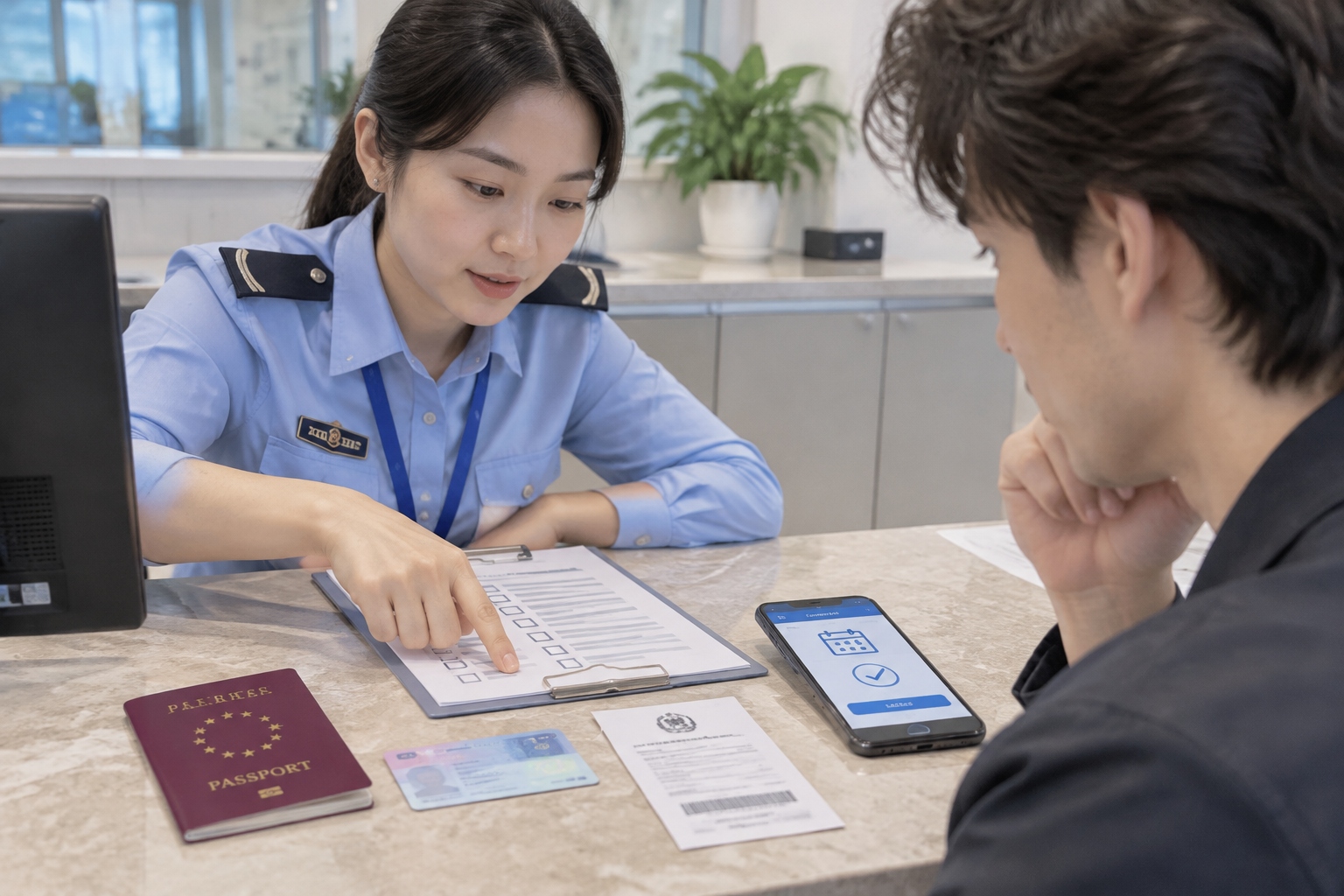
For the work permit, prepare your passport, a recent photo, your degree certificate, a criminal record check that has been apostilled or legalized, a medical examination record, and your employment contract. Your employer supplies company documents. Processing times vary by district and by talent category. A work permit notice often takes 5 to 15 working days; the work permit card often takes 5 to 10 working days after submission. A work-type residence permit usually takes 7 to 15 working days. These are planning numbers, not promises. Check the latest official list before you book a flight.
3. Settle: the bank card, the phone number, the rental contract
This is where the one-stop idea earns its name. Shenzhen’s immigration integration service sub-centers in Qianhai, Longhua and Hetao are designed to connect the legal part of arrival with the daily part. At one visit you can pre-check your work permit documents, book a residence permit appointment, ask about a bank account, get a checklist for your child’s school enrollment and find out which community events are open to foreigners. You will still need to go to a bank branch, a school or a police station for the actual procedure. The center is a switchboard, not a wall that hides every office.
4. Belong: the part no form can issue
Belonging is slower. It happens at a Tuesday evening talk in an innovation park, a Chinese class at a community center, a weekend hike with colleagues. Shenzhen has a large foreign community, but it is spread across districts and industries. The service centers and online platforms matter because they lower the cost of showing up.
Inside a one-stop center: what one window can actually do
Walk into the Longhua service center on a weekday and you will see a familiar scene: a man in a suit checking a folder, a woman with a child reading a school brochure, a young couple asking about rental contracts. The counters are not magic. But they are organized around the questions people actually ask.
At the reception desk, you can ask for a document checklist in English or Chinese. Staff can review your passport, photo and contract for obvious gaps. They can help you book a biometric appointment for the residence permit. Some centers have a bank and a telecom operator on site on certain days, so you can open an account or buy a SIM card without crossing the city. Others host monthly sessions with tax, housing and education officials. The exact services change, so call ahead or check the platform. The value is not that every office sits in one room. The value is that someone has already mapped the rooms for you.
A 25-day timeline from Z visa to residence permit
R., 34, is an Indian hardware engineer at a company in Longhua. He asked me not to use his full name. His timeline is a realistic example, not a guarantee.
Day -30: His employer filed the Foreigner’s Work Permit Notice. Documents included his passport, degree certificate, an apostilled criminal record check, a medical exam and a three-year experience letter. The notice came back in 8 working days.
Day 0: He arrived in Shenzhen on a Z visa. His landlord helped him register his address at the local police station within 24 hours. Keep that registration slip. You will need it.
Day 3: He completed a medical check at a designated clinic. The result took 3 working days.
Day 7: He submitted his work permit application at the Longhua service center. Staff caught a missing photo and a mismatched address. He fixed both the same afternoon.
Day 12: He collected his work permit card.
Day 14: He applied for a work-type residence permit at the exit-entry hall. He received a receipt that served as temporary proof.
Day 25: He collected a two-year residence permit. The same week, he opened a bank account with his passport, residence permit and Chinese phone number. It took 50 minutes.
Day 32: He visited two schools for his daughter. Both asked for his residence permit, his work permit, vaccination records and a translated birth certificate. One school had a waiting list for the next term. This is the part that catches families: school applications can run on a different calendar from your work visa.
The small things that decide whether someone stays
Ask foreign talent why they left a city and you rarely hear about the visa alone. You hear about a bank card that took three visits, a landlord who did not want to register the lease, a child who could not get a school place, a spouse who could not find work. These are not small things. They are the settlement layer.
For children, start early. Shenzhen has international schools, private bilingual schools and public schools with different district rules. You will usually need your passport, residence permit, work permit, birth certificate, vaccination records and proof of address. Some documents need translation. Fees vary widely. Apply months ahead if you can.
For renting, do not skip the registration. Your landlord should provide the property certificate and ID, and you should register your residence at the local police station. A lease that cannot be registered can become a problem when you apply for a bank card, a school place or a permanent residence permit.
For banking, bring your passport, residence permit, Chinese phone number and, in some branches, your work permit or employment contract. Bank of China, ICBC and China Merchants Bank have branches used to foreign customers, but experiences vary. Ask your HR which branch nearby knows the procedure. A bank card is not a luxury. It connects you to mobile payment, salary, utilities and daily life.

What Caihua Tong can and cannot do
Shenzhen’s Caihua Tong platform, often used as a mini program, is the city’s attempt to put the boring parts of arrival in one place. It can show you service center addresses, explain visa categories, list documents, help you book appointments, point you to Chinese learning resources and advertise community events. It can save you a lot of running around.
It cannot approve your work permit. It cannot replace your employer’s sponsorship. It cannot make a school place appear or settle a dispute with a landlord. Treat it as a map and a checklist, not a magic key. If a question involves your legal status, confirm with the exit-entry administration or the foreign experts office.
What one-stop really means
One-stop does not mean one day. It means the city has built an interface for people who arrive with a suitcase and a deadline. The interface is a counter in Qianhai, a checklist in Longhua, a platform called Caihua Tong, a bank teller who knows what a residence permit is, a school office that answers email in English.

Shenzhen is proud of its speed. The more useful story is the slower work: making the first 30 days legible. For a foreign engineer, that is the difference between a project and a life. For the city, it is the difference between hosting talent and keeping it. Policies and processing times change, so check the latest official guidance before you act. But the direction is clear. The open door is not only at the airport. It is at the service window, the bank counter and the school gate.