
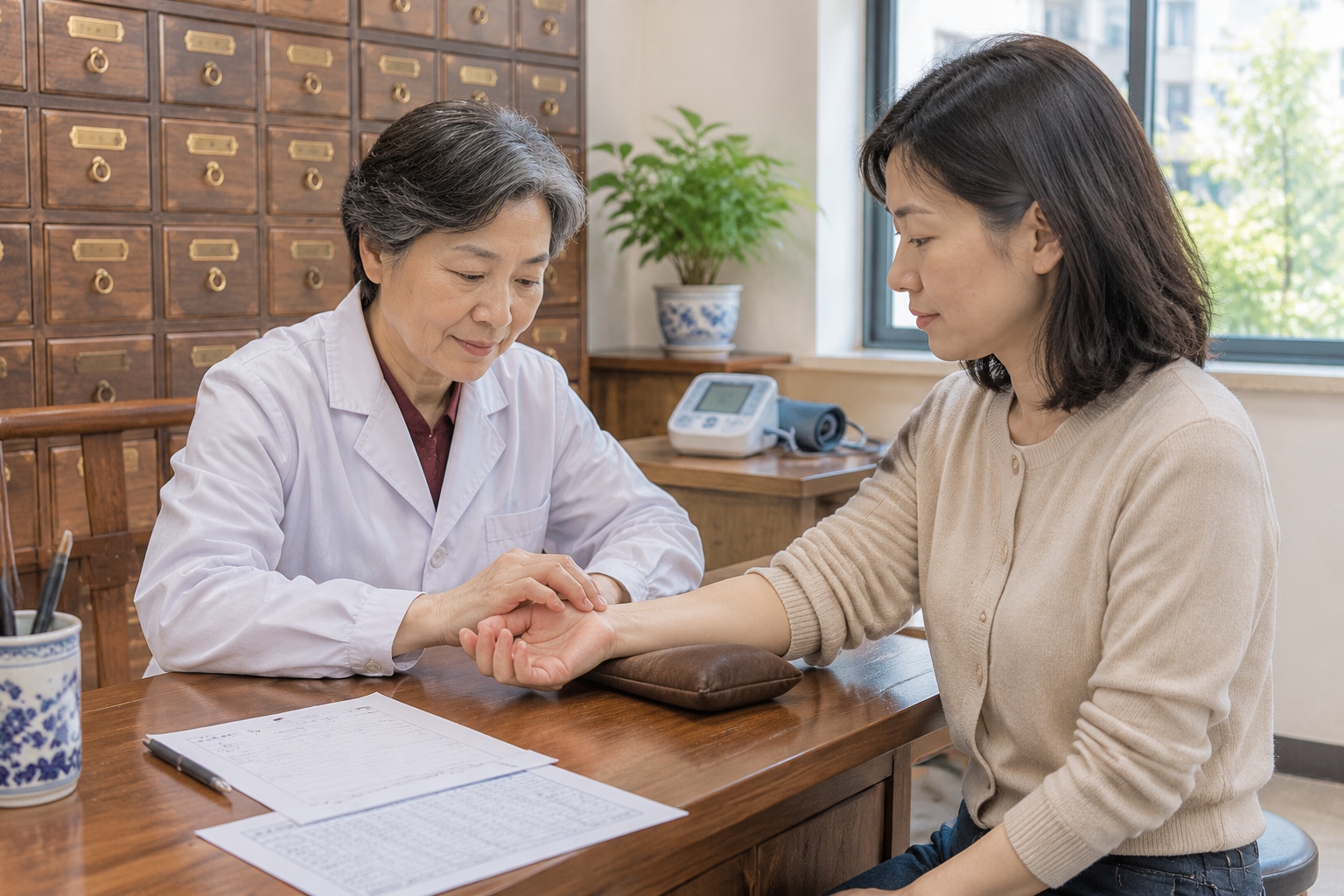

In a public hospital in Hangzhou, a 34-year-old product manager I will call Lin sits in a small clinic room with her jacket still on. She has come about fatigue and poor sleep. The doctor, a woman in her fifties, does not begin with the word energy. She asks about Lin’s appetite, stools, menstrual cycle, temperature, dreams, and how often she wakes at night. Then she looks at Lin’s tongue, takes her pulse at both wrists, and reads the blood test Lin brought from her regular physician.
The room smells faintly of dried herbs and alcohol swabs. A blood pressure cuff hangs by the desk. The doctor writes a herbal formula, suggests acupuncture twice a week, and asks Lin to come back after two weeks. Nothing about the scene is mystical. It is ordinary, bureaucratic, and slightly rushed, like much of healthcare anywhere.

For an outside reader, Traditional Chinese Medicine, or TCM, can look like two incompatible things at once: a wellness brand built on vague ideas about balance, and a dense philosophical system with its own vocabulary. In China it is neither exactly. It is a regulated medical profession, a large consumer market, a subject taught in universities, and a daily argument about evidence, tradition, and safety.
That is why TCM is hard to understand from headlines. A claim that acupuncture works, or that a herb is toxic, or that qi cannot be measured, may be true in one context and misleading in another. You need a few terms, some historical background, and a way to separate clinical claims from marketing.
Why a Glossary Helps More Than a Verdict
Most public arguments about TCM jump straight to verdicts. Is it science? Is it superstition? Those questions matter, but they arrive too early. The system uses words that look familiar in English and mean something different. If you translate qi as energy, you may imagine a measurable force. If you translate zang as organ, you may expect the TCM kidney to filter blood. It does not work that way.
A better start is to learn the handful of terms that do most of the work. Think of them as handles, not equivalents. They help you follow what a practitioner is saying before you decide whether to agree.
A Short TCM Glossary: Ten Terms Worth Knowing
Here are ten high-frequency terms. The explanations are deliberately plain; each could fill a chapter.
| Term | Pinyin | Plain meaning | Common misreading |
|---|---|---|---|
| 气 | qi | The activity, movement, and transforming function of the body. | Not a battery that can be topped up with a drink. |
| 阴阳 | yin-yang | Paired qualities such as cool and warm, rest and activity, moist and dry. | Not good versus evil, or female versus male. |
| 证候 | zheng hou | A pattern: a cluster of signs and symptoms that guides treatment. | Not a lab-confirmed disease in the biomedical sense. |
| 经络 | jing luo | Channels or meridians used in acupuncture theory to describe relationships across the body. | Not anatomical tubes visible on a scan. |
| 脏腑 | zang fu | Organ systems with functions beyond anatomy, such as the kidney’s role in growth and bones. | Not the same as the kidney or liver on a pathology report. |
| 四诊 | si zhen | The four examinations: looking, listening and smelling, asking, and palpating. | Not a replacement for blood tests or imaging. |
| 辨证论治 | bian zheng lun zhi | Pattern differentiation and treatment: choose treatment based on the pattern, not only the disease name. | Not a single formula for everyone with the same diagnosis. |
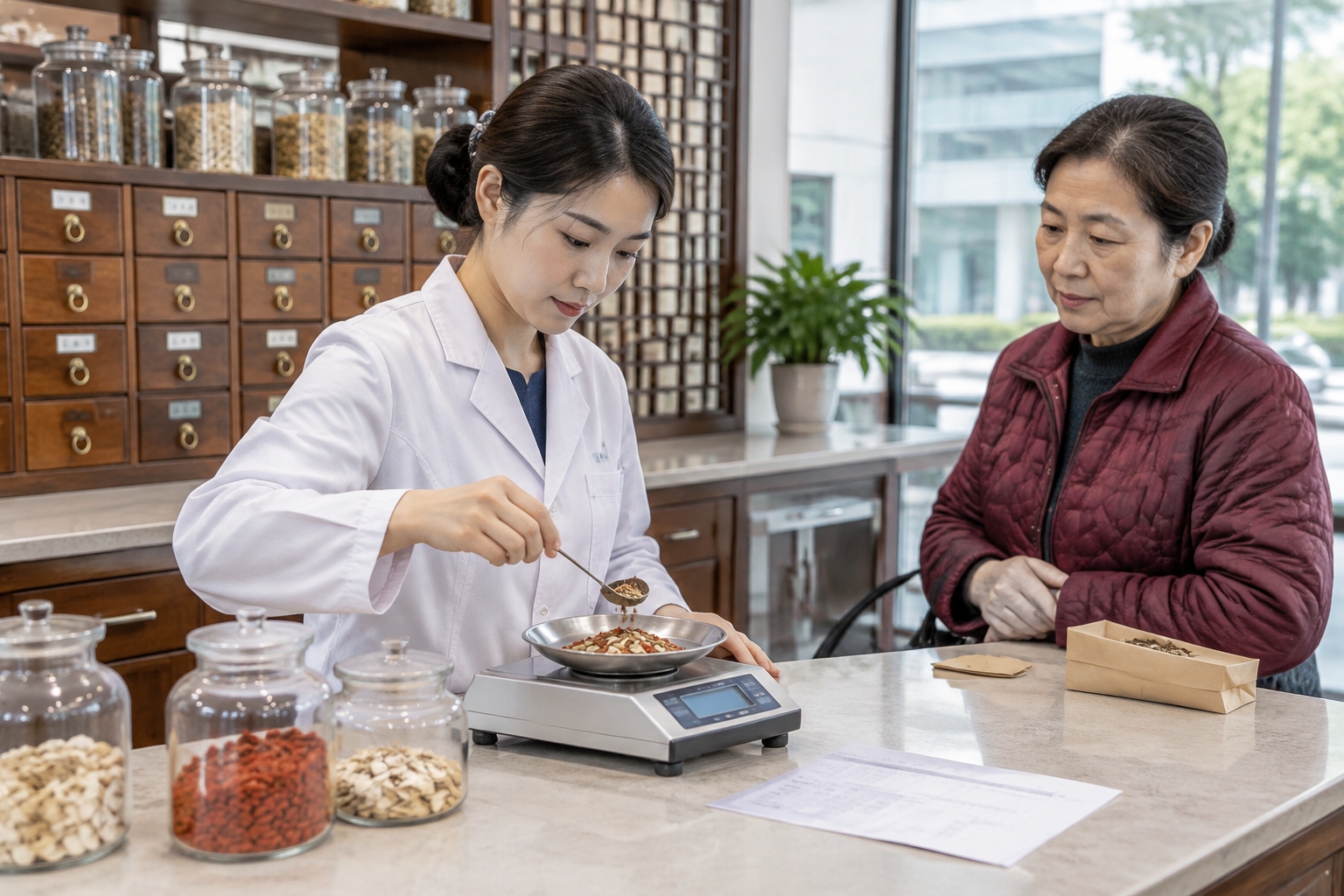
| 中药 | zhong yao | Chinese materia medica: plants, minerals, and some animal products, usually prescribed in formulas. | Not automatically safe because it is natural. |
| 针灸 | zhen jiu | Acupuncture and moxibustion: needling and heat stimulation at selected points. | Not one procedure with one evidence base for every condition. |
| 五行 | wu xing | Five phases: wood, fire, earth, metal, water, used as a relational system. | Not literal elements in the body. |
Where the Concepts Came From
TCM concepts took shape over centuries, in texts such as the Huangdi Neijing, or Inner Canon, and the Shanghan Lun. They were developed in a world without germ theory, modern anatomy, clinical trials, or imaging. That does not make them foolish. European medicine also used humoral ideas for centuries, not because doctors were stupid, but because those ideas organized observations and treatments before modern physiology arrived.
The historical point matters because it changes what you expect. TCM language is not a rough version of modern physiology. It is a different map, built for different purposes: explaining patterns of illness, guiding herbal formulas, and organizing clinical experience. Some parts of that map have been revised in modern Chinese hospitals. Others remain traditional. Practice varies by hospital, practitioner, region, and condition.
The Translation Trap
English makes TCM sound stranger or simpler than it is. Qi becomes energy, which sounds like a rechargeable battery. Meridian comes from geography and suggests a fixed line under the skin. Syndrome sounds like a disease, though zheng hou is closer to a clinical pattern. Liver qi stagnation sounds poetic, almost literary, and that can make it seem either profound or nonsensical.
Translation is not a neutral window. It shapes what you think is being claimed. A reader should treat English TCM terms as handles, not scientific equivalents. When precision matters, ask for the Chinese term and how a particular clinic uses it.
A Reading Path That Saves Time
If you want to go beyond the glossary, read in stages. Do not start with a polemic for or against TCM. Start with structure.
1. Get a map
Read a short university-press introduction or visit a good museum exhibition on Chinese medicine. Your goal is to learn the system’s main parts: diagnosis, herbs, acupuncture, formulas, and the historical texts. You are not yet judging evidence.
2. Add history
Read a historian such as Paul Unschuld, or a reliable overview of Chinese medical history. You will see that TCM is not one frozen tradition. It has changed with print culture, nationalism, hospital training, and export. The version sold abroad is often narrower and more mystical than what is taught in a Chinese medical university.
3. Look at clinical practice
Read ethnographies or patient guides that show how doctors actually reason. In Chinese hospitals, TCM is often practiced alongside biomedicine. A patient may get an MRI, a blood test, acupuncture, and a herbal formula in the same week. That integration is messy, pragmatic, and worth understanding.
4. Read evidence by condition, not by slogan
Acupuncture for chemotherapy-related nausea is not the same question as acupuncture for low back pain, or herbal medicine for COVID-19. Use systematic reviews, clinical guidelines, and Cochrane Library summaries. Look for the condition, the comparator, the outcome, and the quality of the trials. A single study is rarely enough.
5. Go narrow only after that
Then follow your interest: herbal pharmacology, acupuncture mechanisms, drug-herb interactions, regulation, or the history of a single formula. This order prevents two common mistakes: swallowing the whole system as wisdom, or dismissing it as one thing.

How to Think Critically Without Sneering
Critical thinking does not mean starting from contempt. It means asking better questions. What exactly is being claimed? For which condition? Compared with what? What does the evidence show, and how good is it? What are the risks? Who profits? Those questions can be asked respectfully, and they work in both directions.
On the herbal side, natural does not mean safe. Herbs can interact with warfarin, blood pressure drugs, and immunosuppressants. Some products have been contaminated with heavy metals or forbidden ingredients. Endangered animal parts remain a real conservation problem. Regulation in China has tightened, but quality varies, and online sales complicate enforcement.
On the acupuncture side, evidence is uneven. Some reviews find benefit for certain kinds of pain and nausea; others find small effects or poor trial quality. Placebo is powerful, and that matters. It is possible to take a treatment seriously without pretending the evidence is stronger than it is.
On the tradition side, it is lazy to call millions of people stupid. Many Chinese patients use TCM pragmatically. They try it for chronic complaints, post-viral coughs, menstrual pain, or sports injuries. Some are disappointed. Some are helped. Some use it because it is affordable and close to home. That everyday reasoning is more interesting than either camp’s slogans.

If You Visit a TCM Clinic in China
Bring your biomedical records. Tell the practitioner about every drug and supplement you take. Ask what is in the formula, how it should be prepared, and what side effects to watch for. Ask whether the clinic is part of a licensed hospital. Be wary of anyone who promises a cure for everything or tells you to stop prescribed medicine.
Expect questions that seem oddly specific: sleep, stools, sweating, thirst, temperature, mood. Expect the tongue and pulse. Also expect, in many urban hospitals, a computer, a printer, and a queue outside the door. TCM in China is not sealed off from modern life. It is embedded in it.
The Useful Takeaway
The point is not to believe or disbelieve in one word. It is to read the system on its own terms, then ask hard questions in plain language. Learn ten terms. Read history before polemic. Check evidence by condition. Watch for translation effects. And keep your critical thinking warm rather than sneering.
That approach will not settle every argument about TCM. It will make you harder to fool, and harder to bore. More importantly, it will let you see what Lin sees in that clinic room: a tradition that is still being used, argued over, regulated, sold, and tested in ordinary Chinese life.