
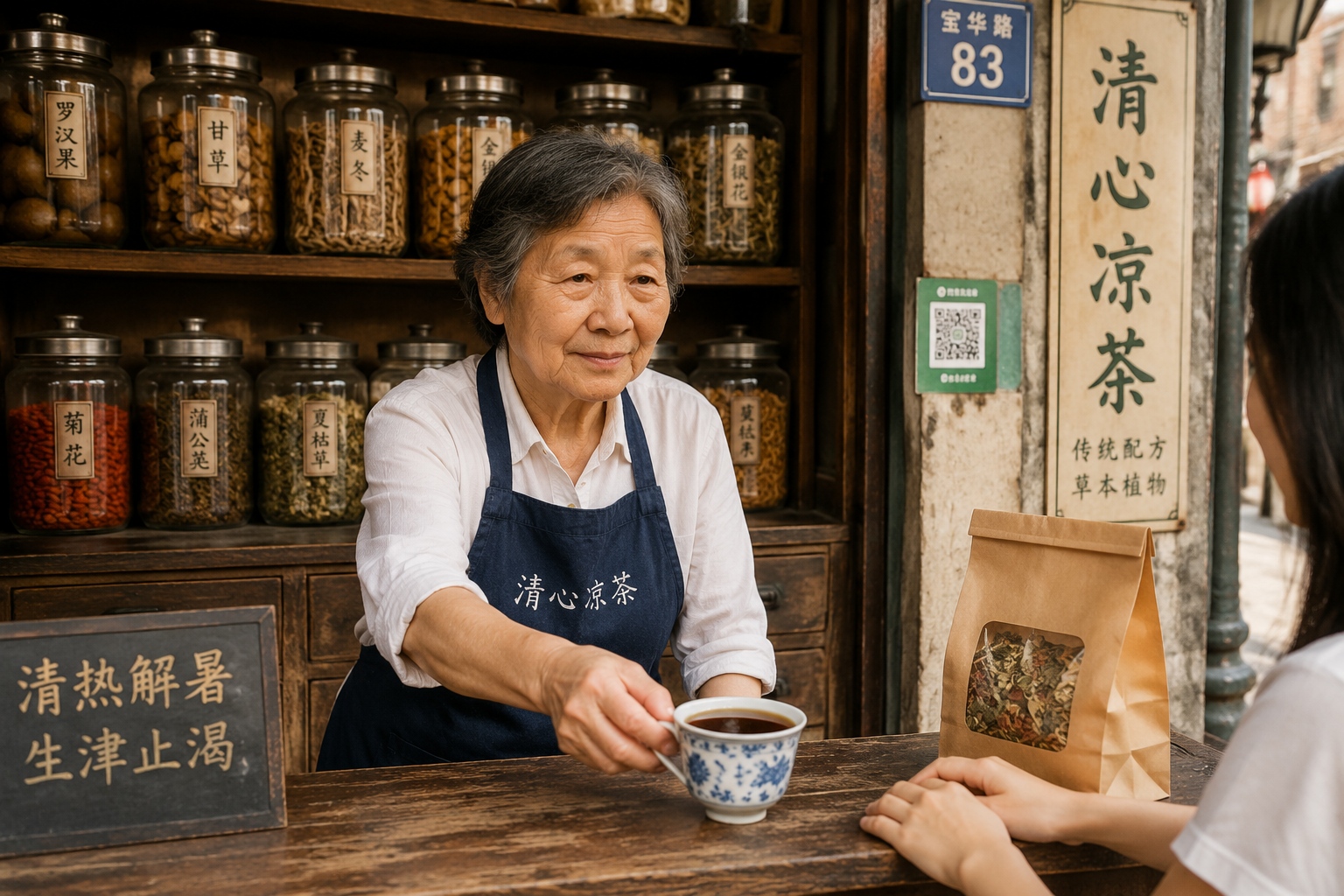

A small cup of something bitter in Guangzhou
The shop has no menu. It has a counter, two thermoses, a stack of paper cups, and a woman in a blue apron who has been selling herbal tea on this street for decades.
She asks two questions. “What’s bothering you?” and “What did you eat last night?”
Then she pours something almost black into a small porcelain cup and slides it across. It tastes like burnt bark, and somewhere underneath, a sweetness that arrives late.
“Bitter,” she says. “You’ve been sleeping late.”
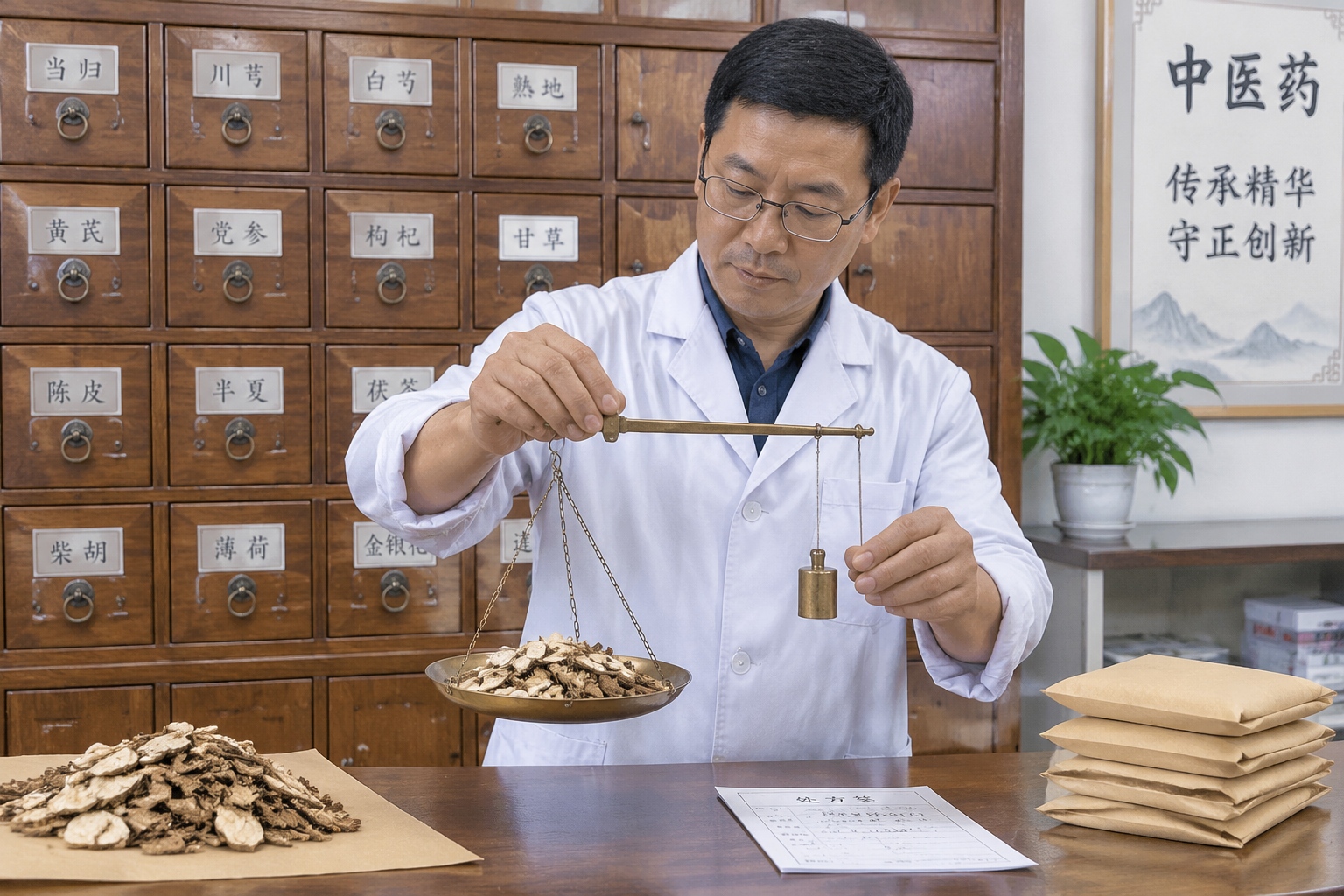
To a visitor this can look like fortune-telling. It isn’t quite. She is using a framework that sorts herbs and foods by taste and explains what each taste does in the body — a framework written down, argued over and revised in China for roughly two thousand years. It still decides what goes into a pot of soup in a Guangzhou kitchen, what a student drinks during exam week, and what a pharmacist weighs out behind a wall of wooden drawers.
Here is what the five flavors actually mean.
Five flavors describe a job, not a taste
Chinese pharmacology labels any herb or food with two things: its nature — cold, cool, neutral, warm or hot — and its flavor — sour, bitter, sweet, pungent or salty. The pair is known as 四气五味, “four natures and five flavors.”
The part that surprises people is that flavor is not mainly about your tongue. It is shorthand for a direction of action: what the substance pushes upward or downward, what it holds in or lets out, which organ system it is said to reach.
This is why bitter melon, bitter tea and bitter herbs all sit in one category without being interchangeable. They share a direction of action, not a chemical identity.
The five flavors, one by one
Sour: the flavor that holds things in
酸收 — sour astringes. Think of things leaking out when they shouldn’t: sweat, a cough that won’t stop, a stomach that empties too fast. Sour substances are used to gather and hold.
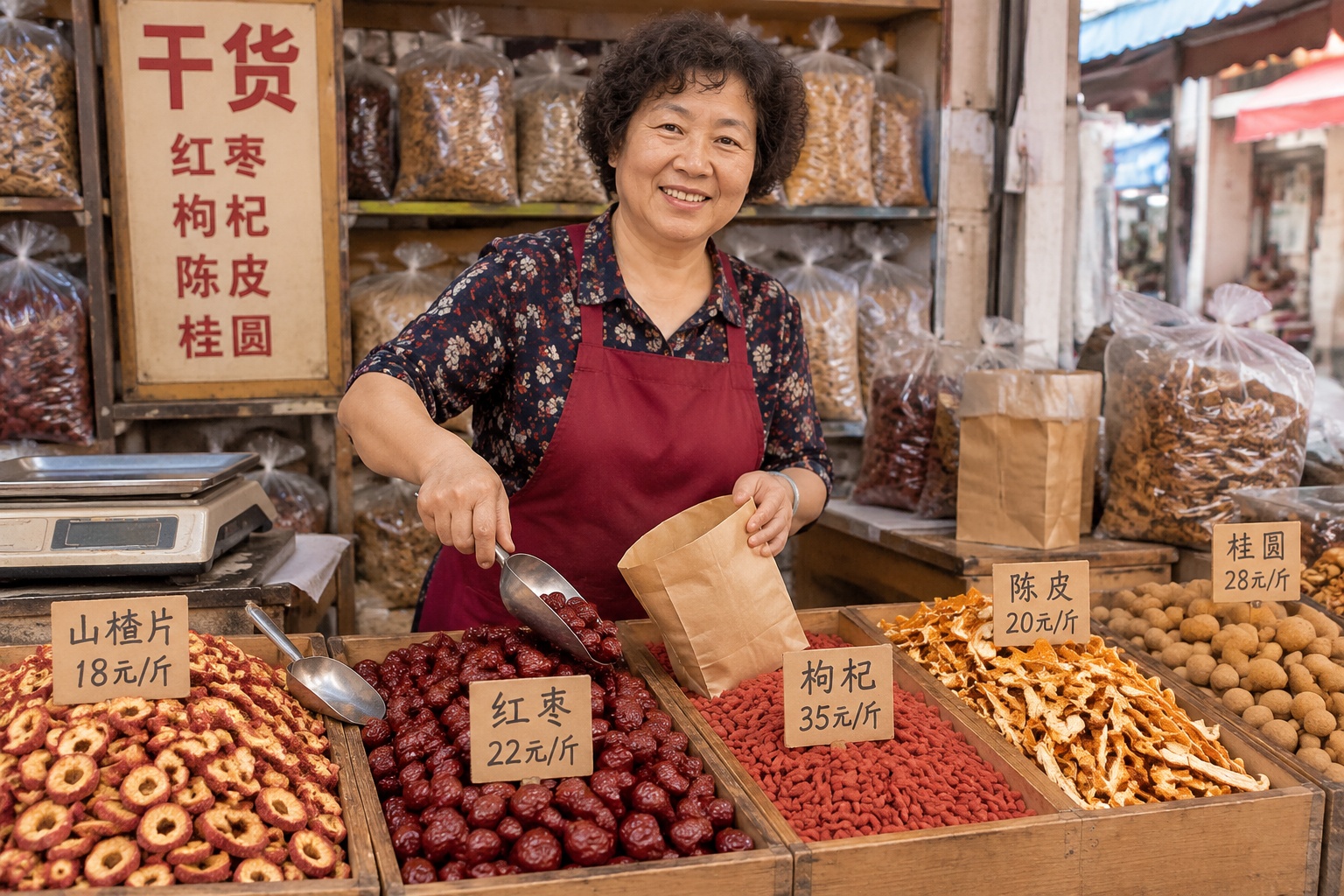
You can taste this logic in ordinary food. Hawthorn (山楂), sold in every dried-goods stall, is what Chinese families reach for after a heavy meat meal — hawthorn slices, candied hawthorn on a stick, hawthorn tea. Smoked plum (乌梅) is the base of 酸梅汤, the dark sweet-sour summer drink sold from bottles in Beijing and made at home from smoked plum, hawthorn, liquorice and rock sugar. Vinegar does similar work in northern kitchens: dumplings, braised ribs, cold noodles.
Bitter: the flavor that drains and cools
苦泄 — bitter drains and moves downward. It is the flavor tied to clearing heat, drying dampness, and getting things moving when they have stalled.
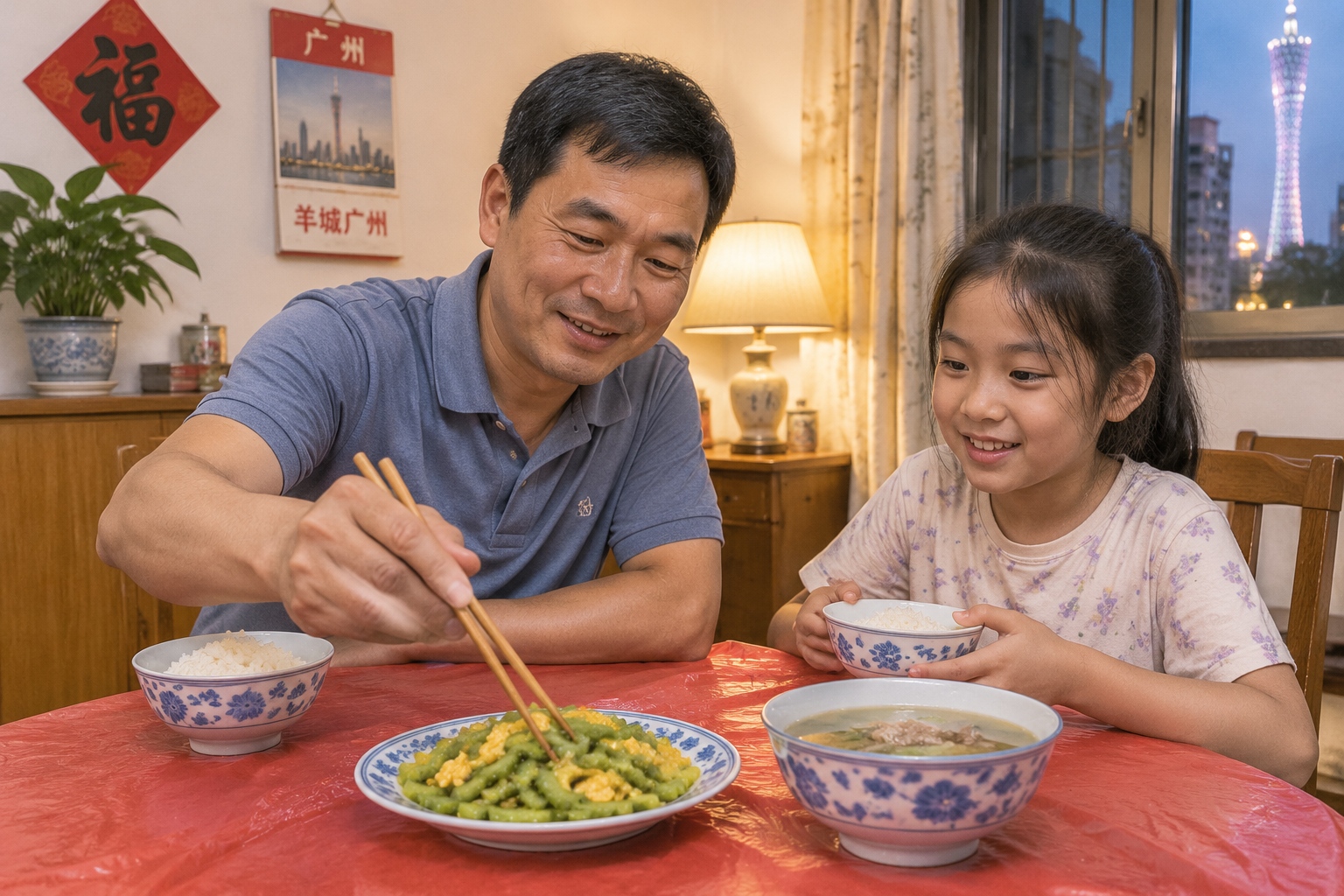
The most familiar example is 苦瓜, bitter melon: sliced, salted, squeezed, then stir-fried with egg or stuffed with pork. In the south it is a summer vegetable, eaten precisely when the weather feels heavy and sticky. Bitter tea (苦丁茶) and dandelion show up for the same reasons. Stronger bitter herbs such as 黄连 are the pharmacy’s business, not the kitchen’s.
One warning appears in the old texts and in modern practice alike: bitter-cold things are not for everyone. Eaten in quantity, they are described as hard on digestion — which roughly matches how most people feel after a week of bitter melon and iced tea.
Sweet: the flavor that slows things down and builds them up
甘缓 — sweet moderates and tonifies. It smooths harshness, eases tension, and in the tonic sense, builds.
甘草, liquorice root, is the clearest case. It turns up in a large share of classical formulas, often in small amounts, less as a remedy than as a peacemaker that keeps the other ingredients from fighting.
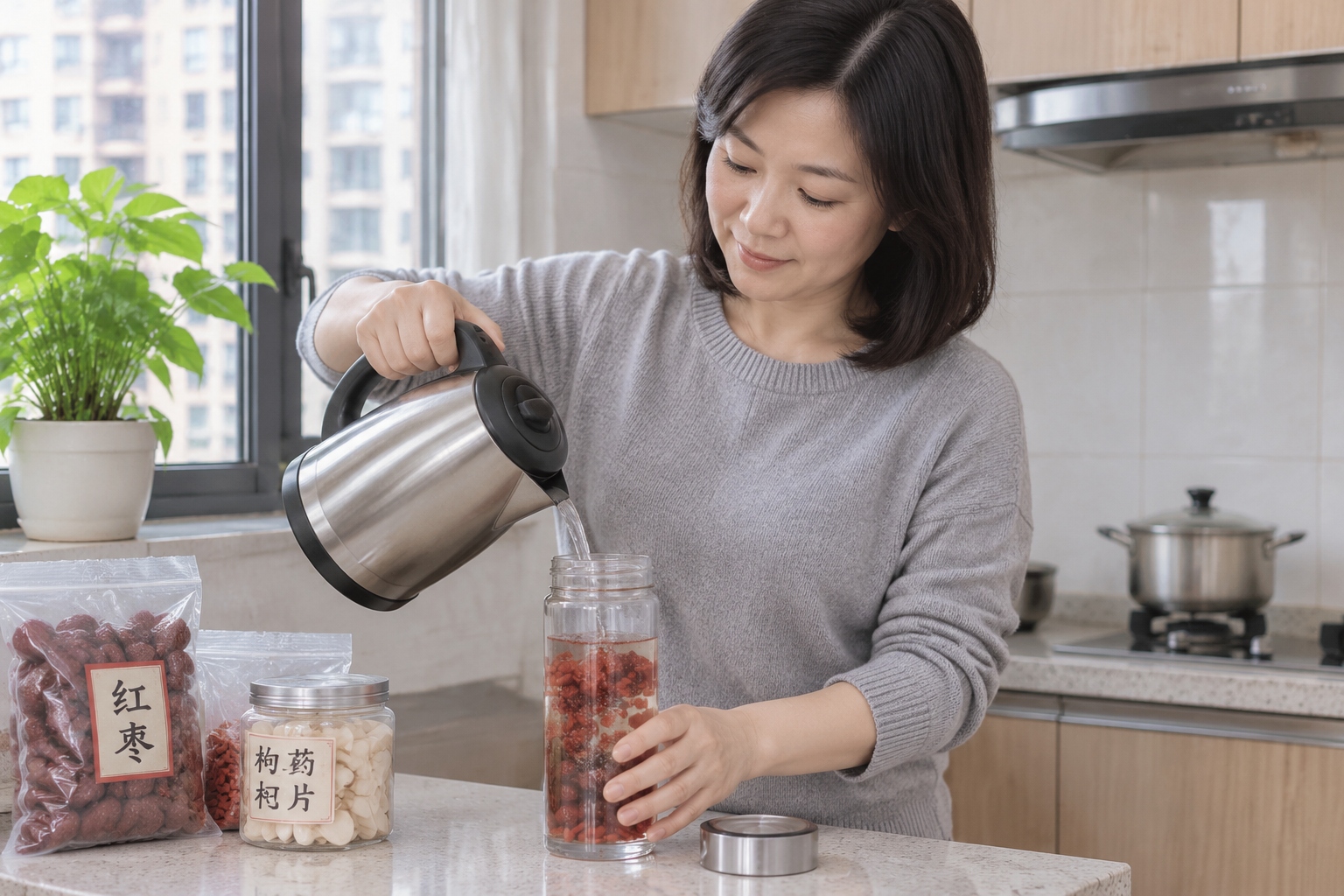
In the kitchen, sweet-tonifying foods look like red dates (红枣), goji berries (枸杞), Chinese yam (山药), longan. That is what floats in a lot of office thermoses at ten in the morning — red dates and goji topped up with hot water all day, a habit so widespread among younger workers that it has become a running joke.
Here is the distinction that matters for anyone from outside: in this system, “sweet” describes a slow, building, harmonizing quality, not a sugar content. A can of soda is sweet and does nothing the tradition would call tonifying. Classical texts warn that too much sweet food weakens the spleen — a line that reads strangely next to a supermarket dessert aisle.
Pungent: the flavor that pushes outward
辛散 — pungent disperses. It moves things outward and upward: opens the surface, pushes out cold, gets qi moving.
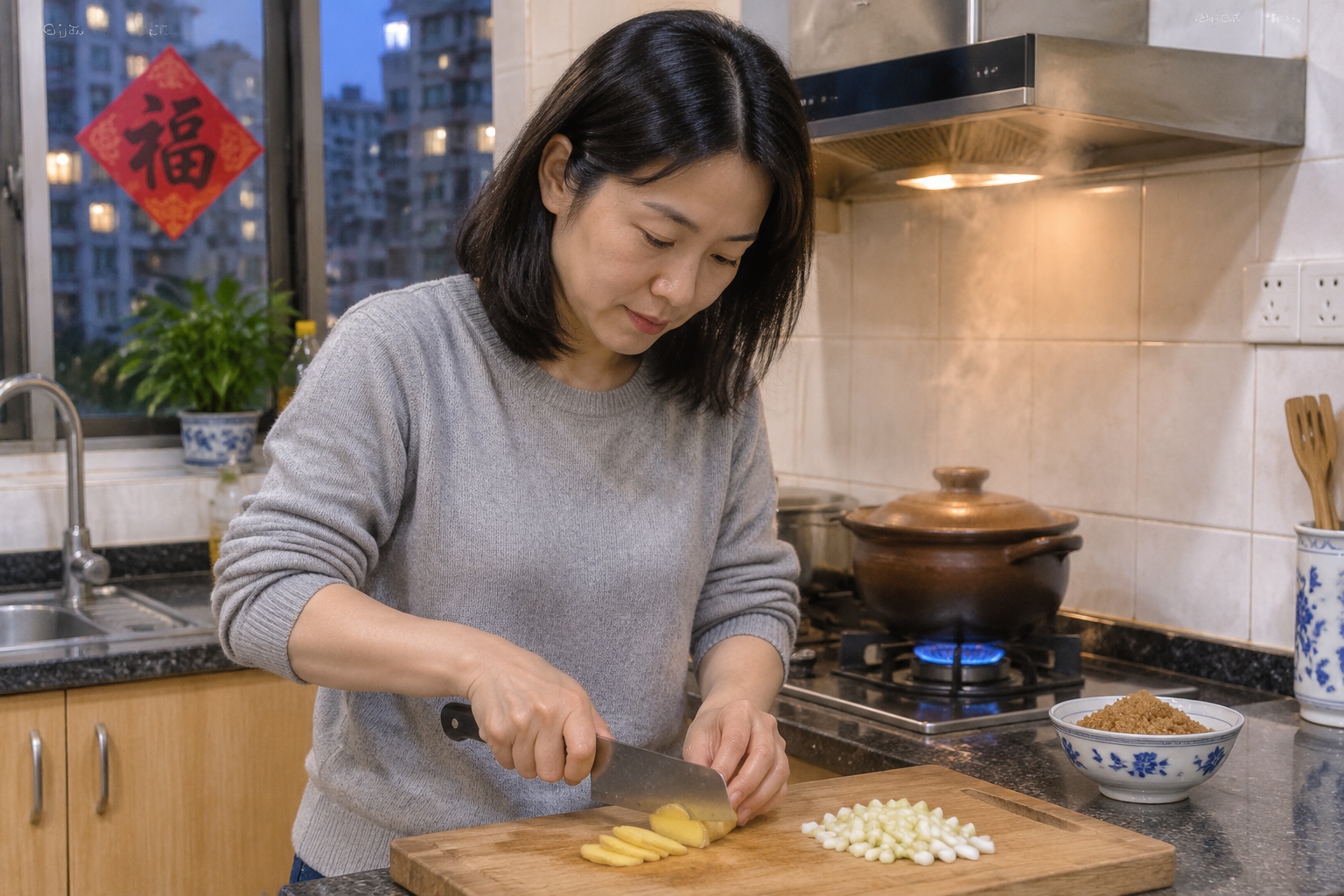
Ginger is the household version. At the first sign of a chill, a grandmother will make 姜汤 — sliced ginger simmered with scallion white and a little brown sugar — and hand it over while it is still hot. Cantonese cooks use white pepper where other cuisines use black. Sichuan cooking uses 花椒, the numbing peppercorn, as a pungent base underneath the chili.
And here is a small surprise: chili peppers only reached China in the late 1500s, arriving from the Americas. The fieriest thing in Chinese cooking is a relatively recent import, while the “pungent” category is far older and was originally built around ginger, pepper, cinnamon bark and aromatics.
Salty: the flavor that softens
咸软 — salty softens hardness and moves downward. The tradition uses it for things that feel hard, knotted or blocked.
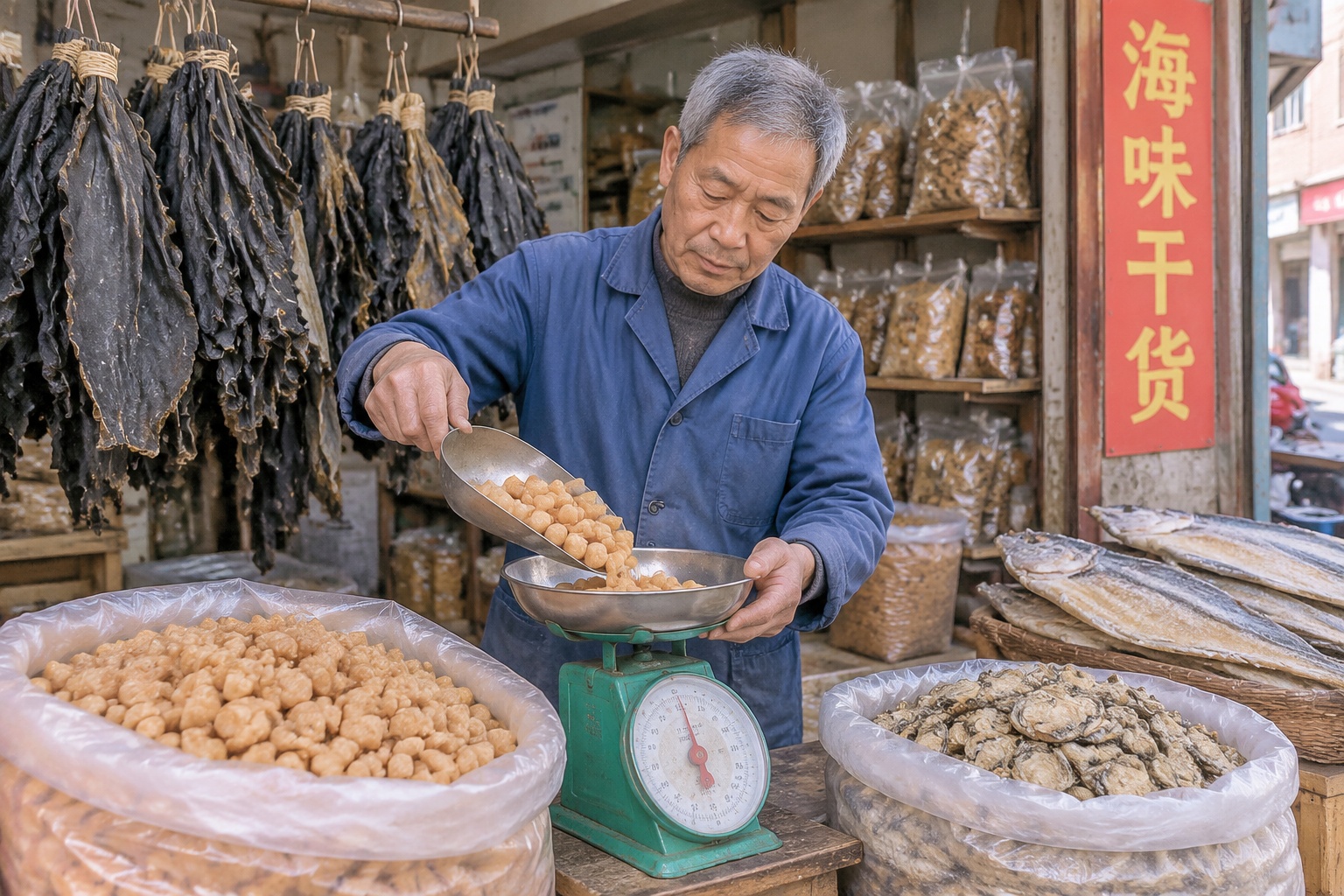
Food-wise this is the seaweed shelf: 海带 kelp in pork-rib soup, dried scallops stirred into congee, salted mustard greens in a noodle broth. Oyster shell (牡蛎) is a standard salty ingredient in formulas, and 芒硝 — Glauber’s salt — is the dramatic example every textbook uses.
There is a second idea attached to salty: 咸入肾, “salty enters the kidney.” It explains why a small amount of salt is treated as necessary rather than optional, and why excess is described as damaging. Home cooking in southern China is not especially salty — but restaurant food and pickles push the daily number up fast.
Flavor alone decides nothing
A flavor label never stands on its own. Two herbs can both be bitter and behave nothing alike, because their nature differs. 黄连 is bitter and cold, used for heat. Bitter-warm herbs in the citrus-peel family go the other direction and are used to get stuck digestion moving.
Processing changes flavor too. Raw rehmannia root (生地) is cold and bitter and used for cooling; the same root steamed with wine into 熟地 becomes warm and sweet and is used for building blood. Same plant, opposite job, different process.
And flavors are combined on purpose. 酸甘化阴 — “sour and sweet generate fluids” — is why 酸梅汤 is built on smoked plum plus rock sugar, and why a classic three-herb formula for thirst and fatigue pairs sweet ginseng with sour schisandra. 辛开苦降 — “pungent opens, bitter descends” — is the logic behind a well-known formula for a stomach that feels both blocked and irritated at once.
What it looks like in an ordinary week
None of this stays in textbooks. It shows up in the rhythm of home cooking.
Cantonese families simmer soup for two hours — lotus root with pork bone, or 霸王花 with apricot kernels — and the choice of what goes in depends on the season and on who has been coughing. Summer brings 绿豆汤, mung bean soup cooked with rock sugar and served cold, the standard answer to heat. Winter brings lamb soup with ginger and angelica. After a hotpot, someone suggests 凉茶, the cold bitter tea sold from street stalls across the south.
Most of this is food, not medicine. It is gentle, it is cheap, and it is mostly about paying attention: to weather, to sleep, to how your body feels that week. Whether it works the way a clinical trial would measure is a separate question — and worth keeping separate.
Where the five flavors stop being useful
Three honest limits.
First, taste is not pharmacology. “Bitter clears heat” is a useful map, not a mechanism, and it tells you nothing about what dose of which plant does what. Plenty of bitter plants are simply toxic.
Second, one flavor label covers very different substances, and the tradition knows it. That is why no practitioner prescribes on flavor alone — they weigh nature, dose, processing, the person’s constitution, the season, and whatever else is already being taken.
Third, herbs interact with drugs. Goji berries, harmless as they look in a thermos, are documented to interact with warfarin. Liquorice raises blood pressure in quantity. Bitter-cold herbs can upset digestion. Anyone who is pregnant, on medication for a heart condition, diabetes or blood thinning, or living with kidney or liver disease should treat online flavor charts — including this article — as background reading, not instructions.
A note on what this article is: it explains a cultural and historical framework behind Chinese food and herbal medicine. It is not medical advice and not a substitute for diagnosis or treatment by a qualified professional. If a symptom worries you, see a doctor — a hospital’s 中医科 (traditional medicine department) is one option, and so is your regular physician.
Back at the counter
The woman in the blue apron does not consult a chart. She asks how I slept, glances at my tongue for a second, and reaches for a different jar.
Whatever you make of the theory, the habit underneath it is oddly practical. It treats what you eat as part of how you feel — not a reward at the end of the day, but an input, adjusted by season, by mood, by whatever has been going on.
The cup is still bitter. But you finish it. That part, at least, is universal.