


Day One: A Question From an African Student
On the first day of my elective course ‘Chinese Wuxia Culture’ at a university in Shanghai, a student from Ghana raised his hand before I even finished the opening slide. ‘Professor, I read the course description, but I still don’t get it,’ he said. ‘Is wuxia just kungfu movies with swords and flying people? Like Crouching Tiger, Hidden Dragon?’

The room laughed. But his question was honest—and it’s the same one most foreign students bring to class. They’ve seen the flying figures, heard of Shaolin monks, maybe watched a Jackie Chan film. But the core concept—xia yi (侠义), the code of the chivalrous hero—remains a fog. That semester, with 22 students from 12 countries, I set out to clear that fog.
What Is ‘Xia Yi’? (And Why It’s Not Just ‘Being a Good Guy’)
In Chinese, xia yi combines two characters: xia (侠) meaning a heroic person who acts for justice, and yi (义) meaning righteousness, duty, or moral obligation. It’s not simply ‘doing good’—it’s about acting outside the system when the system fails. A wuxia hero often breaks the law to uphold a higher moral law. Think of it as an ancient Chinese version of the vigilante, but with a strong emphasis on loyalty, self-sacrifice, and not seeking personal fame.
I explained this to my students, then asked: ‘Does your culture have a figure like that?’
The Brazilian student immediately said, ‘Robin Hood!’ The Egyptian nodded: ‘We have stories of bandits who protect the poor.’ A German student hesitated: ‘Maybe the Wanderer in Romantic tales? But he’s more about nature than justice.’ A Japanese student quietly added, ‘Ronin—masterless samurai—sometimes did similar things.’

The discussion took off. We had found a universal thread: every culture needs heroes who cross the line to do what’s right. But xia yi is distinct in its philosophical roots—Confucian ideas of ren (benevolence) and Daoist detachment from fame.
The Assignment: ‘If You Were a Wuxia Hero…’
For their midterm, I asked students to write a short story or essay: ‘If you were transported into a wuxia world, what kind of hero would you be, and what code would you follow?’
An Indonesian student wrote about a female pirate who defends sea villages against corrupt officials—mixing xia yi with local maritime folklore. A student from the UK imagined a detective-wuxia crossover, where the hero uses both kungfu and logic to uncover a conspiracy in a fictional dynasty. A Saudi student created a hero who never kills, reflecting Islamic ethics, but still fights to restore justice. Another, from South Korea, wrote about a wandering poet-warrior inspired by both Chinese xia and Korean hwarang (flower knights).
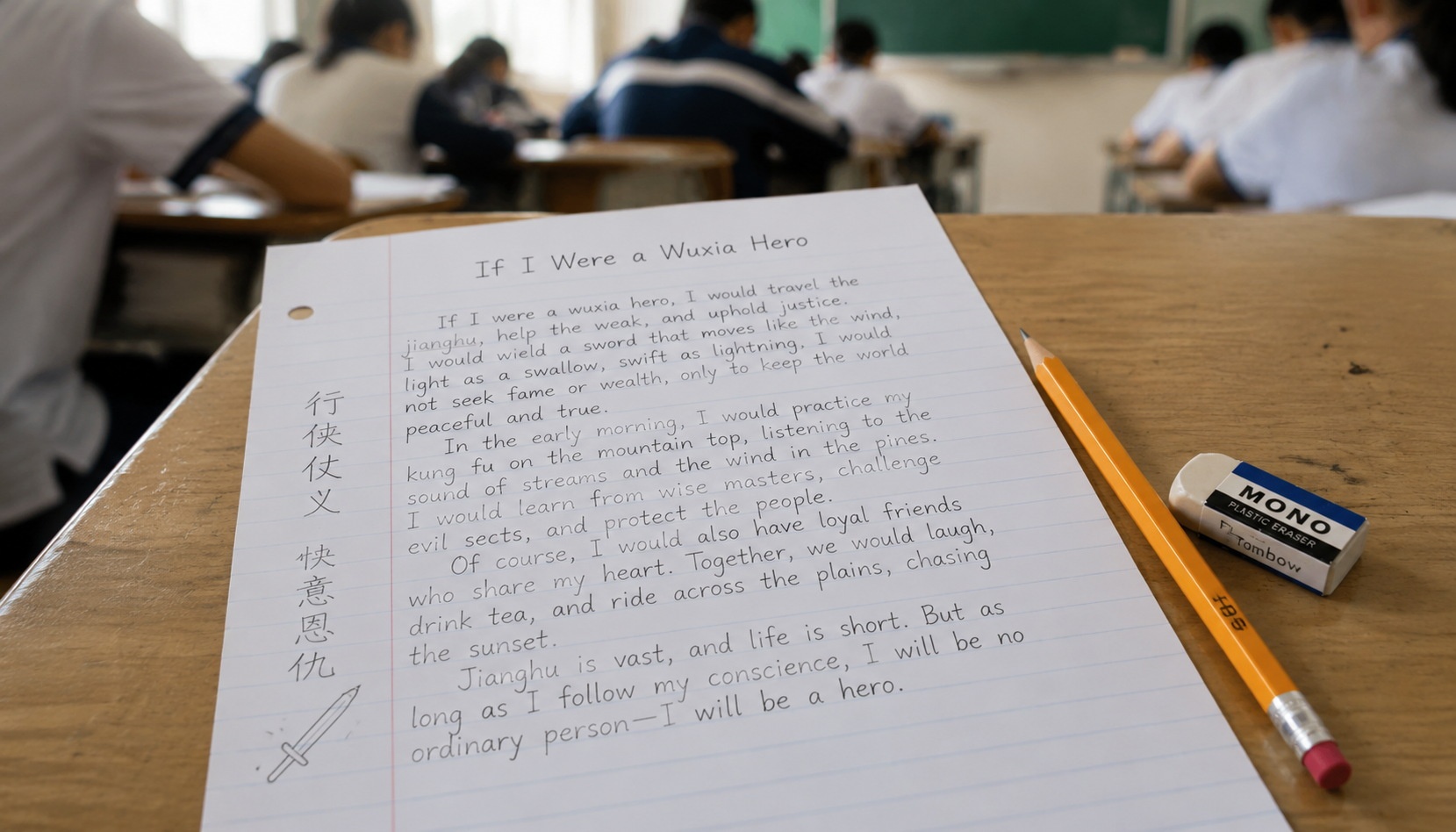
What struck me was how naturally they all anchored their stories in their own cultures. The concept of xia yi became a mirror: they saw themselves and their backgrounds reflected in it.
Flying Daggers and Everyday Ethics
Midway through the semester, we read a short story by Jin Yong, the master of wuxia fiction. The scene where the hero, Guo Jing, refuses to kill an enemy even when everyone tells him to—because it goes against his sense of righteousness. A student from India raised her hand: ‘This is like the Mahabharata. Arjuna hesitates to fight his own cousins. The struggle is the same—duty versus personal feeling.’
Class exploded into a comparative ethics debate. A French student argued that Guo Jing’s choice was more about ‘honor’ than ‘justice.’ A Mexican student disagreed, saying it was about ‘community harmony.’ Nobody was wrong; they were all seeing different dimensions of xia yi through their own lenses.
By the end of the course, the African student who started it all wrote in his final reflection: ‘I used to think wuxia was just exotic action. Now I see it’s a philosophy of how to live when the world is unfair. That’s universal.’
So, What Does ‘Xia Yi’ Mean to Foreign Students?
It’s not a fixed definition. For some, it becomes a challenge to think about justice outside the law. For others, it’s a new vocabulary to discuss moral dilemmas. And for many, it’s simply a fun way to connect Chinese culture to their own heritage.
Teaching wuxia in China to international students isn’t just about explaining ancient stories. It’s about watching cultures talk to each other through the language of heroes. The classroom becomes a microcosm of the world, where a Ghanaian student, a Brazilian, and a Japanese student all agree that sometimes you need a sword, a code, and a bit of wind beneath your feet.

Start the discussion at forum.chinacomes.com