

A Morning in a Connected Farm
The greenhouse on the outskirts of Wuxi was too warm. A sensor placed near the tomato vines had been measuring temperature and humidity around the clock. When the readings crossed a threshold, the system sent a notification to Wang Lin, the farm manager. She tapped her phone, and a ventilation window opened automatically a few seconds later.
Wang Lin is not a tech engineer. She grows tomatoes. But in this city, IoT is no longer a buzzword — it is a quiet layer under the surface of daily work. Wuxi, a city of about 7 million people located 100 kilometres west of Shanghai, has been building the tools for this kind of connected world for more than a decade. And it has become one of the largest, most dense IoT ecosystems in the world, with thousands of companies, demonstration projects and physical infrastructure embedded in everyday urban life.
From “Perception China” to a National IoT Hub
Wuxi’s story starts in 2009. That year, the Chinese government announced a plan to build a “Perception China” network of sensors and chose Wuxi as the site of the country’s first national sensor network innovation demonstration zone. The goal was to develop technologies that let physical objects collect data, share it, and act on it — and to do that not in a lab, but in one real city.
After the zone was launched, both public and private investment began to flow. Wuxi now has more than 3,000 IoT-related companies, ranging from chipmakers and sensor manufacturers to cloud platform providers and system integrators. The total output of the IoT industry here exceeded 400 billion yuan (about 55 billion USD) in 2023. Many of these companies are small and highly specialised, but together they form a supply chain that can turn an idea into a working prototype within weeks — something few other cities can match.
Where IoT Meets Daily Life: Three Real Applications
For most visitors, the most obvious sign of Wuxi’s IoT system is on the roads and in public transport. But the technology is also deeply embedded in factories, utilities and even agriculture. Here are three examples that show how the “Internet of Things” actually changes the way a city runs.
Green lights for connected buses
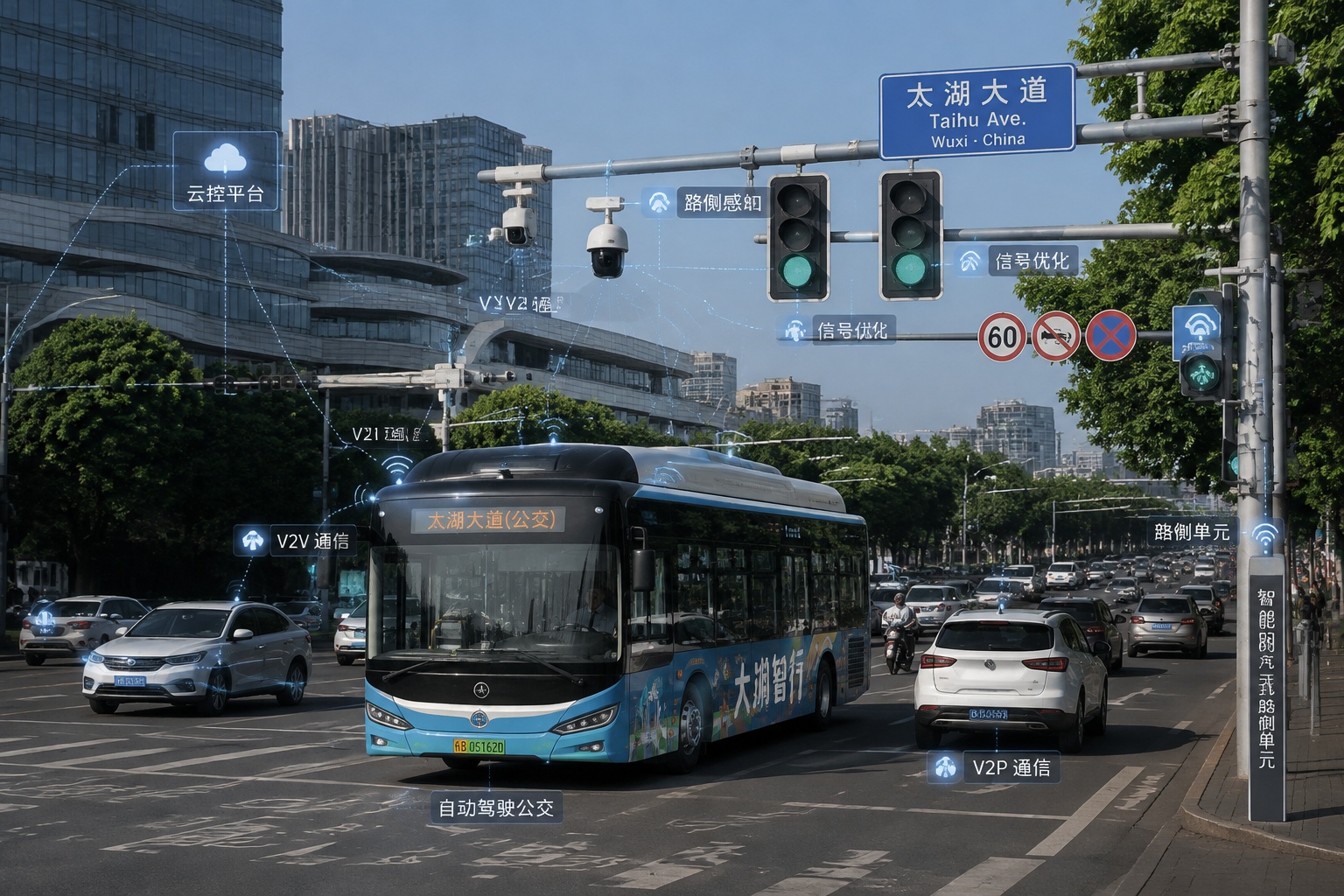
Wuxi was the first city in China to operate a national pilot zone for vehicle-to-everything (V2X) communication. On more than 800 kilometres of open roads, traffic lights, road signs and vehicles communicate with each other in real time. City buses carry on-board units, and when a bus approaches an intersection, the traffic light can shorten or extend its green phase so the bus passes through without stopping. For passengers, this means a smoother ride and, on some routes, nearly 15% shorter journey times, according to local transport operators.
Beyond buses, the city has opened these roads to tests of automated delivery vehicles and driverless shuttles. A local logistics company uses small connected robots to move packages between sorting stations, reducing human error in loading. This level of open, public-road testing is still rare in most of the world.
Factories that talk to themselves
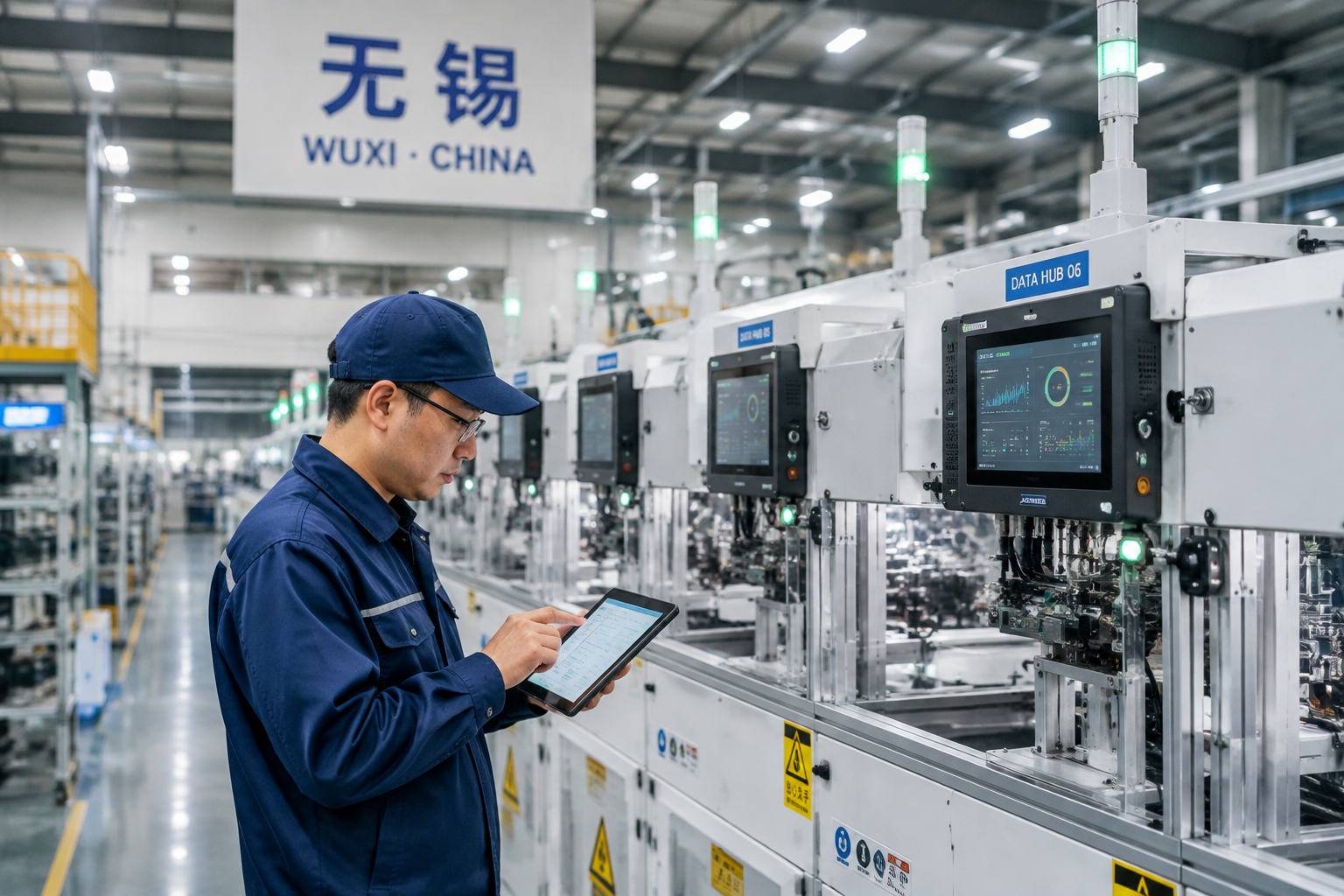
In the manufacturing districts around Wuxi, more than 700 industrial internet projects are now in daily operation. A typical example is a semiconductor equipment maker that installed sensors on every production machine. These sensors measure vibration, temperature and power consumption, and send data to a central dashboard. Instead of waiting for routine check-ups, maintenance is triggered by data itself. The company reports that unplanned downtime has fallen by roughly 30% compared with the years before the system existed.
Smaller suppliers have also adopted simpler versions. A textile factory owner in Wuxi told me that before installing IoT sensors, he could only know whether a loom had stopped by walking around the workshop. Now every machine sends a message to his phone the second it stops. “We used to rely on memory and luck,” he said. “Now we know everything.”
Sensors watching over water and gas
The IoT system has also moved into public utilities. In high-rise residential districts, gas meters now send readings automatically through low-power sensor networks, so no one needs to come and read them. This saves time and reduces the risk of human error. On Taihu Lake, the third-largest freshwater lake in China and a constant focus of water-quality concerns, floating sensor buoys monitor temperature, algae and chemical levels in real time. The data helps local environmental authorities respond before a potential algal bloom becomes a water crisis.
The city has even used IoT to protect outdoor workers. In summer, some construction sites require workers to wear a smart helmet that detects both location and fatigue-related signs, such as the angle of the head. If a worker sits down and stays still for too long, the system sends an alert to the safety manager. These small interventions are not dramatic, but they show how sensor networks can protect people in a practical way.
Why Wuxi, Not Another City?
Wuxi wasn’t the only Chinese city with a strong technology base. What made it the centre of IoT innovation were three unusual advantages.
The first is policy continuity. Since 2009, successive local governments have treated IoT as a core industry, even when other cities chased flashier sectors like artificial intelligence or consumer apps. This long-term attention created a stable market for local pilots and gave companies confidence to invest in new products. When we talk about China’s policy support, we are not talking about a short-term campaign; we are talking about more than a decade of steady focus.
The second advantage is the local manufacturing base. Wuxi has always been one of China’s most important industrial cities, producing precision machinery, textiles, electronics and semiconductors. Because IoT is, in practice, a set of improvements to manufacturing and infrastructure, Wuxi had ready-made users and real problems to solve. You don’t have to invent a demand — the factories and city managers are already asking for better tools.
The third is the willingness to let technologies run in the real world, with all its complexity. For connected-road tests, Wuxi didn’t hide the system on one closed track. It turned major city routes into living laboratories, complete with real traffic, rain, pedestrians and other unpredictable factors. This experience of scaling from a test track to a whole city is hard to copy because it requires communication between city departments, transport operators, telecom providers and many private companies — something Wuxi has worked on for years.
The Limits and the Road Ahead
Nobody in Wuxi would tell you that every IoT project is a perfect success. In fact, engineers and city officials are quick to admit where things have not worked. Many early projects relied heavily on government subsidies or public procurement, and when funding slowed, some applications were quietly scaled back. Hardware suppliers often face thin margins because a sensor is not as profitable as an app or a platform. Data formats are not always interoperable between vendors, which makes it difficult to combine information from different systems.
There is also the question of whether “smart city” dashboards actually improve decisions. Some sceptical engineers argue that too many dashboards are used more for display than for daily management. That critique has pushed Wuxi’s local government to enforce stricter reviews of new projects. When a company proposes a new sensor network, city officials now ask simple questions: Will it reduce costs? Will it improve response time? Does it solve a problem that people actually have? If not, the project is rejected.
Privacy is another frontier. Many IoT devices collect location, energy use and even movement data inside homes and workplaces. Laws about data protection exist, but their practical enforcement is still evolving. Some older residents were uneasy when smart meters were first installed in their apartments, and the city had to explain that the system only reads usage data, not personal activity. Building trust among ordinary residents is now a critical part of expanding IoT.
A Quieter Kind of Revolution
For anyone trying to understand China’s technology development today, Wuxi is a useful example. The city shows that the most significant technological changes are not always loud, viral or dramatic. A sensor detecting a faulty machine part, a road sign talking to a bus, a gas meter reporting its reading — each of these small connections makes daily life just a little smoother. Together, they form a new kind of urban infrastructure that is becoming as normal as electricity or water.
The IoT has become so embedded in Wuxi that most residents no longer notice it. And perhaps that is the point: the deepest infrastructure is the one you stop seeing. As other cities explore their own smart-city projects, they are likely to look at Wuxi not just for new equipment, but for a way of thinking — one that measures success by how few accidents, how little waste, and how much quiet efficiency a network can create.
Start the discussion at forum.chinacomes.com