
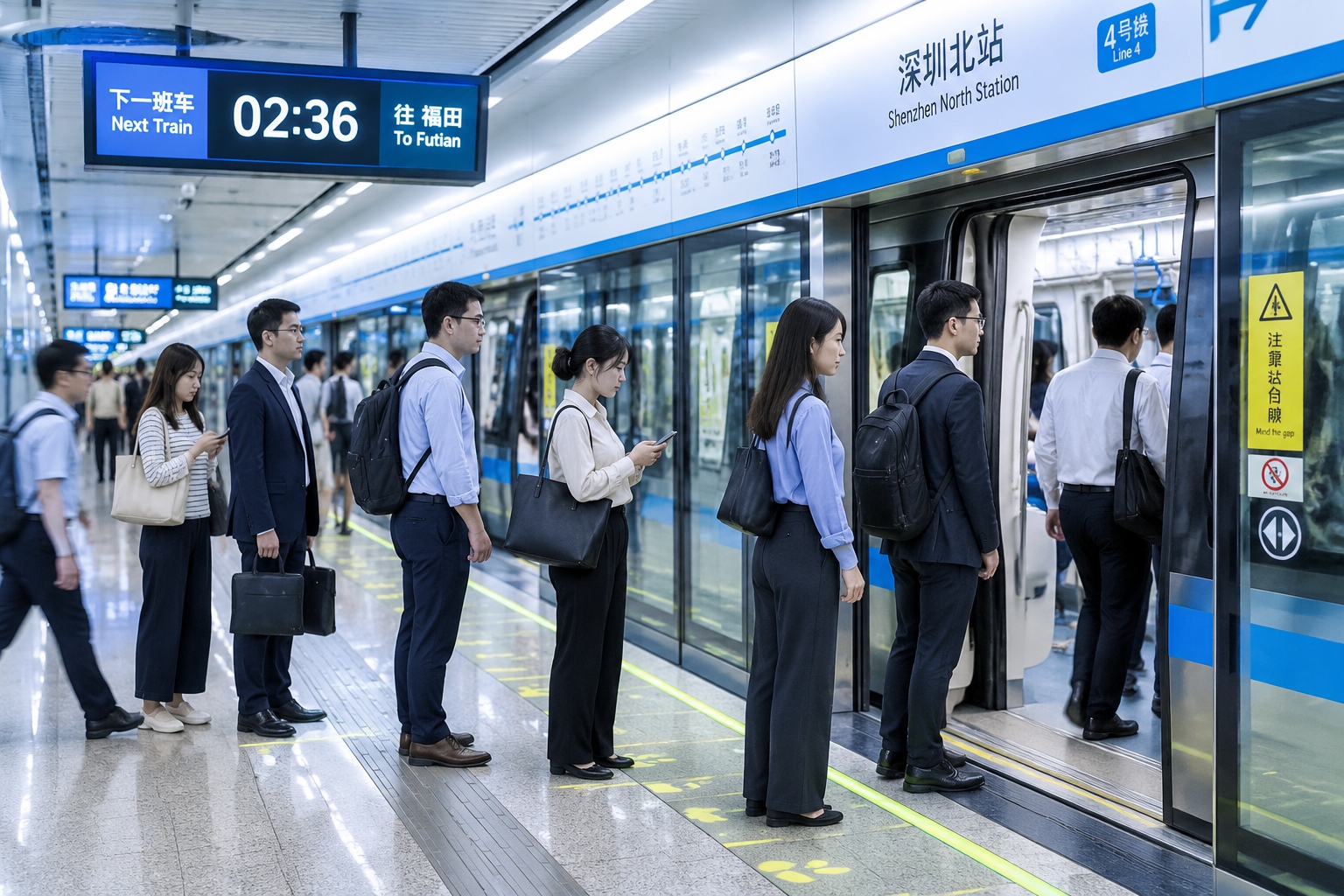

7:20 a.m. at Shenzhen North
At 7:20 on a Monday, the metro level of Shenzhen North station is already running at full temperature. Two floors below the high-speed rail platforms, Lin Yue walks fast along the Line 4 concourse with a laptop bag on one shoulder and a paper cup of soy milk in the other. She lives in Longhua, designs housings for a consumer-electronics company in Nanshan, and makes this trip five days a week: about forty minutes door to door when the transfers line up, closer to an hour when they don’t.
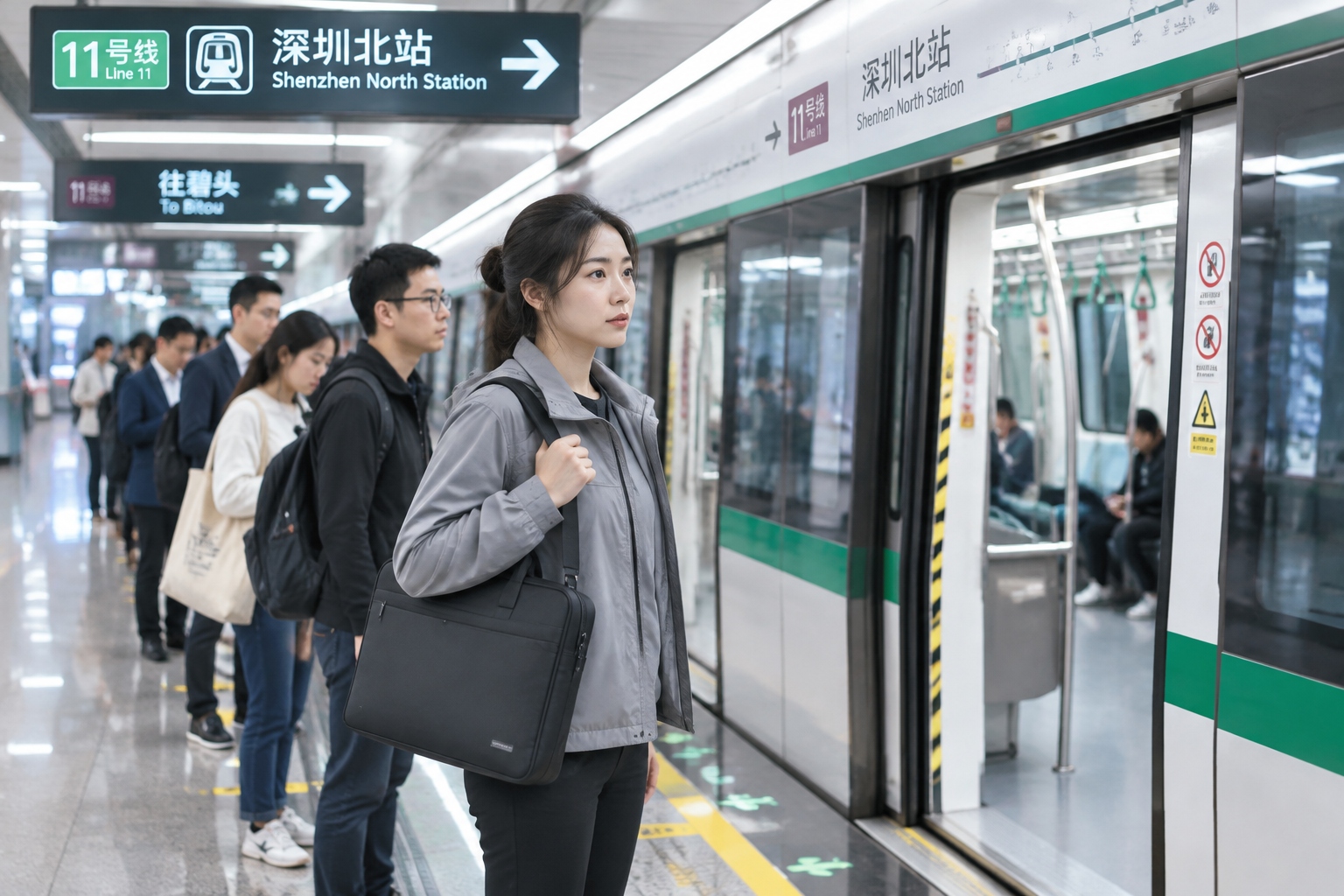
What she pays attention to is not the crowd. It is the small machinery that keeps the crowd moving. Lit strips on the platform floor mark where the doors will open. A screen above each doorway shows how full the next train is, so people drift toward the emptier carriages before it arrives. The countdown clock counts seconds, not minutes. When the train pulls in, she is aboard and standing still in about fifteen seconds. Nobody pushes. It is loud, but not chaotic.
Ask people outside China what produced this, and the answer is usually one word: overtime. Long hours, cheap labor, a culture that rewards presence at a desk. There is truth in that picture. It is also the least useful explanation of why a city of 17.8 million people — a county town of roughly 300,000 in 1980 — can move this smoothly, and why companies here can turn a design into a shipped product faster than almost anywhere on earth.
Overtime is real. It is also the wrong headline.
“Shenzhen speed” was a phrase coined in the 1980s, and it did not originally refer to office hours. In 1981, the Shekou industrial zone put up a billboard that read: “Time is money, efficiency is life.” Three years later, the Guomao building rose in 37 months at a pace of one floor every three days — a national record at the time, and the origin of the slogan “three days, one floor.”
That building was not a story about people staying late. It was a story about scheduling: prefabricated components, crews working in parallel instead of in sequence, materials arriving in the hour they were needed. Construction engineers describe it the way software engineers describe a good pipeline. The work was reorganized, not simply extended.
Forty years on, the same logic runs through almost everything that makes this city feel fast. What looks like individual hustle is usually a system that has deleted waiting. Four layers of it are worth pulling apart, because they are the parts other cities can actually copy.
The first layer: infrastructure that deletes waiting
Shenzhen’s metro opened in 2004. Twenty years later it is more than 550 kilometers of track across 17 lines, carrying on the order of eight million trips on an ordinary weekday. The network was designed with transfers in mind: at several interchanges the walk between platforms is a few hundred meters and stays indoors, so a commuter never surfaces into the rain or waits at a traffic light.
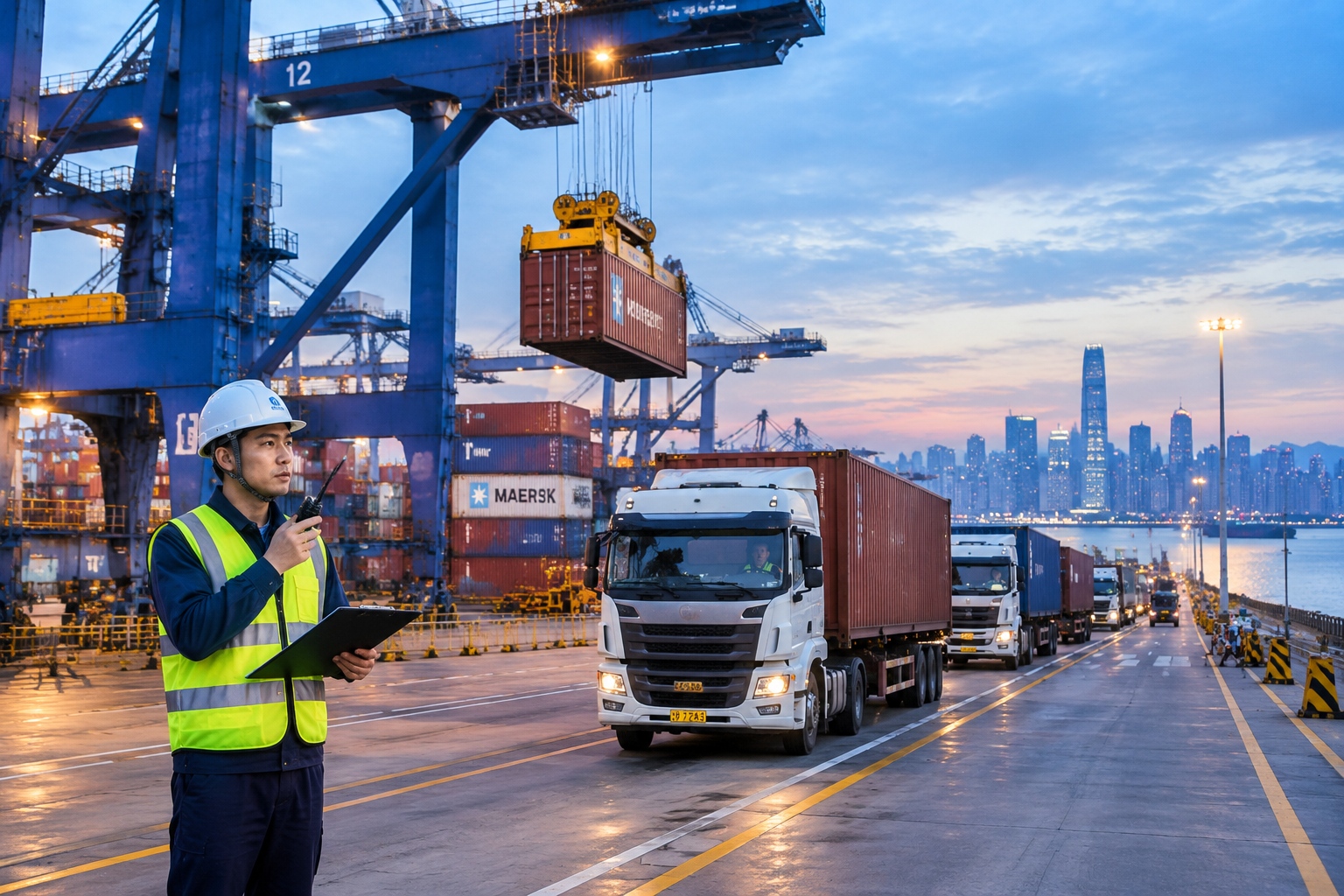
The detail that matters is not the length. It is the tuning. Trains run every two to three minutes at peak, which turns a missed train into a two-minute problem rather than a fifteen-minute one. Bus routes are redrawn around metro stations rather than competing with them. At the port in Yantian, one of the busiest container terminals in the world, trucks book arrival slots in advance, so a driver is not queuing for hours at the gate for a container that was already loaded.
The same thinking reaches the last kilometer. A courier working the dense blocks of Futian can hand over 300 parcels in a day, partly because buildings have designated delivery points and lockers, and partly because the route is dense enough that walking between stops is short. None of this is futuristic. It is the unglamorous work of matching capacity to demand, hour by hour.
The second layer: a supply chain inside walking distance
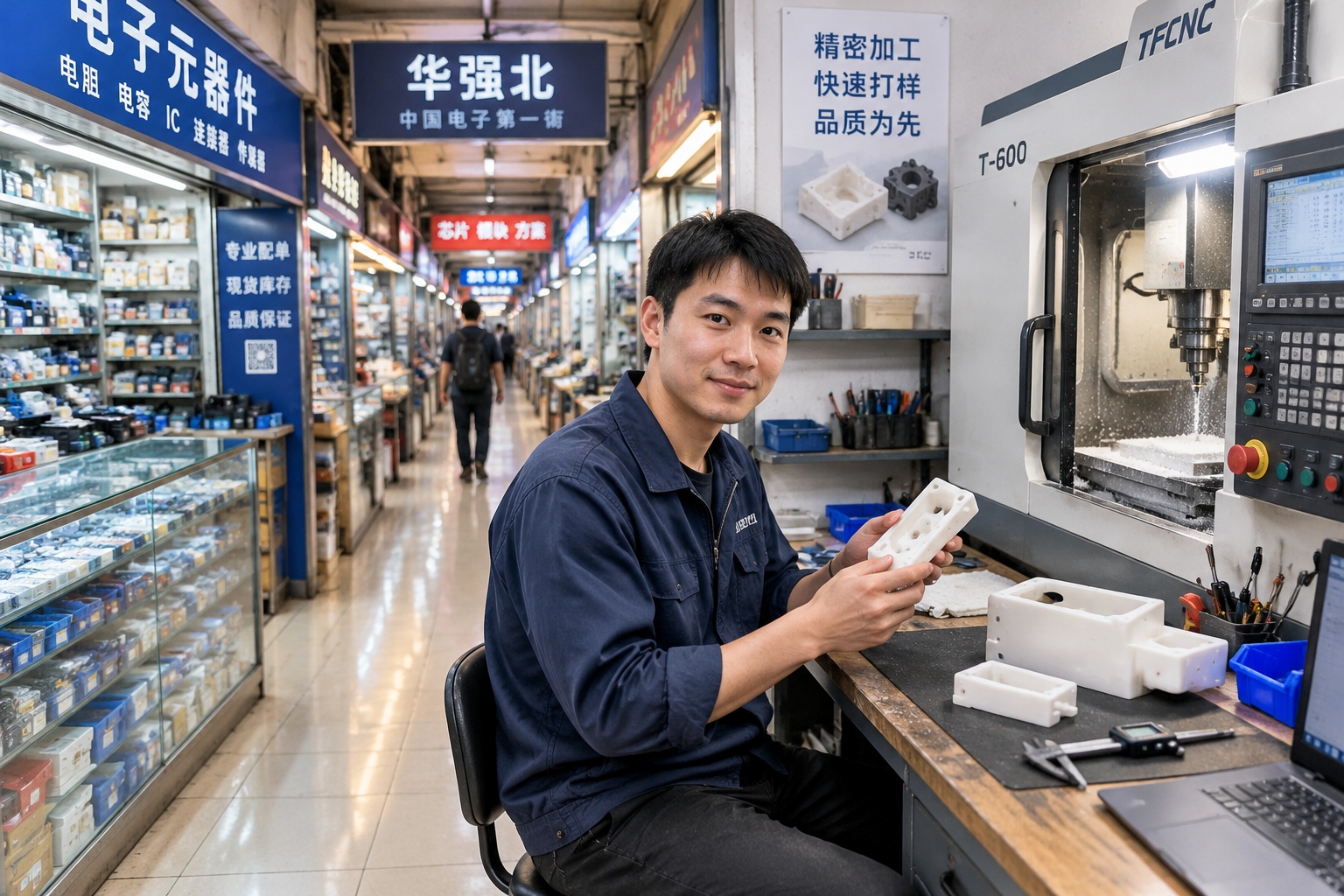
Huaqiangbei is a few blocks of Futian that have been the world’s densest electronics market for decades. On the fourth floor of one building you can buy a connector; two buildings away, someone will cut a metal bracket while you wait; across the street, a shop will anodize it. For a hardware startup, the value is not cheap parts. It is the length of the loop between an idea and a physical object you can hold.
A team can send a CAD file at ten in the morning and be holding a machined or 3D-printed part the same afternoon, then change the design and repeat the next day. In most of the world this loop takes one to three weeks, and each round trip costs money and momentum. Compressing it to hours changes how many attempts a small company can afford — which is, in practice, how many mistakes it can survive.
This is why the speed of Shenzhen manufacturing is so often misread as intensity. A factory in Bao’an running a line for a European client is not fast because workers skip breaks. It is fast because the mold shop, the injection-molding floor, the quality team and the component supplier sit in the same industrial park and talk to each other the same morning a defect appears. Proximity replaces meetings. Feedback arrives before the problem compounds.
The third layer: government that behaves like a service counter
For an outsider, the most surprising part of Shenzhen is often the paperwork. Registering a company can be done online in about a day. The city’s unified app handles hundreds of routine procedures, from residence registration to social insurance records to booking a driving test. Some approvals are labeled “秒批” — literally “approved in seconds” — because the system checks the data automatically instead of routing the file to a person.
Behind that is a duller achievement: departments share data. A resident does not need a stamped certificate from one bureau to hand to another. If a document already exists in the system, the system is expected to find it.
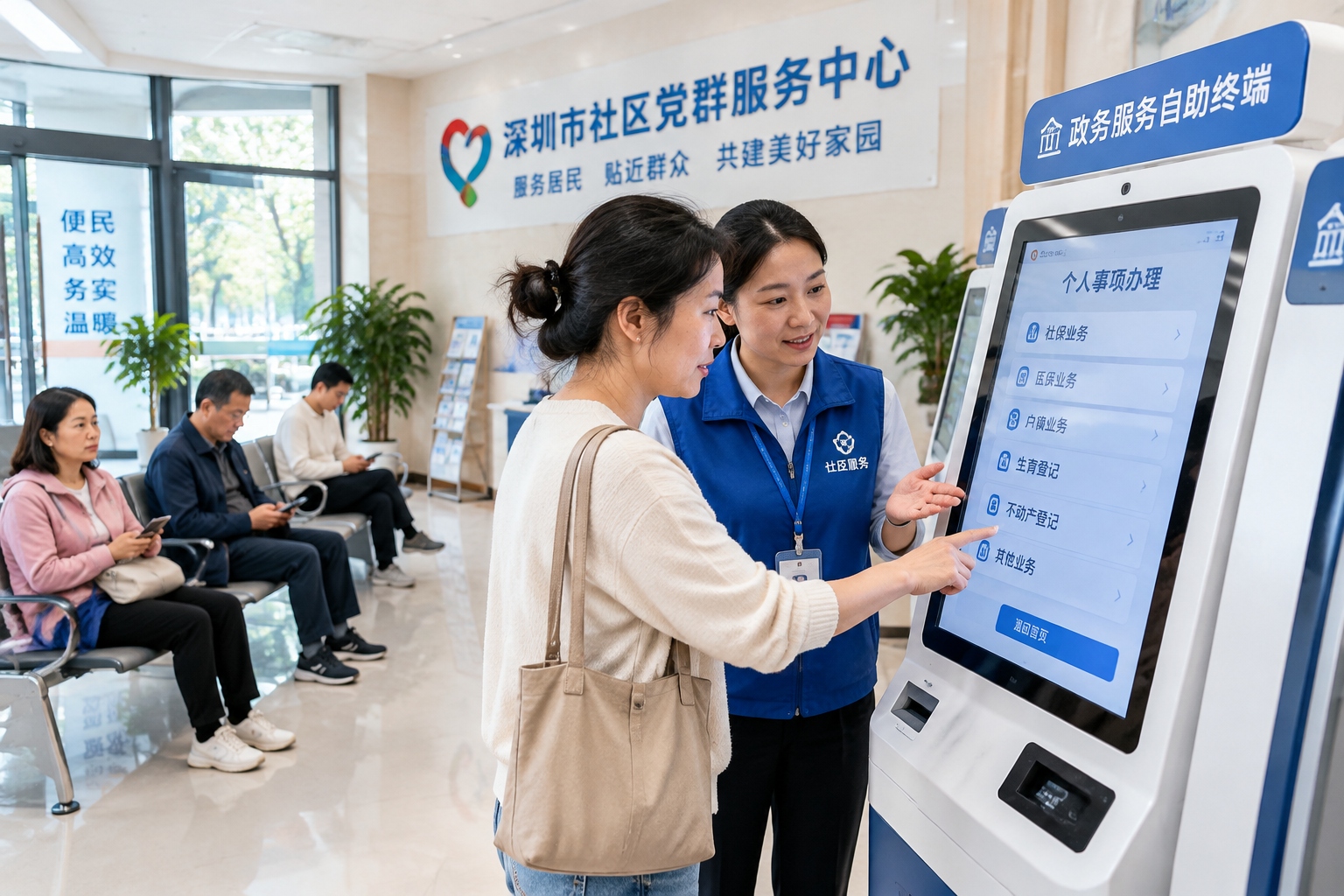
Physical service points fill in the rest. Community centers across the city host self-service machines that stay open after office hours, staffed by people whose job is to explain forms rather than reject them. When a typhoon approaches, the response is similarly procedural: schools close on a published schedule, ferries and some train services are suspended, construction sites are secured, and the notices reach phones before the wind does. You may disagree with a given decision, but the machinery of the decision is visible.
The fourth layer: how the work itself is organized
Inside the office, “fast” has a specific meaning that has little to do with who leaves last. Teams are built around projects rather than departments, so a hardware change does not have to travel up one chain of command and down another. Morning stand-ups run fifteen minutes. Decisions are pushed down to people close to the problem, and the phrase you hear constantly is 拉通 — “pull it through” — meaning get everyone who owns a piece of the problem into one room, or one group chat, until the dependencies are resolved.
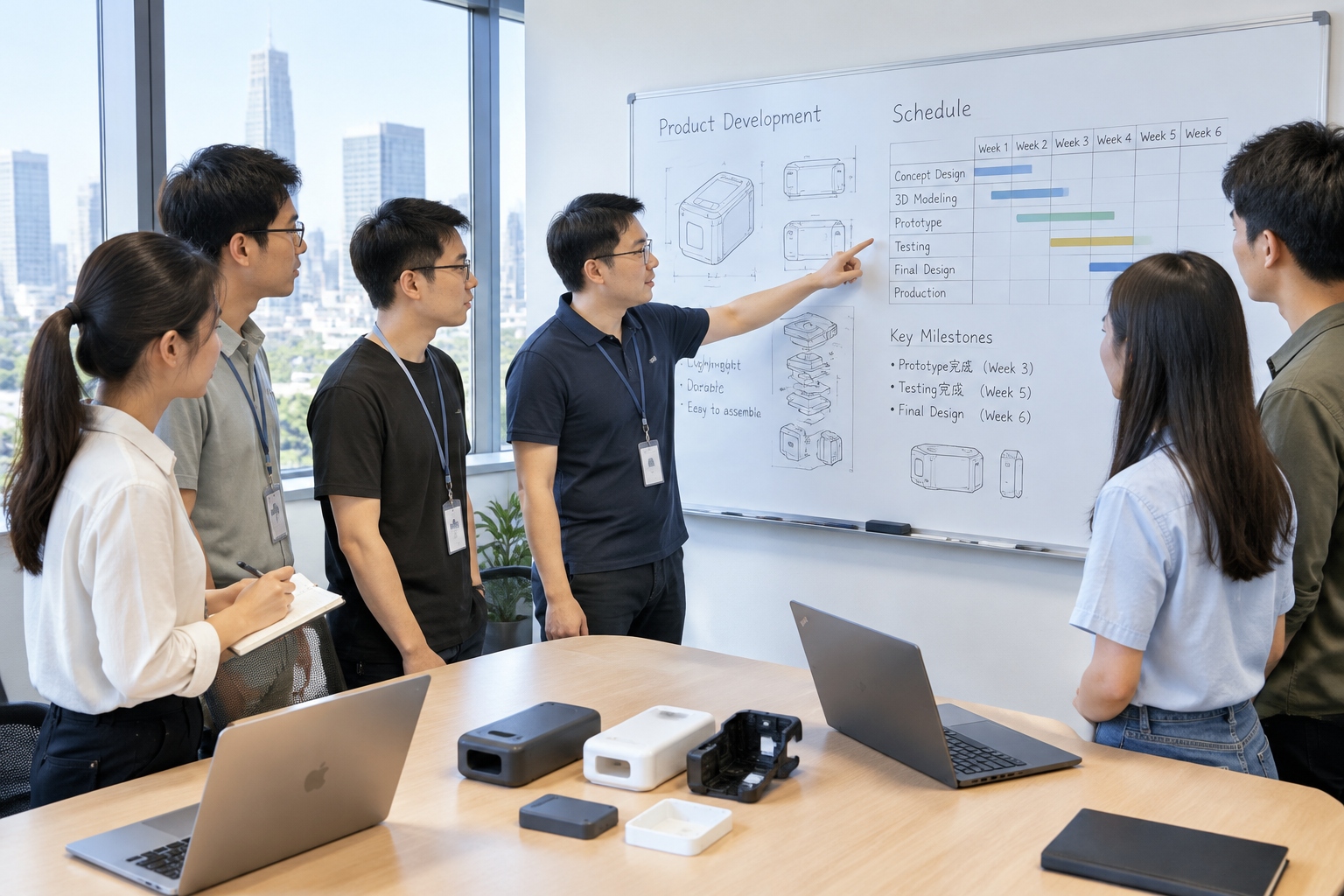
Tools matter more than slogans. Shared documents, work chat groups and cloud design files mean a supplier in Dongguan and an engineer in Nanshan are looking at the same drawing at the same moment. A junior engineer can message the factory floor directly instead of sending a formal request through three levels. The result is less rework — and rework is where most of the lost time in any industry actually lives.
What the speed costs
None of this makes Shenzhen an easy place to live, and the honest version of the story includes the bill.
Housing is the sharpest edge. Apartments in core districts like Futian and Nanshan are priced far beyond what a young engineer earns, which is why a large share of the workforce — estimates run above half — lives in urban villages: dense, low-rise neighborhoods of rented rooms that the city has repeatedly promised to redevelop and repeatedly postponed, partly because they are what makes a starting salary survivable. One-way commutes of forty-five minutes to an hour are normal. The metro is excellent and also very full.
Overtime exists, and the tech industry’s “996” debate — nine in the morning to nine at night, six days a week — started in cities like this one. A 2021 ruling by a Shenzhen court recognized that after-hours WeChat instructions could count as overtime, which tells you both that the practice is common and that the legal line is being drawn, slowly. Delivery riders and factory workers on night shifts are not enjoying a collaborative design loop; they are doing physically hard work under time pressure, and their grievances about dispatch algorithms and injury cover are real.
The people who thrive here tend to be the ones with the thickest safety nets — a local hukou, family housing, savings — and the system’s smoothness does not distribute itself evenly. That is not a footnote to the Shenzhen story. It is part of it.
What is actually worth copying
Stand in the same metro station at 8 a.m. and the lesson is clearer than any slogan. A city can be fast without asking everyone to stay late, if it treats coordination as the main engineering problem: trains that connect, suppliers that sit close together, agencies that share data, teams that resolve dependencies early instead of escalating them.
These are unglamorous fixes, and most of them are boringly technical — timetables, data formats, factory layouts, meeting structures. But boring fixes are the ones that travel. A city that copies Shenzhen’s hours will get tired people. A city that copies its plumbing might get something that looks, from the platform at 8 a.m., very much like speed.
Start the discussion at forum.chinacomes.com