

A Morning That Feels Different
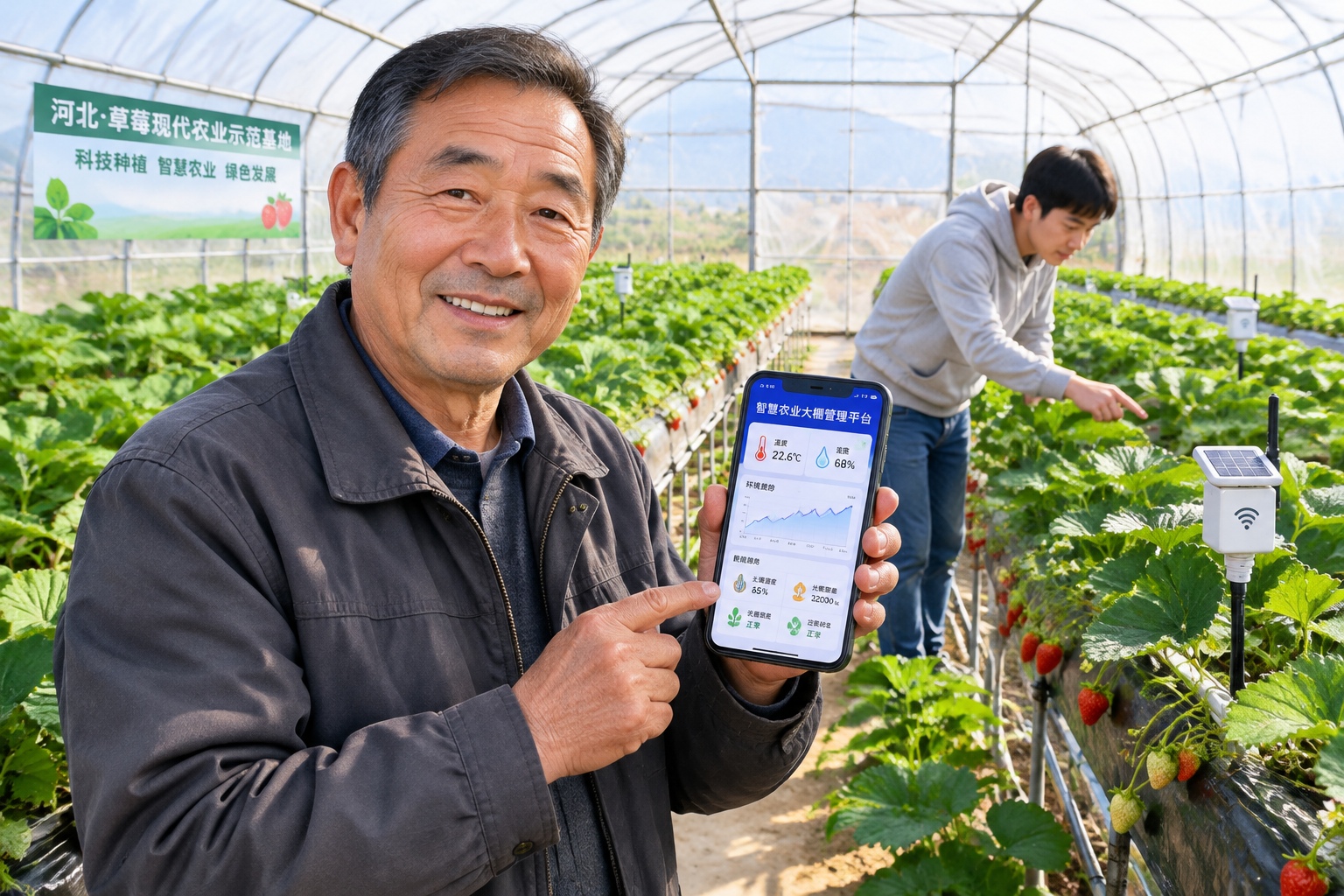
At 6:30 a.m., the sun hasn’t fully risen over the strawberry greenhouses on the outskirts of Shijiazhuang, Hebei Province. Li Wei, a 34-year-old farmer, unlocks his phone and checks the morning report: soil moisture at 42%, leaf temperature 18.3°C, and a notification reminding him that two rows near the east vent need extra water. He taps once. A soft hum starts somewhere down the aisle, and drip irrigation begins its work.
This is not a futuristic lab. It’s a working farm shared by more than 20 households. The only curved screens in sight are the simple dashboard apps on farmers’ phones. Two small drones sit on a charging dock near the entrance, waiting to fly their morning patrol over the 30-acre plot.
For anyone who still pictures Chinese agriculture as endless lines of straw-hatted workers bending over muddy fields, this scene may come as a surprise. But across China, a quiet technological shift is happening — and it’s most visible in something as ordinary as a strawberry.
Why Farming Needed an Upgrade
Strawberries are delicate. They bruise easily, rot quickly, and attract pests. For decades, small farmers in China relied on experience, weather luck, and heavy doses of pesticide to secure a decent harvest. But consumers today want more than red, shiny fruit. They ask about pesticide residues, sugar levels, and even where the fruit was grown.
Supermarket chains and e-commerce platforms now enforce strict standards. Buyers use handheld spectrometers to check sweetness, and batches that fail are rejected. For farmers, this put enormous pressure on an old system. One bad batch could mean a whole season lost.
Local governments in agricultural regions began looking for solutions. Around 2020, several pilot projects introduced AI-assisted farming tools — but unlike high-end smart farms in developed countries, these tools were designed specifically for smallholders with limited budgets and no engineering background.
Technology That Doesn’t Need a Degree
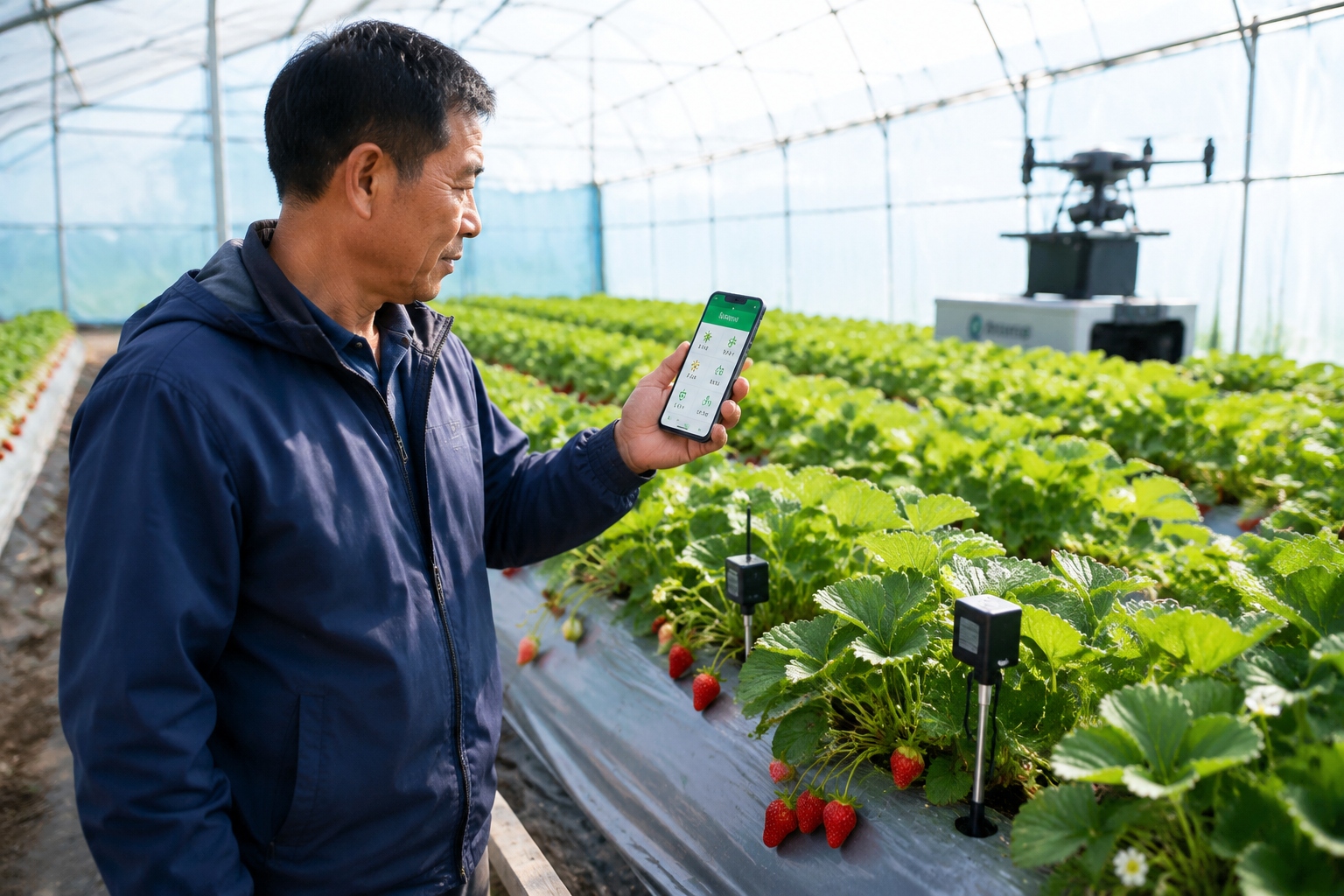
The strawberry cooperative in Shijiazhuang is one such pilot. The system is simple: wireless sensors are placed in the soil and on the leaves. They measure moisture, temperature, nutrient levels, and even the carbon dioxide concentration inside the greenhouse. A small weather station on the roof tracks sunlight and wind. Data goes to a local server or the cloud, where an AI model trained on thousands of strawberry-growing scenarios gives advice.
Farmers don’t need to understand algorithms. They open a WeChat mini-program, see clear icons and colors — green means normal, yellow means attention, red means act. The app tells them when to water, when to ventilate, and whether the risk of mildew is rising.
Drones are the other piece. Twice a day, a drone flies low over the crops, capturing high-resolution images. The AI identifies early signs of pests or nutrient deficiency that human eyes often miss. If it detects a problem, it marks the exact coordinates on a map. The farmer can walk straight to that spot, saving hours of manual inspection.
“It’s like having a senior technician who never sleeps,” says Wang Guifen, a 52-year-old farmer who manages two greenhouses. She admits she was skeptical at first. “I thought, this is just another trick to sell us expensive gadgets. But after one season, my yield went up and I used less pesticide. I don’t understand the math inside, but I understand the results.”
Real Numbers, Better Fruit
The pilot’s data, shared by the local agricultural bureau, shows tangible improvements. Over two growing seasons, average yield per greenhouse increased by about 18%. Pesticide use dropped by roughly 35%, thanks to early warnings that allowed targeted treatment instead of blanket spraying. Water usage was reduced by one quarter because sensors told farmers exactly when and where to irrigate.
More importantly, quality improved. The AI model is calibrated to favor taste, not just size. It monitors sugar accumulation and acidity, helping farmers decide the optimal harvest date. In blind tests organized by a local e-commerce group, strawberries from the AI-assisted farm scored consistently higher on sweetness and firmness than neighboring farms using conventional methods.
“The market price for our premium strawberries is now about 20% higher,” Li Wei says. “The buyers know they can trust the batch because we can show the digital record for each greenhouse. That record is like a passport for the fruit.”
A Young Farmer Comes Home
Li Wei is part of a small but growing wave of young people returning to rural China. After working six years in a Shenzhen electronics factory, he moved back in 2021 to take care of his aging parents. At first, he planned to sell agricultural equipment. Instead, he became the cooperative’s tech manager.
“When I first came back, my neighbors saw me as the guy who couldn’t make it in the city,” he laughs. “But now they ask me to teach them how to use the apps. The old farmers know more about plants than I ever will. The AI doesn’t replace that knowledge — it makes it more precise.”
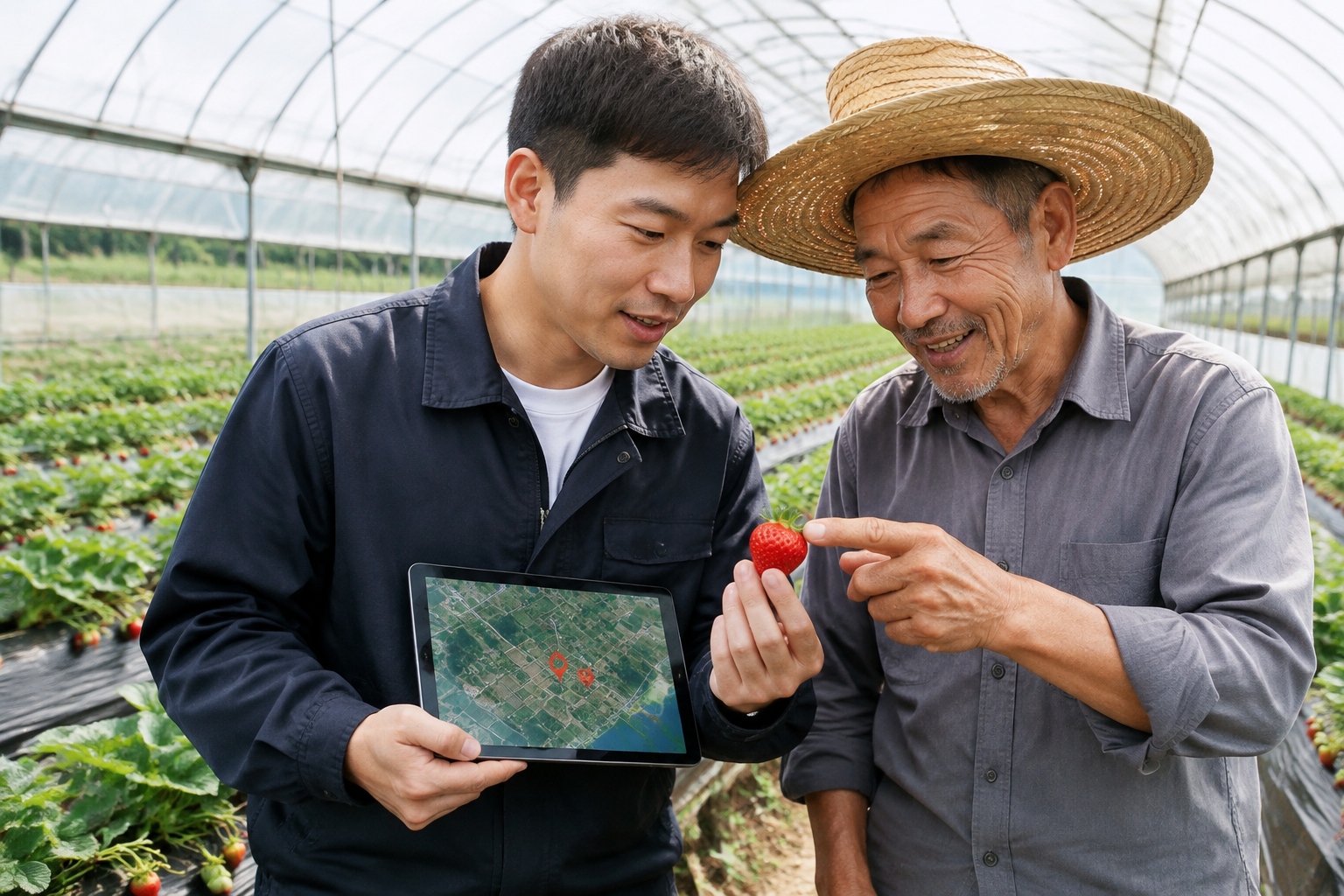
Li spends his mornings walking through greenhouses, checking sensors and talking with older farmers. He often translates the AI’s data into practical language. “The system said the potassium level is low in row 7. Grandpa Zhang will say, ‘Ah, that’s why the leaves look pale.’ Then he adjusts the fertilizer mix. It works because trust goes both ways.”
His generation is comfortable with technology, and he sees a future where farming becomes a respected, skilled profession. “In the past, young people ran away from farming. Now some of us are running back, because it’s getting interesting again.”
The Quiet Agricultural Revolution
China is often associated with massive high-speed rail networks and sprawling megacities. But the country’s agricultural transformation, while less flashy, is reaching hundreds of millions of people. The strawberry farm is just one example. Similar AI-assisted systems are being adapted for rice paddies in the south, apple orchards in the west, and tea plantations in the hills.
What makes this different from earlier modernization drives is accessibility. The hardware costs have fallen dramatically. A basic sensor kit for a small greenhouse can cost less than a mid-range smartphone. The software is designed for Chinese farmers’ literacy levels and internet habits — delivered through WeChat, with voice commands in local dialects.
There are still challenges. Connectivity can be unreliable in remote areas. Some older farmers refuse to trust data over instinct. And the upfront investment, though modest, is not zero. But the direction is clear. AI in Chinese agriculture is not about replacing people with robots on a mass scale. It’s about giving ordinary farmers superpowers they didn’t have before.
Li Wei picks a ripe strawberry and hands it over. It’s bright, firm, and noticeably sweet. “Technology doesn’t make the fruit,” he says. “The plant does. But technology makes it a little easier for us to help the plant do its best.”
In a country where feeding 1.4 billion people was once a national obsession, the next chapter is being written not in laboratories alone, but in the greenhouses where a farmer checks his phone and smiles at what the sensors tell him.
Start the discussion at forum.chinacomes.com