
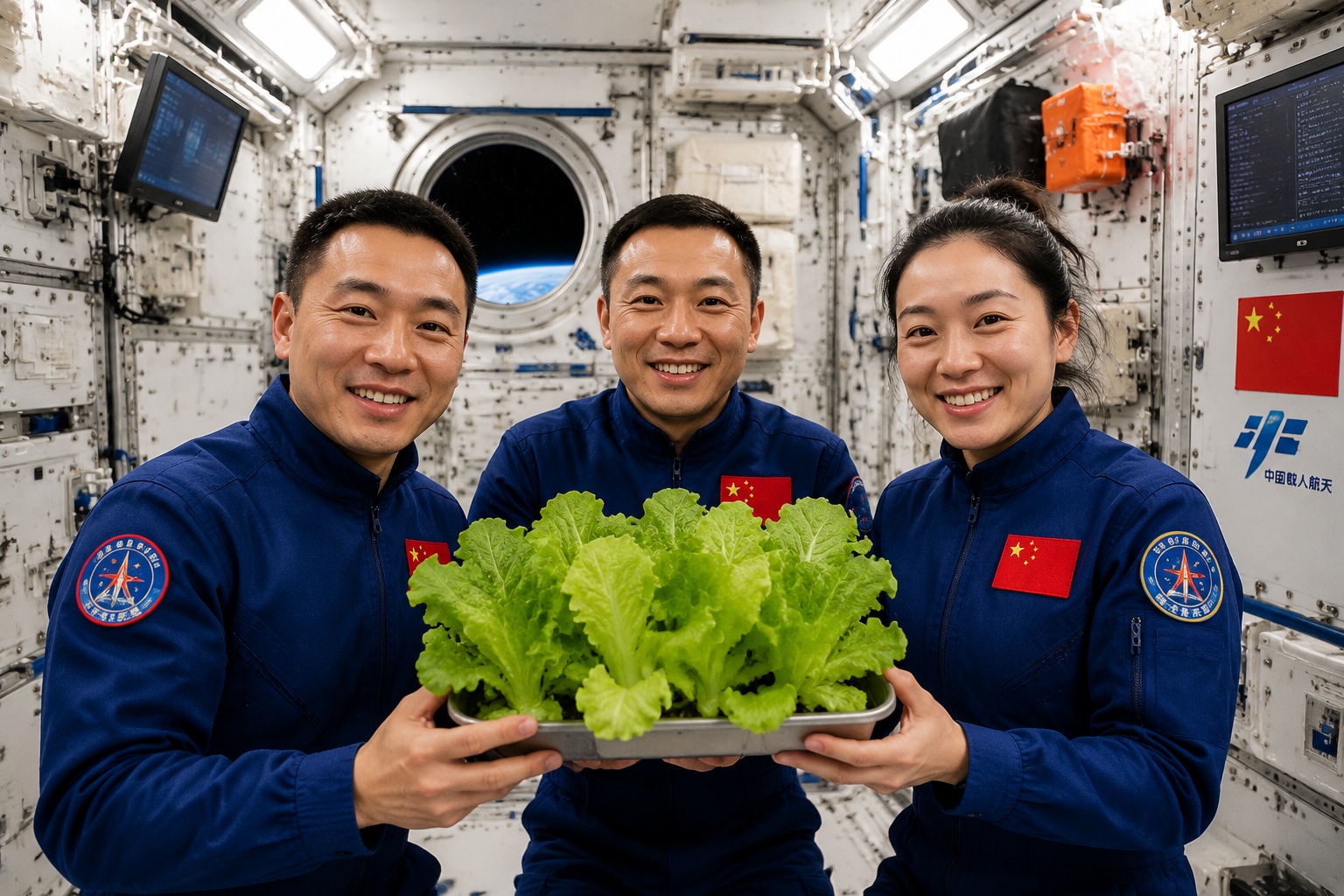

Dinner in the Sky: A Fresh Salad at 28,000 km/h
Imagine finishing a long day at work and heading to the kitchen. You open the fridge, pull out some lettuce, and wash it for a salad. Now imagine doing that while floating in microgravity, with Earth turning below you every 90 minutes. That’s the everyday reality for Chinese astronauts aboard Tiangong, the “Heavenly Palace” space station. Since 2021, the station has hosted rotating crews of three, and one of their favorite side projects is a tiny garden that supplies them with homegrown greens.
A Very Brief History of Space Veggies
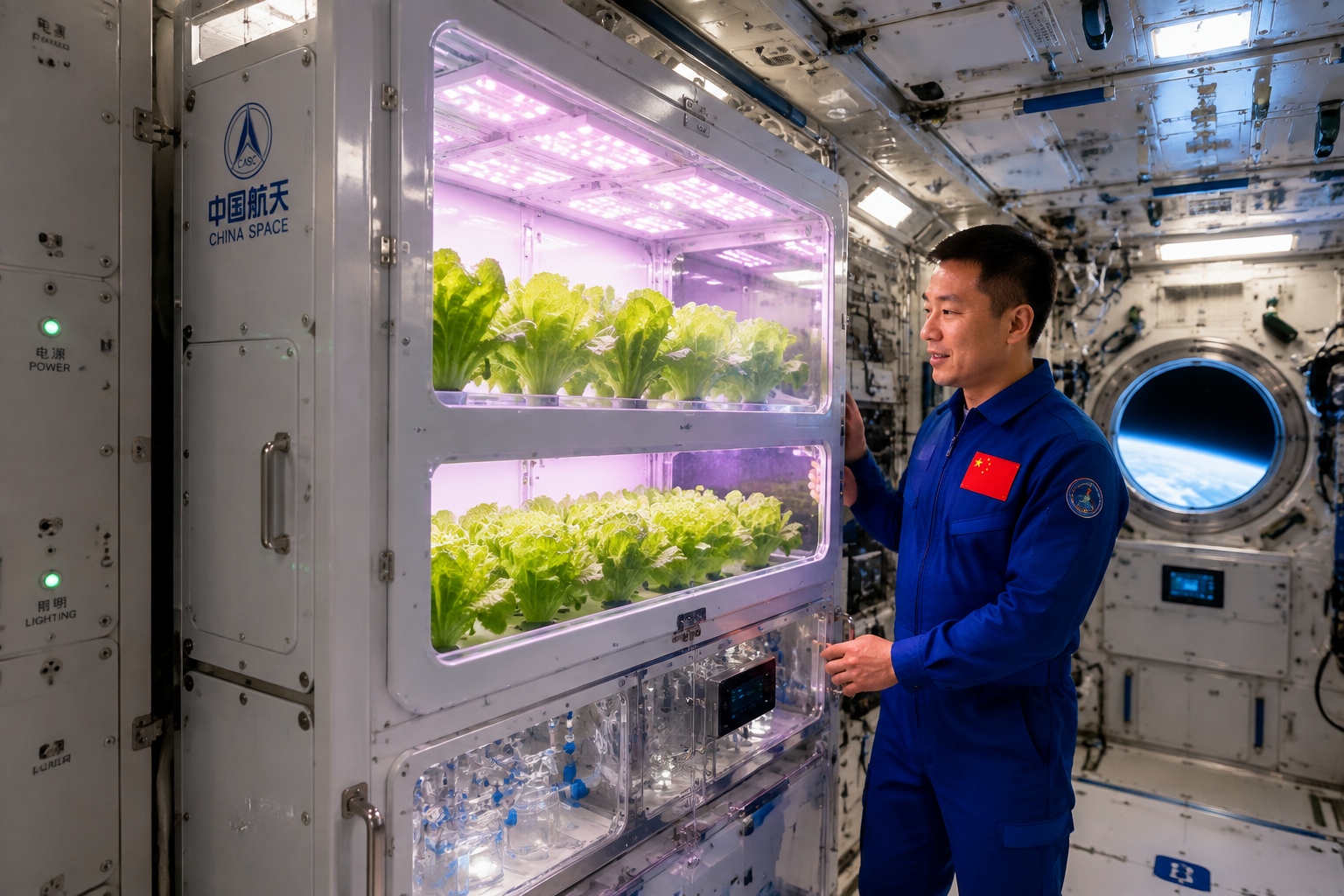
China’s journey in space agriculture didn’t start with Tiangong. Back in 2016, during the Shenzhou-11 mission, astronauts Jing Haipeng and Chen Dong spent 30 days on the Tiangong-2 space lab and successfully grew lettuce. It was a small experiment, but it proved the basic idea: Chinese plants could grow and thrive in orbit. Fast forward to now, and the full Tiangong station hosts a much more advanced “space farm” in the Wentian experiment module. The hardware has evolved from simple planters to modular growth chambers with automatic light, temperature, and humidity control.
How Do You Garden Without Earth, Sun, or Rain?
On the space station, you can’t open a window or step out for fresh air. So space gardening is all about replacing natural conditions with engineered ones. First, there’s no soil. Instead, astronauts use a mineral-based substrate mixed with slow-release polymers that hold water and nutrients. It looks like small clay pebbles. Second, no sunlight. Each plant unit is lit by LED panels that emit a pinkish-purple glow, tuned to the wavelengths plants need most. Third, no gravity to guide water and roots. A special system pumps nutrient solution through the root zone, using capillary action to keep things just moist enough. A fan circulates air so the plants can exchange gases and don’t suffocate in their own humidity.
What the Astronauts Are Actually Growing
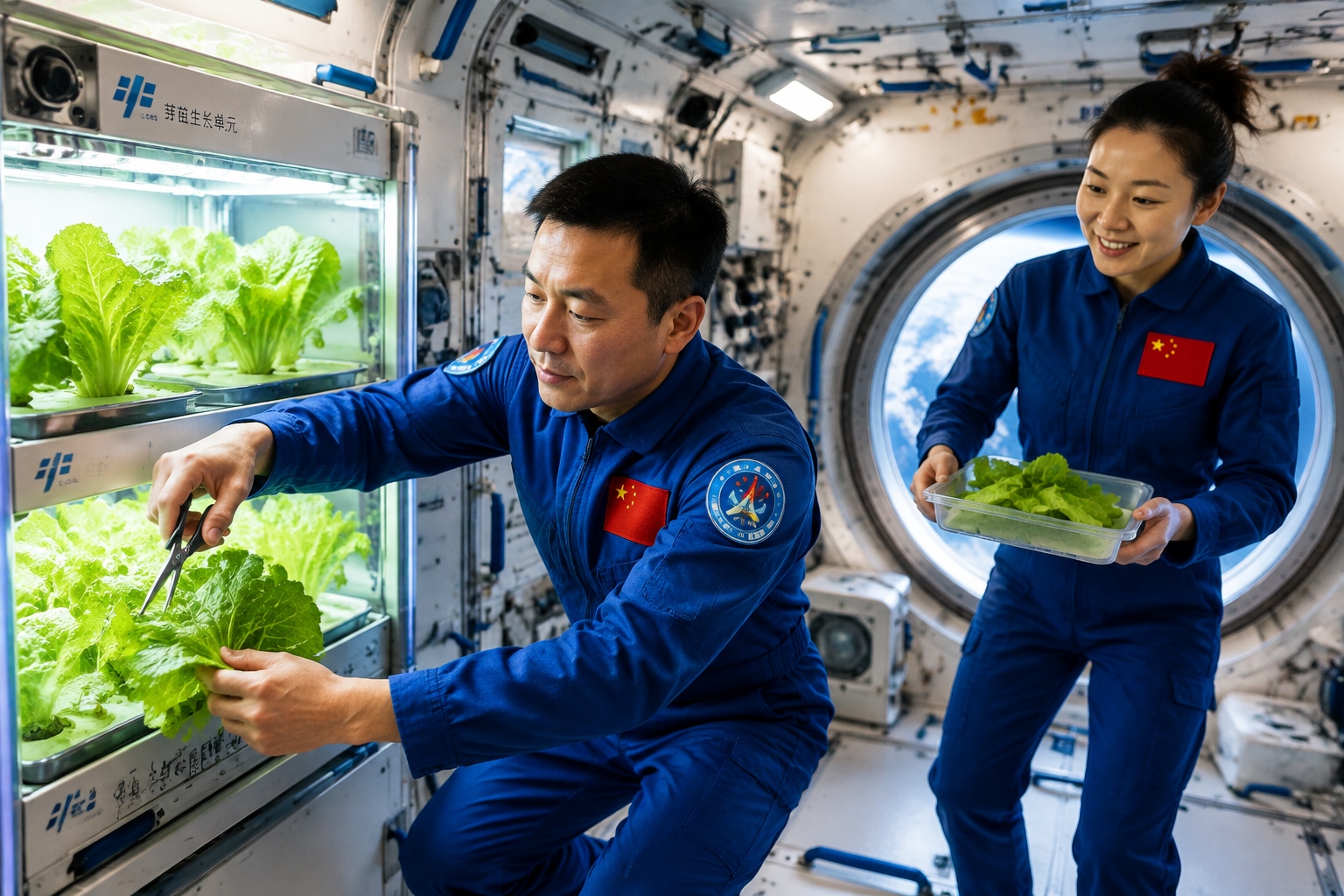
The “space garden” menu is expanding. Leafy greens like lettuce and pak choi have been the easiest wins. Cherry tomatoes have also been tried, and surprisingly, chili peppers. In one mission, astronauts harvested chili peppers and turned them into a spicy sauce, a nod to China’s bold flavors. Rice is a trickier case. Chinese scientists grew rice in orbit for several months, studying how microgravity affects flowering and seed formation. That’s not just for fun—it’s about learning to grow staple crops for long-duration missions to the Moon or Mars.
Why Bother? More Than Just a Fresh Salad
First, there’s cost. Sending a kilogram of food to space costs thousands of dollars. Fresh veggies are a luxury that packaged space meals can’t match. But the real prize is self-sufficiency. If plants can recycle water, produce oxygen, and provide food, you have a closed-loop life support system. That’s a critical step for future deep-space exploration, where re-supply missions won’t be possible. Then there’s the mental health angle. Multiple studies on Earth and in space show that tending plants reduces stress and boosts mood. For astronauts living in a metal box for months, a little green corner can feel like therapy.
“Have You Eaten Yet?”: A Cultural Connection
In Chinese culture, food is never just fuel. The common greeting “你吃了吗?” (“Have you eaten yet?”) shows how central eating is to daily life. So it’s no surprise that China’s space program takes the dining experience seriously. Tiangong’s food supply includes over 120 dishes, from kung pao chicken and fried rice to mooncakes during the Mid-Autumn Festival. Adding freshly grown vegetables turns a space meal into a homey ritual. As one astronaut described the first bite of homegrown lettuce: “It tastes like iced water after a long run—crisp, sweet, and full of life.” It’s a reminder that even in toughest environments, Chinese culture finds a way to eat well.
The Earthly Obsession With Growing Things
If you’ve spent time in China, you’ve probably noticed that people love gardening wherever they can. Balconies are crammed with pots of chilies, mint, and cherry tomatoes. In many urban communities, residents claim small patches of land between buildings and grow vegetables. The same urge to cultivate is playing out 400 kilometers away. It’s not just about science; it’s a cultural habit of making any place feel like home by planting something edible. Some Chinese journalists have even joked that if astronauts ever set foot on Mars, the first thing they’ll build after a habitat is a greenhouse.
What’s Next? Bigger Gardens, Longer Trips
China plans to expand Tiangong from three modules to six in the coming years, likely adding even larger plant-growing facilities. Scientists are also testing flexible vegetable bags that can be stowed away and unrolled when needed. There’s talk of growing cucumbers, green beans, and sweet potatoes. The long-term goal is to support a lunar research base, where crews could cultivate their own food on site. For now, though, the astronauts on Tiangong are just happy to have a little green corner—a taste of tomorrow, and a reminder of home.
Space gardening on Tiangong isn’t just a technical achievement. It’s a human story about bringing everyday life—and Chinese food culture—to the final frontier. The recipe is simple: a bit of water, a sprinkle of light, and a deep cultural drive to plant something, anywhere.
Start the discussion at forum.chinacomes.com