
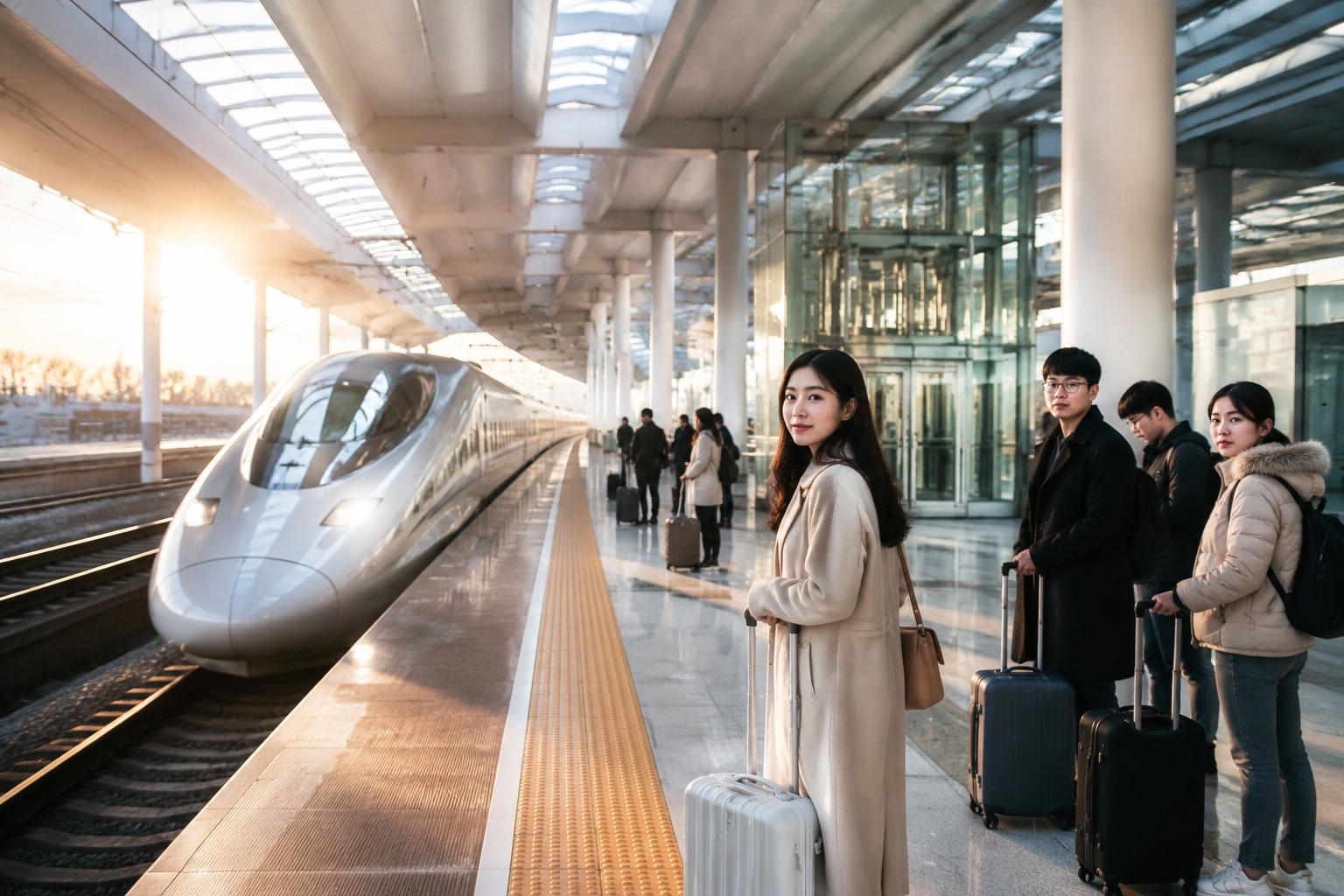

A Saturday Morning Experiment
It was 7:30 AM on a clear Saturday. I was standing on Platform 14 at Beijing South Railway Station, gripping a takeaway coffee and watching the bullet train glide in with a low hum. The train was the G17 to Shanghai Hongqiao. It would cover 1,318 kilometers in 4 hours and 28 minutes. By noon, I planned to be eating soup dumplings in the French Concession.
For a journalist who grew up in a country where a five-hour train ride usually means a cross-country trip, this felt like a magic trick. But for the hundreds of people around me — students with backpacks, parents with strollers, business travelers with wheeled suitcases — it was just another Saturday.
This is the reality of China’s high-speed rail network, now spanning over 50,000 kilometers. That’s more than the circumference of Earth. But what does that number actually mean for people who live here? To find out, I turned my simple trip into a weekend experiment: I would talk to as many passengers as possible, ask about their journeys, and try to understand how this vast grid of steel and electricity has reshaped everyday life.
Four Hours to Shanghai, Zero Check-in Lines
Let’s start with the basics. Flying from Beijing to Shanghai takes about 2.5 hours in the air. But when you add travel to airports, security lines, and delays, the door-to-door time easily stretches to 5 or 6 hours. The high-speed train, by contrast, lets you arrive at the station just 20 minutes before departure. There’s no baggage check, no 100ml liquid limit, and no “we apologize for the delay.”
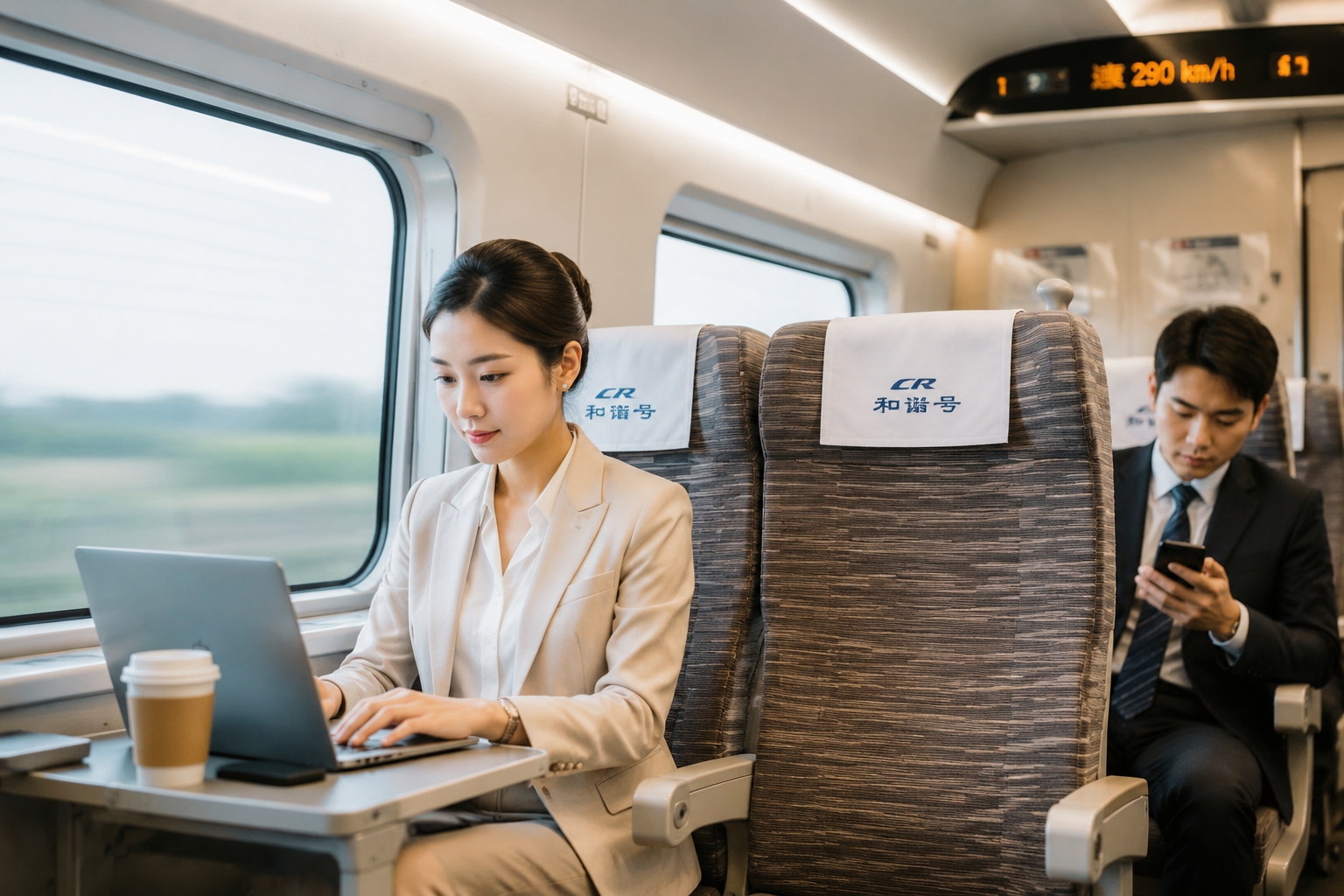
I found my seat — 3F, window — and settled in. The train accelerated smoothly, and within minutes we were rushing past suburban housing blocks and fields. The speedometer above the aisle showed 290 km/h. On my phone, the free Wi-Fi streamed a podcast without a snag.
Across from me sat a young woman named Li Wei, a product manager from Hangzhou. She told me she takes the train to Shanghai almost every week for work. “It’s faster than a taxi across Beijing,” she laughed. “People complain when the journey takes 5 hours, but when I started working in 2015, it was 6 hours. Before that, people used to take the overnight sleeper train — that was 12 hours. We’ve come a long way.”
Her story echoed in many conversations I had that weekend. A college student was going home to Nanjing for his mother’s birthday — just 90 minutes from Shanghai. A retired couple was heading to Suzhou to visit their granddaughter. A salesman in a crumpled suit was planning to be in three different cities before Monday.
What 50,000 Kilometers Really Means
To put 50,000 km in perspective: that’s enough track to circle the equator once and have 6,000 km left over. But numbers alone don’t capture the transformation. The network reaches all but one of China’s provincial-level regions — only Tibet’s Lhasa railway remains a conventional line, though work is underway on a high-speed link that will face permafrost and altitude challenges.
More importantly, the network is designed around city clusters — the Pearl River Delta, the Yangtze River Delta, the Beijing-Tianjin-Hebei region. These are economically integrated areas where high-speed rail makes commuting between cities feel like moving within one metropolis. In the Yangtze River Delta, for example, the rail network is so dense that trains run like metro services, sometimes every 10 minutes.
Ridership numbers are staggering. In 2023, the national railway network carried 3.68 billion passengers, and high-speed rail accounted for about 70% of that. During the “chunyun” (Spring Festival travel rush) earlier this year, trains moved up to 20 million passengers a day. To make this happen, station staff coordinate with military-like precision.
I spoke with Liu Ming, a station manager in Shanghai, who explained how ticketing has evolved. “Ten years ago, people queued overnight for tickets,” he said. “Now it’s all on your phone. Facial recognition makes boarding a smooth walk-through. We’ve also introduced blind ticketing — you just scan and pass. The system knows your seat and platform.”
Beyond Speed: A Social and Economic Connector
During my weekend experiment, I traveled from Shanghai to Nanjing, then back to Beijing. I met a factory owner who said the rail has made his supply chains more agile: “I can visit clients in Shanghai and still be home for dinner in Nanjing.”
I also met a young freelance designer who moved from Beijing to a small city near Chengdu because she could still take high-speed rail to meet clients in the capital every few weeks. “My rent is half of what it was, and I get to live next to mountains,” she told me. “The train is my office.”
But it’s not all about business. The railway has woven a new kind of social fabric. Elderly parents can be closer to their adult children living in big cities. Students can return home for a weekend. Couples in long-distance relationships no longer need to rely on red-eye flights to see each other.
There are also environmental benefits. High-speed rail is far more energy-efficient per passenger-mile than cars or planes. In a country of 1.4 billion people, shifting travel from short-haul flights to electrified trains has a measurable impact on carbon emissions.
What About the Challenges?
No story about a massive infrastructure project comes without caveats. High-speed rail lines are expensive to build and maintain. While ticket prices are generally affordable for the middle class, lower-income workers still often choose slower conventional trains. The network also runs at a loss in many regions — the government subsidizes it as a public service, similar to how many countries fund rural post offices or highways.
And there are limits to the network’s reach. Many rural areas remain not directly served by high-speed rail, requiring bus or conventional connections. On my trip, I noticed that the trains were fastest along the eastern seaboard; in the west, distances feel longer despite the same technology.
Still, for the average person in China’s cities, the high-speed rail has become as essential as an elevator in a skyscraper. It’s not an exotic “wow” moment anymore — it’s just how life works.
What My Weekend Taught Me
I arrived back in Beijing on Sunday evening, feeling like I had committed a small crime — a full weekend trip covering three major cities and I still had time to do laundry. The 50,000 km figure no longer felt abstract. It was the reason a mother could hold her daughter’s hand for a birthday lunch, the reason a businessman could close a deal and still catch his son’s football game, the reason a young designer could trade a cubicle for a mountain view.
High-speed rail isn’t just steel and concrete. It’s a time machine that compresses distance and expands choices. And while China did not invent the bullet train, it has turned it into a national default. That’s something worth understanding, not just as an infrastructure fact, but as a lens into how ordinary lives have been quietly transformed.

If you ever get the chance, buy a ticket, sit by the window, and watch the country glide past. The speed is impressive. But the stories are faster.
Start the discussion at forum.chinacomes.com