

Seventy-two steps
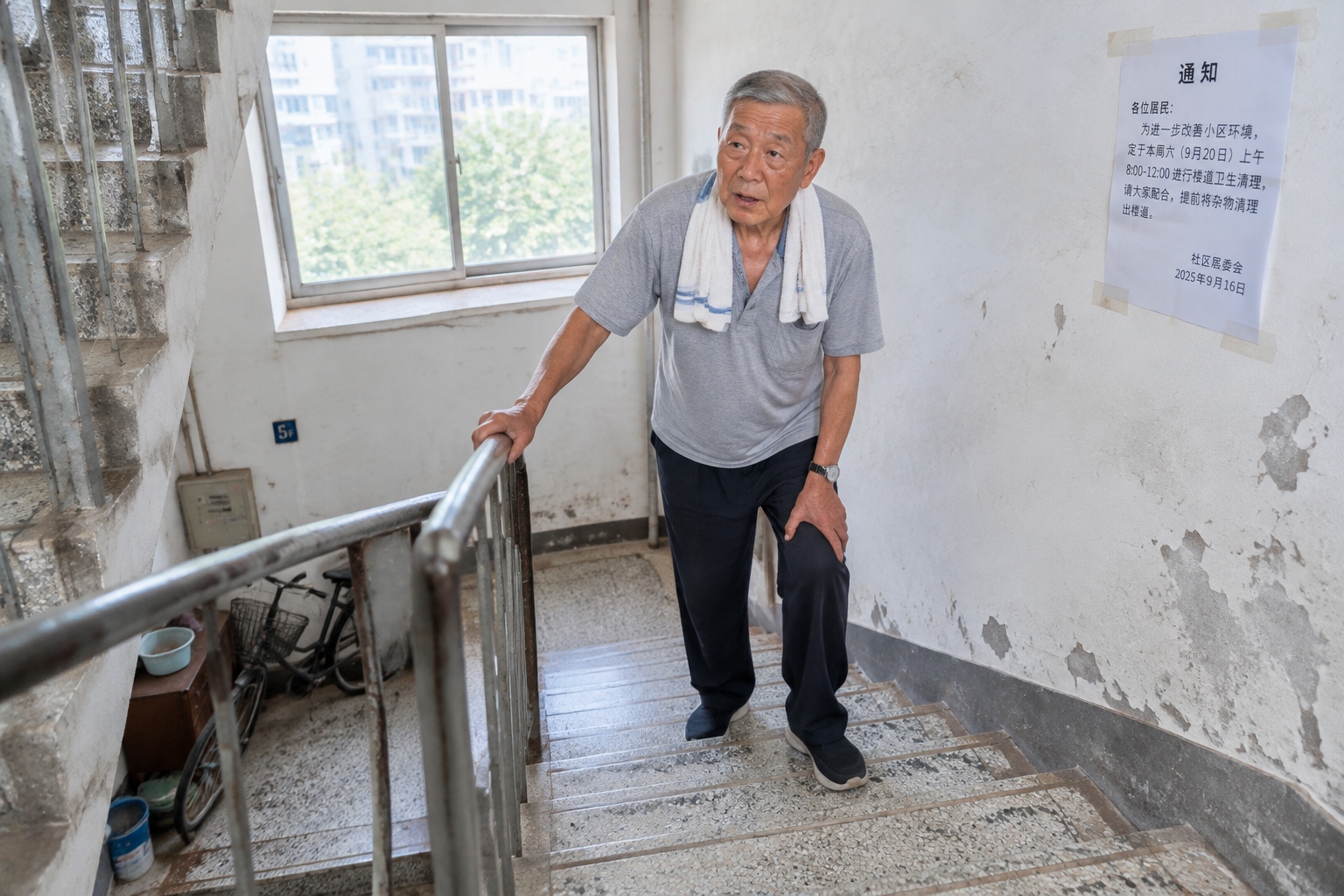
Mr. Huang lives on the fifth floor of a six-story walk-up in a midsize Chinese city. The building went up in 1993, when nobody who approved the plans expected the people moving in to still be living there at 78. His knee gave out in March. He told me he once counted the steps on his way down to the hospital: seventy-two, from his front door to the pavement.
For years he managed them. Then, quite suddenly, he did not. By April his daughter was doing his grocery shopping, and his world had shrunk to two rooms and a balcony from which he could see the courtyard but not reach it.
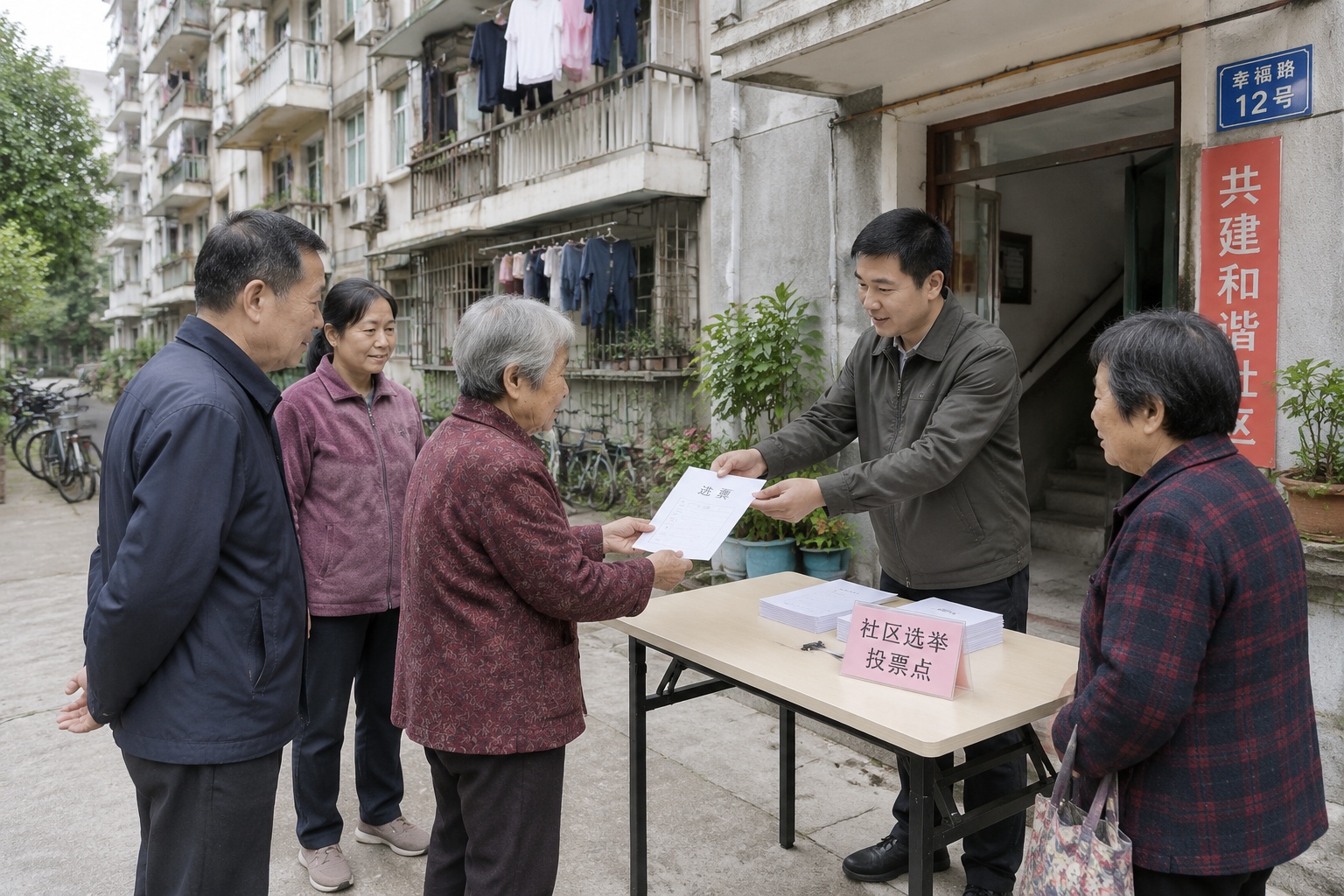
In June, a folding table appeared in that courtyard. On it: a stack of printed forms, a red ink pad, and a clear plastic box with a slot cut into the lid.
Why old walk-ups suddenly have something to decide
Between the mid-1980s and the early 2000s, Chinese cities built an enormous number of six- and seven-story apartment blocks with no elevators. They were the default product of a housing boom that ran on cheap land and rare cars. The families who bought them were in their thirties and forties. Three decades later, many are in their sixties and seventies and still in the same flat, because it is near a hospital, near their grandchildren’s school, and paid off.
Since around 2020, a national urban renewal program known as old residential community renovation (老旧小区改造) has concentrated on upgrading these buildings instead of demolishing them: replacing water and gas pipes, adding parking and green space, fixing wiring, and, where residents want it, attaching elevators to the exterior walls. The money is real. A single elevator retrofit in China commonly costs 600,000 to 900,000 yuan (roughly $85,000 to $125,000), and city and district governments typically cover a third to a half of that.
The subsidy, though, is not the hard part. Under Chinese law, adding an elevator to an existing building is not a municipal project. It is a decision that belongs to the people who own the flats. Which means it has to be voted on. And it can be voted down.
The fight is about light, noise, and who gains
The arithmetic of interest in a six-floor walk-up is brutally clear. On the top floor, an elevator is worth a great deal: an elderly household gets its mobility back, and local estate agents say the flat may gain 10 percent or more in resale value. On the first floor, nothing improves and several things get worse. A steel and glass structure rises outside the window, daylight drops, and the flat that was once the easiest in the building to sell — the one you reach without climbing — loses its only advantage. The fourth floor is ambivalent. The second floor can walk.
This is why negotiations in these buildings are rarely really about elevators. They are about compensation, layout and pride.
Who actually runs the vote
Nobody from the city government knocked on doors. In our compound the process was run by the homeowners’ committee (业委会) — five volunteers elected by the building’s owners at a meeting most people attended reluctantly. Its chair is a retired accountant, Mr. Xu, who keeps minutes in a leather folder and numbers every version of every proposal.
The residents’ committee (居委会), the neighborhood-level body that handles social services, and the subdistrict office above it played a different role. They provided the meeting room, explained the subsidy rules and, when things turned hostile, brought in mediators. They did not vote.
The sequence is standardized in most Chinese cities and lasts far longer than it sounds: an intent survey to check whether a project is even worth pursuing, a design scheme posted in the stairwell for public comment, negotiation rounds, a formal written vote, and then a publicity period in which the tally and any objections are displayed.
Our first intent survey, in the summer of 2022, produced eight willing households out of twelve. That turned out to be the easy part.
What the law actually requires
The Civil Code, which took effect in 2021, sets a national floor for decisions like this one. Owners representing at least two-thirds of the building’s floor area and two-thirds of the households must take part in the vote. Among those who take part, owners holding at least three-quarters of the area and three-quarters of the households must agree.
In a twelve-household building, that means eight households have to vote, and six of those eight have to say yes. Cities then add conditions of their own. Many require that no other owner in the building file a formal objection — a rule that, in practice, can hand a single determined household a veto. That is the real reason these projects take years. Not the ballot, which takes an afternoon, but the months of negotiation that determine what the ballot says.
The deal: money, light, and a drainpipe
Here is what our building eventually agreed on.
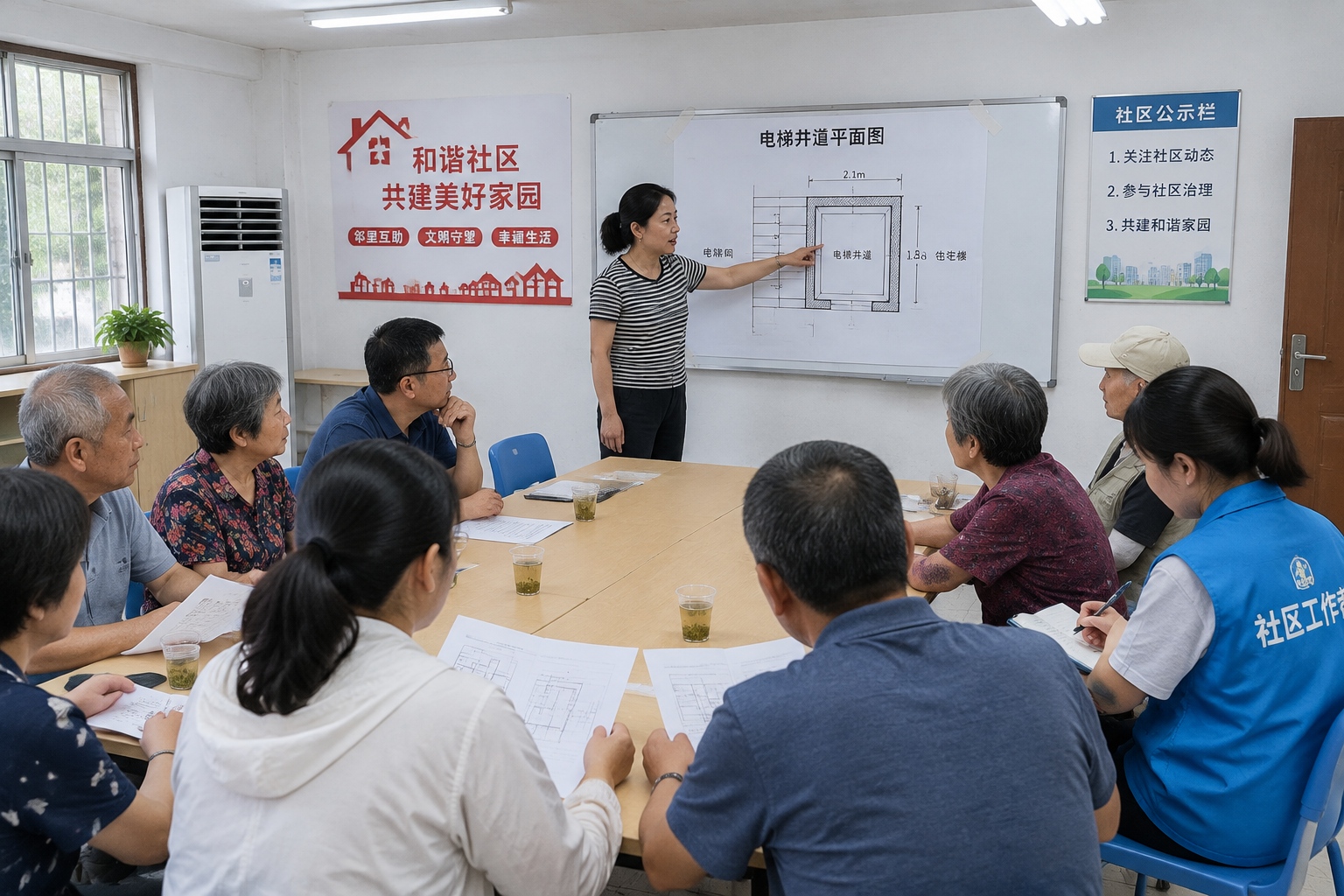
The elevator shaft was moved to the north face, away from the living-room windows of the ground-floor flats, so the family in 1A kept its afternoon light. In exchange for a small loss of corridor space, the corroded drainage pipe that ran past their kitchen wall was replaced at project cost, and the paved strip outside their window was replanted.
Floors one and two paid nothing toward construction. Floors three to six split the owners’ share using a coefficient now standard in many Chinese cities: floor three pays 10 percent, floor four 20, floor five 30, floor six 40. With a total cost of about 650,000 yuan and roughly 300,000 covered by municipal and district subsidies, the owners’ share came to 350,000 — about 17,500 yuan for each household on the third floor, and 70,000 for each on the top floor. The sixth-floor widow whose husband died two years ago paid in installments; her son, who works in Shenzhen, transferred the last of it in November.
Ongoing costs were settled separately. Electricity, cleaning and an annual safety inspection come to roughly 5,000 yuan a year, divided by the same coefficient, with the first and second floors paying a token amount.
The vote itself
The ballot was a single printed sheet, one per household, with three options: agree, disagree, abstain. Voting was done door to door over four evenings, because that is how you reach people who work late. Each voter showed an ID. Landlords who live elsewhere could vote by signed proxy, and two did. A staff member from the residents’ committee watched. The folded ballots went into the plastic box.
The count: eleven ballots cast, ten in favor, one abstention. Eleven of twelve households took part, well above the two-thirds threshold. Ten of those eleven agreed, comfortably above three-quarters. The second-floor landlord who rents his flat out and lives in another district never answered two written notices, and his silence was recorded as non-participation.
Then came the part that matters more than the vote: a seven-day publicity period. The tally, the design, the cost table and the names of the households that had paid were posted in the stairwell, along with a phone number for objections. Nobody called.
After the vote: permits, cranes and a maintenance fund
Approval is roughly the midpoint. What follows is a planning permit, a fire-safety review, registration of the elevator with the market regulator, a construction contract, and three months of drilling, welding and swearing. The subsidy is paid after completion and inspection, which means somebody has to front the money. Our homeowners’ committee opened a temporary account and collected contributions in two installments.
The least glamorous document turned out to be the most important one: the maintenance agreement. It sets out who pays for electricity, cleaning and inspections, what happens when a household refuses to pay, and — the clause that will outlive all of us — that the elevator obligation is written into the property’s file, so a new owner inherits it on purchase.
What nineteen months of arguing looks like from the inside
It took nineteen months from the first survey to the first ride. Two other buildings on our street failed at the negotiation stage and are still waiting. One of them collapsed over a single household that wanted cash compensation the others would not pay.
What made the process survivable was less about goodwill than about record-keeping. Every meeting had minutes. Every design had a version number and a ten-day notice. Objections had to be answered in writing, which forced people who had spent an hour shouting in the courtyard to state on paper exactly what they wanted. When a first-floor owner threatened to sue, the subdistrict arranged a mediation session with a trained mediator and a legal-aid lawyer.
Nobody was talked into it. People changed their minds because the offer changed: the shaft moved north, the drainpipe got fixed, the ground floor paid nothing. That is not a warm story about neighborhood harmony. It is a story about a small group of people with incompatible interests finding a price.
A vote at the scale of a stairwell
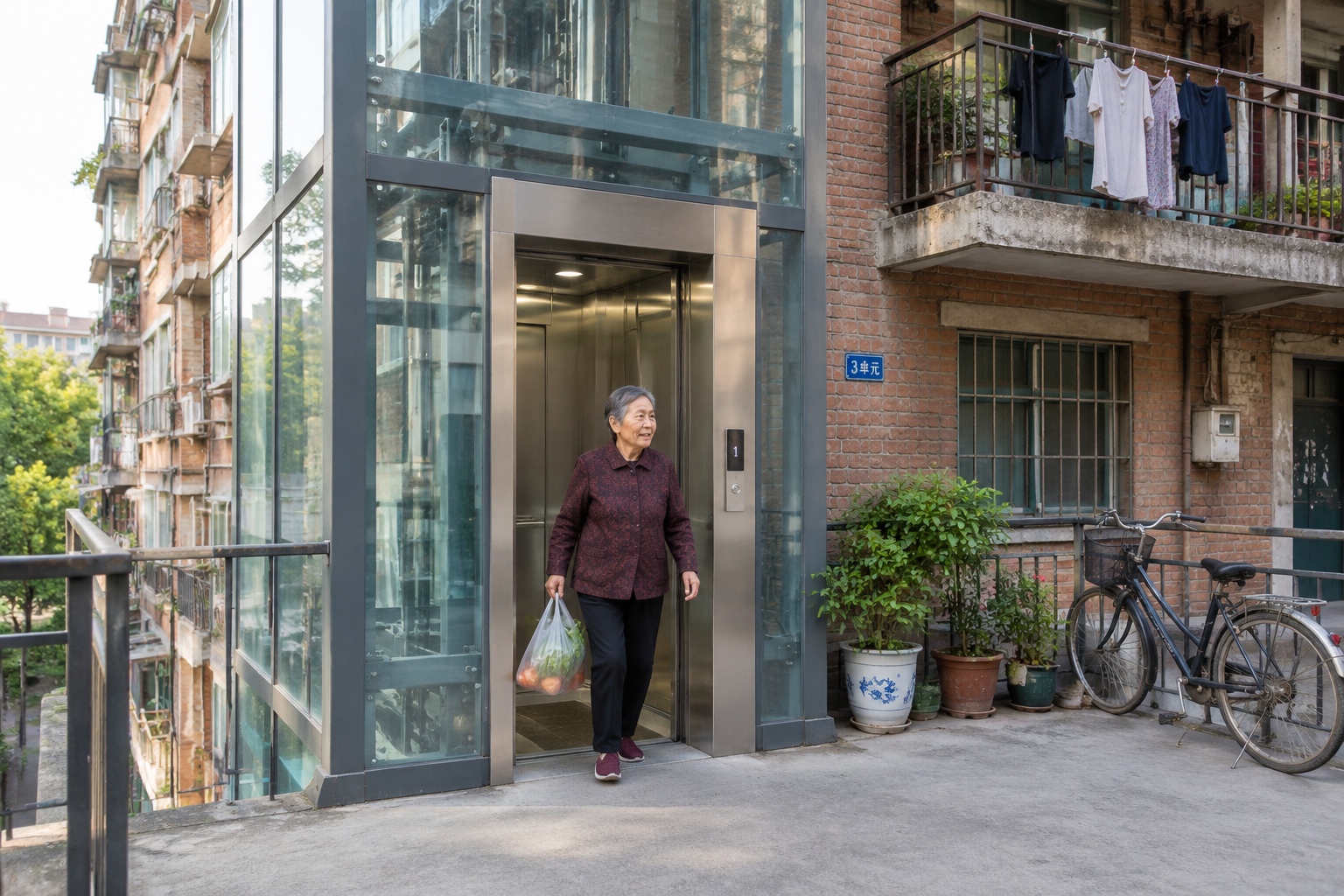
The elevator started running in December. Mr. Huang took it down on the first morning, then went out again in the afternoon, which he had not done in years.
Grassroots democracy in a Chinese city rarely looks like a rally. It looks like a plastic box with a slot in the lid, passed around a courtyard in a building where everyone has to keep living next to everyone else. The decisions are local, the arguments are personal, and the result is almost never a clean win. But there is a written record, a threshold, a publicity period and a vote — and when Mr. Huang presses the button, it is hard to argue that the arguing was wasted.
Start the discussion at forum.chinacomes.com