
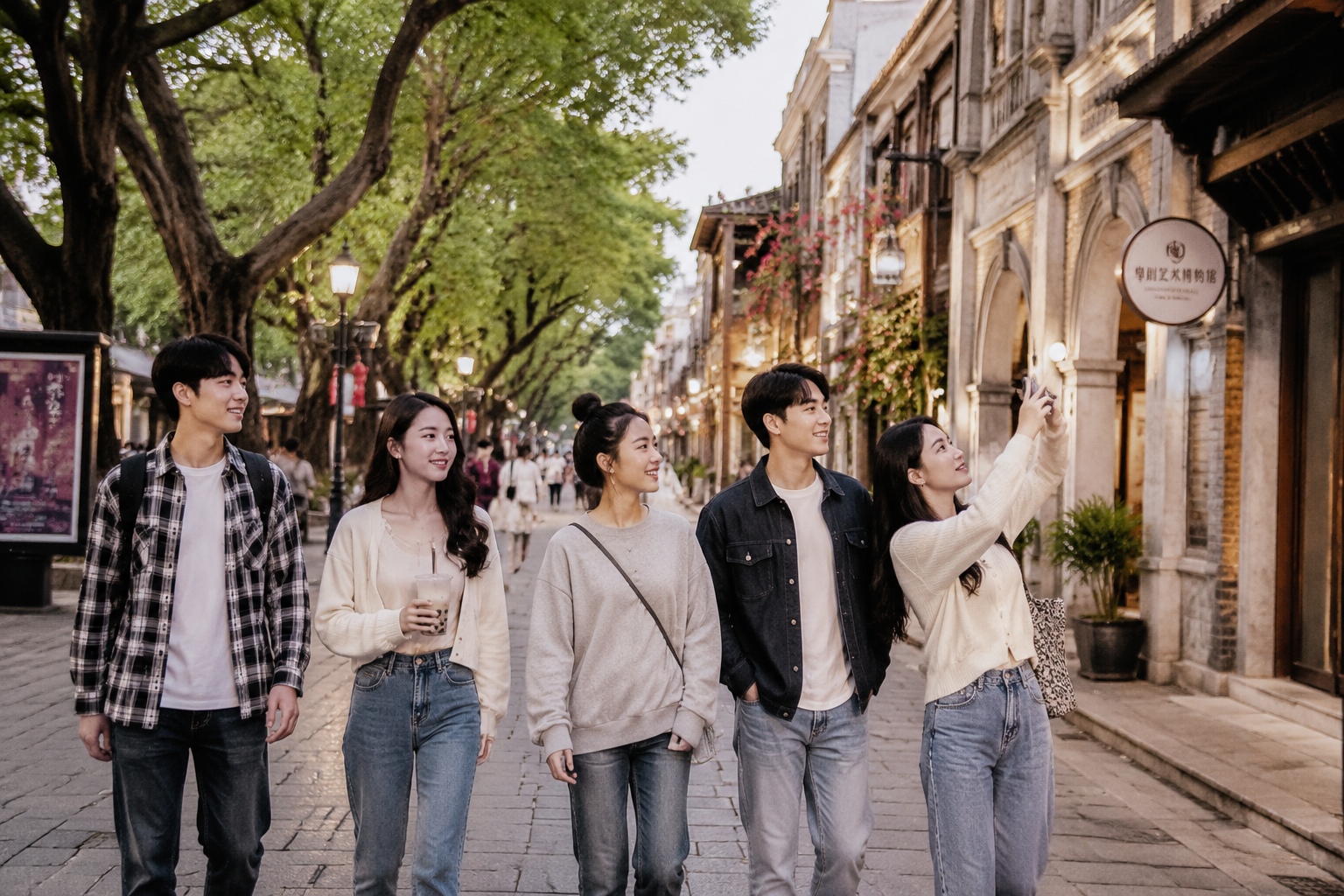

On a warm Saturday evening in Shanghai, 27-year-old designer Lin Lin is not queuing outside a nightclub. Instead, she’s walking down a leafy lane in the former French Concession, phone in hand, bubble tea in the other. Every few steps, she stops to photograph a tiled wall, a tiny bakery, or a cat sleeping on a motorbike seat. Her friends are with her, but no one is rushing. They’re doing what millions of young Chinese now call citywalk — an unhurried, unplanned stroll through the city’s lesser-known corners.
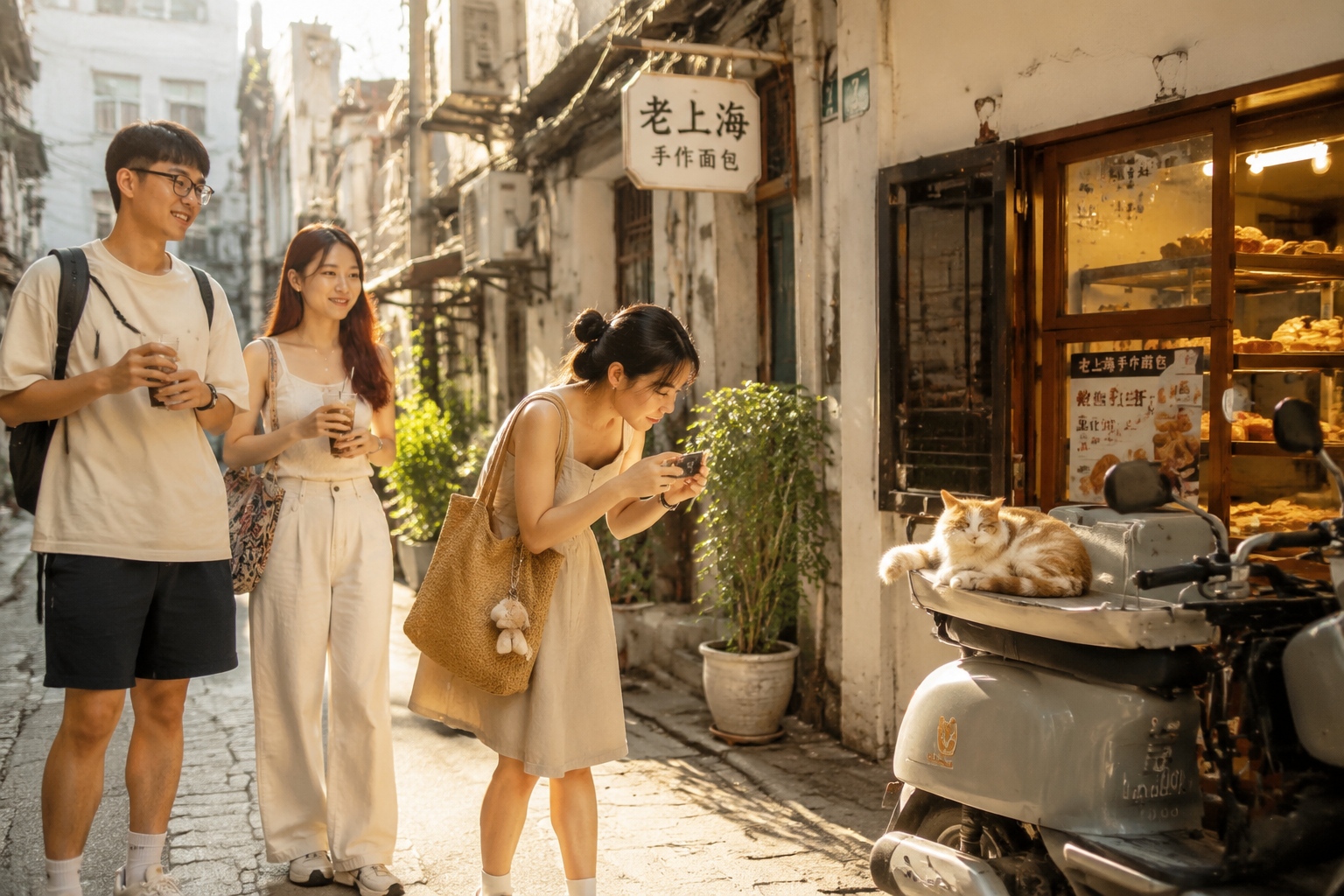
Citywalk is not an organized tour. There’s no guide, no route, and often no destination. The idea is simple: pick a neighborhood, walk, and let the city unfold. On apps like Xiaohongshu (Little Red Book), the hashtag has gathered over 1.6 billion views. Young people share self-made maps of “hidden alleys,” “old market streets,” and “cafés with soul.” It’s less about getting somewhere, and more about reclaiming the city at a human pace.
For many outsiders, this might seem like a mild pastime. But in China’s megacities, where life has long been measured in speed and productivity, citywalk feels almost radical. It offers something nightlife once did: company, stimulation, and a sense of freedom. Only now, the stage is the street itself.
A Different Kind of Night Out
The title “new clubbing” isn’t just a metaphor. For many Chinese young people, the “club” used to be the center of weekend life. From late-night KTV to dance clubs with bottle-priced booths, the urban night was about intensity — loud music, flashing lights, relationships formed over shots of whiskey. But that scene has been shrinking. The cost of a night out in Shanghai can easily exceed ¥1,000 ($140), and for many, the payoff is low: the feeling of being “social” in a room where the bass makes conversation impossible.
Citywalk offers a different kind of high. It starts with the walk itself: a slow, sometimes silent activity that lets you be with friends without forcing conversation. There are discoveries along the way: an unexpected garden, a flower stall, a new mural. And at the end of the walk, you’ve truly seen something. Compare that with a nightclub memory, which often ends in a haze of sweat and sirens.
An economist might call this a shift from “loud consumption” to “quiet consumption.” But it’s also about value. Citywalk costs almost nothing. You can spend an afternoon walking and perhaps buy a ¥12 coffee and a ¥6 baozi. That’s not a bad deal in a country where a movie ticket can set you back ¥80.
Why Are Young Chinese Turning Away from Nightclubs?
There are three practical reasons, and they overlap.
The cost factor
Nightlife in Chinese cities is expensive. In the past, “clubbing” was seen as a symbol of status — you’d buy a bottle of foreign whiskey and put it on the table. But with economic uncertainty and the post-COVID slowdown, young people are more careful with money. A night of clubbing for a group of five can cost a full month’s rent for some. Citywalk, on the other hand, is nearly free. The main investment is a pair of comfortable shoes and a fully charged phone.
Burnout and the need for slow time
China’s urban young are also tired. Long hours, “996” work culture, and the mental remnants of the pandemic have left a generation craving rest. Nightclubs feel exhausting — loud, crowded, and performative. Citywalk feels like taking a breath. Many walkers describe it as a form of mobile meditation. You’re outside, the body moves at walking speed, and your mind can wander. Psychologists have noted that “green exercise” reduces stress, and city parks and leafy streets serve as low-cost wellness centers.
A new aesthetic
There is also a visual shift. The younger generation, especially those born after 1995, grew up on polished Instagram-style images. Now many are drawn to what they call “日常感” (a sense of daily life). They want documentary-style photos, the texture of weathered brick, fading advertisements, and imperfect details. Citywalk feeds this aesthetic. It’s as if they’ve had enough of perfect skylines and want to find the “real” city underneath.
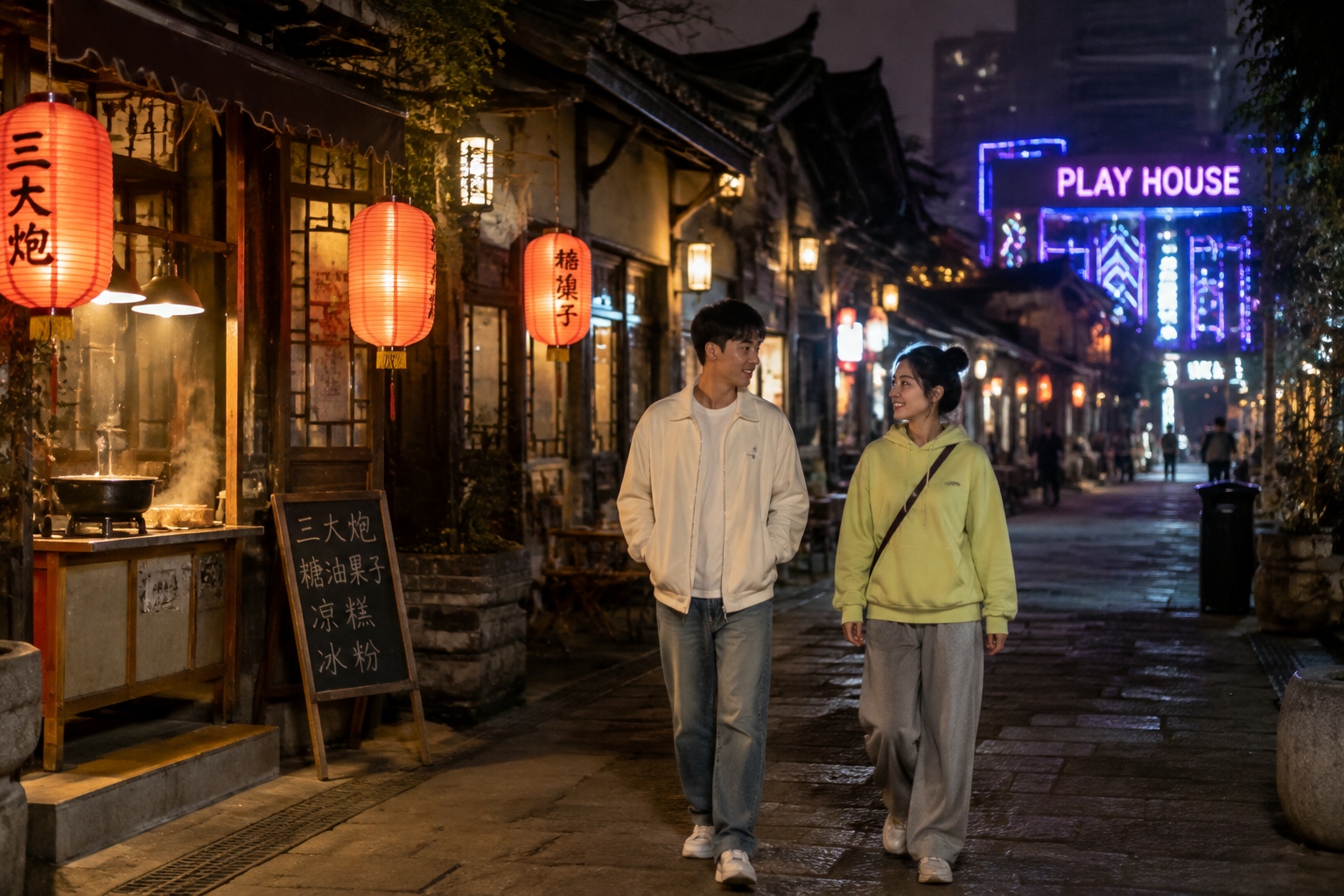
One popular social media format is the “before and after” of a street scene: a grey wall suddenly animated by a passerby in a bright coat. Another is the “lantern-lit alley,” where a thin street is reworked by the golden light of a setting sun. These images are not of famous landmarks. They are of ordinary places that suddenly become special because someone took the time to look.
The Hidden Economy of Citywalk: Old Blocks, Small Shops, New Life
This new affinity for walking has brought unexpected foot traffic to old commercial streets. In Shanghai’s Anfu Road and Wukang Road, some of the sleek boutiques have been replaced by small independent stores: a bakery that sells only red bean buns, a vintage-shop restorer, a flower shop that offers ¥10 stems. Similar things are happening in Beijing’s Baochao Hutong, where courtyard-turned-art studios now attract strolling groups, and in Guangzhou’s Dongshankou, a cluster of decaying Western-style villas that now host cafés and small art exhibitions.
These places benefit not just from walk-in customers but from social media exposure. A walker might stop, take a photo of a door, and within three days the shop owner will see a flood of new visitors. Store owners have learned to adapt: simple benches outside the door, free water for walkers, and signs that read “Welcome, walkers!”. This is a two-way street: the strolling youth give old districts new meaning, and the old districts give the young a sense of authenticity and rootedness.
Yet the trend has its wrinkles. Some popular walking streets are becoming so crowded that they feel like shopping malls. Local residents complain about noise and selfie sticks, and rent increases are pushing out the surviving family shops. In some cases, city walkers are seen as “conspicuous” new gentrifiers. But the core of the movement remains democratic. Any street can be walked. There is no cover charge. The city belongs to you simply because you are present.
Reclaiming Public Space, One Step at a Time
In urban China, public space has often been designed for efficiency: wide roads, underpasses, and plazas too gigantic to feel human. Citywalk is a spatial rebellion. It treats the street as a stage, not just a connector. Urban planners have started to take notice. In 2022, the city of Shanghai released a plan for “slow travel” networks, adding bike lanes, leafy steps, and rest areas along old streets. Several cities have launched “walk-friendly” campaigns, encouraging citizens to explore neighborhoods on foot.
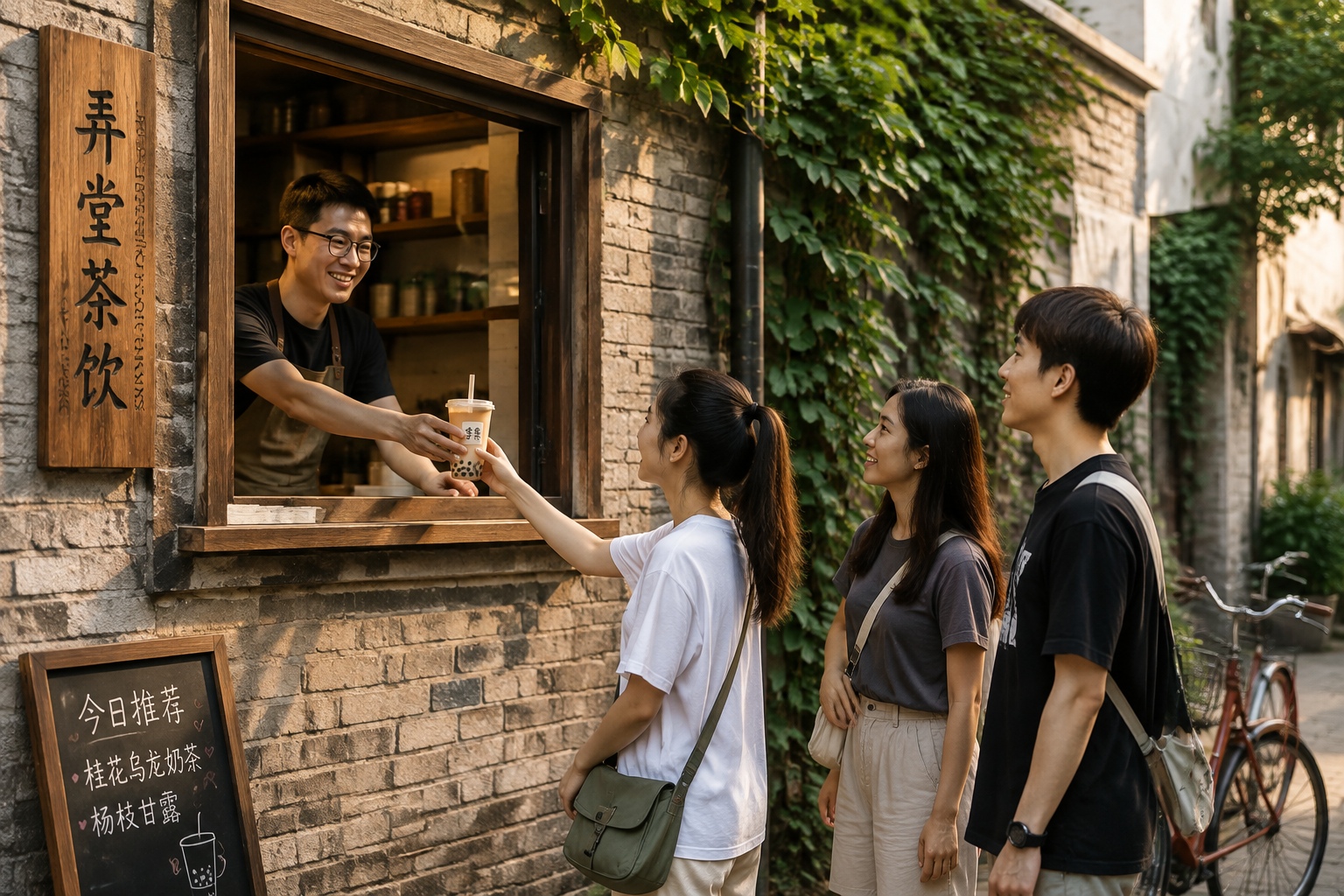
For young people, this is more than a news story. Rethinking space means rethinking relationships. Some have formed citywalk groups that meet on weekends and walk together for hours, stopping for food or photos. They are strangers, but they share the same tempo. “It’s like going to a club with people who actually want to talk,” one participant told me. “We speak about what we see, not about work.”
This social aspect is why citywalk works as a club replacement. A nightclub sells exclusivity — the idea that being inside is better. A citywalk sells openness — the idea that being outside is enough. It is a club where the door is always open, the music is the city itself, and you don’t have to dress a certain way to get in.
Conclusion: The Street Is the Place to Be
Citywalk is not a cure-all. It doesn’t solve the cost of living, the long work hours, or the gap between generations. But it does something simple and powerful: it reminds young Chinese that they have a right to their city, in all its ordinary and imperfect beauty. They are not just consumers or commuters; they are walkers, and in walking, they are listening.
So the next time you see a young person in China staring at a wall, pause. They might not be lost. They might just be finding something.
Start the discussion at forum.chinacomes.com