
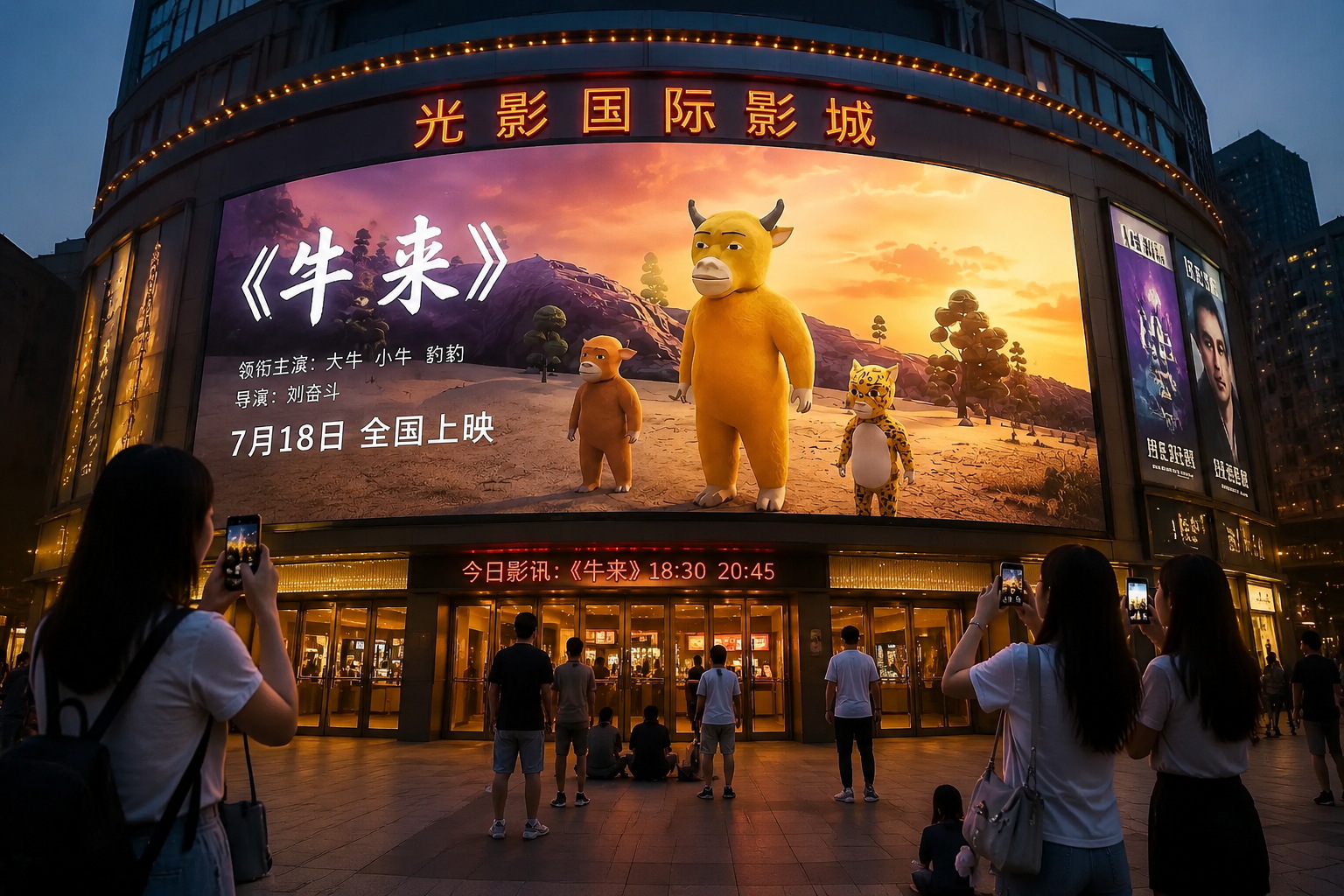

The Least Likely Box-Office Hit of the Summer
In the summer of 2026, a Chinese animated film called Niu Lai turned the box office upside down. For its first ten days in theaters, it earned just 7,169 yuan (about $1,000) in total, with fewer than 300 admissions. On its worst day, it pulled in only 188 yuan. Then, within a matter of days, it crossed 29 million yuan. By August 20, its cumulative box office had reached 29.08 million yuan, and industry projections now suggest it could hit 135 million. How did a movie widely mocked as a disaster become the most talked-about phenomenon of the season?

A Box-Office Rollercoaster Unlike Any Other
Niu Lai’s box-office curve reads like a wild fantasy:
- August 5 – Opening day: ¥3,420 from 122 admissions.
- August 5–13 – Daily earnings hover between ¥100 and ¥1,000; total reaches ¥7,169.
- August 14 – A Weibo hashtag “Niu Lai box office ¥7,352, no ‘ten-thousand’ number” goes viral. Screenings jump from fewer than 5 to 168.
- August 15 – Single-day box office hits ¥646,000, a several-hundred-fold spike. 72 related hashtags appear on Weibo hot search.
- August 16 – Passes ¥4.6 million, entering the top 10 domestic animated films of 2026.
- August 18 – Exceeds ¥20 million.
- August 20 – Nearly ¥29 million and counting.
In just a few days, box office surged over 4,000 times. Even Bloomberg took note, saying the phenomenon highlights the growing power of social media attention—even negative attention—on Chinese consumer behavior.
Why Everyone Says It’s Terrible
The “greatness” of Niu Lai’s badness is comprehensive.
Production quality: The 3D modeling is crude, character movements stiff, and clipping errors frequent. One viewer complained, “This isn’t 2026 animation; it’s an entry-level 3D homework assignment from 2006.” Film blogger “No. 3 Hall Ticket Inspector” called it “so bad it’s funny, but also visually traumatic.”
Story and dialogue: The narrative is disjointed, the dialogue awkward. The film tells the story of a little bull named Niu Lai and has been compared to a “stripped-down Lion King.” A Douban user described the experience as “sitting on needles.”
The biggest trap: The promotional poster was a beautiful ink-wash painting, elegant and healing—but the actual film was a disaster. Netizens joked, “A single poster fooled the entire audience.” That huge gap between expectation and reality became the first spark for online chaos.
The Two-Person Crew Behind the Chaos
The production story is just as surprising. The core team consisted of two people: director Xin Yumeng and his 60-something mother, Sun Lifang. Xin, who previously worked in interior decoration, spent five years teaching himself animation, handling direction, writing, production, and even voice acting. His mother co-wrote and voiced a character, and she also sang the ending theme.
The production company, Dalian Jingyuan Culture and Media, was formerly a decoration engineering firm that pivoted to film in 2021, with registered capital of just 100,000 yuan and only one insured employee. The distributor reportedly advised Xin not to release the film after watching it, but he insisted on bringing it to the big screen.
That persistence is touching, but as one critic noted, “The sincerity of a dream should not blur the standard for evaluating a work.”
Why We Can’t Stop Watching: The Viral Formula
The film’s explosion is the result of several chance factors stacking up.
First, extreme contrast triggers curiosity. The gorgeous ink-wash poster versus the crude 3D visuals created an army of “victims” who shared their shock online. As screenshots of the awkward models and bizarre voice acting spread, people flocked to see it for themselves. In an era of increasingly polished AI animation, Niu Lai’s raw, hand-crafted look became a rare spectacle. Thousands said, “I have to see how bad it really is.”
Second, a pun made it a cultural meme. The title Niu Lai sounds like “bull market is coming” (niu shi lai). With China’s stock market swinging, the name hit a nerve with investors. Watching the film turned into a playful “prayer for a bull market,” and jokes about it spread through finance communities. That expanded the audience from animation fans to an enormous base of retail investors.
Third, social media supercharged the craze. It all started with a single Weibo post: “Box office ¥7,352, no ten-thousand.” An ordinary user, an ordinary observation, and algorithms turned it into the #8 trending topic. From then on, “checking in at a bad movie” became a collective performance. Audiences weren’t just watching—they were filming clips, making memes, and inventing gags. As one netizen joked, Niu Lai might be the only movie where the audience openly films the screen and the director is grateful for it.
Demographic data shows the largest audience group is 18-to-24-year-olds—not typical animation fans, but young people who came to join the meme rather than to enjoy the film.
A Sober Look at the Frenzy
The phenomenon raises serious questions.
“Appreciating ugliness” is not the same as acceptance. Audiences bought a ticket to participate in an internet moment, not to embrace low-quality filmmaking. This temporary curiosity shouldn’t be mistaken for real appreciation.
“Bad becomes hot” could become a formula. When a universally mocked film becomes a hit, there’s a risk that “make it cheap, add memes” turns into a replicable strategy. One critic warned, “A one-off internet carnival might be harmless, but a proven speculative logic will tempt imitators.”
“Compliance” isn’t “competence.” The film passed technical review because Chinese censorship focuses on safety and stability; as long as content stays within red lines, it can be released. But this raises a deeper question: shouldn’t publicly screened art meet a basic standard of quality?
The limits of grassroots creation. We should support new voices, but not at the cost of lowering the industry’s overall craft. “Being seen” is only a start; “being recognized” still requires real talent.
Bottom Line: After the Carnival
Niu Lai is a peculiar spectacle created by extreme contrasts, pun culture, and social media. It’s a funhouse mirror reflecting the logic of short-video-era distribution, the public’s emotional outlets, and the box office’s hunger for profit.
As a review put it: “Niu Lai will eventually fade, hashtags will change, and the crowds will disperse. But the signal it sends is dangerous: if good content keeps absenting itself, bad content will fill the void.”
Carnivals can be fun, but an industry’s dignity ultimately depends on solid work. It’s fine to laugh at the buzz around Niu Lai, but we should also call for more truly good films that win audiences through quality—the kind of “niu” films that deserve to come back.

Start the discussion at forum.chinacomes.com