
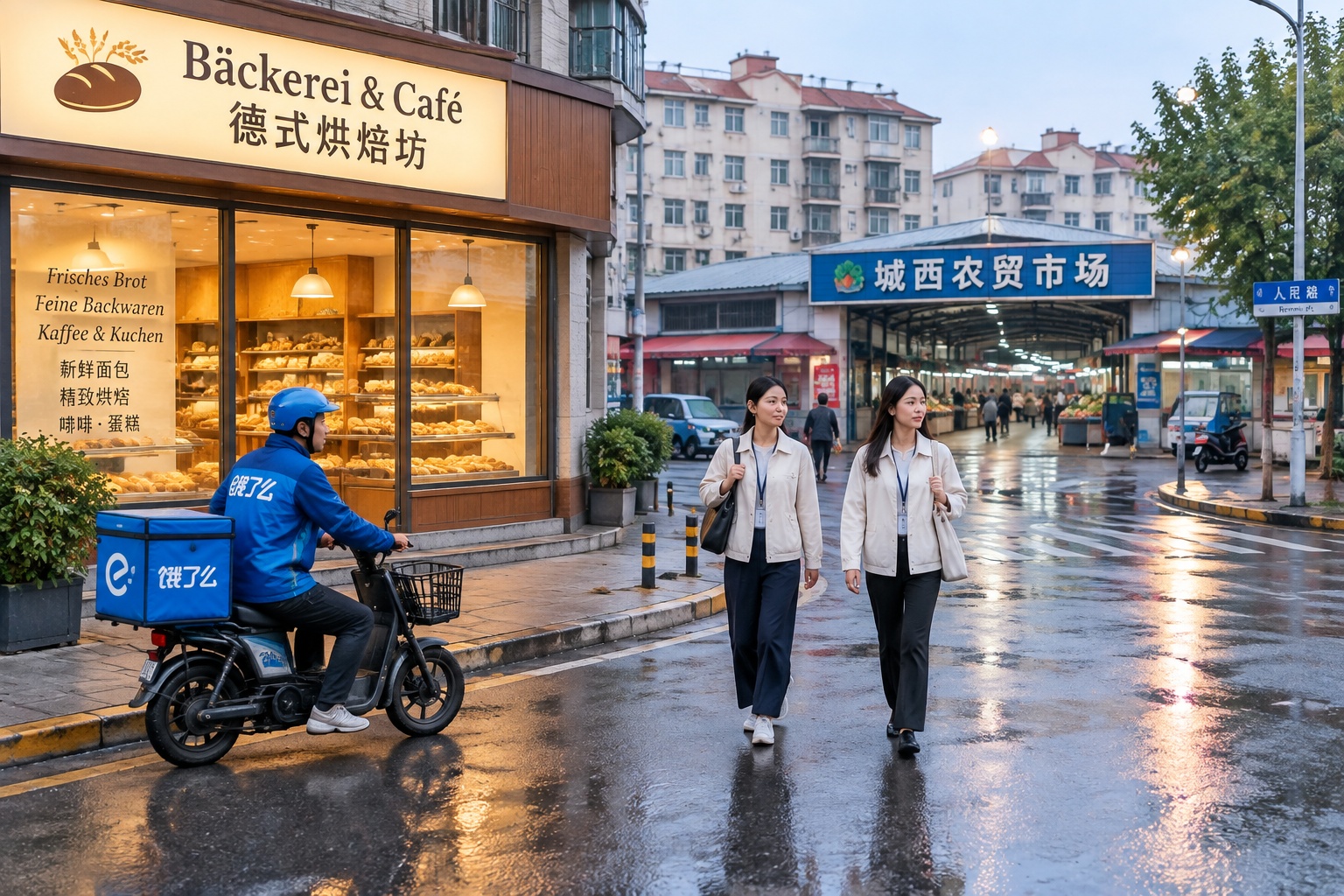

6:40 a.m. — Rye bread on Zheng He Road
What reaches you first on Zheng He Road at 6:40 in the morning is not traffic. It is bread: caraway, sourdough, a faint scorched edge of rye drifting out of a shop that prints Bäckerei on the top line of its sign and the Chinese characters for bakery on the second.
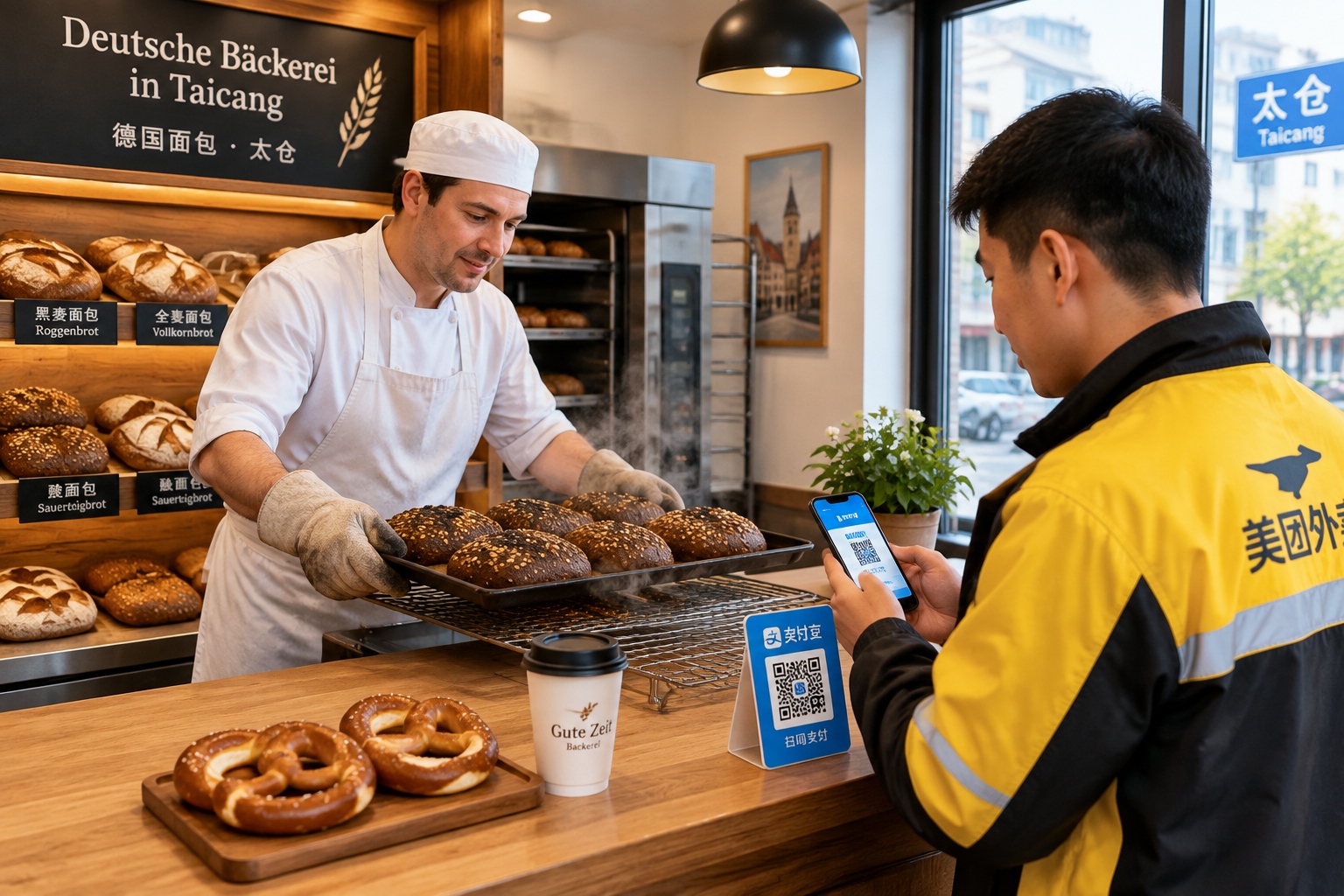
Inside, a baker in a white cap slides dark loaves onto a cooling rack. A man in a delivery jacket orders two pretzels and a coffee in Mandarin, then says danke out of habit. He works for a German auto-parts supplier twelve minutes away.
Taicang is a county-level city of roughly 830,000 people in Jiangsu province, about 50 kilometres northwest of Shanghai, and it is not on most tourist itineraries. Six hundred years ago the treasure fleets of the Ming admiral Zheng He gathered near here before sailing into the Indian Ocean. The ships in the Yangtze port now carry machine tools and car parts, and the foreigners in town are more likely to be German production managers than sailors.
Since the spring maker Kern-Liebers became the first German firm here in 1993, more than 500 German companies have followed. Officials like to point out that around 60 of them are world market leaders in narrow niches, the kind of firms Germans call hidden champions: valves, sensors, textile machinery, precision springs.
For a visitor, the number is not the interesting part. What matters is how a foreign business cluster has soaked into the daily texture of a small Chinese city — what people eat at seven in the morning, how they get to work, what their children study, where they go at nine at night.
7:20 a.m. — The bus that runs in two languages
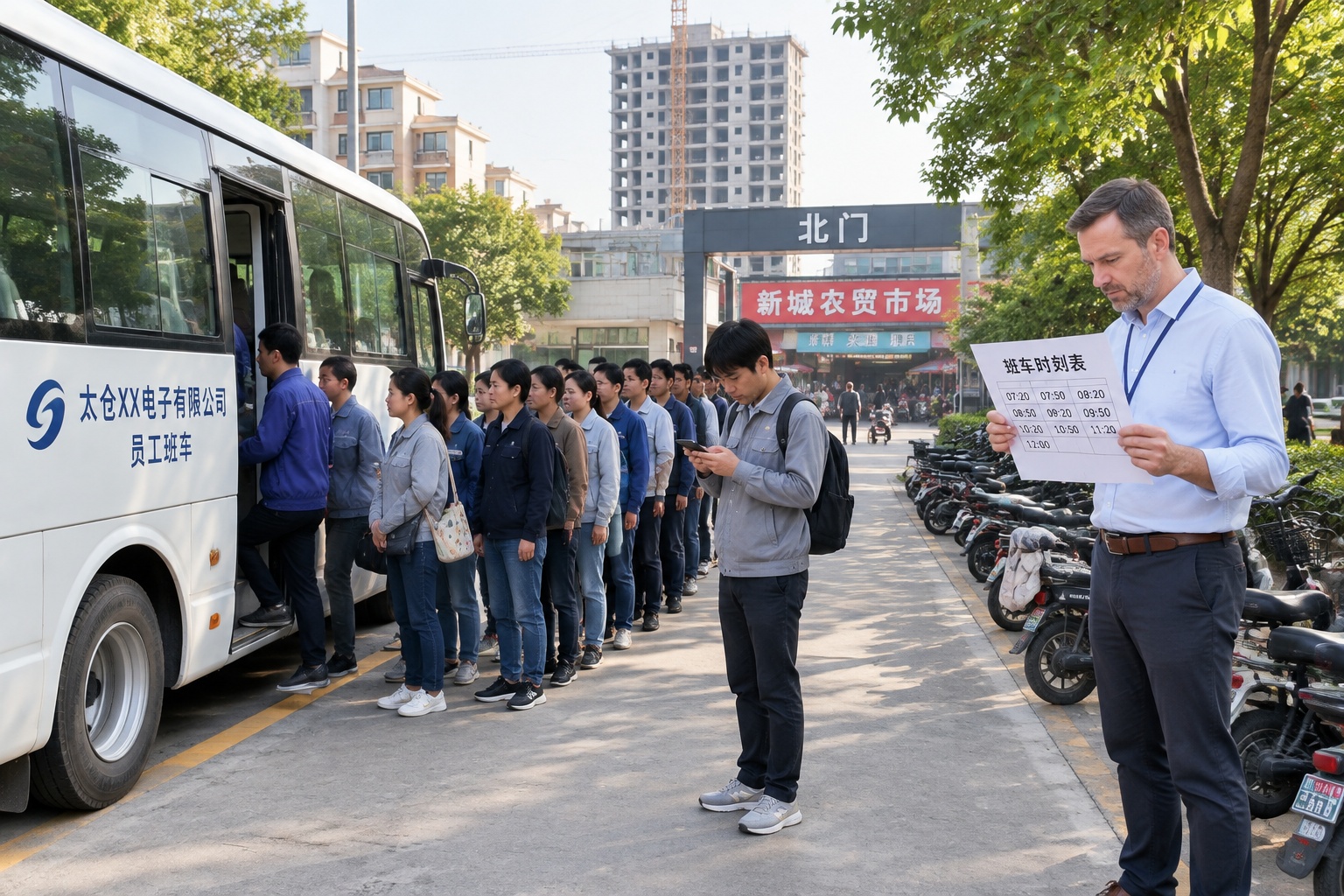
At the north gate of a housing compound, about thirty people wait for the shuttle. These buses are not public. Each large plant runs its own, and the routes trace a map of the industrial zone.
Wang Lei, 29, is on his phone revising German vocabulary before a technical meeting on Thursday. Next to him a German quality manager reads a printed schedule; he has lived here four years and speaks enough Mandarin to argue about lunch.
The ride takes eleven minutes. It passes a wet market, an unfinished apartment tower, and a long blue fence with solar panels stacked behind it. Almost every factory roof in the zone is covered in panels now. Thousands of e-bikes are parked under the trees. Nobody finds any of this remarkable. It is simply the commute.
8:30 a.m. — Where the future is measured in microns
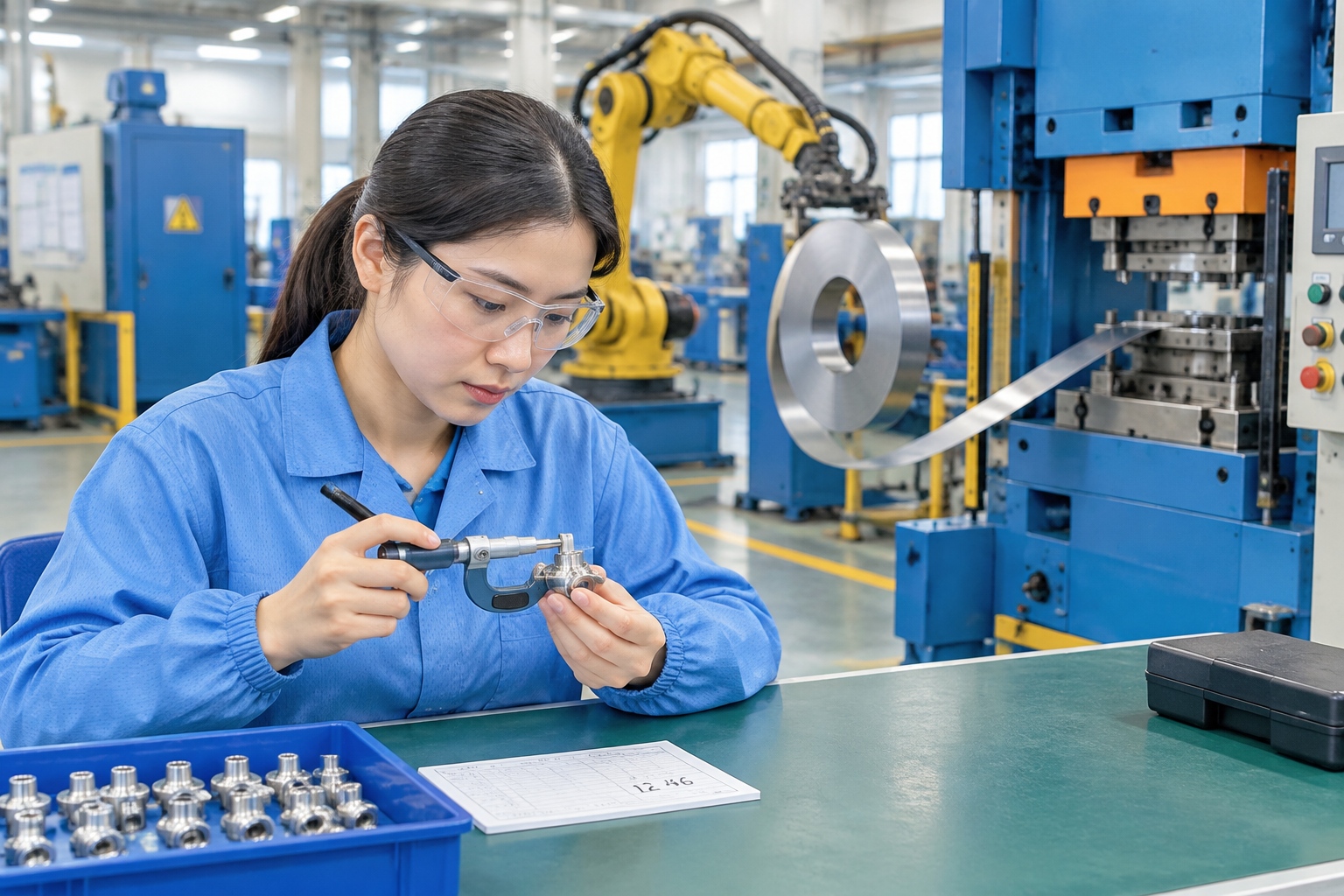
Inside a stamping and assembly plant, the noise comes in waves. A robot arm lifts a coil of steel strip, a press slams down, and a technician in a blue smock measures a palm-sized connector with a micrometer and writes the number on a card.
This plant used to make parts for diesel fuel systems. The same buildings now supply battery cooling plates and electric power steering components, and the customer list has shifted east as Chinese carmakers have grown. The switch happened faster than anyone’s five-year plan predicted.
Chen Hui, 34, leads a team of nine. She spent six Saturdays last year in a laser-welding course, paid for partly by the company and partly by a municipal subsidy for skills training. Her pay rose about 20 percent after she passed. She says her father, who worked in a state textile mill in the 1990s, still cannot quite believe she gets sent to Stuttgart for two weeks at a time.
There is pressure here too. German firms in Taicang now compete with Chinese suppliers who match quality on many parts and quote lower prices. Managers talk openly about needing to localize design, not just production. The era when a German brand alone justified a premium is fading, and everyone in this zone knows it.
10:30 a.m. — German exams, Chinese teenagers
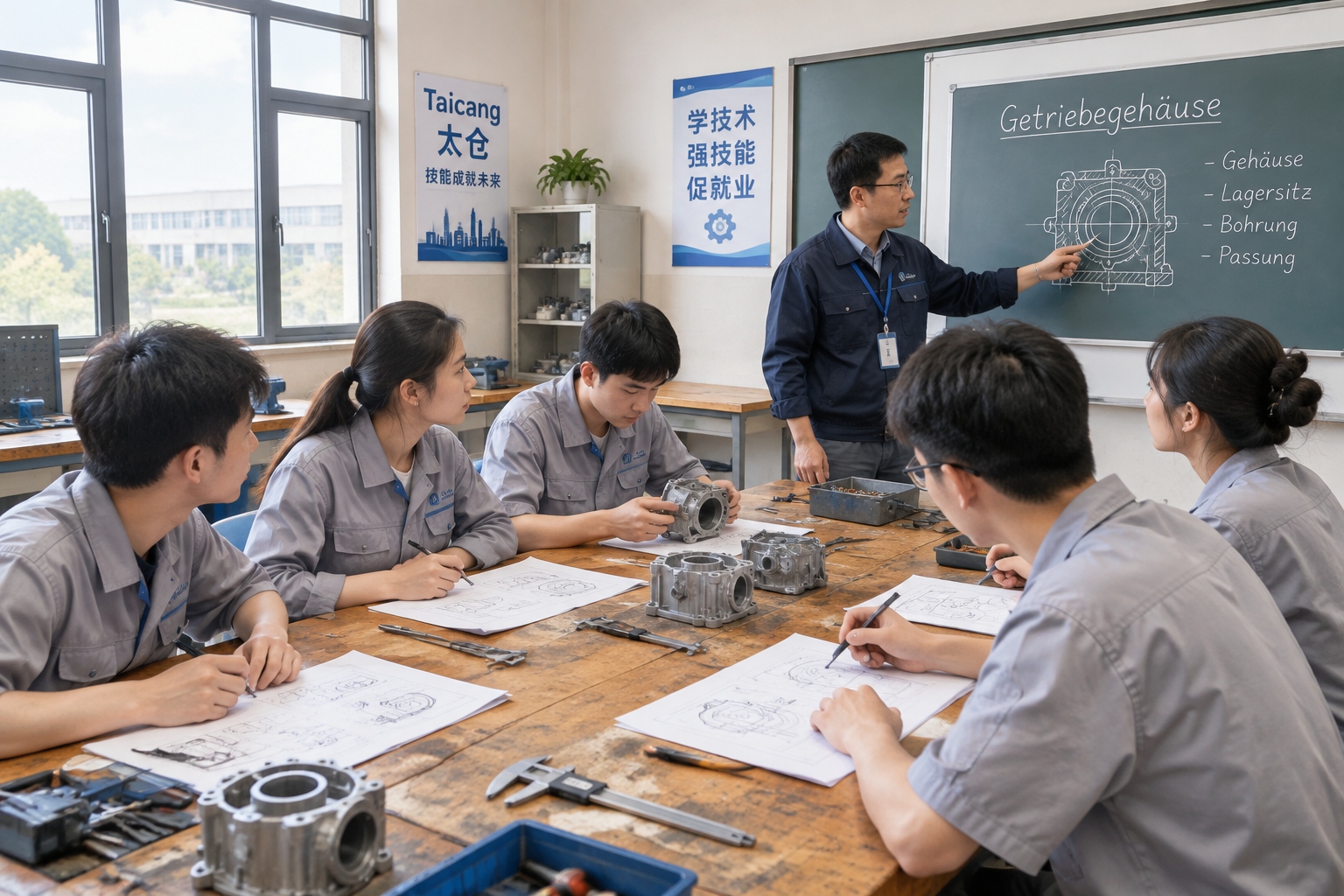
Across town, a vocational college runs a Chinese version of Germany’s dual system: two days a week in the classroom, three days in a real plant, an exam written and graded to German industry standards.
In one classroom, eighteen-year-olds bend over drawings of a gear housing. The textbook is bilingual. The teacher writes a term on the whiteboard in German, repeats it in Mandarin, then asks a student to explain what the part actually does.
Twelve years ago, most parents here wanted a university degree for their child. Vocational school was where you went if you did not test well. That hierarchy has not disappeared, but it has softened. Graduates of this programme can start at 5,000 to 7,000 yuan a month with a certificate German employers recognize, and the best are hired before they finish.
Liu Yuting, 19, says her aunt asked why she was learning to run a lathe when she could have studied accounting. Her answer: software is replacing accountants, but somebody still has to set up the machine.
1:00 p.m. — Lunch, WeChat, and potato salad
The canteen at noon shows how the two sides actually mix. Long tables, trays, a Sichuan-style pork dish, braised fish, and a counter with sausage and potato salad that began as an experiment for expatriate staff and is now popular with everyone.
Conversation is mostly in Mandarin, with German words for parts and processes dropped in. A young engineer uses a translation app to ask a German colleague about a tolerance. Ten years ago this plant kept a permanent interpreter on the floor; today it has one for three buildings.
Some things stay hard. Serious negotiation still happens in English or through a professional interpreter, and German families say the most difficult part of Taicang is not food or weather but schools, which is why many send children to Shanghai or to an international programme. That is the unglamorous side of a business town.
3:30 p.m. — A small city with two calendars
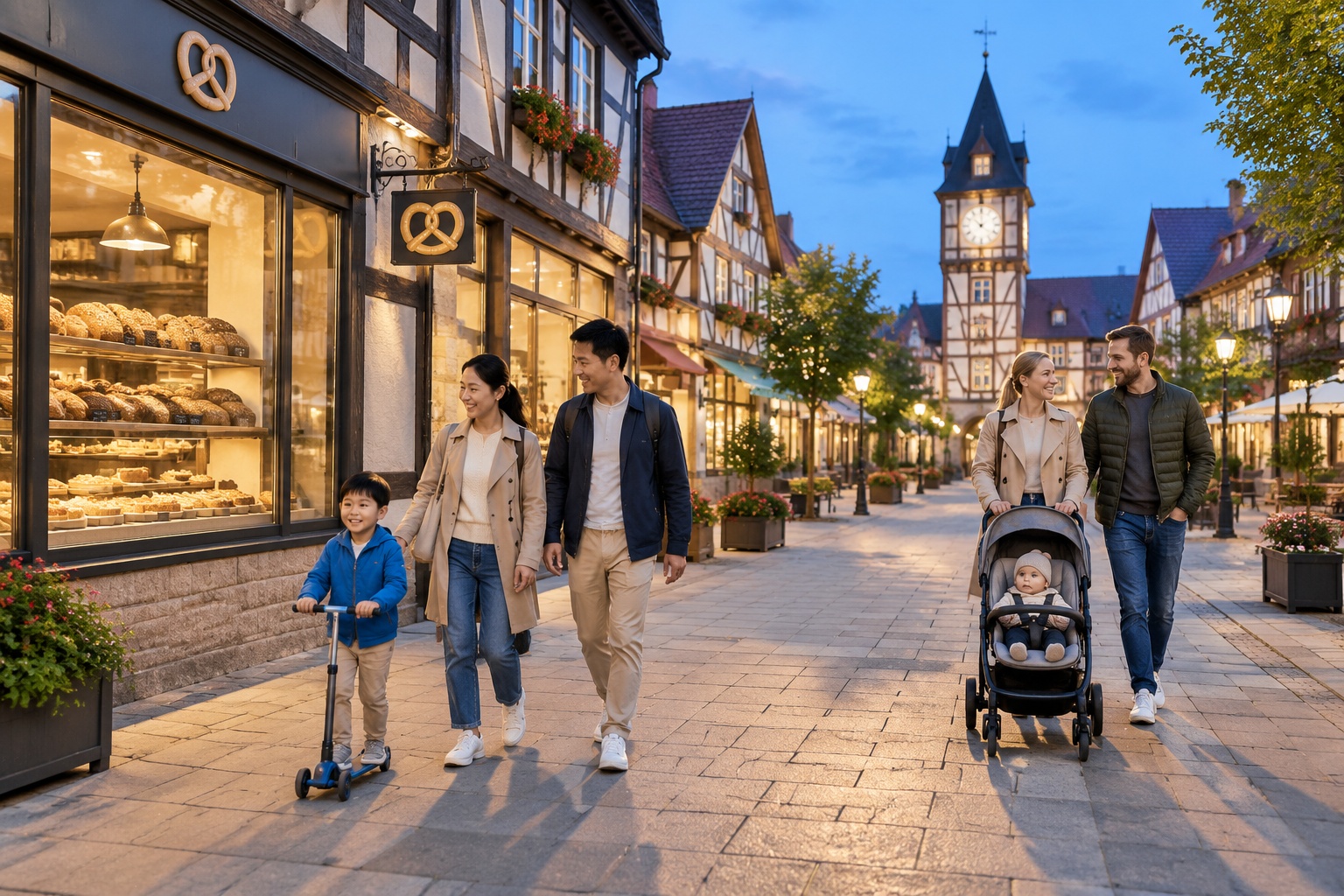
Fifteen minutes from the factory zone stands a street built to resemble Rothenburg ob der Tauber: half-timbered facades, a clock tower, a bakery selling dark bread and Black Forest cake, a beer garden with long tables. It began as an attempt to give German staff and their families somewhere familiar. It has become a weekend photo spot for Chinese families driving over from Taicang and Kunshan.
On a weekday afternoon it is quiet. A few storefronts sit empty, and the effect is closer to a stage set than a neighbourhood. Then December arrives, and a Christmas market fills the square with lights, mulled wine, roasted chestnuts and a queue of children waiting for a German-style Santa.
The honest version: the street is a little kitsch, and it is also a real place where a German family can buy the bread their grandmother made and a Chinese child can learn to sing Silent Night in two languages. Both are true at once.
6:30 p.m. — After the whistle
The shift ends and the city rearranges itself. E-bikes stream out of the gates. The path along the old canal fills with runners. A hotpot restaurant and a German pub sit on the same block, and both are full by eight.
Rent is part of the draw. A two-bedroom flat near the zone costs roughly 2,000 to 3,500 yuan a month, a fraction of Shanghai prices, which is why many engineers in their twenties stay put. A few do the opposite: they live in Taicang, take the 30-minute high-speed train to Shanghai Hongqiao for meetings and are home for dinner.
Nobody I spoke to here was nostalgic about the past or dazzled by the future. They talked about a salary, a promotion, a German exam in November, a child’s school, a football match on Sunday. Which may be the most useful thing to know about Taicang: a global industry arriving did not turn daily life into science fiction. It made ordinary life slightly more complicated, and slightly better paid.
If you go
Taicang is easy to reach. High-speed trains run from Shanghai Hongqiao to Taicang Station in about 30 minutes for roughly 25 to 40 yuan, and from Suzhou in about 20. From the station, taxis and ride-hailing apps are the simplest option; the city is flat and good for bike-share as well.
Spring (March to May) and autumn (September to November) are the best months. Summer is hot and humid, and the Christmas market in December is the one clear winter reason to come.
The German-style street, the bakeries and the restaurants are open to anyone. Factories are not tourist sites; visits usually need an appointment through a company contact or through German Centre Taicang, which supports German small and mid-sized firms in the zone. Bring a mobile payment app, since many places have barely handled cash for years, and expect restaurants to close between 2 and 5 p.m.
Budget: 300 to 600 yuan for a comfortable hotel, 60 to 150 yuan for a main course in a Western restaurant, 15 to 30 yuan for a loaf of German bread worth carrying home.
Start the discussion at forum.chinacomes.com