
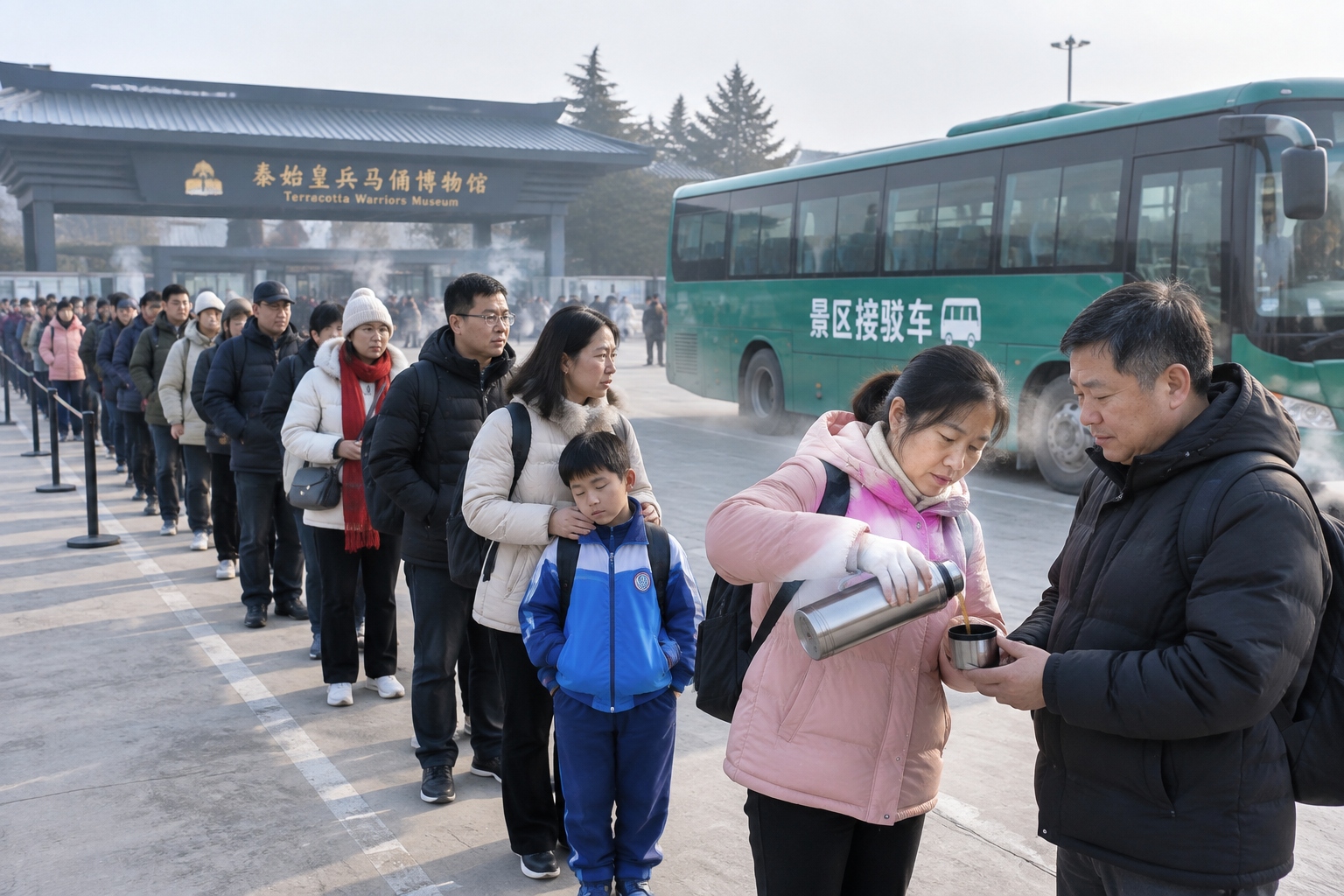

7:40 a.m. in Xi’an: The Queue Folds Back on Itself Four Times
It is two degrees Celsius. The shuttle bus to the Terracotta Warriors leaves from a lot outside the ticket hall, and the line has folded back on itself four times. A woman in a padded pink jacket unscrews a thermos and pours tea into the cup-shaped lid for her husband. A boy in a blue school uniform sleeps standing up; his mother holds the back of his collar. The bus idles, smelling of diesel and wet wool.
I had been in China for six hours. My name is Park Jun-ho. I’m thirty-four, a graphic designer in Seoul, and I had been carrying a mental map of this country around for twenty years. It had already started to come apart in the taxi from the airport.
The Map I Brought With Me
Koreans learn China early. Mine came from a school atlas where South Korea and China sat close together on facing pages, from news footage of Beijing, from a semester of Chinese I barely passed, and from every drama that mentions a factory in Qingdao.
I knew the numbers. South Korea is about 100,000 square kilometers. China is about 9.6 million. Ninety-six times. Fifty-one million people against 1.41 billion.
Knowing a number and standing inside it are different things. That’s what two weeks and five cities taught me — not that China is big, which everyone already knows, but that “big” is not a useful word for it.
Xi’an: Where the Numbers Start Moving
The warriors were as advertised. Pit One is 230 meters long, and the figures stand in ranks like a formation waiting for an order that is 2,200 years late. What stayed with me was the machinery around them: timed tickets booked three days ahead on a WeChat mini-program with my passport number, a security line, shuttle buses for a distance I could have walked, a wall of QR codes at every gate.
Nothing about it felt improvised. Everything about it felt counted.
That afternoon I rented a bicycle on top of the Xi’an city wall. The wall runs 13.7 kilometers around the old city and takes about 100 minutes at a tourist’s pace. You ride above the traffic, past apartment towers, past a man flying a kite shaped like a swallow. From up there it could be any city.
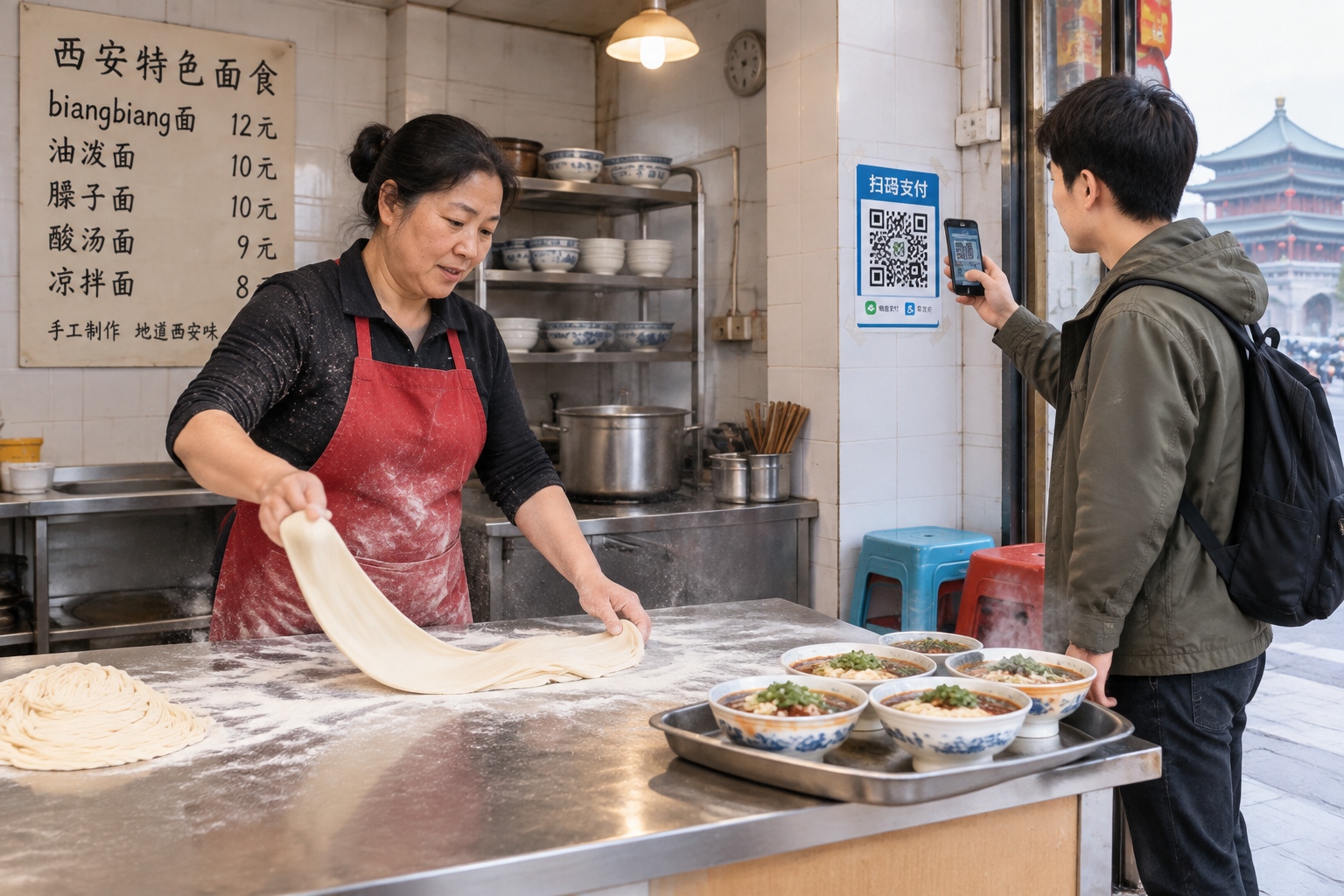
Down on the street, a woman in a noodle shop stretched biangbiang noodles by slapping them against the counter, one long band at a time, and asked where I was from. Korea. She nodded and said, “Samsung.” I laughed and paid by scanning a square of paper taped to the wall. She never looked up from the dough. My Korean card cleared before I reached the door.
West: The Country Stops Behaving Like a Country
The next morning I took a train west to Dunhuang. It leaves in the dark and arrives in the dark.
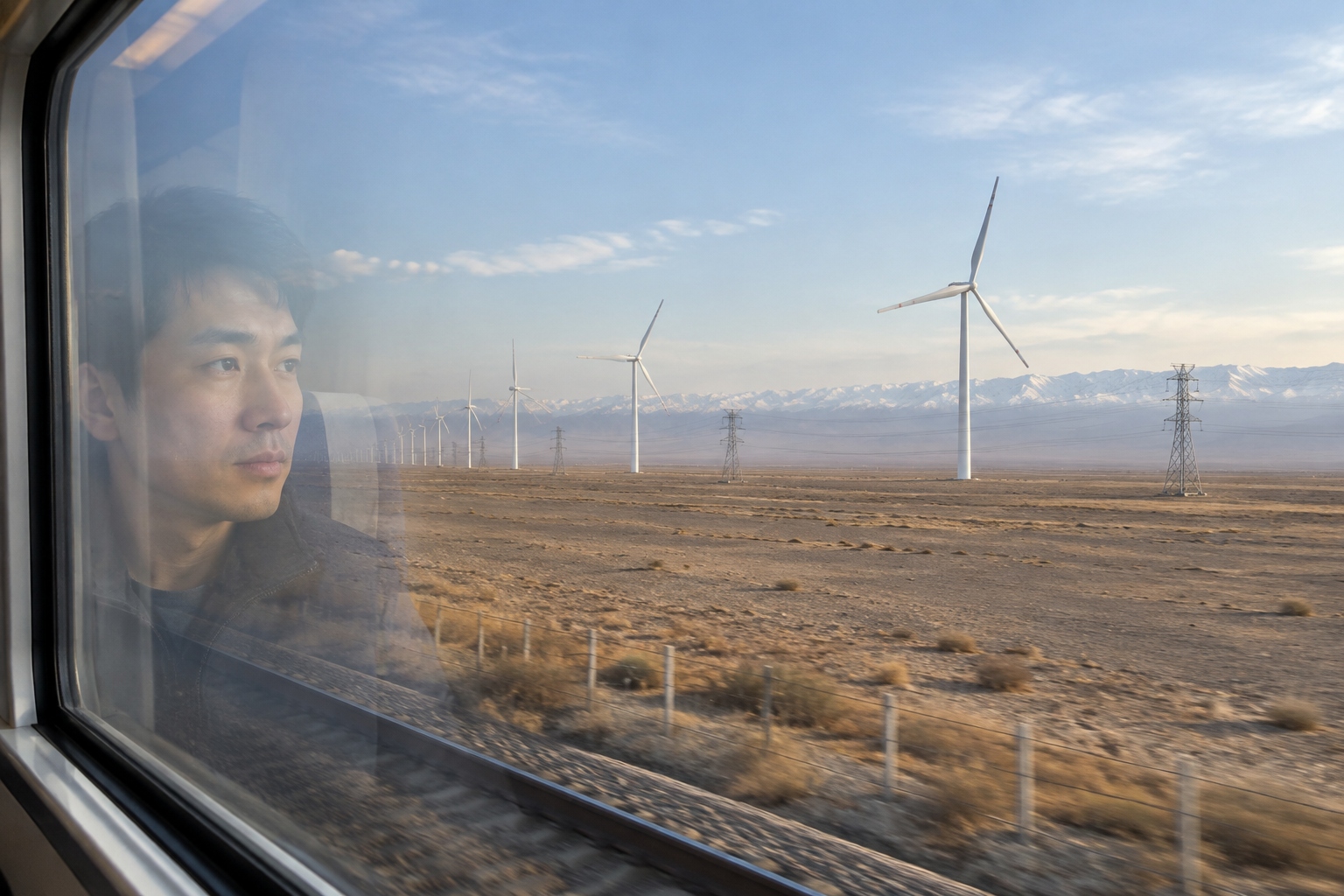
For the first few hours there are greenhouses and orchards and towns with names I couldn’t pronounce. Then, past Zhangye, the green stops. The Hexi Corridor opens up and there is nothing but brown gravel to the horizon, a line of pylons, and then wind turbines — hundreds, then thousands, standing in rows across the desert like something planted. I started counting and gave up before lunch.
The Gobi is not a view. It’s a duration. You look at it, and then you look at it for five more hours.
In Korea you cannot drive forty minutes without hitting a city. The country is roughly 400 kilometers long and it is never empty. Here I was on a train that had been moving all day and would still be inside the same country when I woke up.
Dunhuang: Six Thousand Tickets a Day, and Then the Sand
Dunhuang runs on Beijing time, but the sun doesn’t. In November it was still dark at 7:30 in the morning. Nobody around me found that strange.
The Mogao Caves cap standard tickets at roughly 6,000 visitors a day, spread across timed slots, each group seeing eight caves with a few minutes inside each one. I ended up with an emergency ticket and saw fewer. A guide unlocked a door, swept her flashlight across the ceiling, and a thousand-year-old painted ceiling appeared and vanished in about ninety seconds. Every neck in the group was craned the same way. Nobody spoke.
Outside, at the Mingsha dunes, a camel handler named Wang told me he does this from April to October and repairs air conditioners in the winter. I asked how many camels were at the site. “I don’t know. Too many to count.”
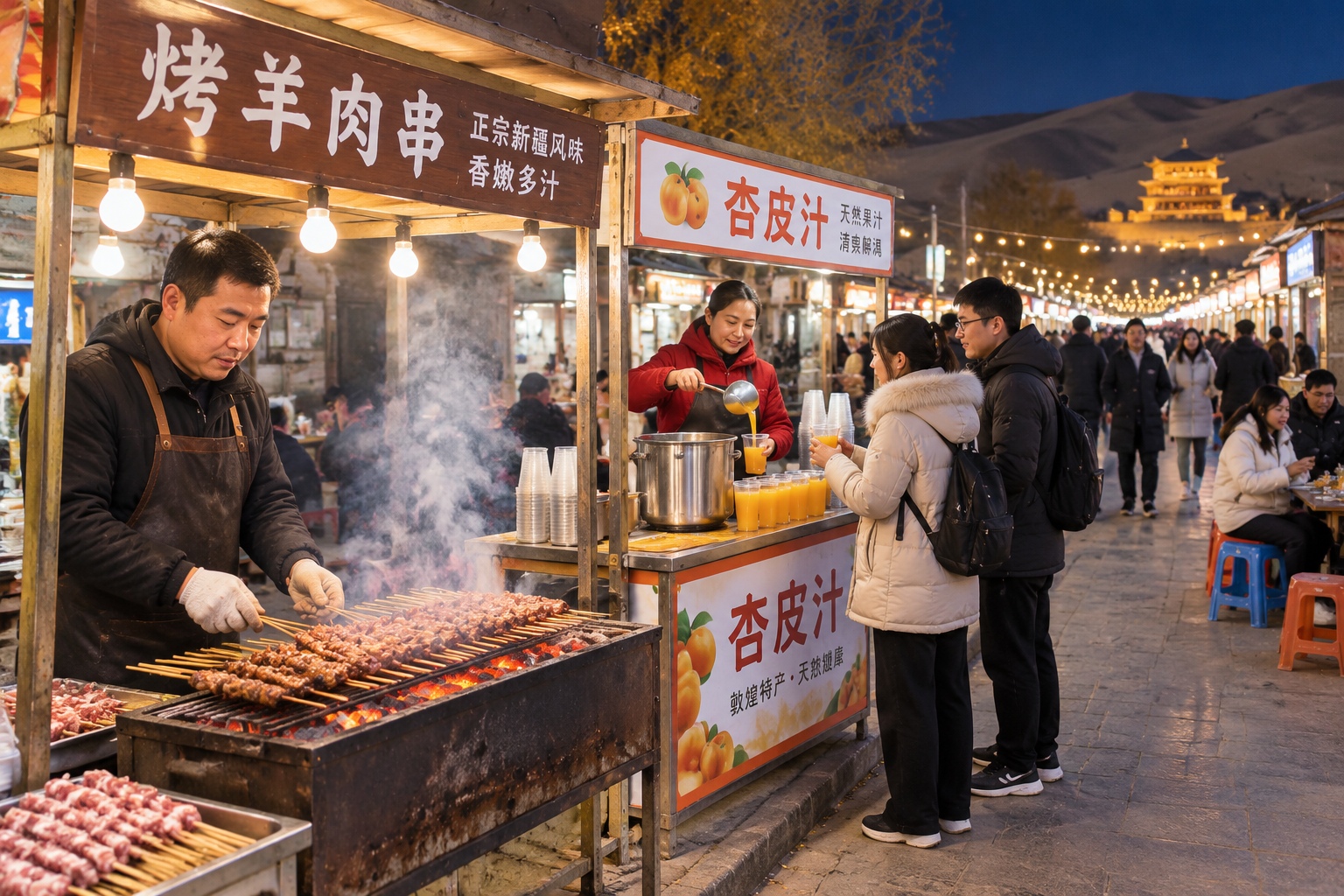
In the night market I ate lamb skewers for about fifteen yuan and drank apricot juice. I noticed something there that took me another week to name: in two weeks, I heard almost no European languages. Nearly everyone traveling was Chinese, seeing their own country. Domestic trips in China ran to something like 5.6 billion in 2024. Foreign visitors are a rounding error inside that number.
Chengdu, and a Three-Hour Flight That Doesn’t Compute
Dunhuang to Chengdu is a flight over mountains into a subtropical basin. In one move, the air went from dry, cold and sharp to wet, mild and smelling of food.
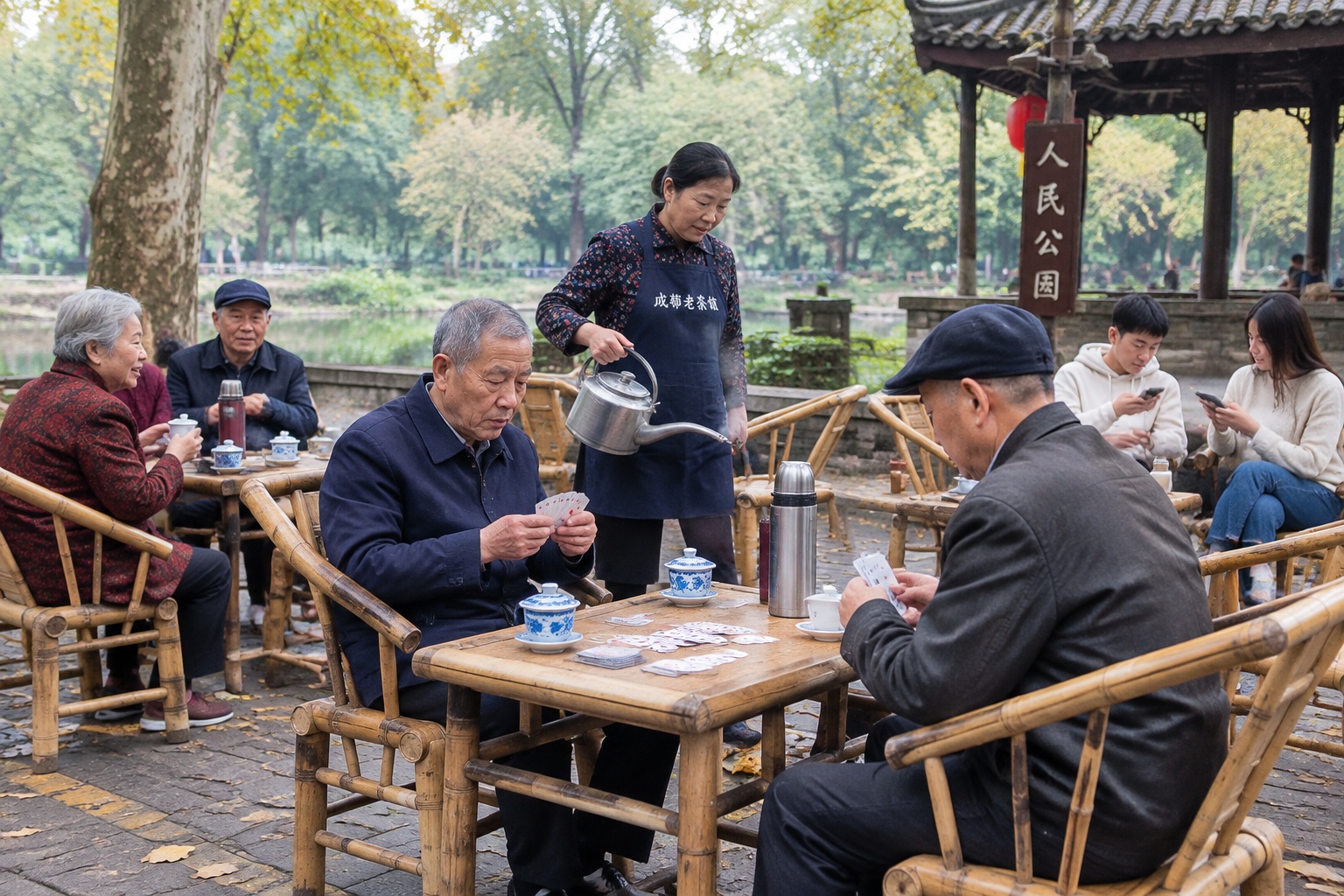
Chengdu holds around 21 million people and behaves like a city of three. In People’s Park, retirees sit in bamboo chairs over ten-yuan cups of tea, ear cleaners walk between the tables with tuning forks, and men play cards with the seriousness of surgeons. At eleven at night the hotpot restaurants are full and the street outside is louder than the room inside.
My driver to the airport, Mr. Liu, told me his younger brother works in an electronics plant in Shenzhen and comes home twice a year. He said it the way you’d say a brother lives in another country. It isn’t. It’s about 1,300 kilometers, and four hours on a train.
Then I flew to Shanghai. The flight was two hours and fifty-five minutes. From Seoul, three hours gets you to Tokyo, to Taipei, to Beijing — you leave the country. Here I had crossed from Chengdu to Shanghai, roughly the same distance as Seoul to Taipei, and I had not left the middle of it.
Shanghai: Where the Word Stops Working
Shanghai’s metro runs more than 800 kilometers. I got lost inside People’s Square station the way you get lost in a forest: by walking confidently in the wrong direction for eleven minutes.
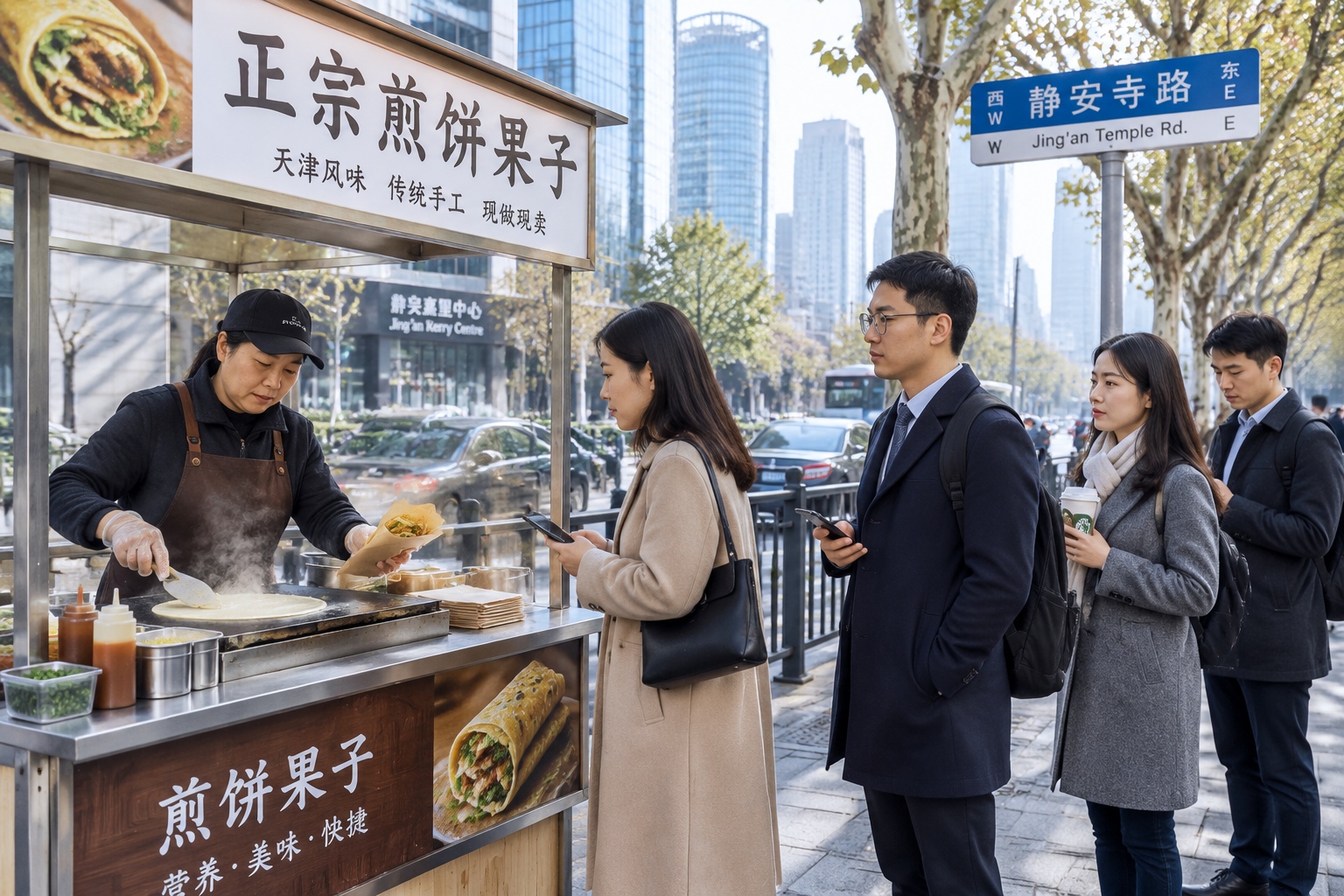
The city where I ate breakfast was not the city I had woken up in three days earlier. Shanghai has its own dialect, its own bread, its own way of dressing. My hotel clerk in Xi’an could not have followed a conversation between two old men in a Jing’an teahouse. And yet: same visa, same currency, same phone number format, same QR code on every wall, same hot-water fountain in the airport.
This is the point where I stopped being able to hold the thing in one hand. Xi’an, Dunhuang, Chengdu and Shanghai are not four versions of one place. They are four places that agreed, for reasons of history, to share a passport.
Koreans call China Jungguk — “the central country.” My model of it, I realized, had been a bigger Korea: one ethnicity, one cuisine, one language, dense and fast. What I actually found was 56 recognized ethnic groups, dialects that are mutually unintelligible, cuisines that share almost nothing, and one written script holding the whole arrangement to a wall.
What I Couldn’t Square
I don’t want to leave the friction out, because the friction was real and I met it every day.
Booking anything meant WeChat or Alipay. My Korean card worked in both, which surprised me, but passport verification failed twice and locked me out of a museum ticket for an hour. Some budget hotels don’t accept foreign passports. Google Maps is close to useless for walking around. I couldn’t read the comments under any video I watched, which meant I could see the surface of an argument and never the argument underneath it.
And there were things I have no clean sentence for: cameras on poles, security scanners at every metro entrance and every tourist site, the sense that a very large system was paying attention. I’m not going to write that I didn’t notice, or that I understood it.
What I can say is what happened on the same days. Trains that leave on the minute. Streets where a woman alone at 1 a.m. walks home looking at her phone. A hot lunch for fifteen yuan. A two-week domestic bill — train, two flights, hotels, food — that came to under a thousand dollars.
Back in Seoul, My Map Shrank
I landed at Incheon, took the airport bus, and was home in fifty minutes. That is the whole width of my country, and it takes fifty minutes.
I looked at a map of Korea that evening and it looked like a page. This is not a judgment about which country is better. Korea is small, dense, familiar and mine; I like it here. It’s a calibration. Two weeks and five cities was a badly planned trip. I would do it again exactly the same way.
If you go, pick a region, not a country. Fly into one city, stay ten days, move 300 kilometers in one direction and stop. Then go home and look at your own map, and see whether it still looks right.
I still have the paper ticket from the Mogao Caves folded in my wallet. The numbers printed on it mean nothing to me now. I keep it anyway.
Start the discussion at forum.chinacomes.com