

By 8:40 a.m., the Line Already Curled Past the Gate
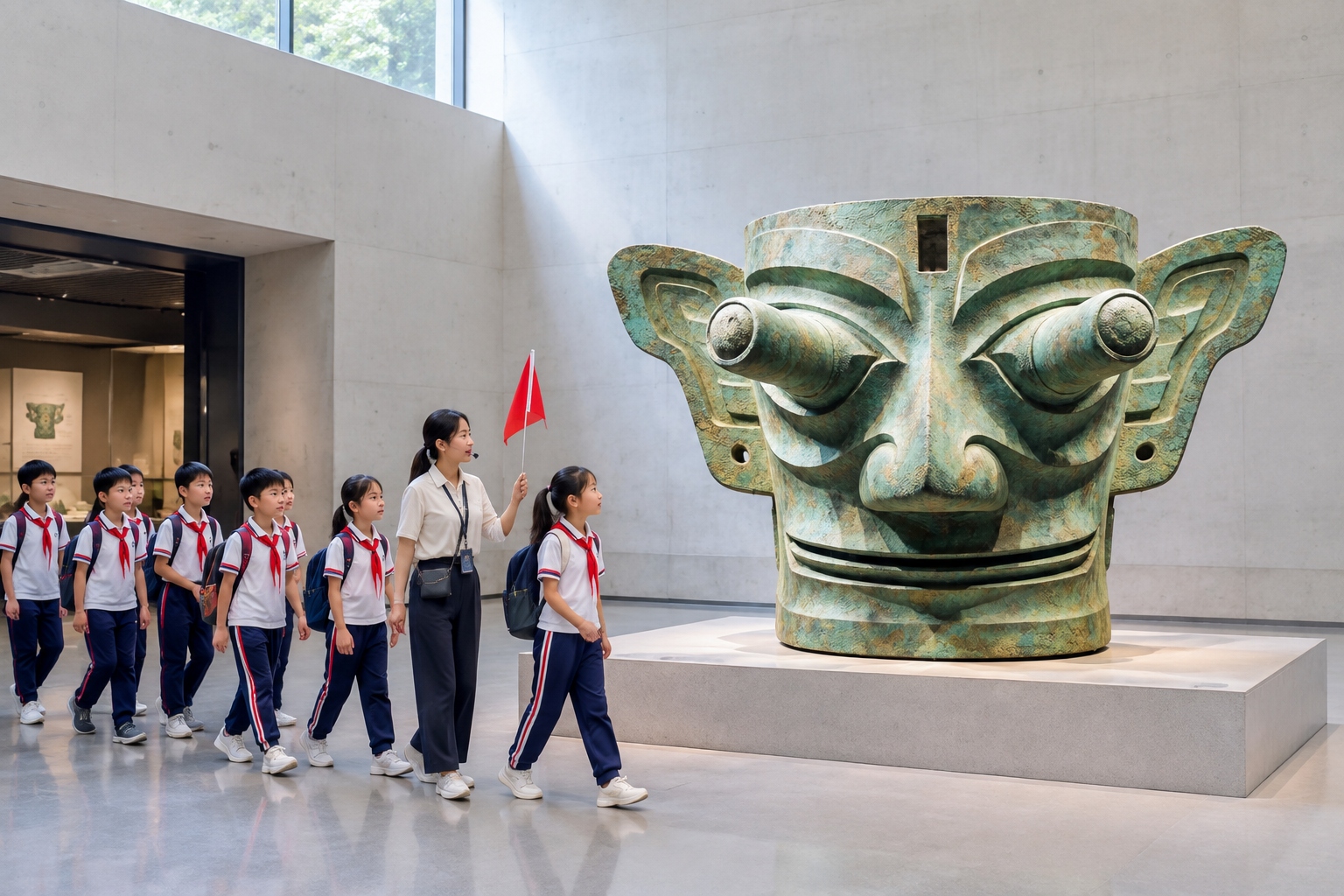
By 8:40 on a Tuesday morning, the queue outside the Sanxingdui Museum in Guanghan already curved past the ticket gate. A group of middle schoolers in red-striped uniforms passed a phone down the row, laughing at a photo of a bronze mask with ears like wings. Their teacher held up a small flag and repeated one instruction: no running inside.
Guanghan is a quiet city of about 600,000 people, roughly 40 kilometers north of Chengdu, surrounded by flat farmland and low morning mist. Buses from Chengdu pull in here every day. Almost everyone in line is Chinese, part of a school group, a family or a young couple on a day off, and almost all of them have come for the same reason. Something very strange came out of the ground a few hundred meters away, and nobody has fully explained it.
Since 2020, archaeologists have opened six new pits at the Sanxingdui site, numbered 3 through 8, beside the two that stunned the world in 1986. The new pits produced gold masks, bronze figures, jade, elephant tusks and traces of silk. Carbon dating published in 2022 placed several of them in roughly the 12th century BCE, the same centuries as the late Shang dynasty, whose capital lay more than 1,200 kilometers to the northeast.
What makes these pits more than a treasure story is what they do to a familiar map.
What Actually Came Out of the New Pits
The objects need no embellishment. Pit 3 held a bronze figure kneeling with a ritual vessel balanced on its head, about 1.15 meters tall. A sheet of gold foil, almost a complete mask, survived in the same pit. Pit 8 gave up a bronze altar and composite creatures that look like nothing else in Chinese archaeology. Pit 4 preserved silk, not as fabric but as protein residue detected in the soil. Hundreds of elephant tusks were stacked across several pits, some more than a meter long.
Almost everything had been burned, broken or partly melted before burial. That was deliberate, not accidental. Researchers read these pits as the remains of ritual deposits, not rubbish dumps and not tombs.
What the pits do not contain matters too. There are no human burials, no writing, and no inscription linking the ancient Shu people to the kings named in later Chinese texts. The pits answer some questions and open many more.
Why Sichuan’s Bronze Age Got Left Off the Map
The standard telling of early China runs along the Yellow River: Erlitou, then Shang, then Zhou. Sichuan used to be hard to fit into that story. The Chengdu Plain sits inside a ring of mountains, wet and often foggy, growing rice rather than millet, and by three thousand years ago it held sizable walled settlements of its own.
Written sources say almost nothing useful. The Chronicles of Huayang, compiled centuries later, lists names such as Cancong, Boguan and Yufu, then stops.
Sanxingdui first came to outside attention in 1929, when a farmer digging an irrigation ditch turned up jade and stone objects. Formal excavation began in 1934. The discovery of Pits 1 and 2 in 1986 made international headlines, but for decades the textbook version of China’s Bronze Age still started in the Central Plains.
Dating has now scrambled the idea that Sichuan was a late, peripheral copy. The new pits overlap with the Shang at their height, and the objects inside them look like nothing from Anyang.
How a Pit Becomes Data
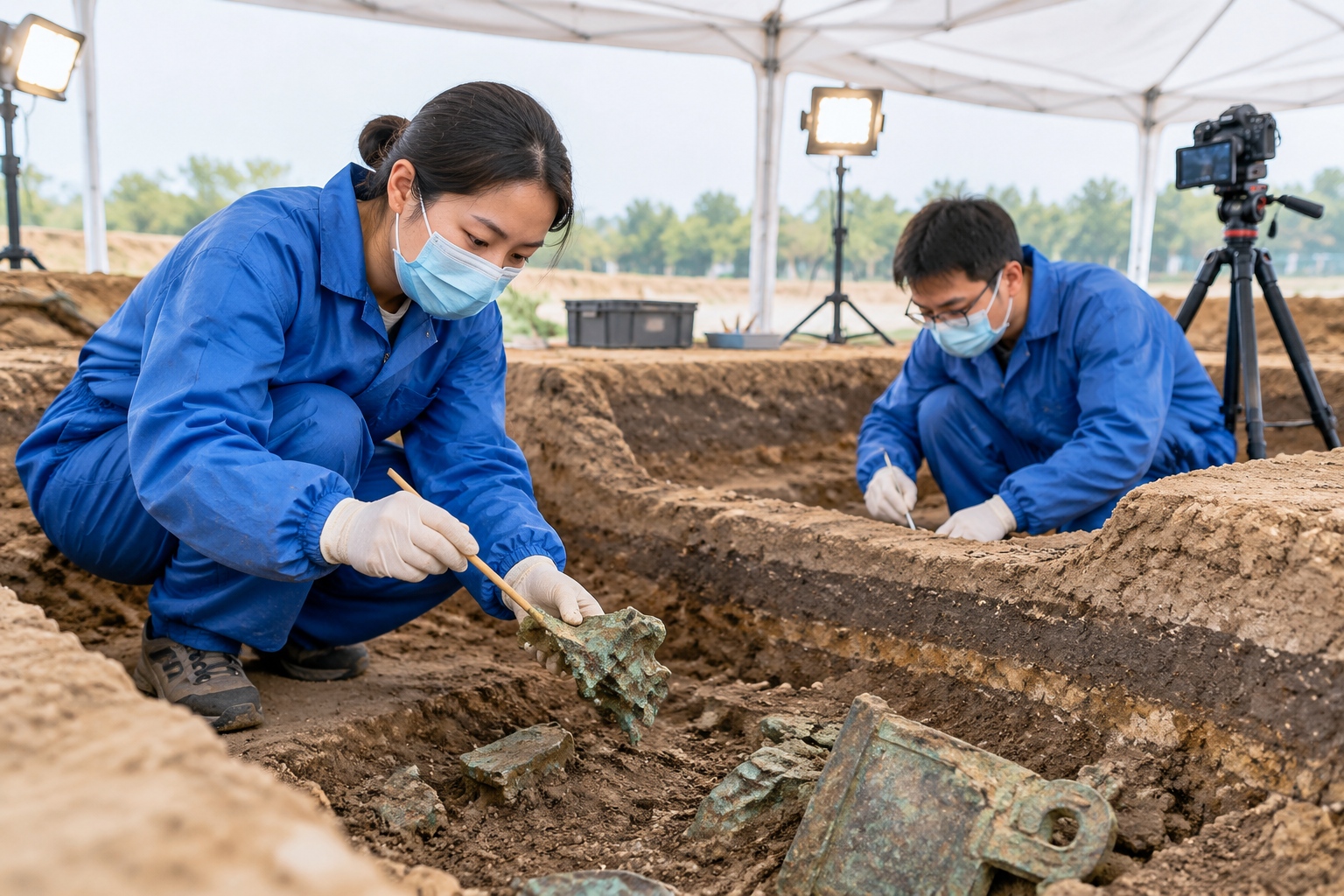
Visitors never see the working tents, humidity-controlled and lit for photography. Inside, archaeologists in coveralls lift fragments with bamboo tools and cotton swabs, wrap each find for temporary support, and fix it in plaster before it moves. Soil from the pits is screened, washed and logged. The whole pit gets a 3D scan.
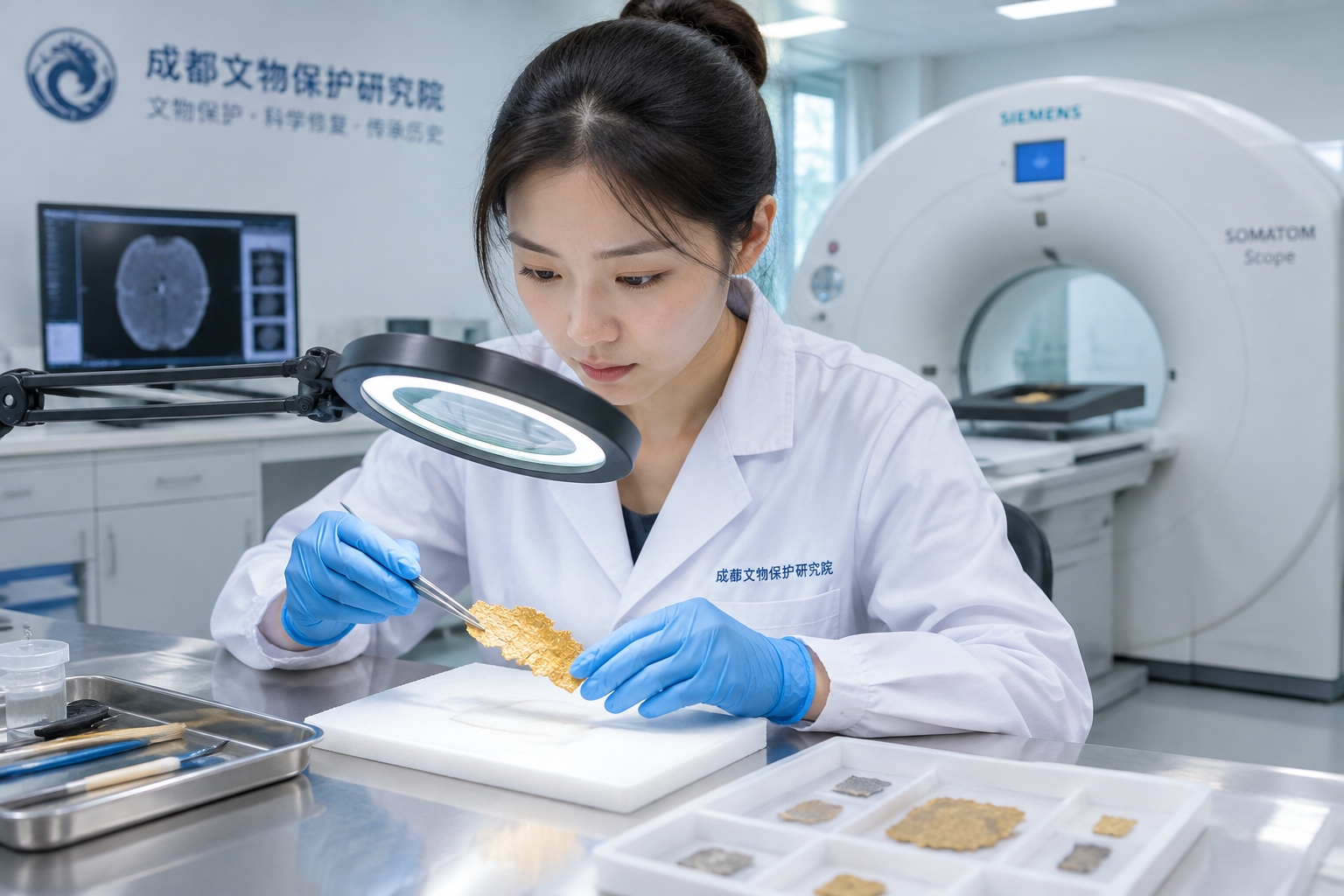
Then the work shifts to the laboratory. In Chengdu, CT scanning reveals the internal structure of bronzes without cutting them open. Lead isotope analysis suggests where the metal may have come from. Residue analysis recovered the silk from Pit 4. None of this is done by one team: museums, universities and conservation institutes share samples and data, and parts of the excavation were streamed live, with young audiences watching past midnight as a tusk came free of the earth.
Why the Map Has to Change
Three things undermine the single-center story.
Craft. The Sanxingdui bronzes show a local casting tradition. They were not imported from the Shang heartland. Casters used piece-mold techniques comparable to those in the Central Plains, but applied them to faces, trees and creatures of their own design. Core supports inside the castings show people who knew exactly what they were doing. The open question is whether that knowledge arrived with bronze and craftsmen, or developed in parallel.
Routes. Jade types and vessel forms such as the zun and lei echo shapes from the Central Plains and the middle Yangtze. Ivory points south and southwest, where wild Asian elephants probably still lived in Sichuan three thousand years ago.
Belief. The masks, the protruding eyes, the gold: none of it has a counterpart at Shang sites. Whatever ritual these pits belonged to, it belonged to a culture with its own visual language.
Put together, the picture shifts from one river to a network of several centers in contact, borrowing, refusing and inventing.
What Nobody Knows Yet
Disagreement is normal here. The dating looks firmer than it did, but whether the pits were dug within a single generation or across a century is still argued. Were the tusks offerings, or supports for other objects? What does the absence of human remains mean? Was the burning part of the rite, or an accident of later events?
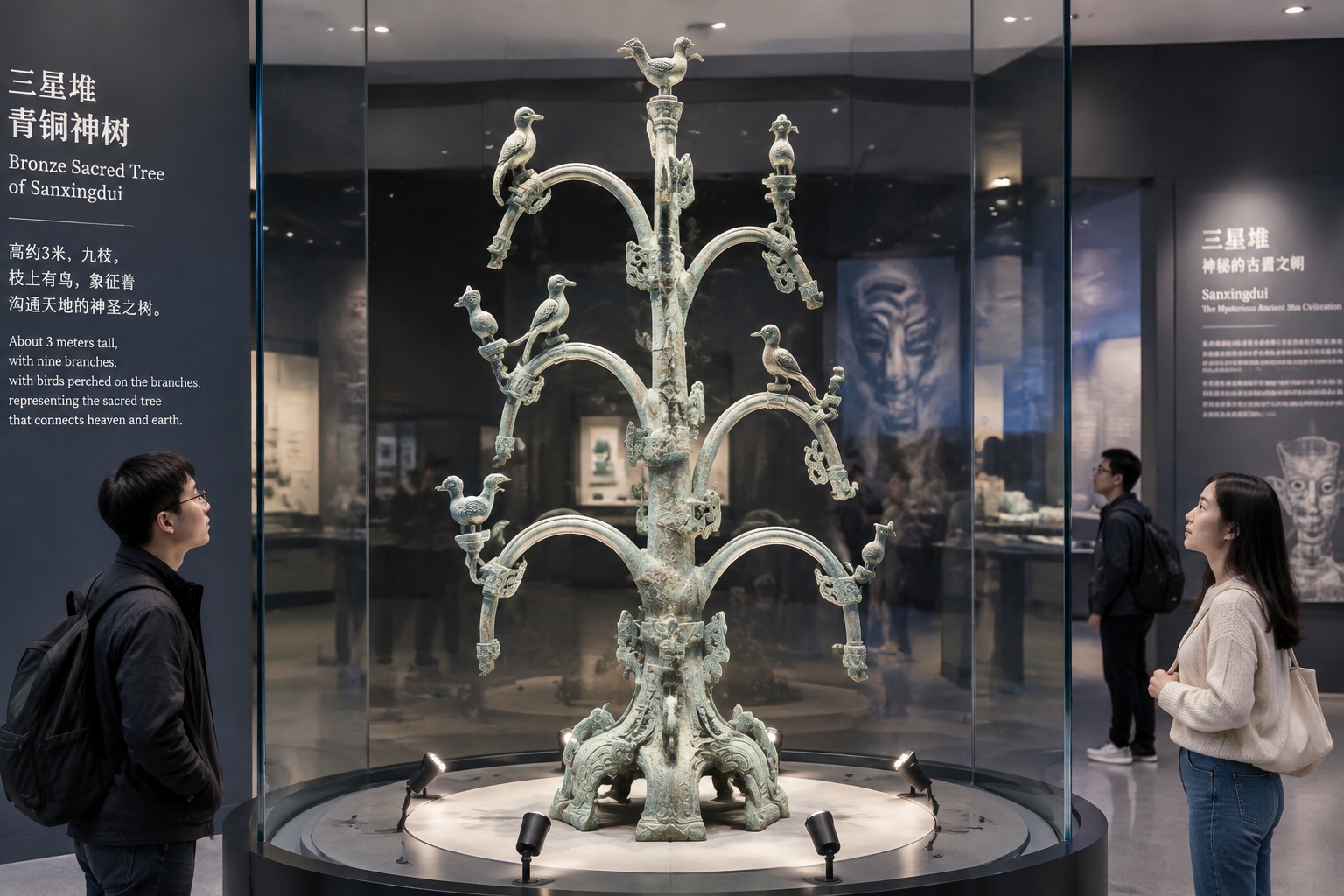
Without writing, interpretation rests almost entirely on form and context. Even the tall standing bronze figure reproduced on every souvenir could be a ruler, a priest, an ancestor or a god.
Tour guides handle this better than anyone. In one gallery I heard a guide tell a school group, with a small laugh, that archaeologists do not know. A boy near the front said, in a tone of complete satisfaction, that this was the fun part.
Outside the Museum: Noodles, Buses and a Small City With a Big Dig
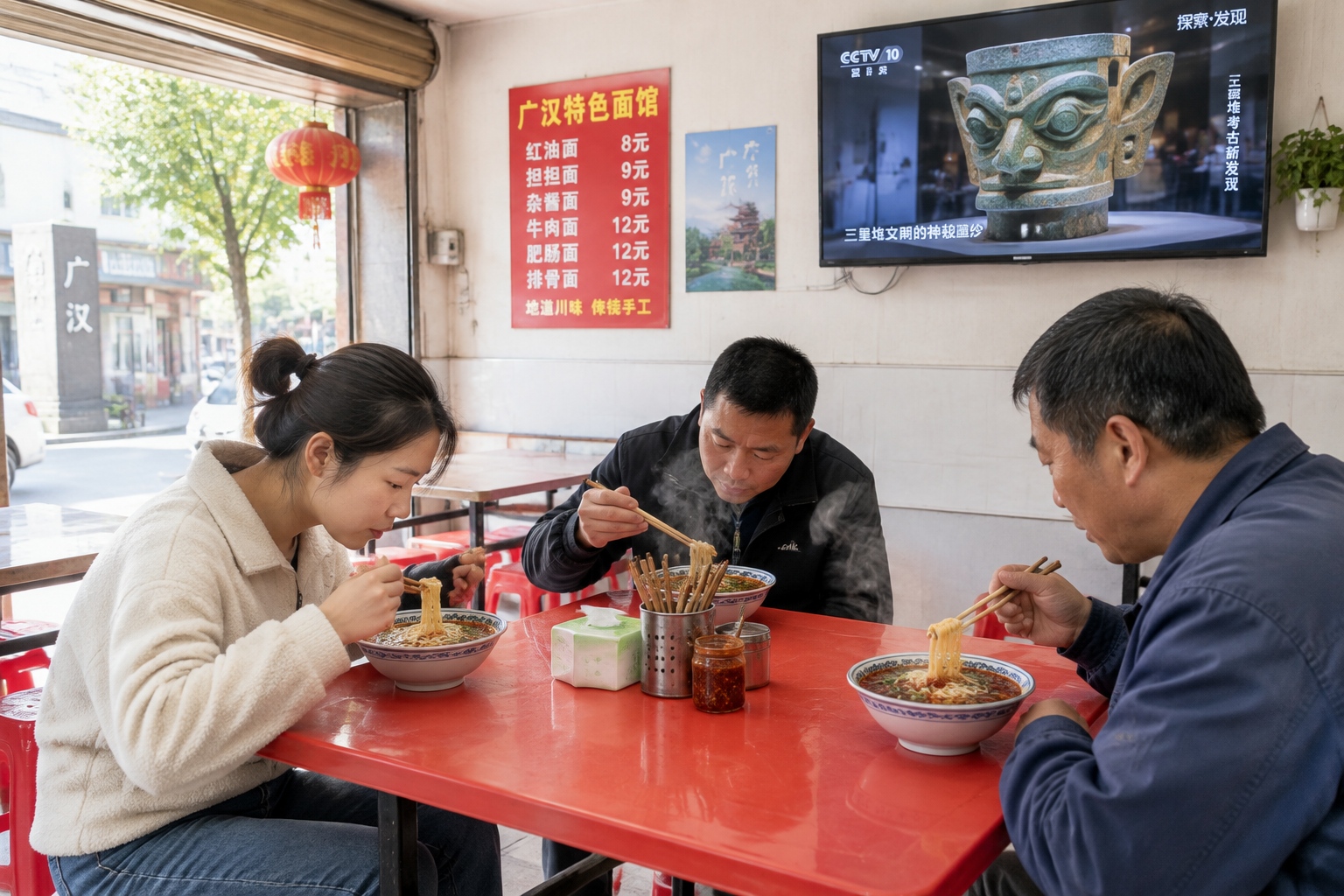
Ten minutes away by car, ordinary life continues. In a corner noodle shop, bowls of red-oil noodles sit on enamel tables, a CCTV archaeology documentary plays on the wall, and two taxi drivers complain about fares, not about bronzes.
The museum’s new building opened in 2023 with more than 1,500 objects on display. Queues got longer, hotels filled up, and local drivers learned to treat the site as a destination. Farmers near the excavation area received compensation for land, while protection rules limit what can be built around it.
If you go: the museum is in Guanghan, Sichuan, about 40 kilometers north of Chengdu. The easiest route is a high-speed train from Chengdu North to Guanghan North, roughly 20 minutes, then a 15-minute taxi. Tickets cost around 70 yuan and usually require a reservation through the museum’s WeChat mini-program; the museum is normally closed on Mondays. Arrive at opening around 9 a.m., because tour groups fill the first hall by mid-morning. Bring a light jacket, since the galleries run cool.
The Point Is Not Certainty
For readers outside China, the value of Sanxingdui is not only in the objects. It is in the conclusions those objects cancel. They remove the idea that Chinese civilization had a single birthplace. They show that three thousand years ago, on a foggy plain between mountains, people cast enormous bronze faces, pressed gold onto masks, buried tusks by the hundred, and built a ritual life we still cannot fully read.
A schoolgirl stands in front of those eyes. In a laboratory far away, a chemist reads isotope ratios from a spoonful of soil. Both are part of the same unfinished story, and that, more than any headline, is what makes the pits worth the trip.
Start the discussion at forum.chinacomes.com