

8:40 a.m. at a Shenzhen metro station
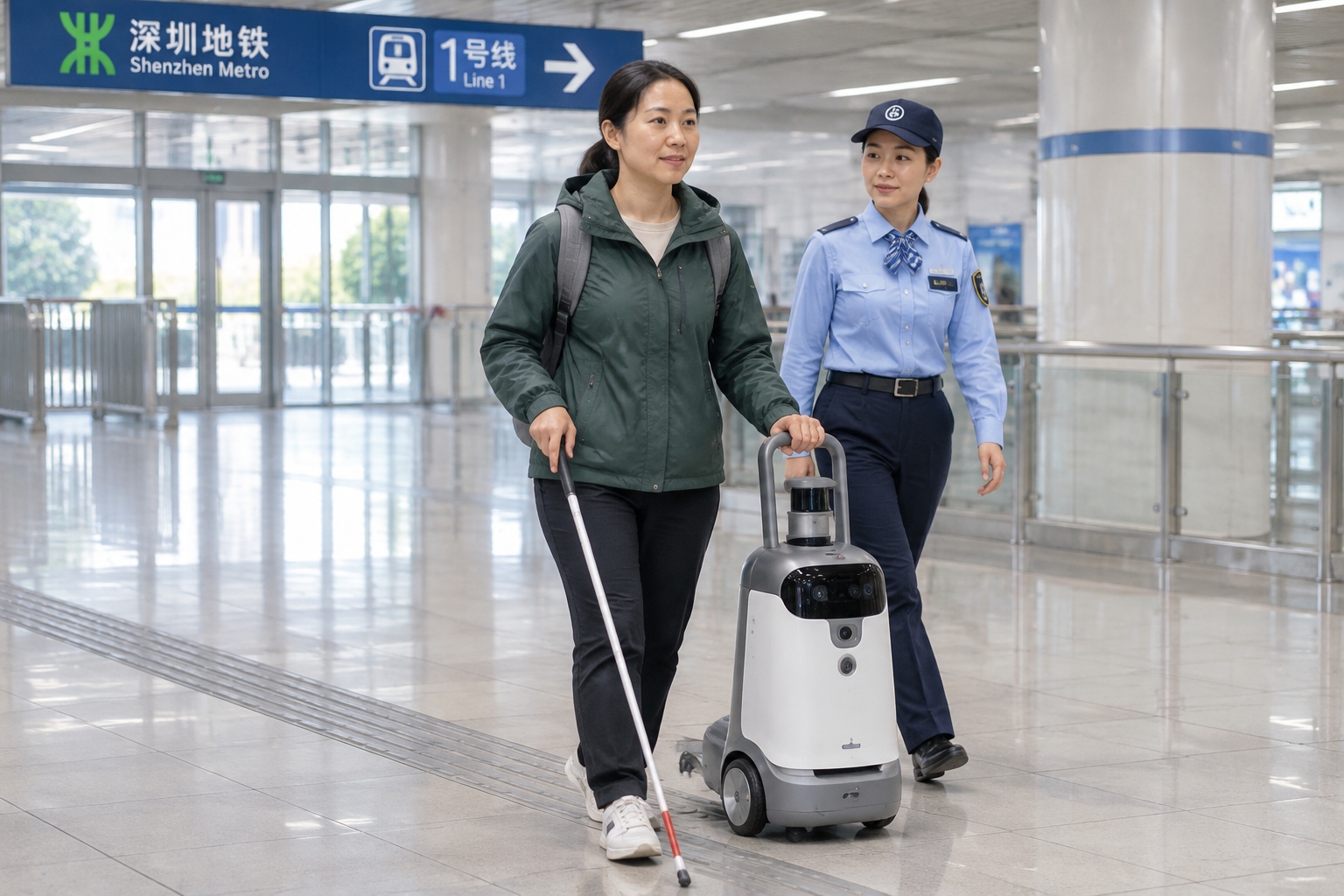
Ms. Chen is 34 and has been blind since her teens. On a Tuesday morning she stands at the top of the escalator at Fumin Station, in Shenzhen’s Futian district. Her left hand holds a folded white cane. Her right hand rests on the handle of something that looks like a small floor-cleaning machine.
It is a guide robot. Station staff call it Xiaosuan, “little garlic.” It is roughly knee-high, white and grey, with a sensor panel where a face would be. When she takes the handle it tells her, in Mandarin, that it is ready and asks where she is going. She says the Line 4 platform. The robot rolls forward at walking pace.
“Three metres ahead, ticket gates.” “Left side, escalator.” “Please wait, passengers crossing.” The voice is flat and slightly too loud, the way station announcements are.
A staff member in a light blue uniform walks half a step behind them — not steering, just present. At the gate, someone swipes a card. On the platform, Ms. Chen lets go of the handle. The robot turns around and rolls back toward the escalator, and another staff member carries it up.
The reason this machine exists is a shortage. China has roughly 17 million people with significant visual impairment. It has fewer than 500 working guide dogs. Training one costs somewhere around 150,000 to 200,000 yuan (about $21,000–28,000) and takes more than a year; waiting lists at the country’s guide-dog schools run into years. Millions of people, hundreds of dogs. That arithmetic is why Shenzhen and a few other cities are willing to try a robot instead.
What a robot guide dog can and cannot do
Xiaosuan is not a dog, and it does not pretend to be. It runs on wheels, so it cannot take stairs; it needs lifts. It needs charging, and a human to lift it onto a train. During the pilot it operates only on a mapped section of a handful of stations, and you get one by asking at the service desk.
What it is good at is the boring middle part of a journey: the fifty metres of concourse where the acoustics confuse a cane, the gate that has to be the right gate, the escalator edge that a white cane finds late. It also does something harder to put in a spec sheet. When Ms. Chen walks with it, people move aside. Staff appear. A machine that broadcasts “this person is being looked after” turns out to be socially useful in a crowded station.
“It doesn’t replace my cane,” she told me. “It replaces asking a stranger where the lift is. Some days I ask six times.”
Three users, three different gaps
The blind commuter
Ms. Chen works as a massage therapist, which is one of the few jobs the labour market reliably opens to blind people in China — not because other jobs are impossible, but because hiring managers rarely test that assumption. Her commute is two lines and a bus. She has memorised it to the doorway: eleven shopfronts between the bus stop and the station entrance, the third one playing music, and if the music is off she slows down.
At home she also uses a pair of AI guide glasses, camera-and-ultrasound frames that announce obstacles, read text and warn about steps. They cost a few thousand yuan and they help indoors and on familiar pavements. Outside, they struggle with construction barriers, sun glare and crowds. Every blind person I’ve spoken with describes the same weak spot: a device can tell you there is an object, but not whether it is a parked delivery scooter you can walk around or a hole you cannot.
The patient learning to stand again
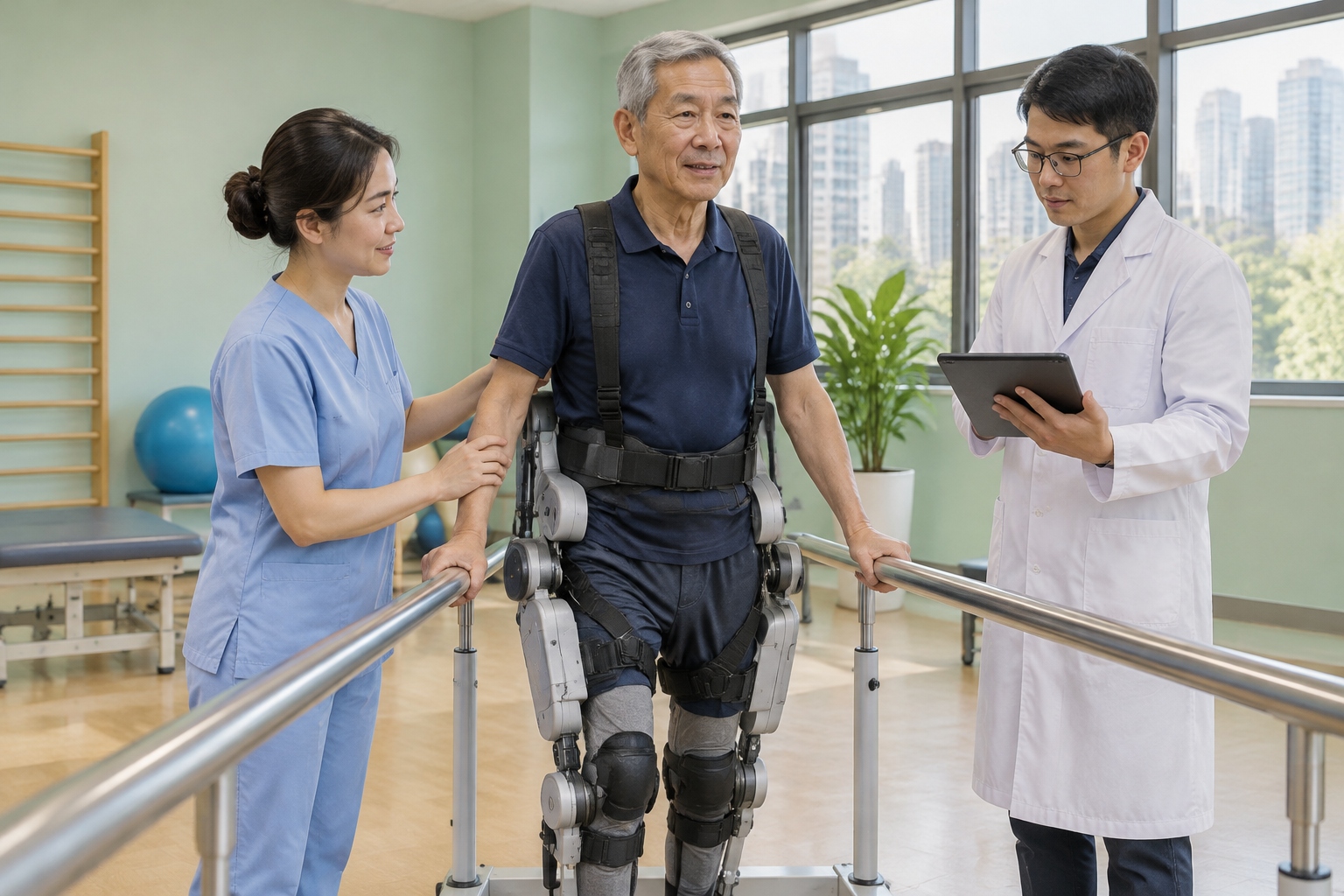
Two floors up in a rehabilitation hospital across town, Mr. Zhou, 61, is being strapped into a lower-limb exoskeleton. He had a stroke fourteen months ago and his left side still doesn’t cooperate. It takes two therapists about twenty minutes to fit the frame: waist, thighs, shins, sensors, then the checks — skin, blood pressure, whether he can hold his own head up today.
Then he stands. He stands for forty minutes, three times a week, and walks maybe thirty steps between parallel bars while the machine does perhaps 60 percent of the work. His therapist controls the gait from a tablet.
The honest version of this therapy is unglamorous. The evidence says it is a useful addition to conventional rehab for some stroke patients, not a miracle, and it is not for everyone — severe spasticity, fragile bones or unstable blood pressure rule it out. What changes for Mr. Zhou is less measurable. Standing changes how you breathe, how your gut works, how you sleep. “I see the room from up here,” he said, and laughed at how stupid that sounded. It didn’t sound stupid.
The wheelchair user and the lift that is broken
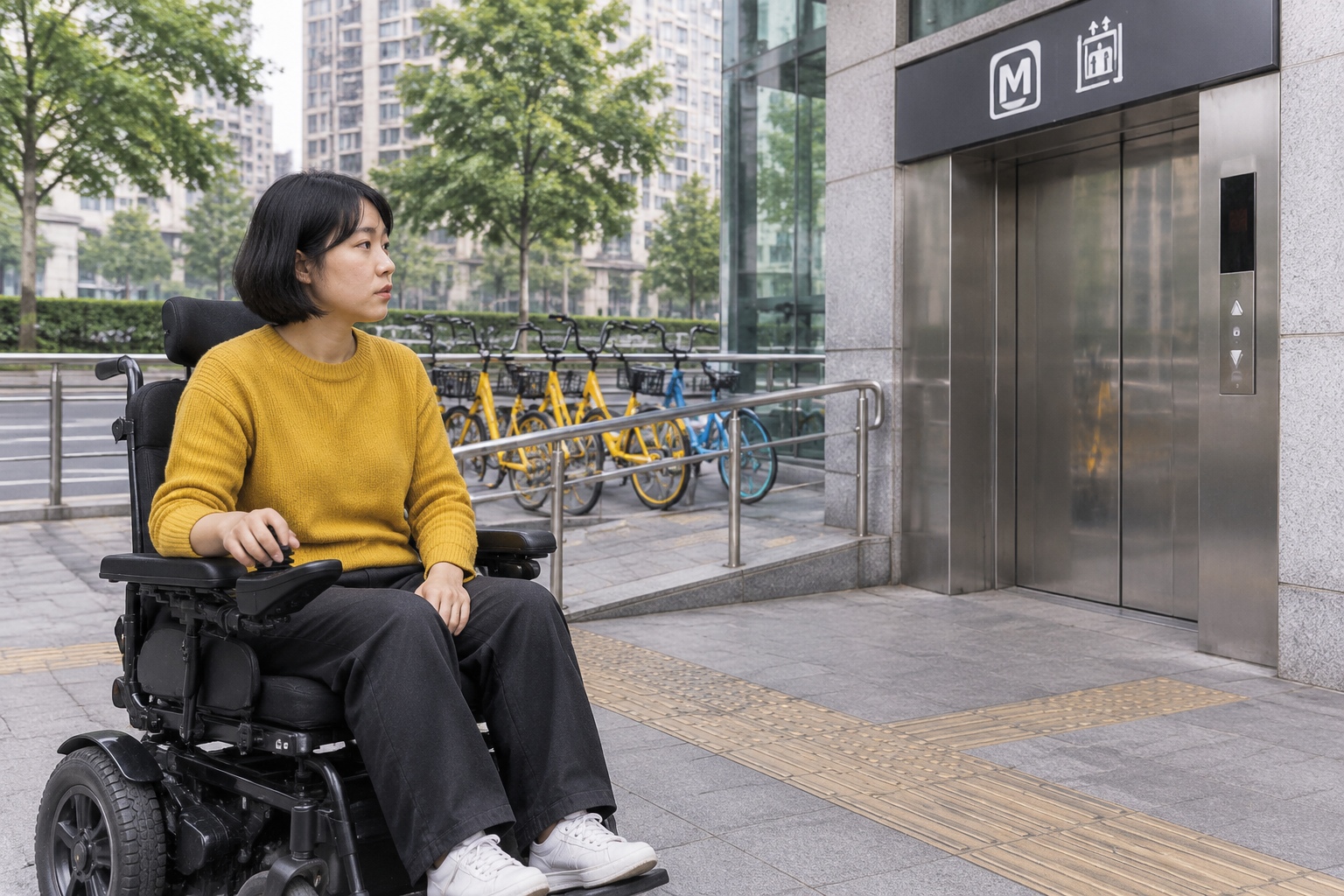
Lin is 28, a product designer in Nanshan, and uses a power wheelchair. She has tried the smart wheelchairs on the market: stair-climbing models, seats that rise so you can talk to people at eye level, anti-tip sensors. “The technology is genuinely impressive,” she said. “Then I look at the price, and it’s a car.”
Her actual problems are smaller and more stubborn. The lift at her station is out of service maybe once every two weeks, which means going one stop further and coming back. The ramp from the street to the station plaza is regularly blocked by parked shared bikes. The gap between platform and train is five to eight centimetres; staff keep a portable ramp in the station office, and finding someone to fetch it is its own small negotiation.
What it costs, and what has actually reached living rooms
Prices in this field move fast, and they vary by city, hospital and configuration. But the rough shape of the market is fairly stable:
- Electric wheelchairs: 2,000–8,000 yuan for ordinary models; “smart” stair-climbing or standing chairs run from tens of thousands into the price of a small car. Already common in homes, bought with family money and disability subsidies.
- AI guide glasses: a few thousand yuan. Sold to individuals, but the useful ones are still a supplement to a cane, not a replacement.
- Rehabilitation exoskeletons: hospital-grade units are quoted at 200,000–500,000 yuan and are bought mainly by hospitals and rehab centres. A session is often charged at 100–300 yuan. Home rental and purchase exist in a few cities, but they are the exception, not the norm.
- Guide robots: not for sale to individuals at all. They are station equipment, like a lift or a ramp — which is both their strength and their limit.
Who pays for “technology for good”
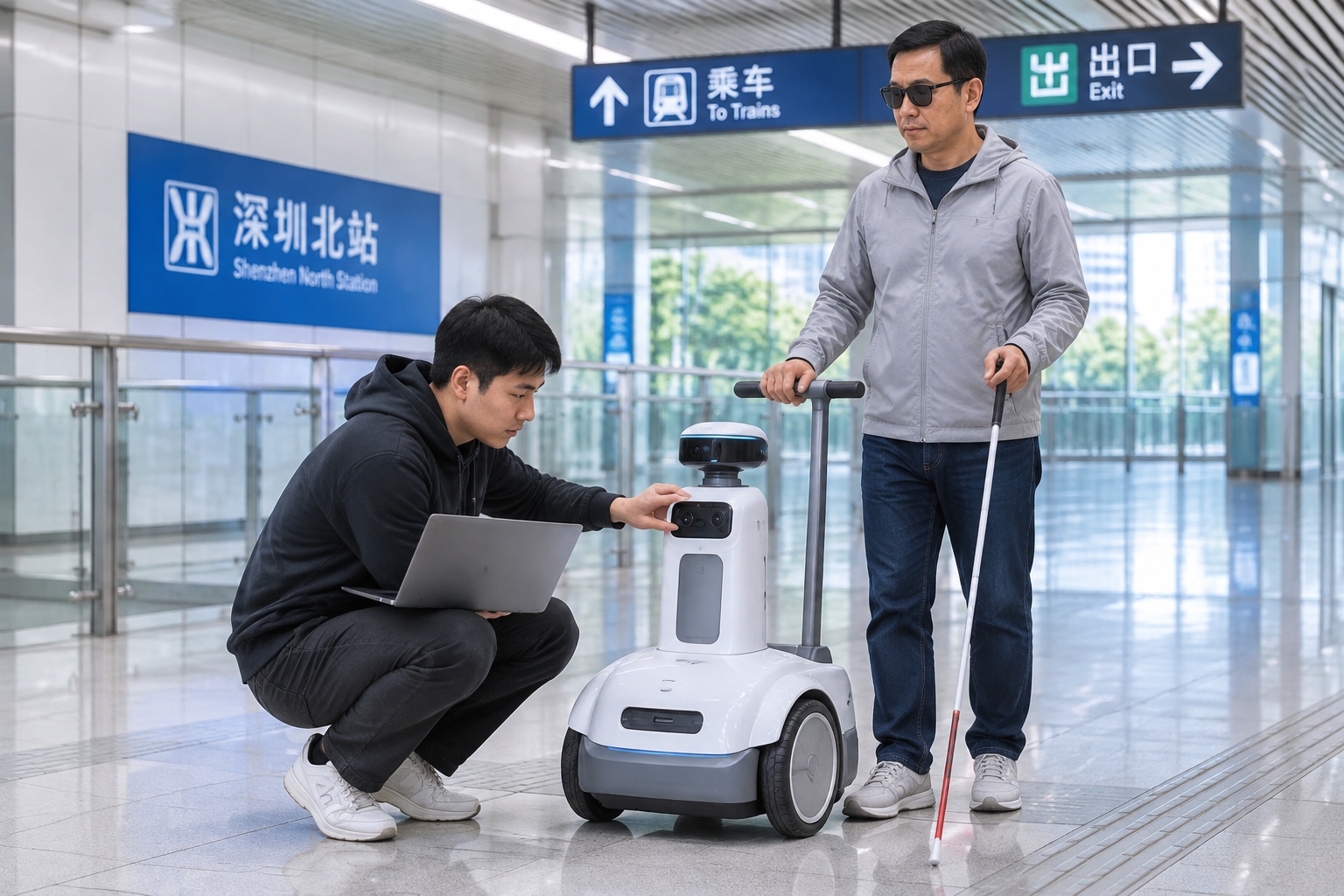
Follow the money and the pattern becomes clear. Exoskeletons sell because hospitals have rehab departments, budgets and reimbursement rules. Guide robots appear because a metro operator, a district government and a robotics company can split the cost of a pilot, and because a city that has written barrier-free construction into local regulation needs something to show. Guide glasses sell because individuals and their families decide a few thousand yuan is worth it.
Public subsidy matters more than it looks. Most Chinese cities publish a list of assistive devices with partial reimbursement for residents with a disability certificate — typically a percentage of the price, capped at a few hundred to a few thousand yuan per item, and different from district to district. Some cities have begun piloting rehabilitation robots into medical insurance for stroke patients. And every device that reads a person’s body needs medical device registration before it can be sold, which is why so much of this sector’s early money goes into clinical trials rather than marketing.
That structure shapes the products. When the customer is an institution, the device is designed to be robust, expensive and operated by a trained professional. The home version arrives years later, cheaper and worse, or never.
The question a city has to answer
Here is where I stop explaining and hand the problem over, because it is not really a technology problem.
A guide robot costs far more per user than a smooth pavement. A ramp and a working lift serve wheelchair users, parents with strollers, delivery riders and anyone with a sprained ankle. A city with a fixed budget for accessibility has to choose between a visible pilot that gets photographed and invisible maintenance that gets complained about. China is currently doing both, unevenly, and the balance differs between Shenzhen and a county town four hours away.
So: if you were allocating that budget, would you buy the robot, or would you fix the lifts and clear the bikes off the ramps and wait for the price of the robot to fall? Efficiency and inclusion are usually described as a trade-off. In practice, the cheaper option is very often also the more inclusive one, and the expensive option is the one that photographs better.
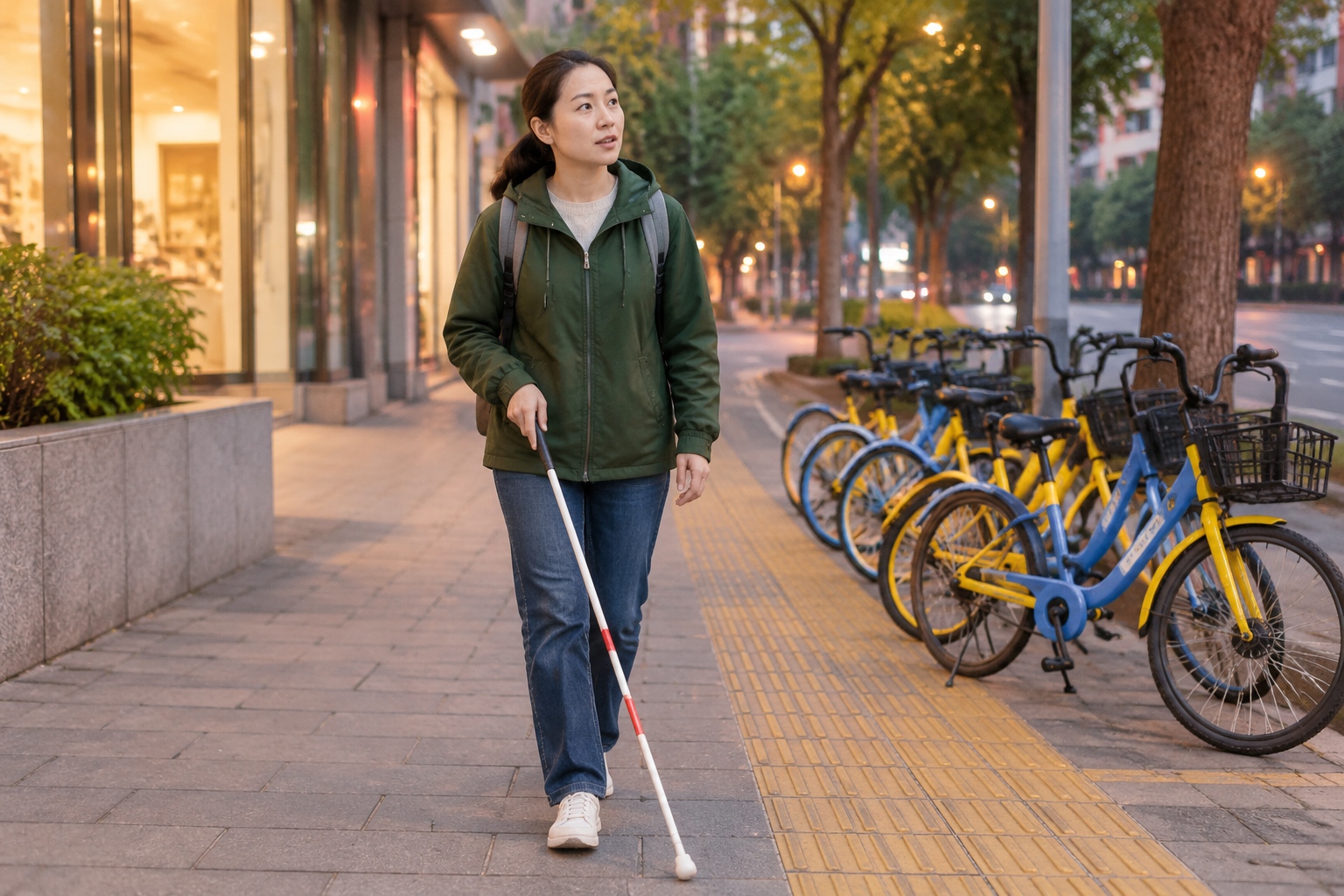
Tuesday morning, the last 500 metres
Ms. Chen gets off at her stop. There is no robot at this station. She unfolds the cane, finds the wall with her fingertips and starts counting doorways.
Eleven shopfronts to the bus stop. The third one plays music. Today it is playing, so she walks at her normal speed, past the phone repair shop and the bakery and the place that smells of disinfectant, and out onto the street where the pavement is hers again.