

Ninety Seconds, One Wok, and a Sound Like Sand Hitting Glass
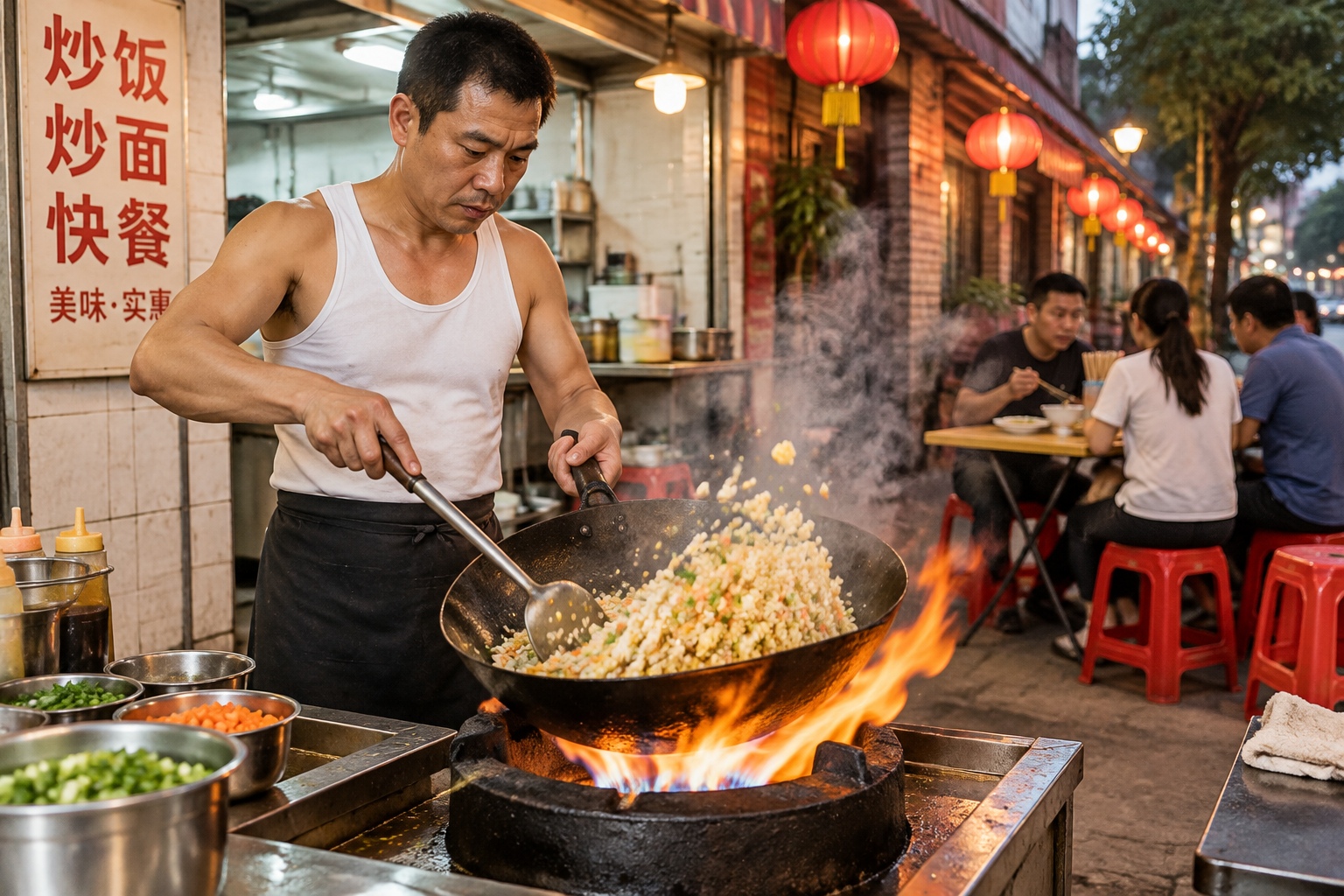
On a side street in Guangzhou, a cook in a white singlet stands at a burner that sounds less like a stove than a small aircraft idling. The wok in his hand is black, heavier than it looks, and about as wide as a car tyre. He tips in cold rice — yesterday’s rice — and for a second there is a hiss like sand hitting glass. Then the whole thing lifts: grains scattering, flame curling up around the rim, egg and scallion joining in mid-air.
Ninety seconds later it is on a plate. Every grain is separate, each edge slightly bronzed. The smell arrives before the plate does.
Now try the same thing at home. Same rice, same egg, same soy sauce. You get something pale, damp and faintly clumpy. It tastes fine. It does not taste like that.
The difference has a name in Chinese: guo qi (锅气), or in Cantonese, wok hei. Literally “wok breath.” Cooks argue about it. Diners use it to decide whether a restaurant is worth coming back to. Food writers have spent decades trying to describe it without sounding mystical.
It is not mystical. It is physics, and a home kitchen is built to lose this particular fight.
What Guo Qi Actually Is
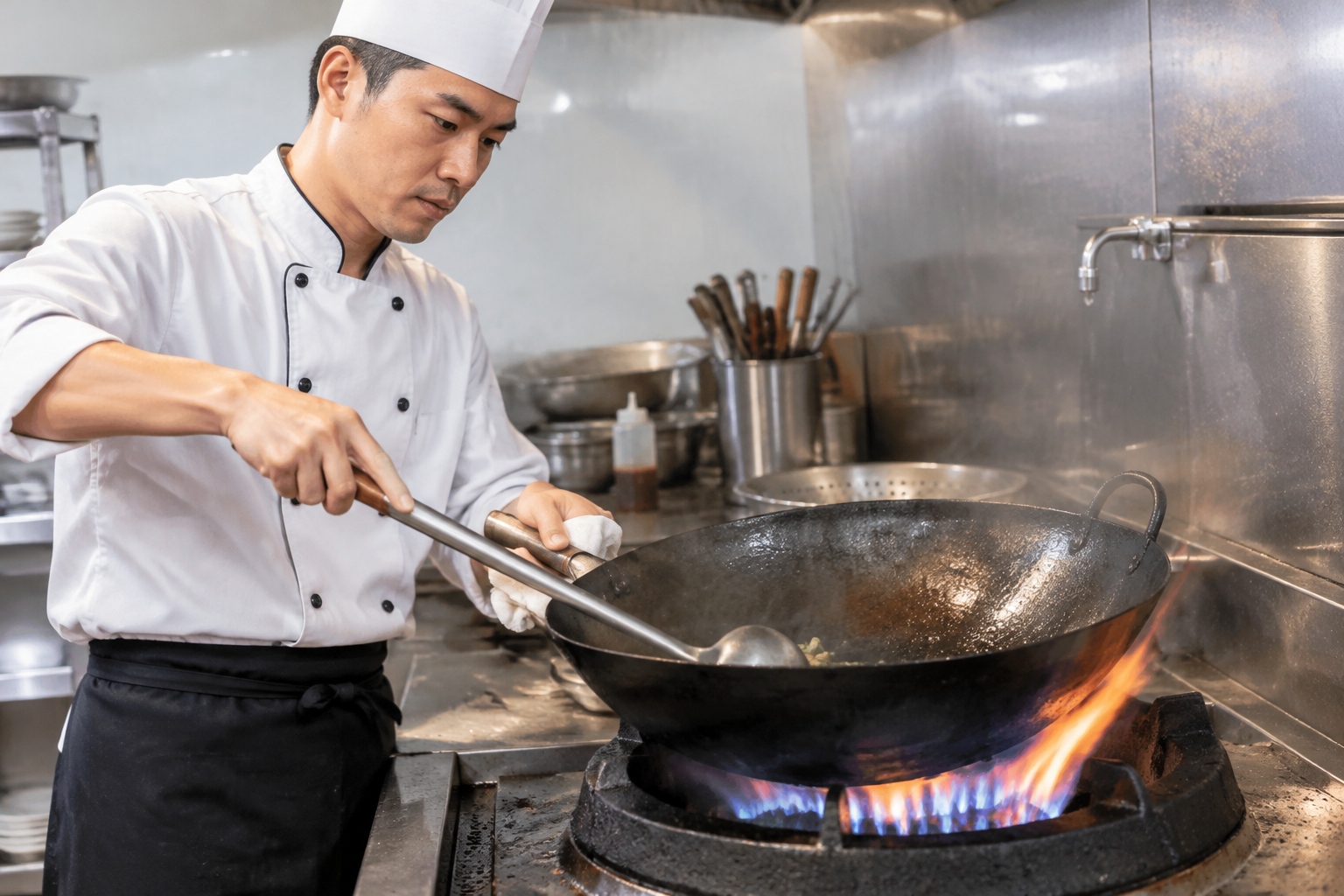
Two things happen when cold food hits very hot iron. Sugars and proteins on the surface of the food start the Maillard reaction, which kicks in somewhere around 140–165°C, and caramelisation follows. Between them they produce hundreds of aroma compounds. At the same time, surface water flashes into steam, and that steam carries oil and volatile molecules up into the air. That is the smell that makes people turn their heads on the pavement.
The catch is that water and browning want opposite things. As long as there is free water sitting on the surface of the rice, the temperature cannot climb much past 100°C, no matter how hot the metal underneath is. You get steaming, not searing. What you need is heat intense enough that the water leaves fast — fast enough for the surface to brown before the inside turns to paste.
There is a third element, and it is the one people rarely mention: aerosolised oil. When oil hits iron that is well past its smoke point, tiny droplets lift off and burn, and some of that smoke settles back onto the food. Part of what diners call “the taste of the wok” is, quite literally, the taste of a very hot pan.
The Hardware Gap: 3 Kilowatts vs 100,000 BTU
Numbers first. A typical domestic gas burner in a Chinese apartment puts out 3–4 kilowatts. A home induction hob, 2–3.5 kW. A commercial restaurant burner — the kind called 猛火炉, literally “fierce fire stove” — runs 30 to 60 kW, and is often rated in the tens of thousands of BTU per hour. Some models advertise 100,000 BTU.
That is roughly ten to twenty times the heat, delivered into the same square foot of metal.
Then there is the pan itself. Restaurant woks are carbon steel, 1.5 to 3 mm thick, weighing two to three kilograms, seasoned over years until the surface is black and slick. Many home cooks use a light nonstick pan weighing 700 grams. That gap matters more than most people realise, because frying rice is not only about temperature — it is about stored heat.
Watch what happens when you tip a bowl of cold rice into a thin pan. The surface temperature collapses. The pan has no reserve, so it takes a minute or two to climb back. During that minute the rice is essentially steaming in its own moisture. A thick, heavy wok does the opposite: it dumps heat into the food so quickly that the surface never really gets the chance to cool.
Shape matters too. A round-bottomed wok concentrates heat at the centre and creates a temperature gradient up the sides — hottest in the middle, cooler near the rim. A good cook uses that gradient like a dial, pushing food up the wall to slow it down and back into the centre to drive it.
Why the Chef Never Stops Tossing
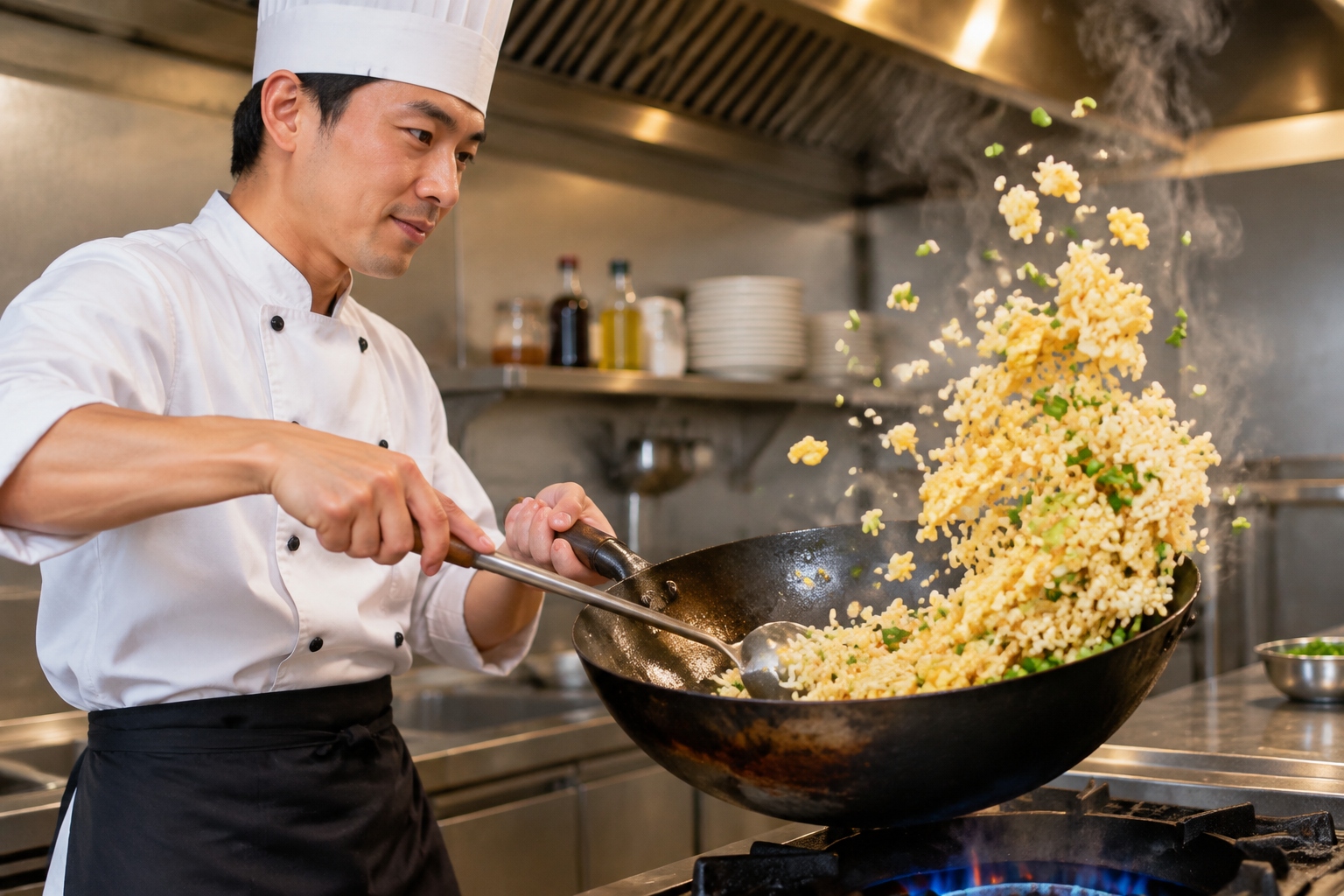
People assume the tossing is showmanship. It is temperature management.
Every time the rice leaves the metal, the wok surface rebounds toward 250–300°C. Every second the rice sits, it pulls heat out and cools that surface. The chef’s rhythm — three, four, five tosses in quick succession, then a pause — keeps the metal cycling between very hot and still very hot, and never lets it settle into the wet, sticky zone around 100°C.
Experienced cooks run this on sound rather than a timer. The sizzle has a pitch. When it is sharp and high, the pan is hot and moisture is still flying off. When it drops and softens, either the water is gone or the heat is. That is the cue to lift the wok off the flame or throw in the next ingredient. No thermometer involved. It is the same skill as a grill cook reading coals, learned across thousands of repetitions.
The Time Problem
Here is the part home cooks most often get wrong: portion size.
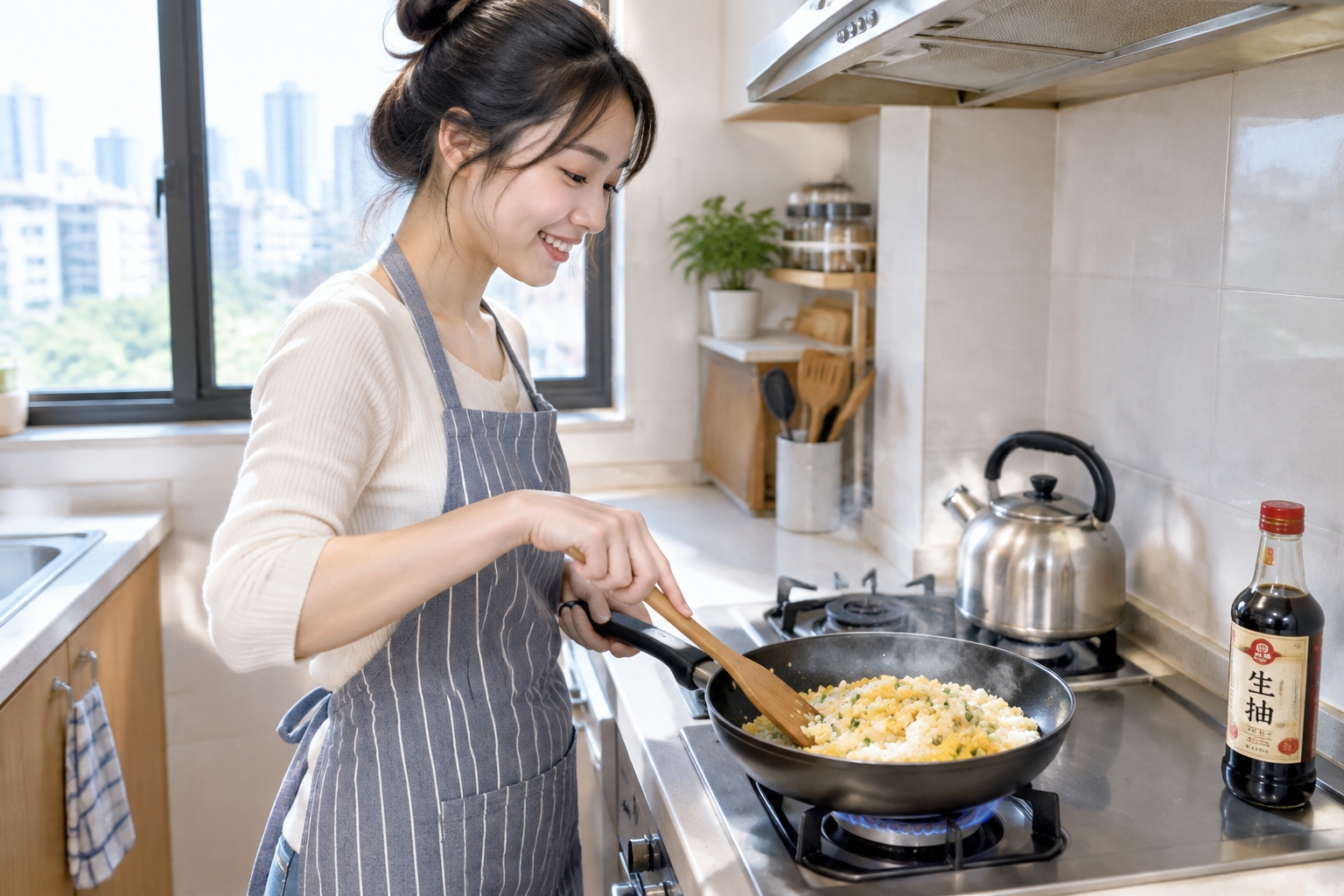
In a restaurant, fried rice is made one or two servings at a time, in a wok that is already ripping hot. At home, people cook for four, load everything in at once, and end up with four times the mass of cold food sitting in the same pan. The pan loses immediately.
The rice matters as well. Freshly cooked rice carries a lot of surface moisture and loose starch. Left overnight in the fridge, loosely covered, it firms up and dries slightly — exactly what you want. Chinese cooks have said this for generations: day-old rice, always.
And there is one more thing nobody enjoys hearing. Even with perfect technique, an ordinary domestic hob has a ceiling. You can get close. You cannot get all the way.
Guo Qi Is a Social Thing, Not Just a Flavour
Guo qi does something unusual in Chinese food culture: it is shared vocabulary. Ordinary diners use it. Someone eating a plate of beef chow fun will say it “has guo qi” or it does not, the way diners elsewhere might comment on whether a steak was properly rested. The term comes from Cantonese cooking, but it has spread across the country and into home kitchens — including the ones that never quite manage it.
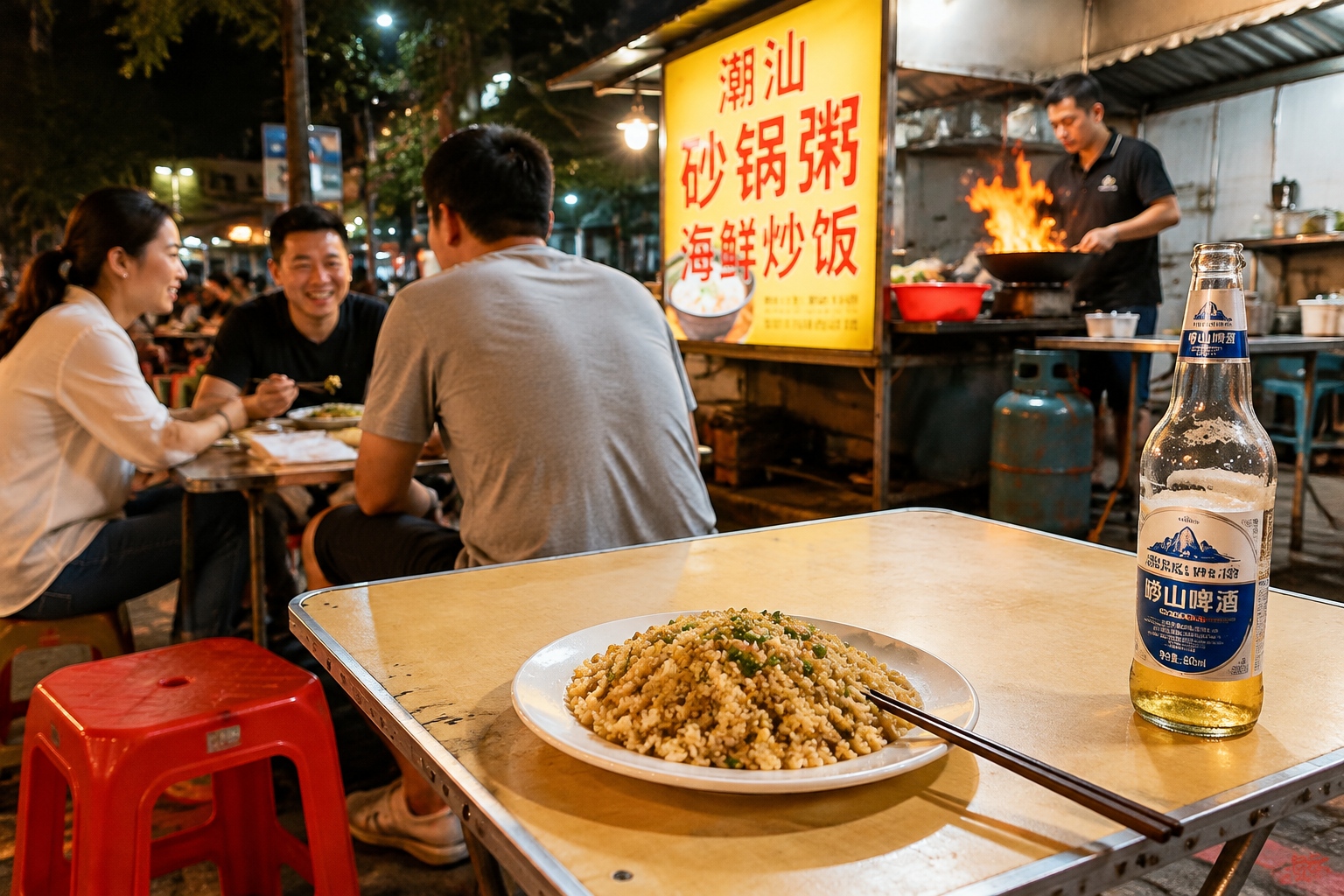
It also shapes how cities eat. The open-front stalls and 大排档 — the folding-table, plastic-stool night restaurants of southern China — are built around a visible burner. The point is not only the food. It is the flame, the noise, the smell drifting down the block, the speed at which a plate appears. You can make fried rice at home any night of the week, but the stall sells the ninety seconds as much as the rice.
There is an economy to it, too. Rice, egg and a handful of scallion cost very little. A wok burner and a cook’s arms are relatively cheap. Guo qi is what turns cheap ingredients into something people will queue for.
How to Get Closer at Home
You will not match a 40-kilowatt jet burner on a home stove. But most home fried rice fails for reasons that have nothing to do with the stove, and those you can fix.
Fix the tools first
- Swap the nonstick for a carbon steel wok or a cast iron pan — something heavy, and keep it seasoned. A thin pan will always lose.
- Use an oil with a high smoke point: peanut, rice bran, refined canola. Olive oil burns and tastes wrong here.
Then fix the technique
- Cook one or two servings at a time. This is the single biggest change. Crowding is what makes rice gluey.
- Dry your rice. Spread it on a plate and leave it uncovered in the fridge overnight. If all you have is fresh rice, spread it out and let it steam off for twenty minutes.
- Heat the wok until a drop of water beads and skitters across the surface, then add oil, swirl, pour it out, add fresh oil and start. This is the classic hot-wok-cold-oil move, and it is what stops things sticking.
- Do not stir constantly. Let the rice sit for five to ten seconds so it can actually brown, then toss. Press it flat against the metal with the back of your spatula. Browning needs contact.
- Have everything chopped and within arm’s reach before you turn on the flame. The whole cook takes about ninety seconds. There is no time to go looking for the soy sauce.
- Open a window and turn on the extractor fan. You are going to make smoke. That smoke is part of the flavour, but your neighbours do not have to enjoy it.
What You Are Actually Chasing
Guo qi is not a secret ingredient or a chef’s trick. It is heat, mass and time — three variables a restaurant kitchen is designed to maximise and a home kitchen is designed to lose. Knowing that changes how you cook. You stop blaming the recipe, you stop adding more soy sauce to compensate, and you start preheating the pan for longer than feels reasonable.
You probably still will not get all the way there. But you will get close enough that a friend at your table pauses mid-bite and asks what you did differently.
Start the discussion at forum.chinacomes.com