

1:47 p.m., Standing Over a Bowl of Noodles
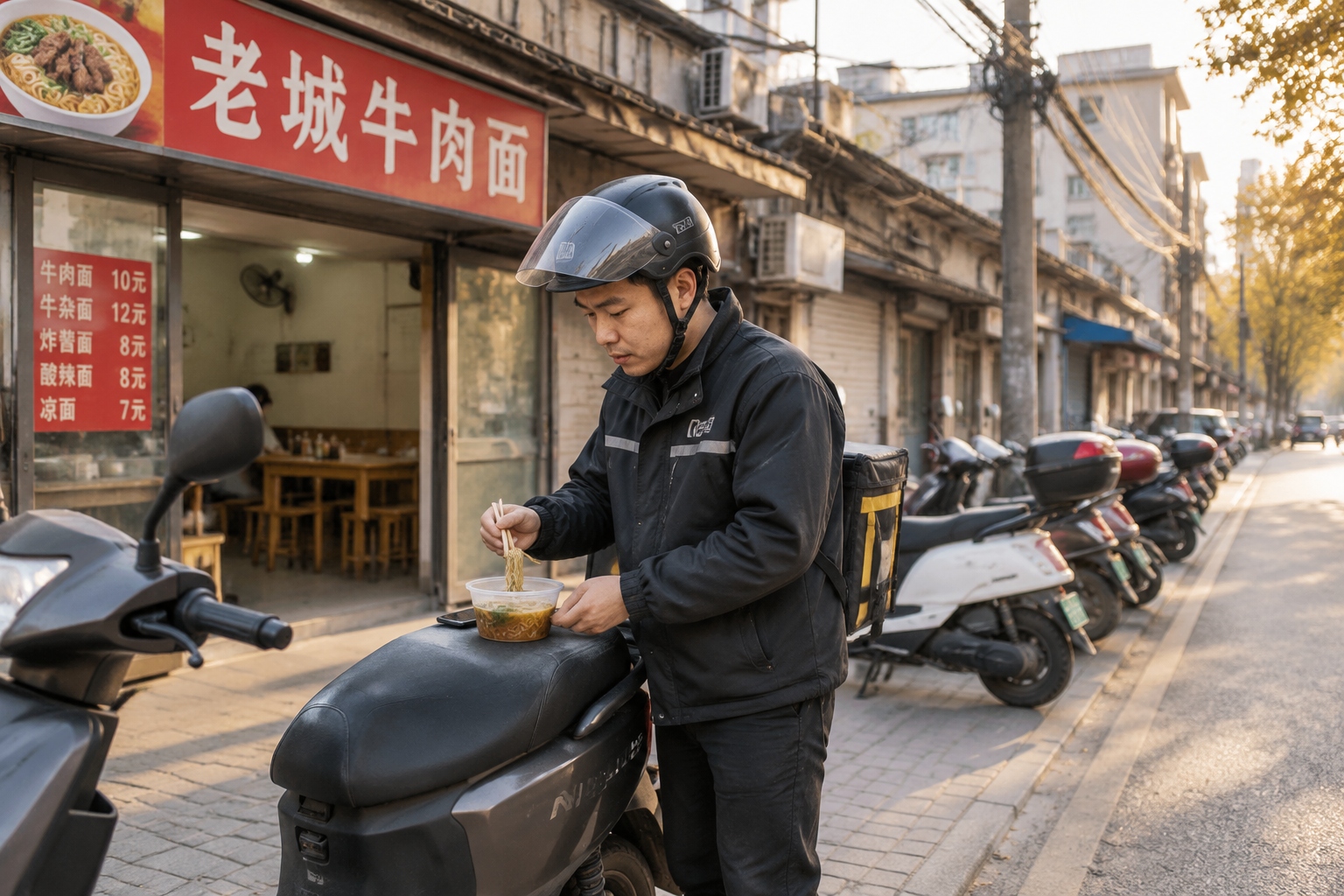
Li Wei stops his electric scooter beside a noodle shop on a side street in Jinshui district, Zhengzhou. The sign is green, the frontage is maybe three metres wide, and the shop sits under a tangle of overhead cables. There are no empty tables inside. He isn’t looking for one. From the plastic crate under his seat he pulls a takeaway bowl, leans against the scooter, and eats standing up.
“Lunch is usually twelve or thirteen yuan,” he says, lifting flat wheat noodles with his chopsticks. “It’s not that I don’t want something better. Sitting down costs twenty minutes. Twenty minutes is two or three orders.”
Midday in Zhengzhou runs on a different clock for anyone working delivery. The lunch rush runs from about eleven to half past one. In that window Li Wei covers office towers, hospitals, old residential blocks and the retail basements under the CBD. Each order pays roughly three to six yuan depending on distance and weather. He usually starts at seven in the morning and doesn’t stop until the rush is over. By the time this bowl reaches him, he’s already ridden around forty kilometres.
That’s how a food map gets made here. Not from review apps or short-video rankings, but from parking, charging, kitchen speed and the unspoken ceiling of ten yuan a meal.
Who He Is, and How His Day Gets Cut Into Pieces
Li Wei is 36, from a village outside Zhoukou, about two and a half hours southeast of Zhengzhou. He has been riding for a delivery platform for four years. Before that he worked in a furniture factory and then drove a van for a wholesaler. He lives alone in a rented single room near an old neighbourhood, pays 900 yuan a month, and sends money home.
A normal day looks like this. Seven in the morning, a ten-minute stand-up meeting at the station where a manager runs through safety notices and the day’s targets. Then orders. The first surge is breakfast, then a lull, then the lunch peak. Afternoon is scattered — single orders, long gaps, a lot of waiting near mall entrances. Evening peak starts around five and can run to nine. Twice a week he takes a night shift that ends near midnight.
Meals don’t fit neatly into any of it. They happen in the gaps: ten minutes between orders, five minutes at a red light with a bun in one hand. He estimates he eats a proper sit-down meal maybe twice a week.
“Weather controls everything,” he says. “When it rains, orders pile up and nobody eats. When it’s 38 degrees, you don’t want hot food. You want cold water and something you can swallow fast.”
The Breakfast Map: Hulatang, Buns and a Six-Yuan Budget
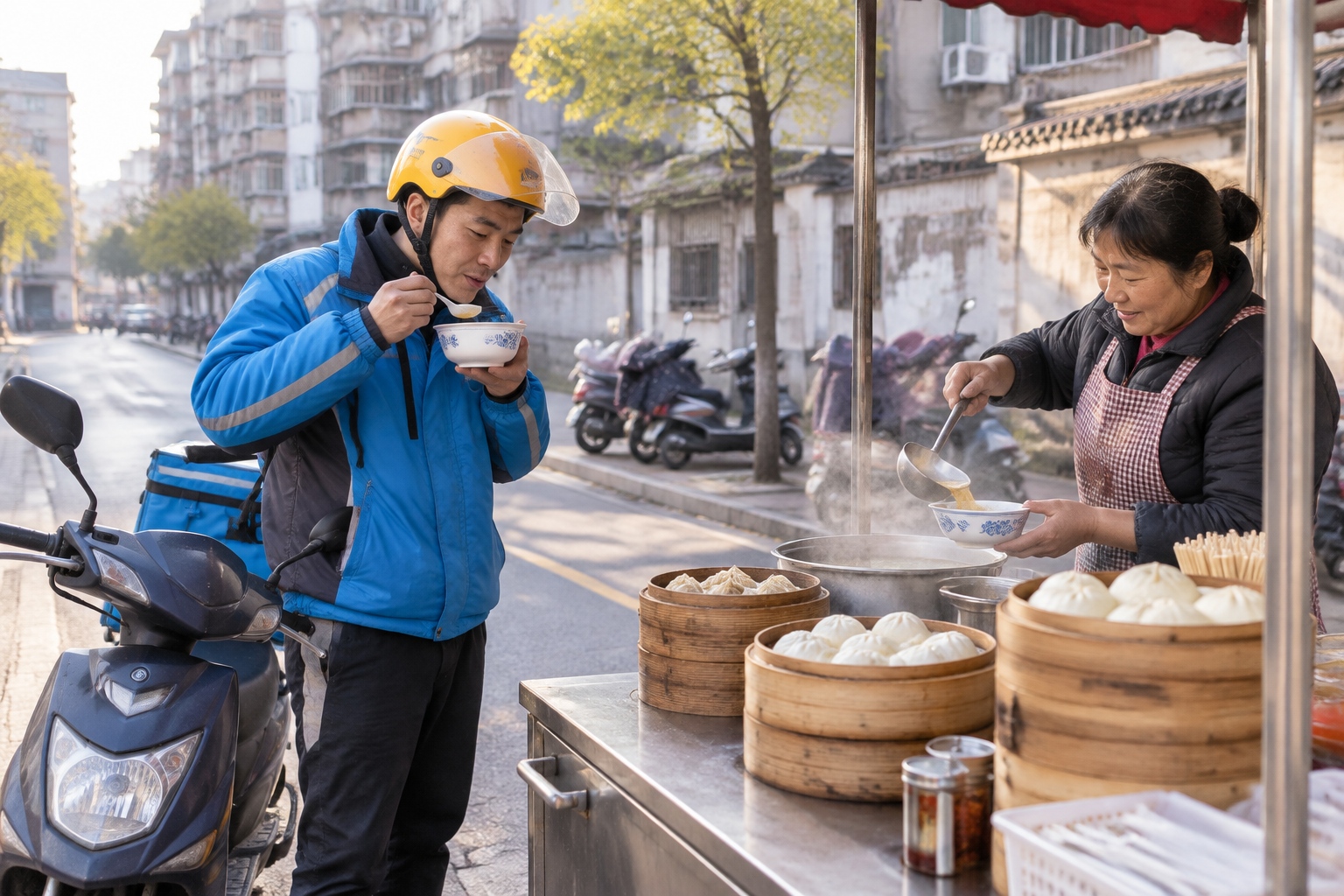
The morning stop is the most fixed point in his day. Near his station, on the edge of an older residential compound where the ground floor has been converted into small shops, there’s a row of breakfast stalls that set up at half past five and close by nine.
His usual order is hulatang — a thick, peppery soup from Henan with beef, wood ear mushroom and gluten — plus two fried buns, or youtiao dipped into soy milk. Hulatang costs six to eight yuan a bowl in this part of town. Buns are one yuan each. He spends eight or nine yuan in total and eats in under ten minutes.
Why always the same stall? Three reasons, and none of them are about flavour. The owner knows his face and has the bowl ready when he sees the helmet. There’s space to pull the scooter onto the pavement without blocking traffic. And there’s a power strip by the door where he can top up his phone while he eats.
“The soup is good,” he says. “But honestly, if this stall closed, I’d find another one with the same three things. That’s what a good breakfast place means to me.”
He knows the differences between the two main styles of hulatang — one from Xiaoyao town, one from Beiwudu — and has a preference, but he laughs when asked to explain it. “You can’t taste the difference when you’re eating in eight minutes. I just know the one up the road makes it spicier.”
Why Not a Proper Restaurant for Lunch?
Zhengzhou has no shortage of famous food. Hui mian, the city’s signature wide noodle in bone broth, has restaurants with queues down the street. There are roast duck shops, old-state-run dumpling halls, and a whole genre of short-video-food streets.
Li Wei avoids almost all of it during working hours. Three practical reasons:
Parking and charging
His scooter is his income. Finding a legal spot near a popular restaurant can take ten minutes, and if he leaves it on the pavement there’s a fine. He chooses places where a dozen scooters already sit in a row outside and the shop owner doesn’t mind.
Kitchen speed
A proper sit-down restaurant can take twenty minutes to get food on the table. A small canteen serving rice with braised toppings, or a noodle shop with a pot already boiling, can hand him a box in five.
Price stability
He wants a meal that costs the same in January and July. Chain convenience stores and small neighbourhood kitchens give him that. Trendy places don’t.
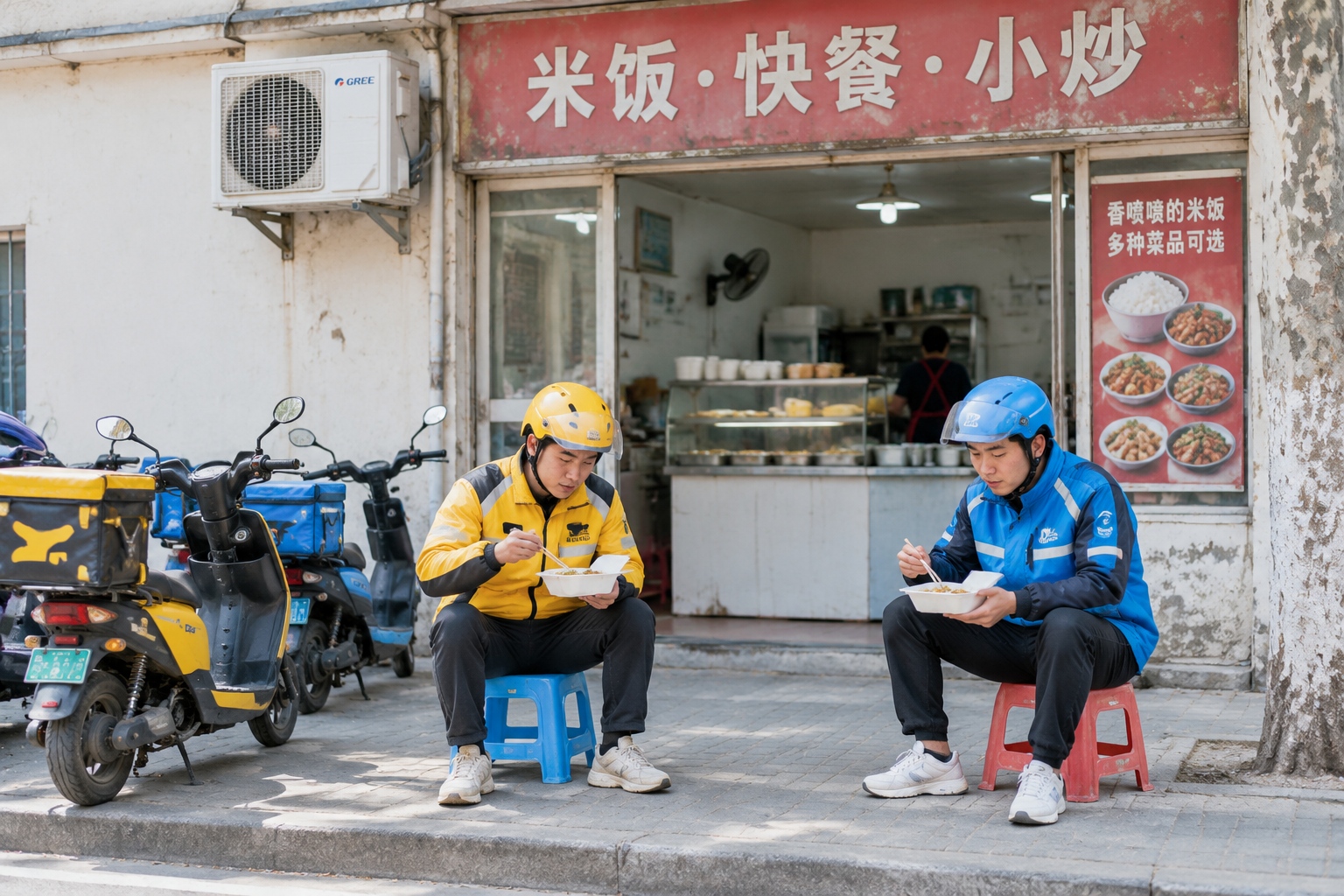
His lunch rotation is small: a rice-with-toppings place behind an office complex, a noodle shop near a hospital, a dumpling counter in a supermarket basement, and the noodle shop where I met him. All of them sit between ten and fourteen yuan. All of them let him stand outside or sit on a plastic stool with his helmet on the table.
The Afternoon Fill-In: Water, Fruit, and a Place to Sit
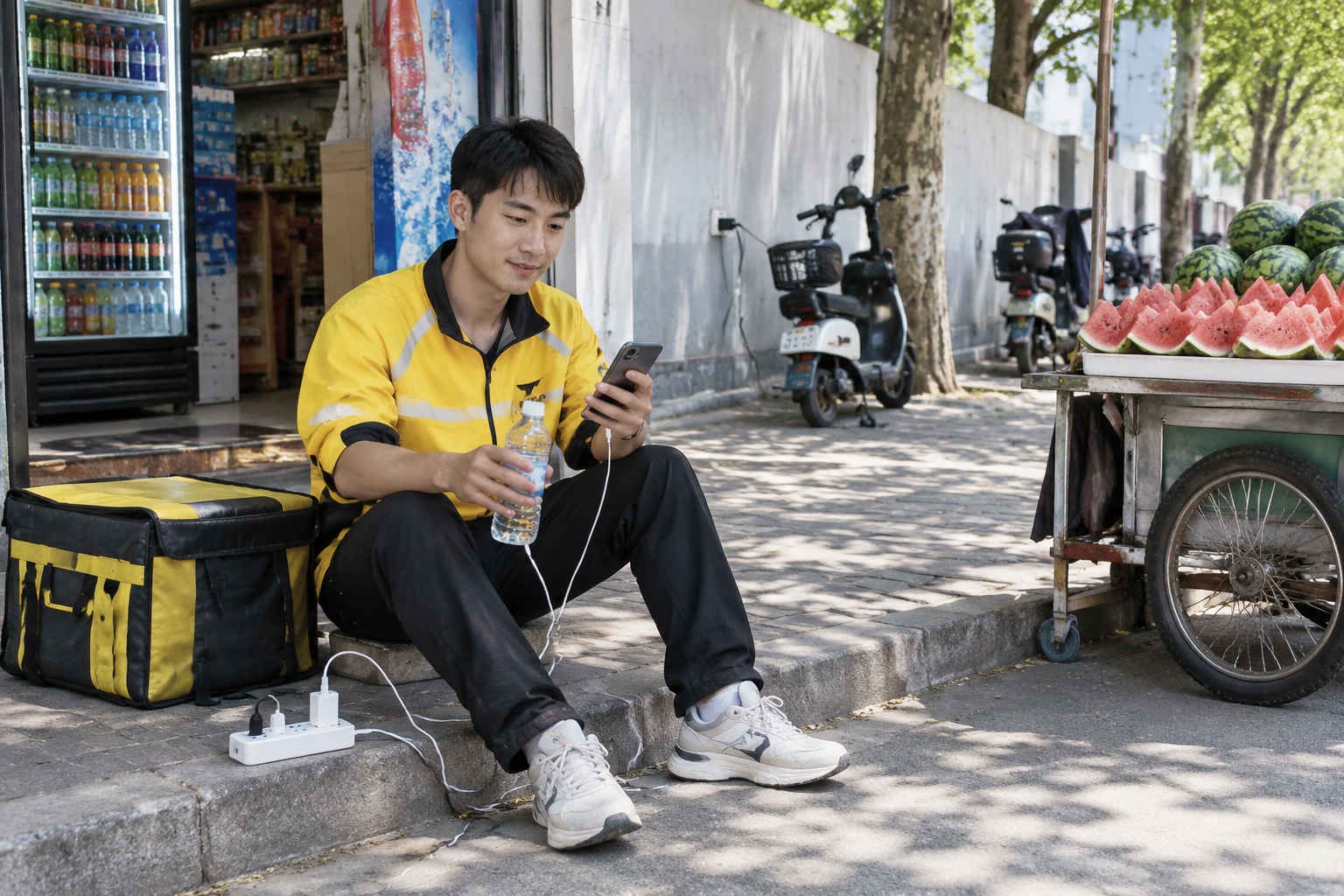
Between two and four in the afternoon, orders thin out. This is when the city looks different to him — quieter streets, empty shopfronts, delivery riders clustered in the shade under overpasses, charging cables running out of convenience store doors.
He spends five to eight yuan on a bottle of ice water and a piece of fruit from a cart. In summer he drinks three or four bottles a day and says the heat is harder than the rain. In winter he buys roasted sweet potatoes from a barrel vendor for six yuan and holds them to warm his hands.
There’s a small cold-drink shop near a residential compound that has become an unofficial rest stop. The owner put out four plastic chairs and a power strip. On any given afternoon, three or four riders are there, phones plugged in, comparing order distances and complaining about a particular building with a broken elevator.
“This is the only part of the day I actually talk to people,” he says. “Twenty minutes, and then everyone disappears again.”
Dinner After the Evening Peak: A 23-Yuan Night
By nine at night the streets around the old neighbourhoods get busy again, but for a different crowd. Small restaurants roll out tables onto the pavement. Skewer stalls light up. A bowl of hui mian is twelve to eighteen yuan; a dozen lamb skewers around thirty; a plate of cold vegetables six.
On a normal night Li Wei spends about twenty-three yuan. Either a bowl of noodles at a shop near his rented room, or a takeaway box of rice and two dishes that he eats at home in front of his phone. Once a week he meets two riders he knows and they split a few dishes, which brings the cost down to about eighteen yuan each.
He does the arithmetic out loud without being asked. A good day is 250 to 300 yuan in earnings; a bad day, in heavy rain with a scooter fault, is under 150. Rent is 900. Phone and scooter charging, about 150 a month. Food, 1,200 to 1,400 if he’s careful. The rest goes to his parents and to a savings account he checks less often than he should.
“I could eat better,” he says. “But eating better means thirty yuan a meal, that’s nine hundred a month more. I’d rather send that home.”
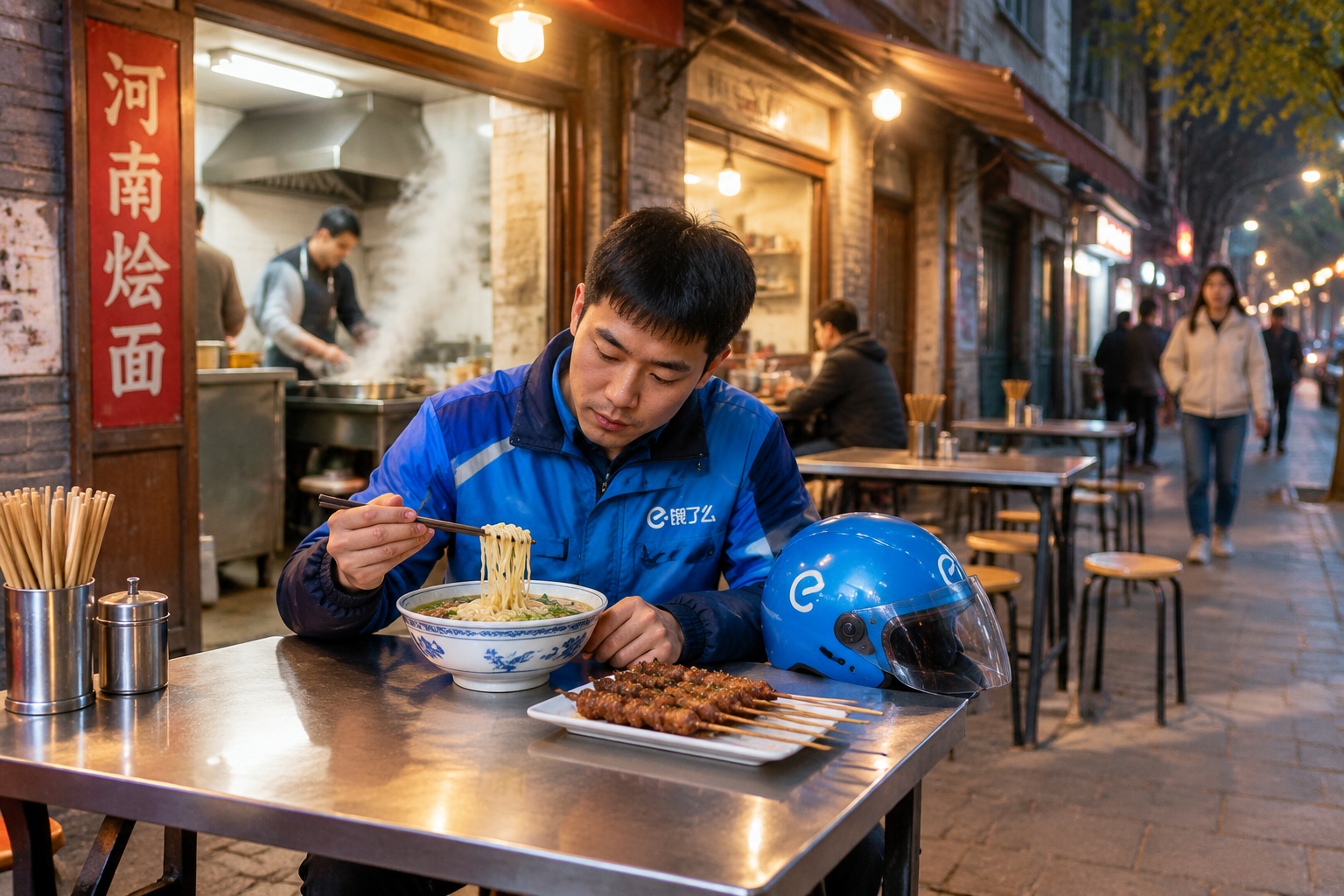
How a Changing City Redraws the Map
Zhengzhou has grown fast. The new eastern district, Zhengdong, is all glass towers, wide roads and underground malls where a bowl of noodles costs twenty-five yuan and there’s nowhere to leave a scooter. The older districts to the west and north are denser, cheaper, and full of the small kitchens that keep riders fed.
When he first started, he ate mostly around the station. Now his map has about twenty spots, and it moves with the platform’s dispatch patterns. When the app started sending him more orders to the southern industrial edge, he found two new lunch places within a month. When a stretch of old low-rise shops was demolished for redevelopment, three of his regulars disappeared in a single season.
Night-time economy campaigns have changed the evening options too. More late stalls stay open past eleven, which matters for riders on the late shift. The city has also added some public rest areas and rider service stations with water, charging and toilets — useful, though Li Wei says he mostly uses the ones he already knows.
What hasn’t changed is the basic logic. A delivery rider’s food map is a map of the city’s seams: the gaps between office towers and housing blocks, between the rush and the lull, between what the city advertises and what it costs to actually live here.
The Map Is Just Lunch
Li Wei doesn’t describe himself as a food person. He can’t name the best restaurant in Zhengzhou and gets mildly annoyed when asked. What he can do is tell you which shop on which corner will hand him a hot bowl in four minutes, which vendor won’t mind him parking across the entrance, and which stretch of pavement has shade at two in the afternoon in July.
“People ask me where to eat in Zhengzhou,” he says. “I tell them I don’t know. I know where I eat.”
That’s the whole map. Not a discovery, not a hidden gem, not a story about exotic local flavour. A working man’s route through a city of thirteen million, drawn one ten-yuan meal at a time.
Start the discussion at forum.chinacomes.com