


An afternoon in Bao’an
At 3:40 p.m. on a Thursday, the fifth-floor packing area in Bao’an feels warmer than the street outside. A label printer clicks out a strip of stickers. A worker in a blue smock peels one off, lines it up with the edge of a white box, and presses it down with her thumb. Behind her, cartons of Bluetooth temperature loggers are stacked waist-high. Each box holds a device the size of a matchbox, with a small LCD screen and a sensor probe. The customer is a small German brand selling to cafés and home users. The order is 2,800 units. The factory lets me follow it but not use its name or the customer’s. The people I meet are introduced by surname or English name.
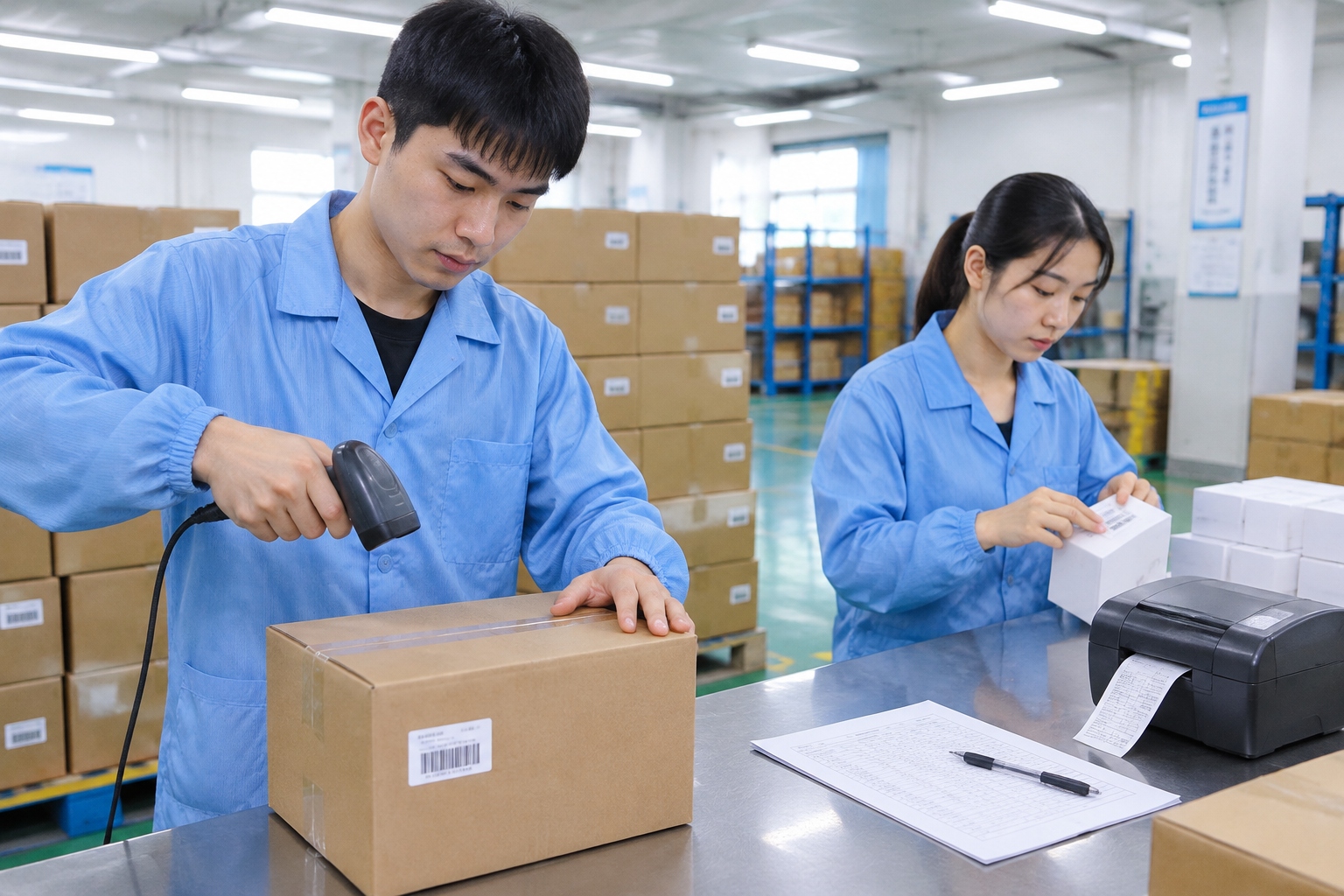
The line is not dramatic. No robot arm swings across the floor. I see repetition: test, wipe, bag, label, seal, stack. At the end, a young worker named Xiao Wei scans each carton. The scanner beeps. He checks a paper sheet. It says 2,400. The remaining 400 are still on the aging rack near the window.
What ‘two weeks’ actually means
Mr. Li, the factory owner and a former process engineer, says the order went from final design files to sealed cartons in 11 working days. That is the number behind ‘from sketch to shelf in two weeks.’ It is not two weeks from a blank page. The German brand spent months on product definition, crowdfunding, and certification. The clock starts when the design is frozen: housing, circuit board, firmware, and packaging fixed enough to order parts and build tooling.
Nor does ‘shelf’ mean a retail shelf in Berlin. The cartons go by truck to Shenzhen airport, fly to Amsterdam, and land in the customer’s third-party warehouse. A small batch reaches a pop-up shop in three days; the rest waits for online orders. From factory floor to warehouse shelf is about two weeks. From warehouse to a kitchen counter is another story, with freight, customs, and retail margins. The logger itself is a mature IoT device: Bluetooth chip, temperature and humidity sensor, small lithium battery, PCB, plastic case, and test jig. None of these parts is exotic. What is new is the case shape, the firmware display, and the packaging.
Week one: CAD files, hand samples, and a lot of WeChat
On day one, Chen Gong, a process engineer in his thirties, opens the customer’s CAD file on a desktop near the line. The case is a rounded rectangle with a clip on the back. The clip looks simple. It is not. The first version interferes with the battery compartment by 0.8mm. Chen Gong changes the rib thickness, adds a small draft angle, and sends the file to a 3D printer in the same building. Three hours later he has a hand sample in matte white resin. He presses the clip and takes a photo.
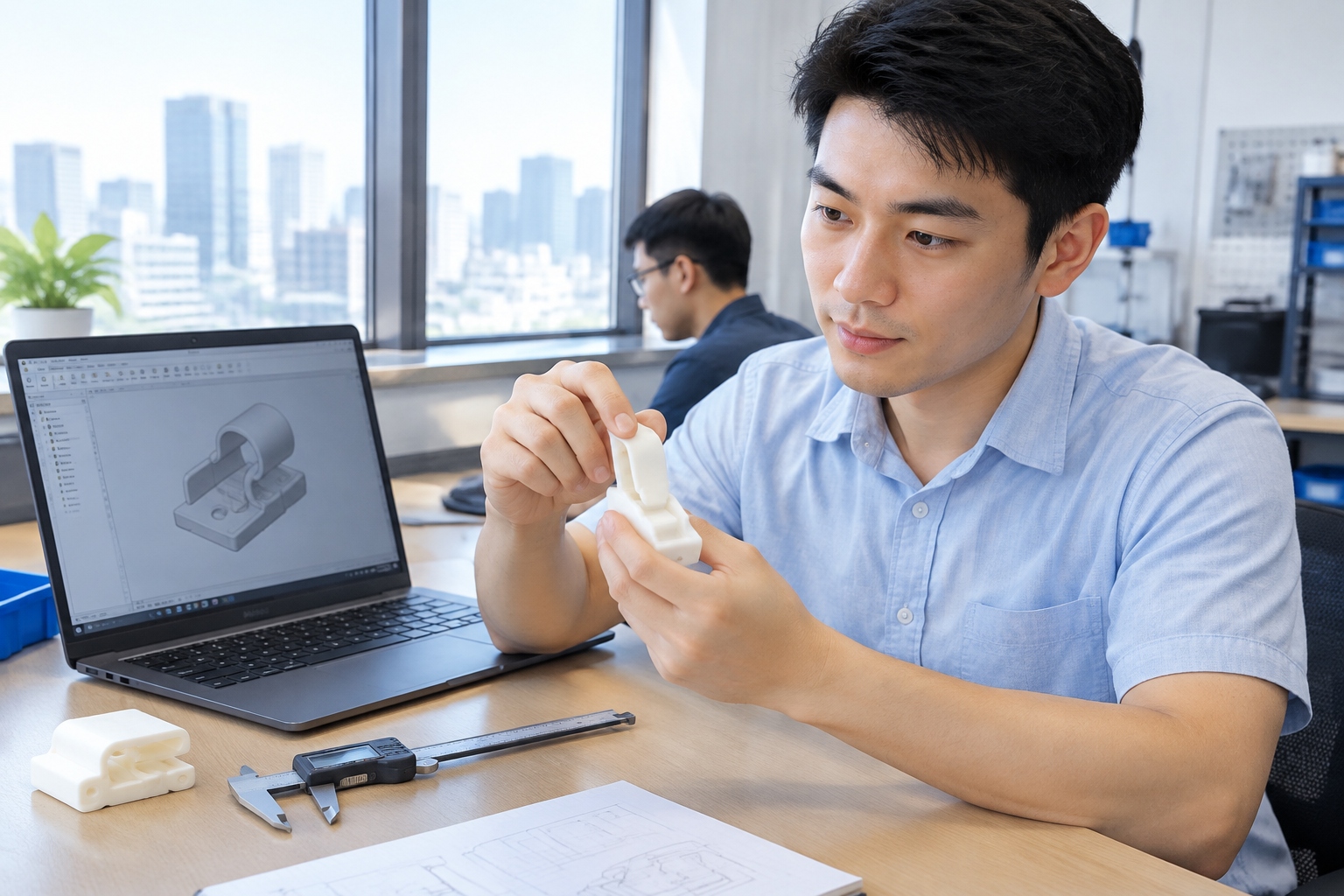
The photo goes into a WeChat group with the customer, sales manager, electronics engineer, and mold maker. The customer is in Berlin, six hours behind Shenzhen. Decisions arrive at night. Chen Gong answers in the morning with a short video: the clip flexing, the battery door opening, calipers on the screen. The back-and-forth is a series of small corrections: a screw boss moved 1.5mm, a light pipe adjusted, a logo deepened by 0.2mm. Each change is cheap before the mold is cut and expensive after. By day three, the electronics engineer has moved a sensor opening by 2mm. The factory solders five prototype boards, flashes firmware, and tests Bluetooth range in the stairwell. The signal is stable at 18 meters. The customer asks for a longer scan interval to save battery. A new build goes out the same afternoon.
The parts ecosystem next door
On day four, procurement officer Zhou Jie starts the parts list. Most components are already in the stockroom: Bluetooth chip, sensor, battery, LCD, passives. The connector is the problem. The approved model has a five-day lead time. Zhou Jie calls two suppliers. One has 200 pieces in Dongguan. The other has a similar model. She does not substitute it alone. She sends a photo and datasheet to Chen Gong, who checks pin pitch and mating height. Then she takes an e-bike to Huaqiangbei, about 40 minutes away, and returns with 300 connectors in a clear bag.

This is the part of Shenzhen that is hard to copy. The injection mold shop is in Chang’an, 30 minutes away. The PCB house is in Shajing. The packaging printer is in Longhua. The battery supplier is in Huizhou. A missing part can become a same-day errand instead of a two-week wait. Density does not make everything cheap; small orders often pay higher unit prices. What it buys is time. The factory can wait until the design is nearly final before committing to parts, because the parts are close by.
On the line: solder paste, tests, and rework
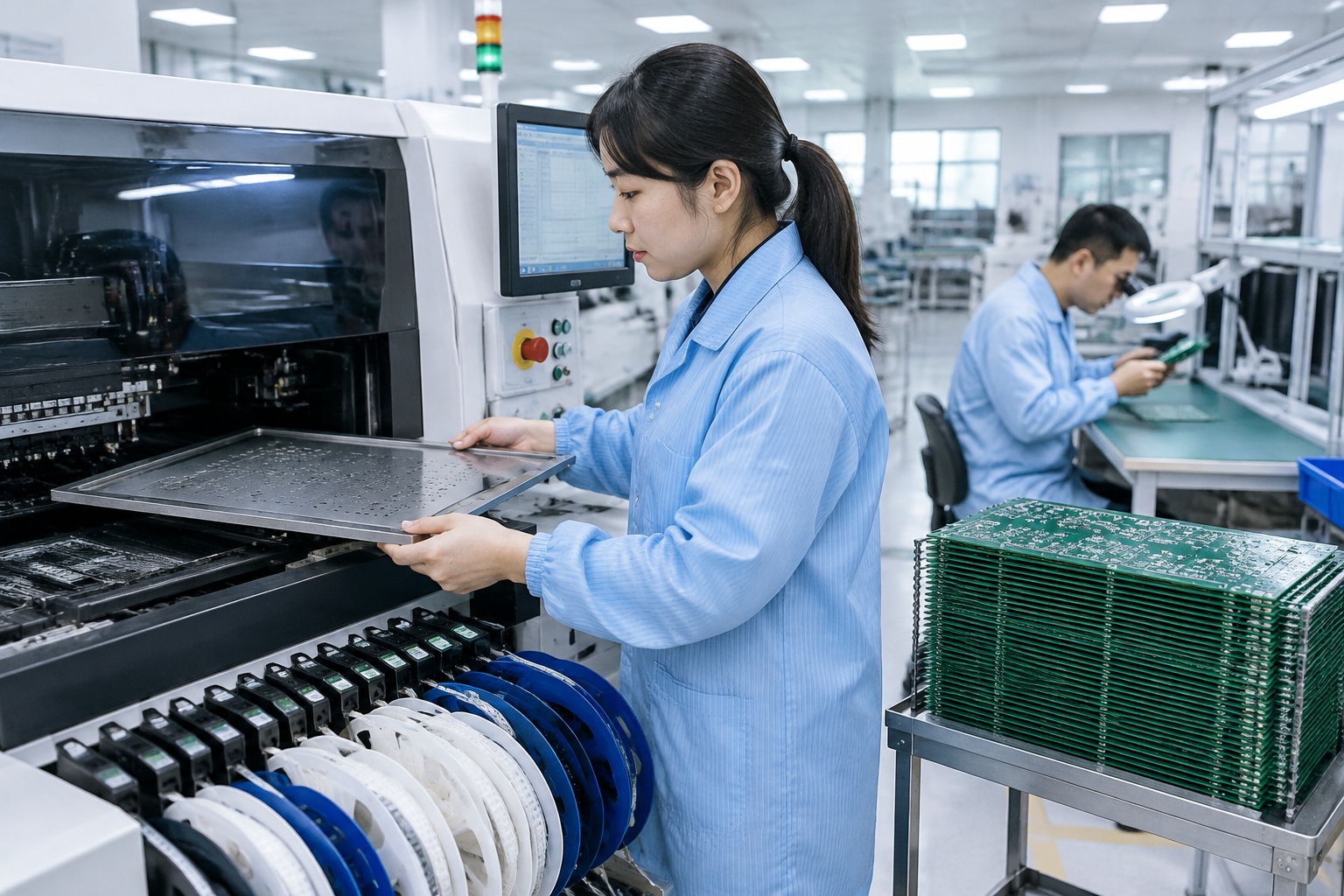
The SMT line starts at 8:20 a.m. on day six. A technician loads a stencil and solder paste. The pick-and-place machine sucks up tiny components and places them with a rapid tick. The first panel is a first-article check: three boards inspected under a magnifier, then run through the reflow oven. An engineer checks solder joints and sensor polarity. Only then does the line run the full batch. The machine does not look fast when you watch one board. It looks fast when you look away for ten minutes and see a stack of panels.
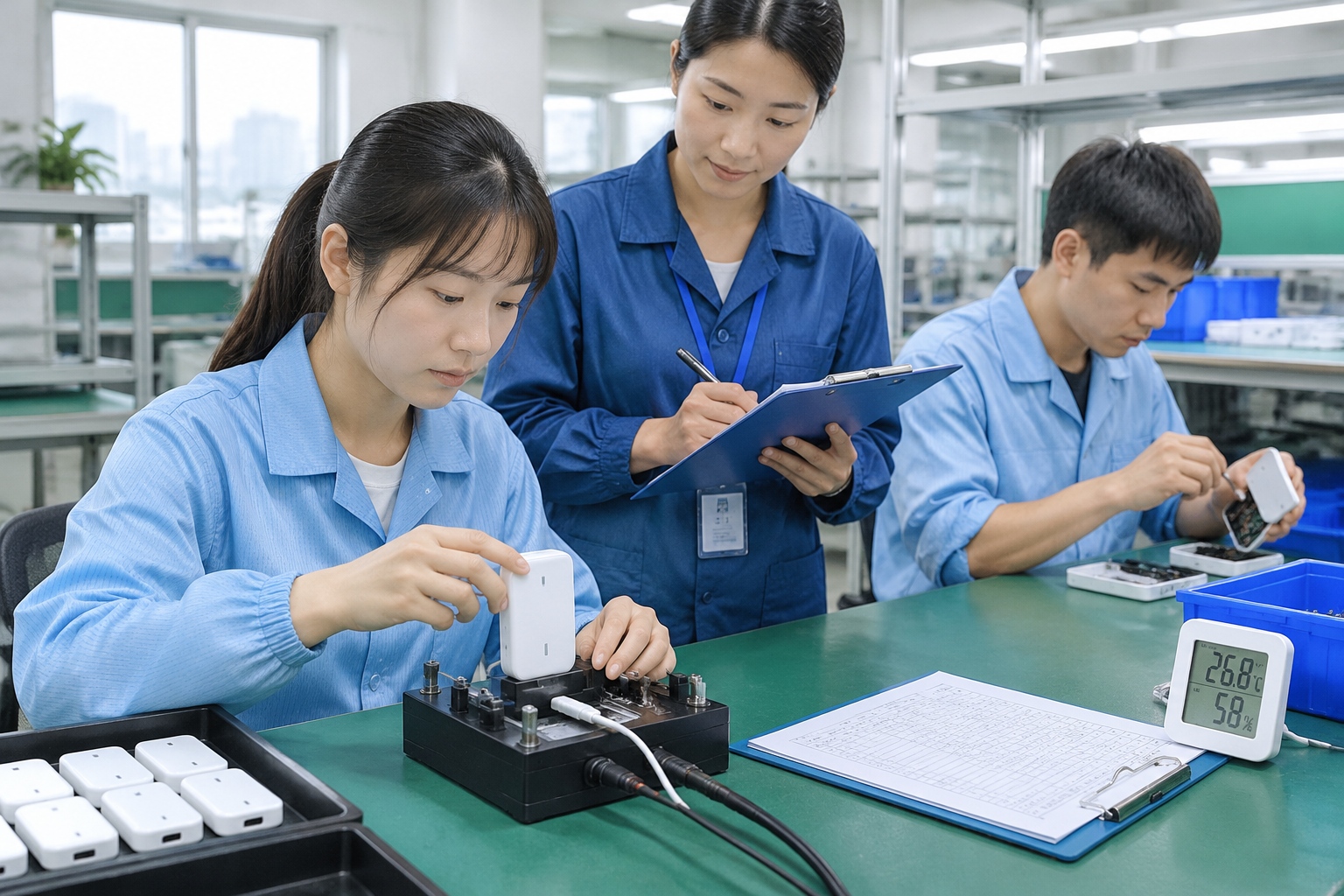
After SMT, workers add the battery, LCD, and connector. The board snaps into the case, the clip is tested by hand, and the unit goes to a test jig. The jig checks screen, sensor reading, Bluetooth address, and battery voltage. Each test takes about 18 seconds. A red light means failure. On my visit, three units fail because the display is misaligned. A worker at rework opens the case, reseats the connector, and tests again. Failures are logged on paper and signed by the line leader. Then the units sit on an aging rack for four hours, powered on, logging temperature every minute. A technician checks a sample against a reference thermometer. Only then do they move to packing.
The packing work is small and exact: wipe the screen, peel the film, slide the unit into a bag, add a cable and card, close the box, apply the label, scan the carton. The label has a barcode and a batch number. If a customer reports a problem, the factory can trace the unit back to the SMT shift and the battery batch.
The people keeping the schedule
Line leader A Zhen runs the morning meeting at 7:50. She writes the day’s target on a whiteboard: 1,200 units. She assigns stations, checks absences, and asks about a missing fixture. Workers start at 8. At noon they take an hour for lunch. On normal days they finish at 6. On this order, they work until 8:30 for three days. No one calls it a sprint. It is a schedule. Xiao Wei, 22, from Guangxi, sits at calibration. He has worked here two years. His hands move quickly: plug in, wait, press, unplug. He says the hardest part is not speed. It is staying careful when the same action repeats 800 times.
Chen Gong spends much of the day standing. He crouches by the test jig with a small screwdriver, adjusts a pogo pin, and asks the operator to try again. When cases arrive with a tight clip, he tests one with the assembly worker. The talk is direct, sometimes loud, then over. People ask for tape, borrow a scanner, complain about the heat, and share oranges at the end of the line. The pace is steady, not frantic. Pressure shows in paper sheets and the whiteboard, not in shouting.
Why the speed is possible, and where it stops
Four things make the 11-day timeline possible. First, the division of labor is fine. Mold maker, PCB house, SMT line, assembly team, test engineer, and packer are separate specialists. Second, the factory is set up for small batches. It can switch a line for 2,800 units without stopping a larger order for a week. Third, the communication chain is short. Customer, sales manager, engineer, and line leader can be in the same WeChat group and the same building. A problem that would take three emails abroad takes ten minutes here. Fourth, logistics is dense. A missing connector is a 40-minute e-bike ride, not an international shipment.
The limits are just as real. The model depends on standard parts. A custom sensor, a new radio module, or a medical certification can make two weeks impossible. It depends on a customer who decides quickly. Every extra day of indecision pushes the shipment. It depends on suppliers who will interrupt their own schedules for a small order. And it depends on overtime. The speed is not free. It is paid for in air freight, higher unit costs for small volumes, and the attention of people who are already busy.
What this means for buyers elsewhere
For a small hardware brand, the two-week turnaround changes inventory. A founder can order 2,800 units, test the market, and reorder before the first batch sells out. That reduces the risk of a cash-heavy production run. It also makes rapid fixes possible: a new firmware build, a tighter clip, a different label. The cost is air freight and a higher unit price. The product may cost more than a version made in a low-cost factory with a three-month lead time. The buyer is paying for flexibility. Not every category can copy this. Furniture, apparel, and products with long certification cycles move more slowly. Even in electronics, the model works best with mature components and orders small enough to fit a flexible line. Speed comes from a system: nearby suppliers, short communication, small batches, and workers who fix problems at the line. A buyer who wants that speed has to participate in it: clear specs, fast decisions, and a willingness to pay for air freight instead of waiting for a ship.
The next batch is already scheduled
At 5:20 p.m., the last carton is sealed. Xiao Wei writes 2,800 on the sheet and signs it. A truck will come at seven. The cartons go to the airport, not to a retail store. On the whiteboard, Monday’s order is already written: 4,000 units, a different case color, the same board. Chen Gong is looking at a new bracket on his screen. The label printer clicks out another strip. The shelf is not an ending. It is a handoff.
Start the discussion at forum.chinacomes.com