

At 6:40 a.m., the market is already online
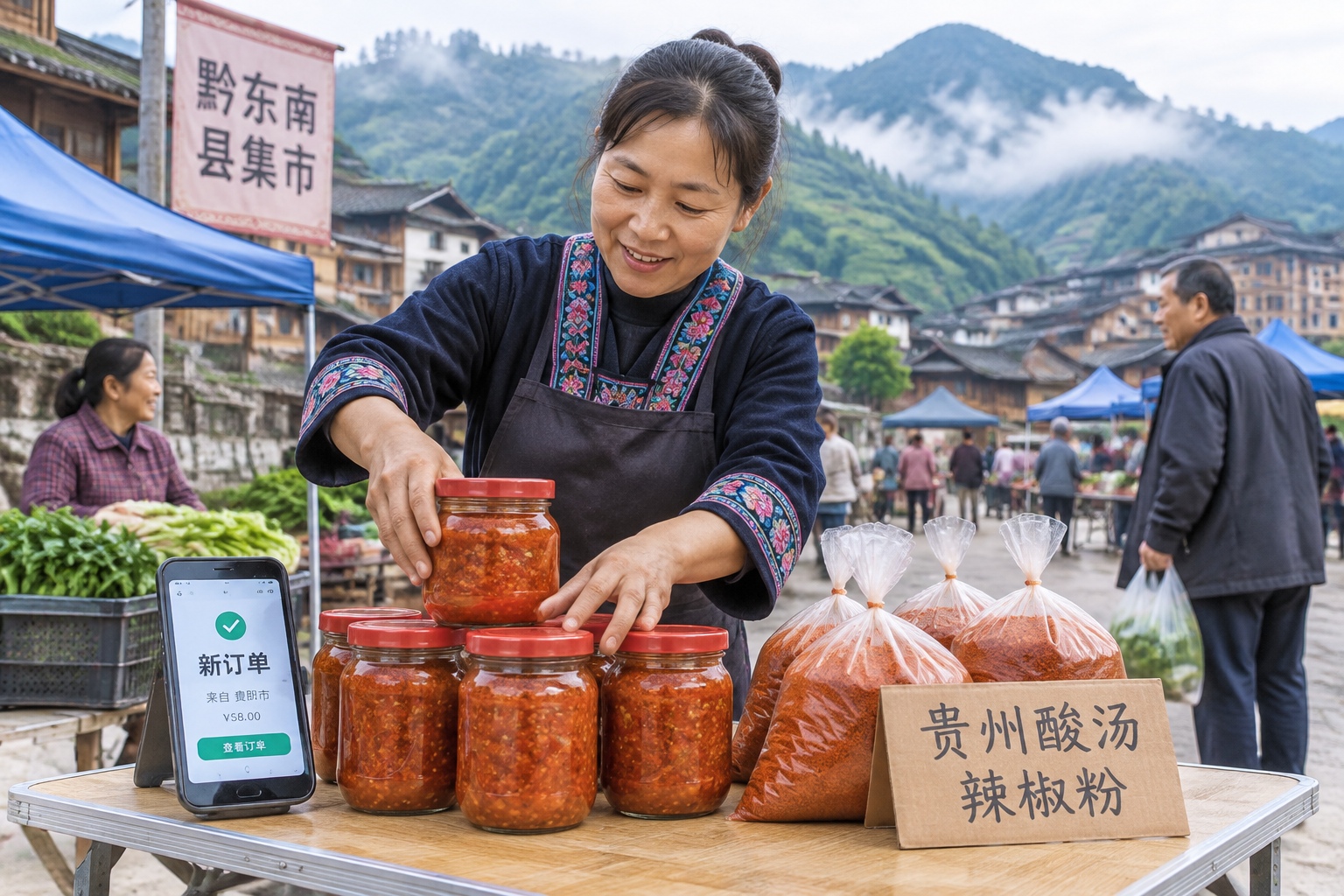
At 6:40 a.m. in a county market in Qiandongnan, Guizhou, Pan Yue is doing two things at once. She arranges glass jars of fermented red sour soup on a folding table, next to bags of chili powder, dried rice noodles and smoked pork. Then she checks her phone. A notice from a village express station says three boxes are waiting for pickup. Two are going to Hangzhou, one to Shenzhen. The jars in front of her may be sold by noon; the boxes behind her will travel more than 1,000 kilometers.
Guizhou sour soup is not a household flavor for most people outside China. It is a fermented base made from tomatoes and chilies, used for fish, beef, noodles and hot pot. It tastes sour first, then gently fiery, with a deep savory edge. For people in Guizhou, it is everyday food. For a customer in Shanghai or Guangzhou, it is a way to cook something that does not taste like the rest of the supermarket.
How does that flavor leave the mountains? The easy answer is e-commerce. The more accurate answer is a chain of small, ordinary steps: a workshop that can seal and label food, a village pickup point, a county sorting center, a truck to Guiyang or Zunyi, a line-haul to a city hub, and a courier who rings a doorbell. None of it is magic. That is what makes it worth looking at.
Why mountain food used to stay local
Guizhou is often described as a province without much flat land. About 92% of its territory is mountainous or hilly. Roads have improved enormously, but distance still matters. A county may sit two hours from the next county seat; a village may be another 40 minutes up a winding road. For a small food producer, that geography used to set a hard boundary.
The old business model was simple. Make chili powder, sour soup or cured meat in small batches. Sell it in the county market, to restaurants, or to relatives who carried it back to the city. Production was tied to the household stove. Packaging was a plastic bag or a reused jar. Shelf life was short, especially for fresh rice noodles and meat. The sales radius was small because the producer could not guarantee what happened after the bag left the stall.
This is where the word miracle can mislead. Guizhou snacks did not suddenly become national because of one road or one platform. They moved because a long list of unglamorous problems got solved: sealing, labeling, shelf-life testing, order forecasting, pickup, sorting, transport and delivery. Each step is modest. Together, they change the size of the market a small workshop can reach.
From the stove to a parcel
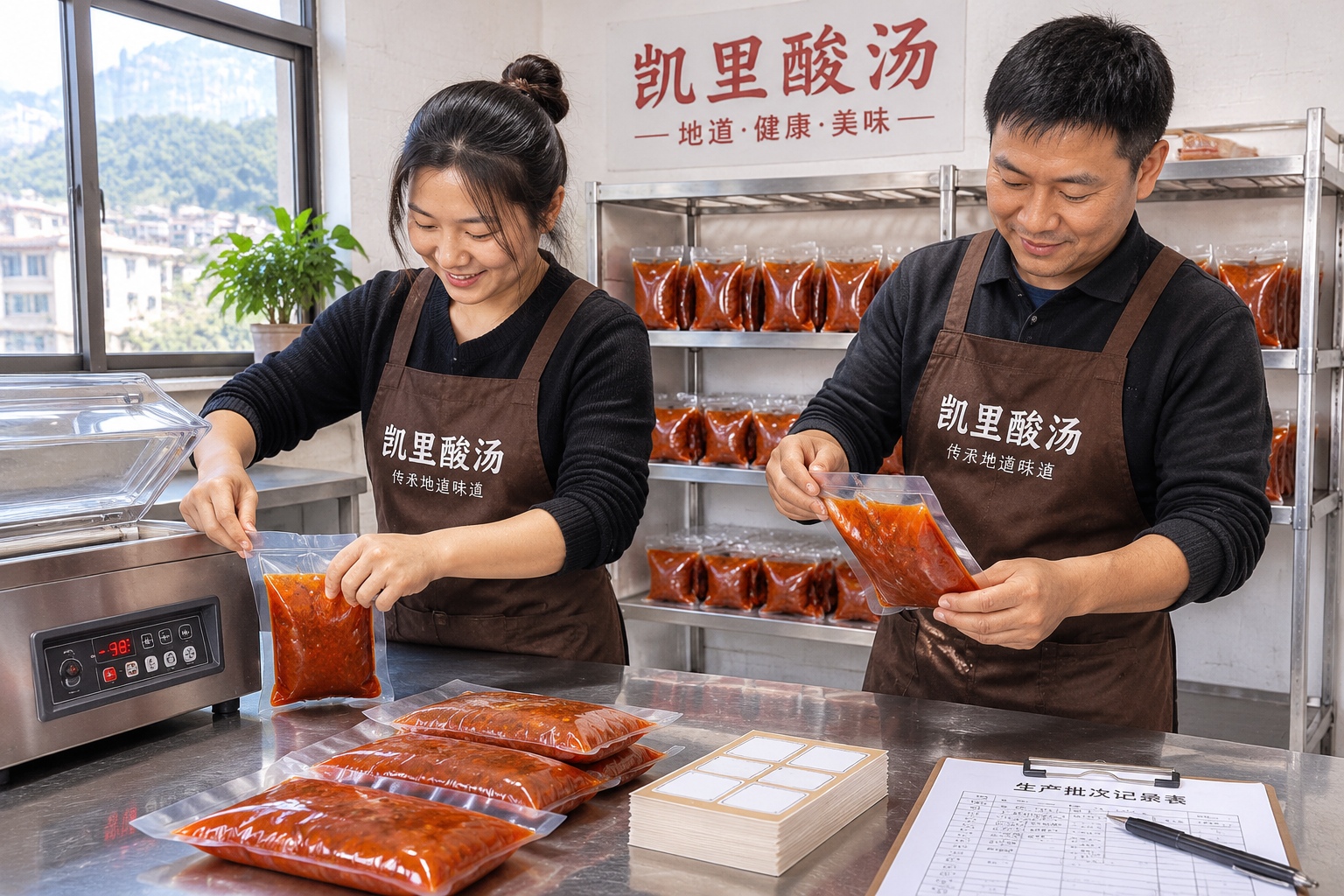
In a small workshop in Kaili, an owner I will call Luo Mei starts production at 8 a.m. Her main product is a sour soup base. She buys tomatoes and chilies from nearby farms during the harvest season, ferments them in food-grade tanks, cooks the base, and packs it into vacuum-sealed pouches. The pouch is plain, but the label carries more information than a market stall ever did: ingredients, batch number, production date, shelf life, storage instructions and a QR code.
The workshop is not a factory. It has three stainless-steel tables, two vacuum machines, a filling station and a small area for labeling. On a busy day, Luo Mei and four workers pack about 1,200 pouches. That is small by industrial standards, but large enough to fill orders from online shops. The key change is not the machine. It is the routine: produce against orders, keep batch records, test shelf life, and pack so the product survives a week in a truck.
Not every Guizhou snack needs a cold chain. Vacuum-sealed sour soup base and chili powder are shelf-stable. Fresh rice noodles, tofu and some cured meats are different. For those, a simple cold chain may involve insulated boxes, gel ice packs, and a courier service that moves the parcel to a sorting center the same day. The cold chain is not always high-tech. Often it is a foam box and a careful handoff.
This is also where small food producers meet a new kind of discipline. A restaurant can adjust a recipe by taste. An online order cannot. The sour soup must taste the same in January and July. The pouch must not leak. The label must match the batch. The producer must know how many orders will come after a short video goes live. None of this is romantic, but it is what lets a mountain flavor survive a 2,000-kilometer journey.
The first mile: a village pickup point
The first mile is often the hardest. In a village in Leishan County, the express station is a corner of a small grocery shop. There is a shelf for parcels, a scanner, a stack of cardboard boxes and a handwritten notice with opening hours. The shop owner also sells cooking oil, soap and mobile phone top-ups. When a courier van arrives, usually in the afternoon, she helps unload and scan. When a villager comes in, she checks the phone number and hands over the box.
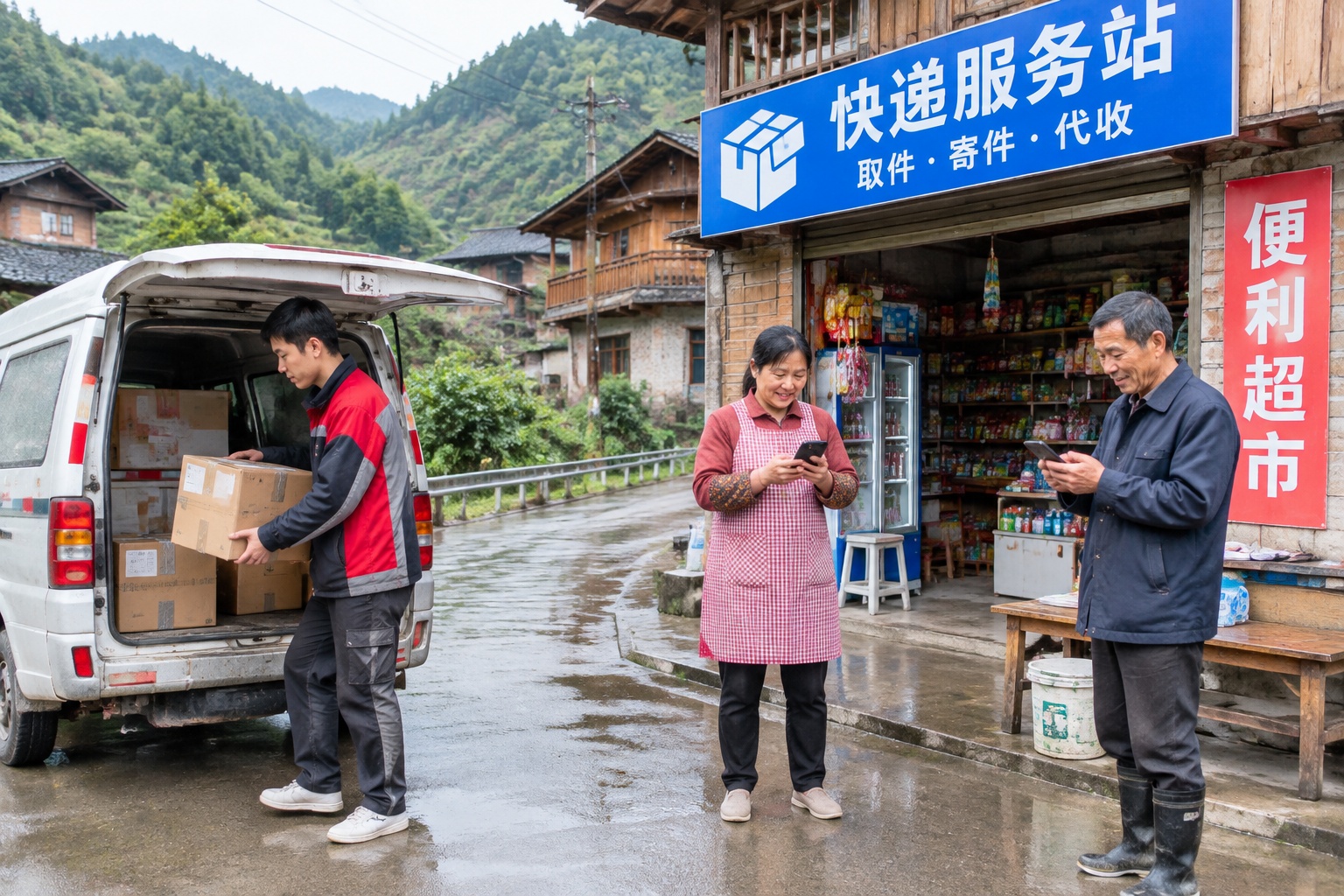
The courier knows the road. He drives from the township to several villages, collecting outbound parcels and dropping off inbound ones. On rainy days, the road is slower. On market days, the shop is busier. The van may carry only 30 or 40 parcels from one village, but that is enough to keep the route alive. China had more than 300,000 village-level express service stations by 2023, according to the State Post Bureau. The number matters less than the pattern: the pickup point is no longer only in the county town. It is closer to the kitchen.
For Luo Mei, the change is visible in her daily schedule. Two years ago, she had to carry boxes to the county town herself or ask a friend with a car. Now she calls the village station, and the courier picks up at the shop. The cost per parcel is still a real line in her budget, but the time saved goes into production and customer service. A package from her workshop to Guiyang usually takes one day. To Shanghai or Guangzhou, three to five days. That is not same-day delivery. It is fast enough for a pantry product.
Where the orders come from
Most of Luo Mei’s orders come from short videos and live streams. A young woman named Chen Yu, who returned to Guizhou after working in Guangdong, runs the online shop. She films in the workshop kitchen, not in a studio. The camera shows a pot of red sour soup simmering, a bowl of rice noodles, and the vacuum machine sealing a pouch. The videos are simple. The comments are practical: Is it very spicy? How much water? Can I use it for hot pot? Chen answers in Mandarin with a Guizhou accent, sometimes with a laugh.
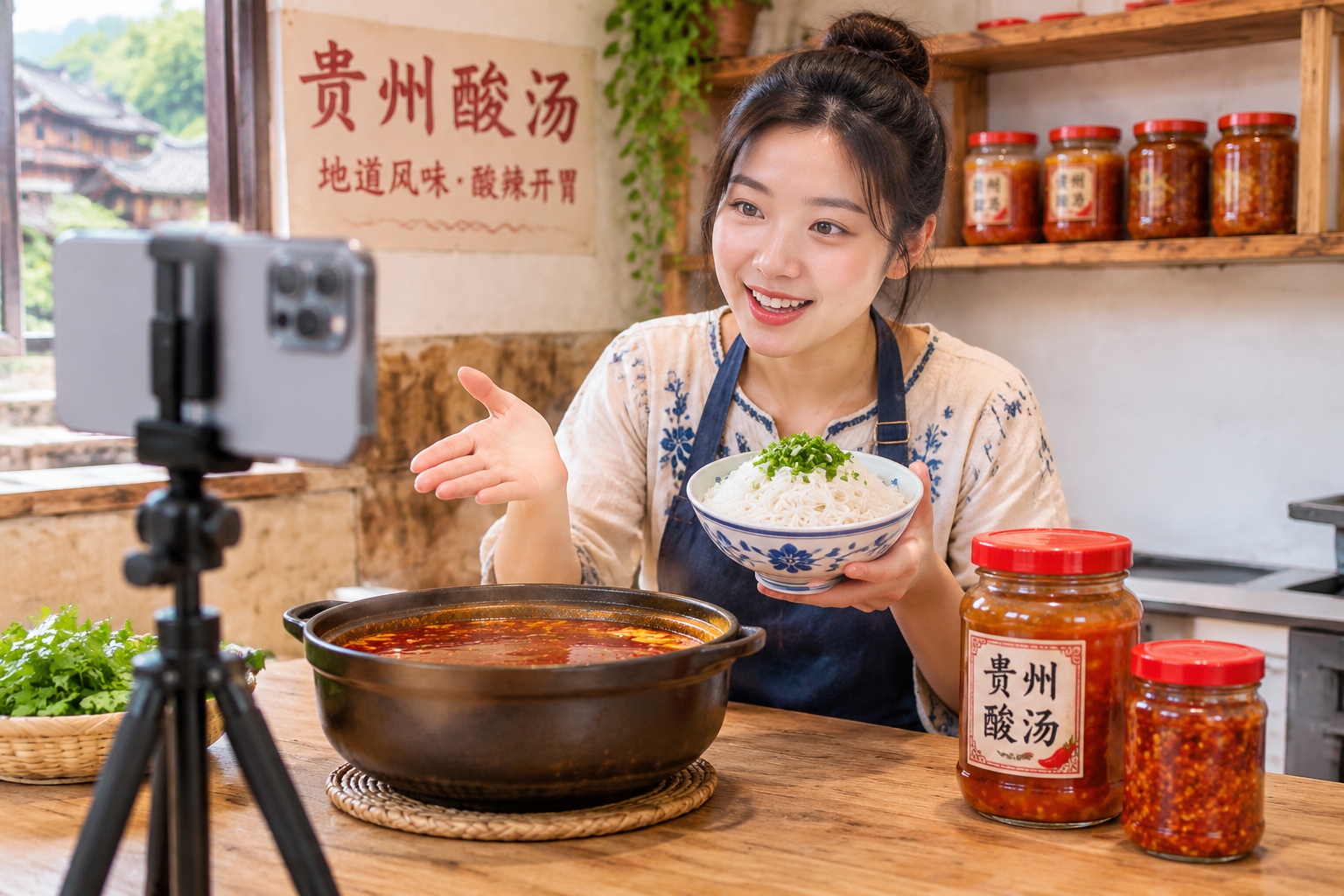
For overseas readers, this may look familiar. It is social commerce, similar to buying from a creator on Instagram or TikTok. But the scale and routine are different. A single live stream can bring 300 orders in an evening. That is good news for the workshop and bad news for its scheduling. If the tomatoes are not fermented long enough, the order cannot ship. If the pouches are not labeled, the courier cannot take them. The online shop is not a separate digital world. It pulls on the physical workshop every day.
The buyers are ordinary urban consumers. A teacher in Nanjing orders sour soup base because she ate it on a trip to Guizhou. A young father in Shenzhen buys chili powder to recreate a restaurant dish. A college student in Wuhan buys a gift box for her roommate. They are not looking for a luxury product. They want a reliable, affordable taste of a place. That demand is what turns a village pickup point into a business channel.
The last mile to a national table
Here is how one order moves. On Monday at 10 a.m., Luo Mei packs a two-pouch order for a customer in Shanghai. At 3 p.m., the village courier scans it at the grocery shop. By 7 p.m., it reaches the county sorting center. Around 2 a.m. Tuesday, it leaves for Guiyang. On Tuesday afternoon, it is loaded onto a line-haul truck to Shanghai or handed to an air cargo route. On Wednesday or Thursday, it reaches a city distribution center, then a neighborhood station, then a delivery courier. The customer opens the box and puts the pouches in a kitchen cabinet.
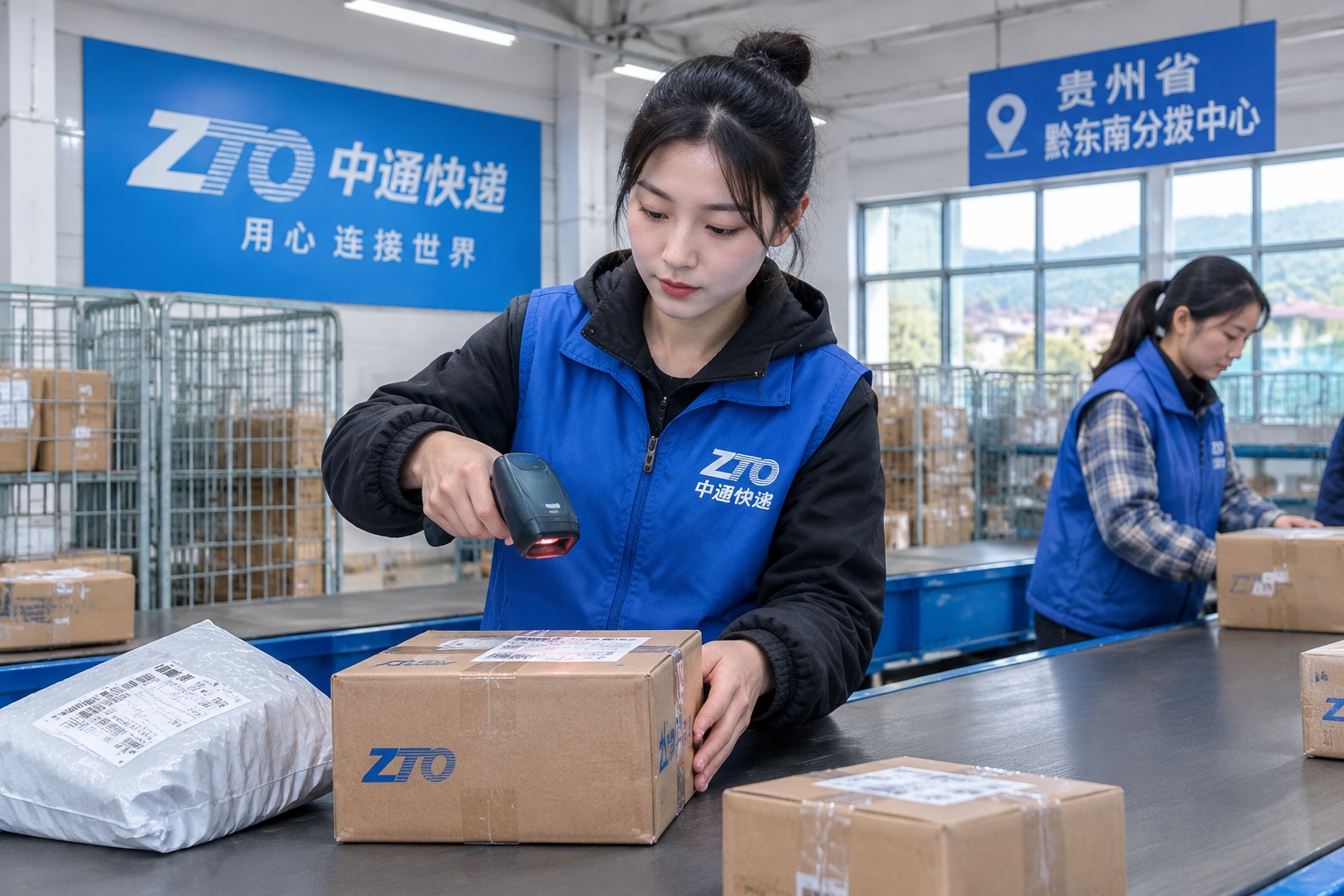
The timeline is ordinary, which is the point. A few years ago, this route would have been possible but expensive and unreliable for a small producer. Today it is a standard service, with tracking at each step. The customer can see the parcel move. Luo Mei can see the returns and the delays. The courier can see the address and the delivery time. The infrastructure is not a slogan. It is a series of scans.
For fresh products, the last mile is tighter. A box of fresh rice noodles may need to move through a cold-chain route, with less room for error. It costs more, and the customer may pay for it. That is why shelf-stable sour soup and chili powder travel farther than fresh noodles. The logistics system does not erase distance. It sorts products by how well they can handle distance.
What still slows things down
It would be easy to end with a happy story of mountain food going national. The reality is more textured. Packaging is a real cost. A vacuum pouch, a box, a label and a gel pack can take a noticeable share of a product priced for everyday use. Seasonal harvests create peaks and gaps. Quality control is hard when a workshop scales from 200 to 1,200 pouches a day. A single leaking pouch can damage a shop’s reputation.
Rural delivery also has an economics problem. A village station may handle only a few dozen parcels a day. The courier still has to drive the route. In remote areas, service may not be daily. The station owner may earn a small commission per parcel and rely on the grocery shop for income. This is not a flaw in the story; it is the story. The system works because many small operators make a thin margin work together.
There are limits, too, on what can travel. Freshness, food safety and local taste do not scale automatically. A sour soup that tastes right in Kaili may need adjustment for a customer in Beijing. A producer who wants to sell nationwide must learn about labeling rules, storage tests and customer expectations. The road is open, but the work is not finished.
Back to the table
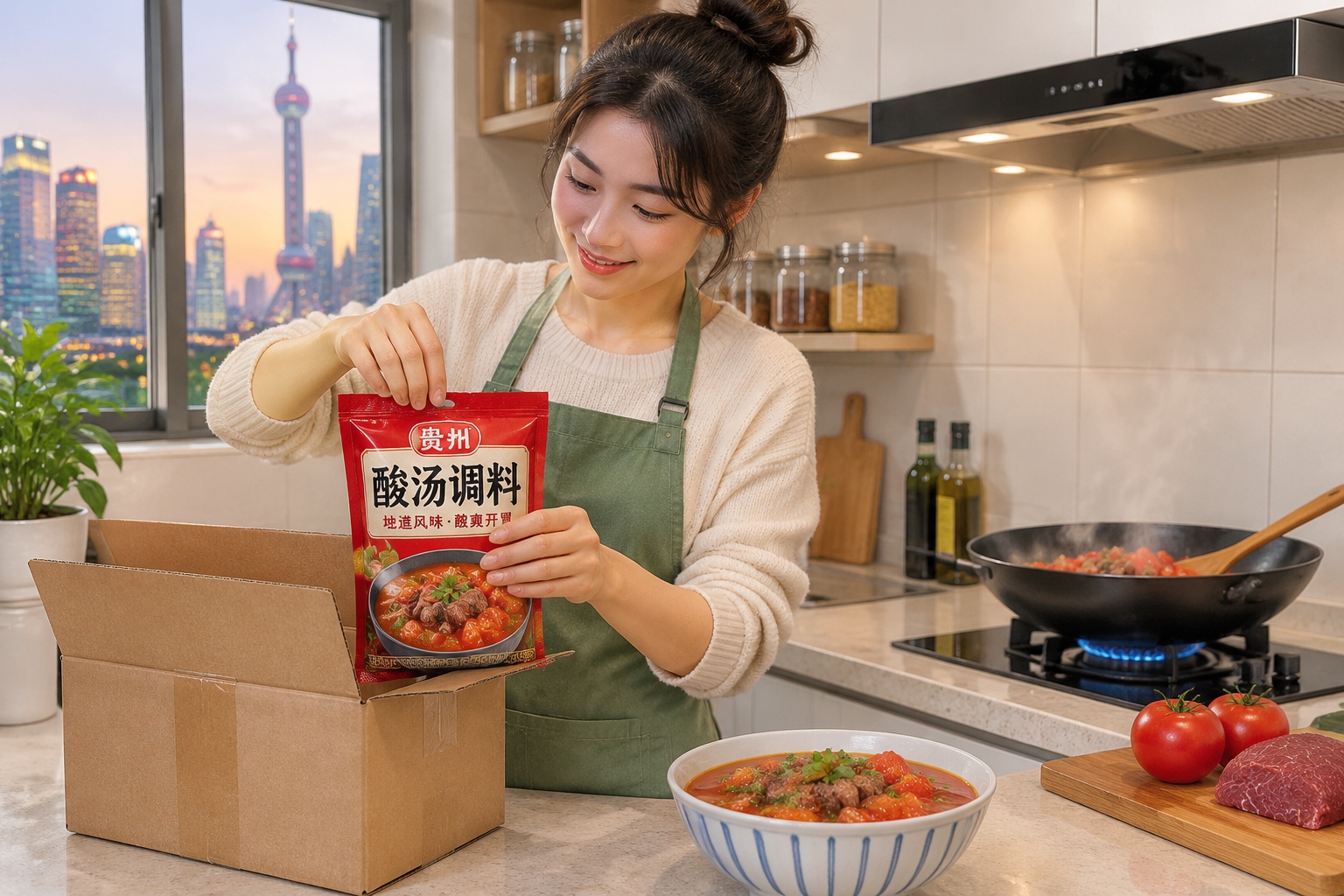
On Friday evening in Shanghai, a customer opens a box from Guizhou. She puts a pouch of sour soup base on the counter, cuts tomatoes, slices beef, and makes a pot of soup for two. She does not think about the village pickup point or the county sorting center. She thinks about whether the soup is too sour, whether the beef is tender, whether she should order more.
In Guizhou, Luo Mei is checking the next day’s orders. The courier is driving back from the last village. The shop owner is closing the express station and turning off the scanner. None of them is performing a miracle. They are doing ordinary work that has become more connected. That is what the journey from deep mountains to national tables actually looks like: not a single leap, but many hands passing a small package along.