

At 11:40, the bowls come out
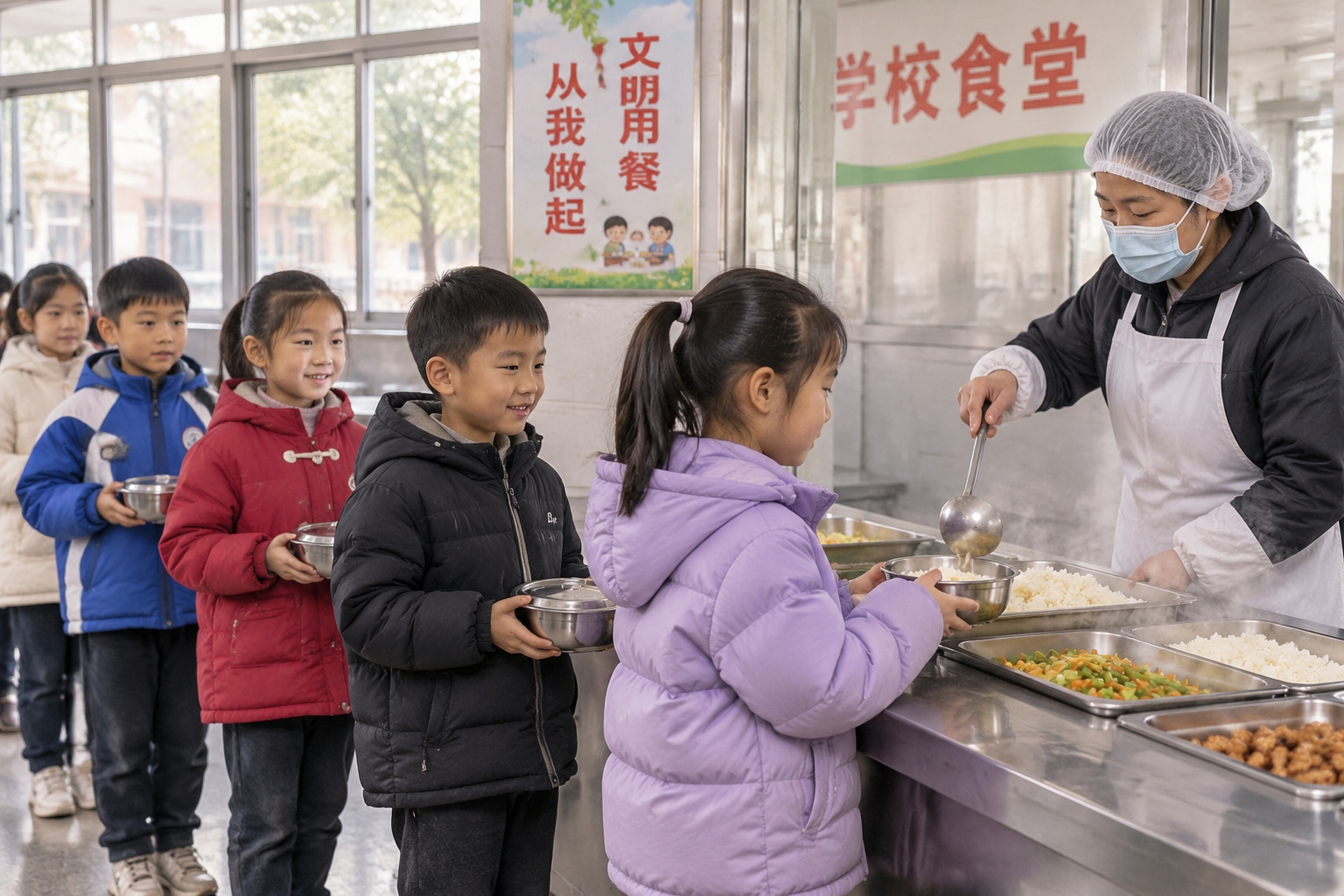
The bell rings at 11:40 and the stairwell fills with children carrying their own bowls. Stainless steel, most of them, with a lid and a small clip that holds a pair of chopsticks. At a township primary school in a mountain county in Guizhou, the bowl is the first clue: a school where children own a bowl is a school with a kitchen.
Fifteen years ago, many of these children would have walked home for lunch, or eaten cold rice out of a thermos, or made do with a steamed bun and a packet of pickles. Now they queue.
The queue moves faster than you expect. A cook in a white apron and a hairnet stands behind two steel trays. Rice first, then a ladle of pork and potatoes, then tomato with egg, then a spoonful of greens, then soup. Forty seconds per child, maybe less.
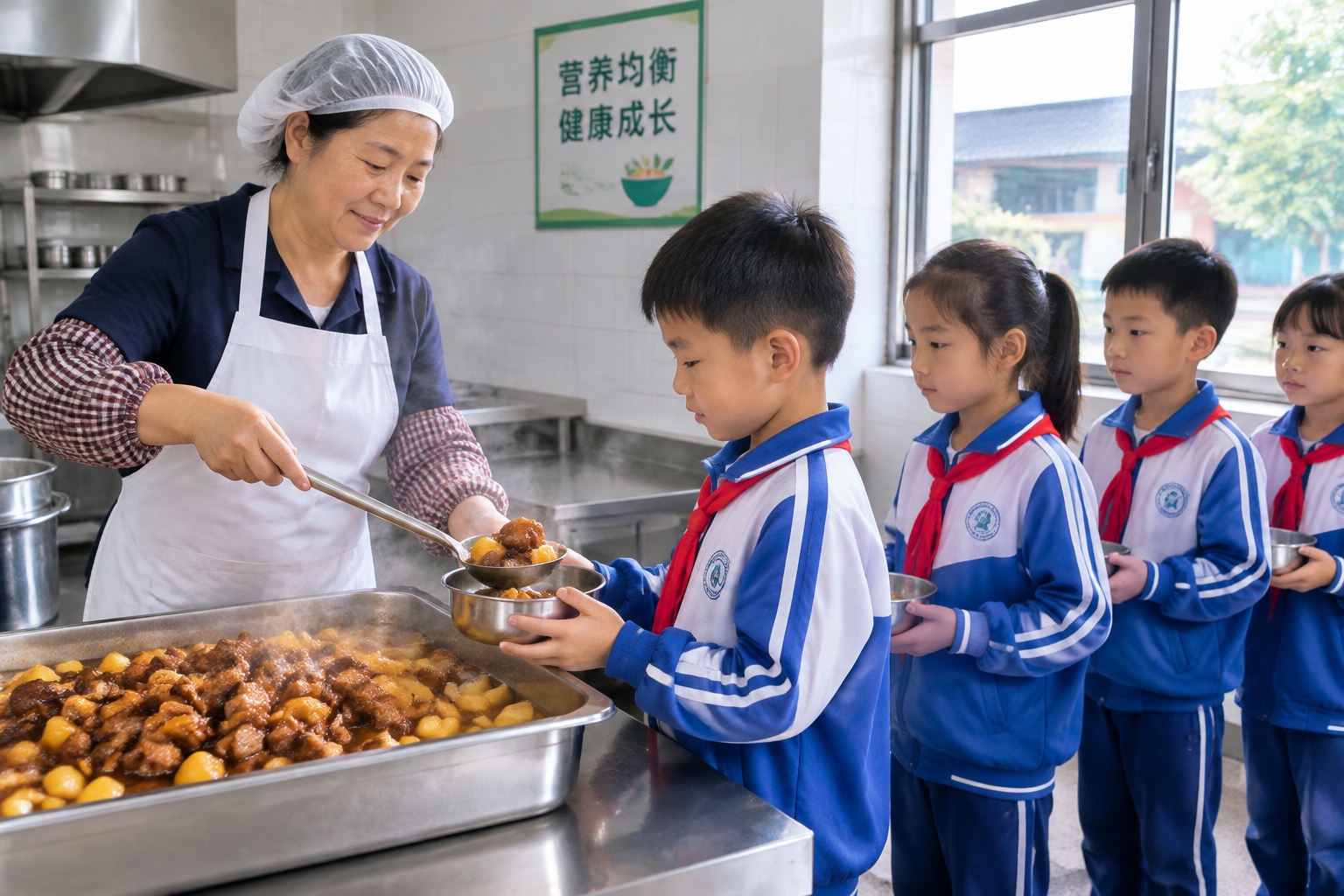
Today’s menu is written on a whiteboard by the door: rice, pork with potatoes, tomato and egg, stir-fried greens, seaweed and egg soup. Other days it is beef with radish, chicken with mushrooms, or mapo tofu. There is almost always a soup, because soup makes the rice go further.
Lunch costs four yuan per student. That is about 55 US cents.
Four yuan is food money, not lunch money
Here is the part that surprises most visitors. Four yuan does not pay for the cook, the kitchen, the gas, the bowls or the refrigerator. Those come out of a separate government budget. The four yuan buys food, and nothing else. That rule is written into the national program, and it is the reason the arithmetic works at all.
Roughly: 150 grams of rice, about 0.6 yuan. Sixty grams of pork, 1.7. Vegetables, 0.6. Oil, salt, soy sauce, garlic, ginger, a little starch — 0.3. That lands near 3.8 yuan, and the last twenty cents absorb the weeks when greens are cheap and the meat portion can be a little bigger.
Purchasing is centralized at county level. Schools order through a platform, suppliers bid, deliveries arrive in the morning with paperwork attached. It is less romantic than a trip to the morning market, and it is also how you stop a thousand schools from buying a thousand different grades of pork.
What’s actually on the plate
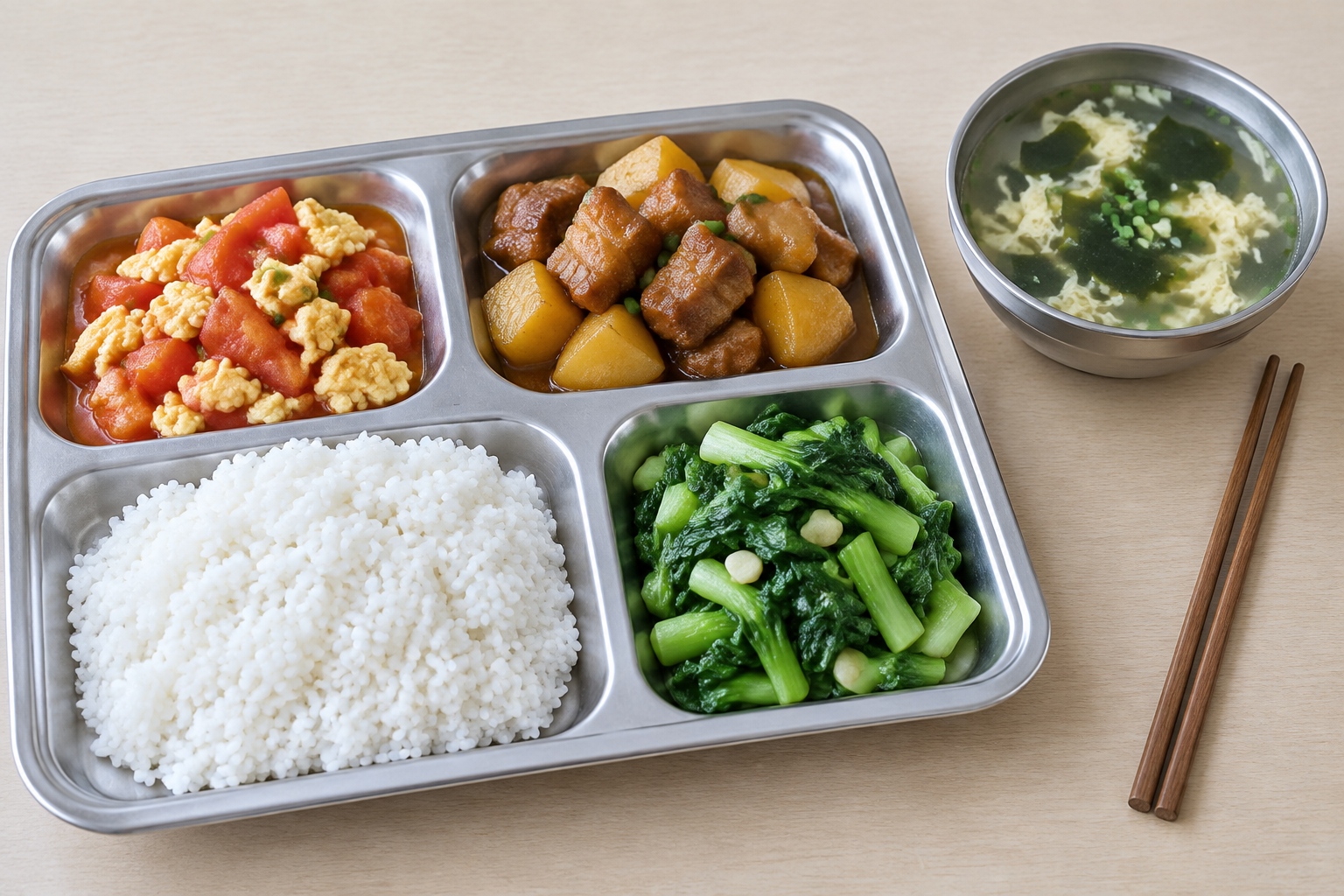
The portions are small by restaurant standards and generous by school-canteen standards. Meat is measured with a ladle rather than handed out freely. Rice and soup are unlimited — a deliberate choice, because a hungry twelve-year-old will always take more rice, and the school would rather he did that than sit through afternoon classes hungry.
Two details are worth noticing.
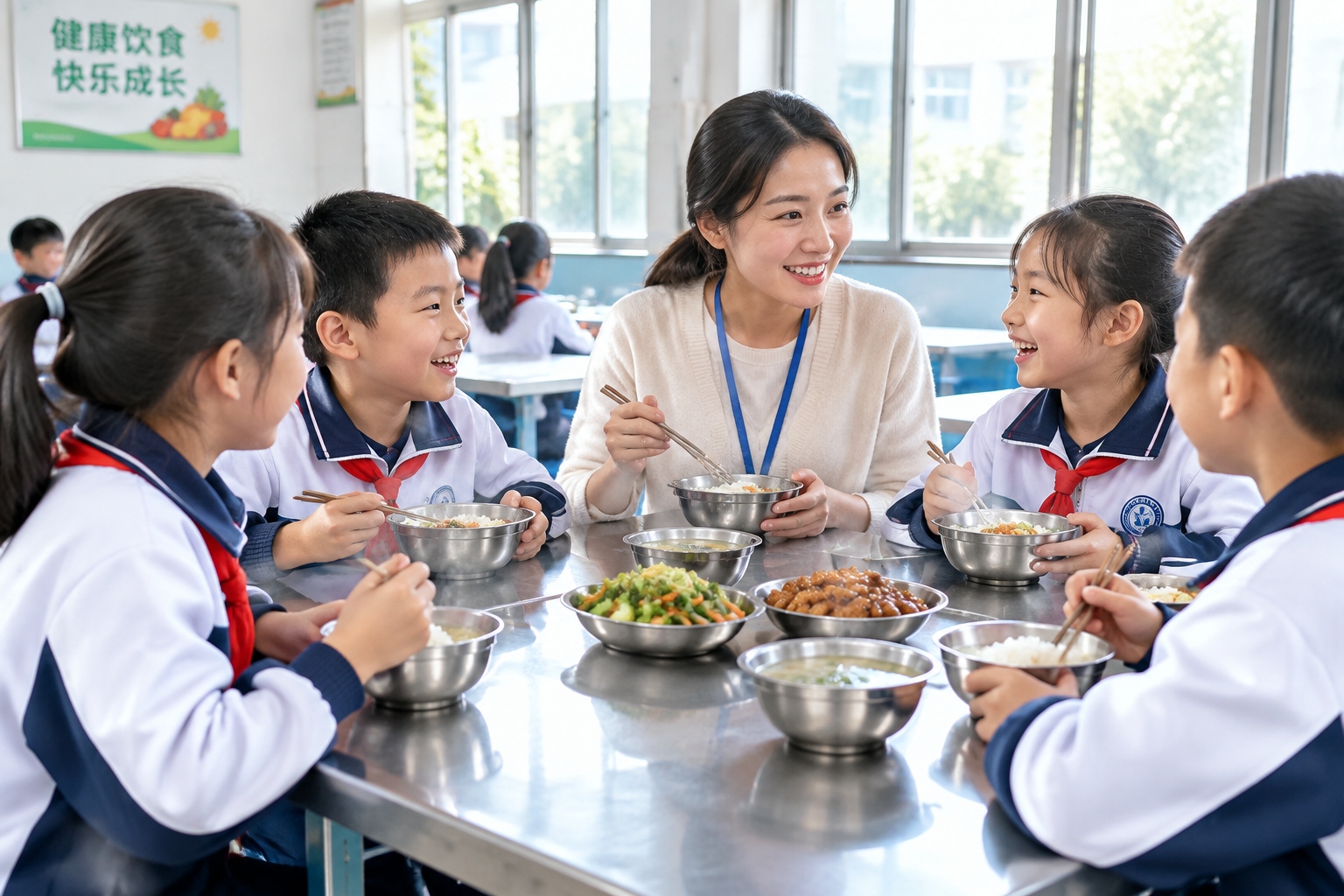
The first is that the teachers eat the same food at the next table. It is called peican, literally “accompanying the meal.” It started as local practice in a few counties and became a national requirement in 2019. The idea is simple: if an adult with a name, a salary and a job eats this lunch every day, the lunch has to be edible.
The second is the small refrigerator near the kitchen door. Every dish is sampled and stored for 48 hours, one labeled box per meal, so that if a class reports stomach aches, someone can trace exactly what was eaten. A school with a bad lunch is, because of this, unusually hard to hide.
On the wall opposite the serving window there is a poster: Clean Plate. Classes get scored on how much food comes back. It began as an anti-waste campaign and has quietly turned into a way of finding out which dishes children actually refuse to eat.
Most of the cooks are local women, several of them mothers of children in this school, hired by the county and paid from the same side of the budget that covers the building. In a village with few jobs, three kitchen positions are not a small thing. It also means the person ladling your son’s pork knows exactly who he is.
Before there was a kitchen
The national school nutrition program began in late 2011 with three yuan per student per day, in 680 of the country’s poorest counties, covering around 26 million children. The standard rose to four yuan in 2014 and to five yuan in 2021, where it stands now, reaching roughly 37 million students.
In the early years, plenty of schools had no kitchen at all. The money arrived, but there was nowhere to cook. In those places the program ran as a mid-morning supplement instead — a carton of milk and a bun, or a boiled egg. Better than nothing, and clearly not a meal. Building the kitchens took far longer than paying for the food.
That is the part of the story you can actually taste. Not the policy document, but the steam on the window and the noise of four hundred bowls being scraped.
For some children, this is the most reliable hot meal of the day
Many of the children here live with grandparents. Their parents work in factories in Guangdong or Zhejiang and come home for Spring Festival. Grandmothers cook, and they cook well, but feeding one child at the end of a working day in a mountain village often means rice, pickles, and whatever was dried last autumn.
For the boarding students — and in many rural counties that is a third or more of the older children — the school kitchen is not lunch. It is breakfast, lunch and dinner, three hundred days a year. The school serves congee, eggs and steamed buns in the morning and a hot dish at night; the four-yuan figure applies only to the midday meal, and for the poorest families a government hardship allowance covers the rest.
Ask teachers what changed and they rarely reach for nutrition statistics. They talk about attendance in the afternoon. About children who stopped falling asleep at their desks. About the boy who used to be sent home at noon because there was nothing for him to eat there.
What four yuan doesn’t fix
It is worth being honest about the limits, because the system’s own auditors are.
Children do not eat what they are given. Greens come back on the plate while the meat and rice disappear. A lunch can hit its protein target and still be heavy on oil and salt, because school cooking in China tends toward flavor first. And four yuan is a national floor, not a national standard: wealthier provinces add their own money on top, so a school in a coastal county can serve a noticeably better lunch than a school three hours inland in the same province.
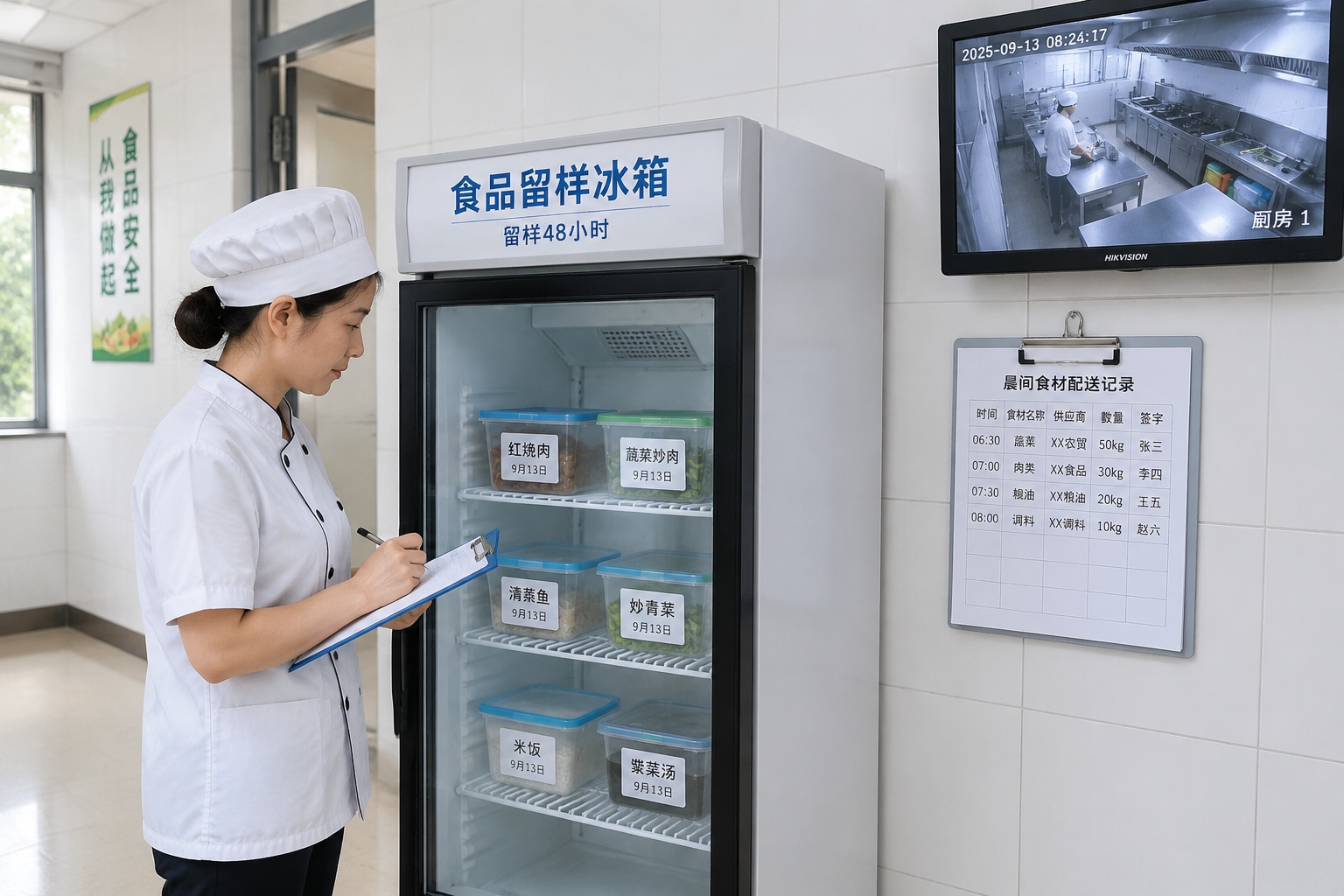
Food safety failures have happened. They have also produced, in practice, one of the most closely watched kitchens in the country: every delivery logged, every dish photographed, every meal sampled and refrigerated, and in many schools a live camera feed of the kitchen playing on a screen in the corridor where parents walk past.
Raising the number from four to five did not quietly solve everything either. Pork prices move. Vegetables are seasonal. A higher per-student subsidy mostly buys a little more meat, not a different menu.
Even counting the cook’s wage and the gas, a meal here lands somewhere around six yuan — under a dollar, and still a wide margin below what a school lunch costs in the United States or Western Europe.
Why this plate is a good place to start
If you want to understand how a country of 1.4 billion people handles something as unglamorous as feeding 37 million schoolchildren, a lunch tray is a surprisingly efficient way in. It shows you the budget line, the county procurement office, the cook’s shift, the teacher’s lunch, the grandmother in the village, the parents in a factory 1,500 kilometers away. All of it arrives on one plate at 11:40.
The lunch is not perfect. Nobody who has eaten it claims otherwise. But four yuan, spent on food and nothing else, with an adult at the next table and a sample in the fridge, is a fairly serious answer to a question most countries are still arguing about.
I asked a third-grade girl what she liked best. She thought about it for a while, the way children do when they are asked to be fair.
“The soup,” she said. “Because you can have more.”